
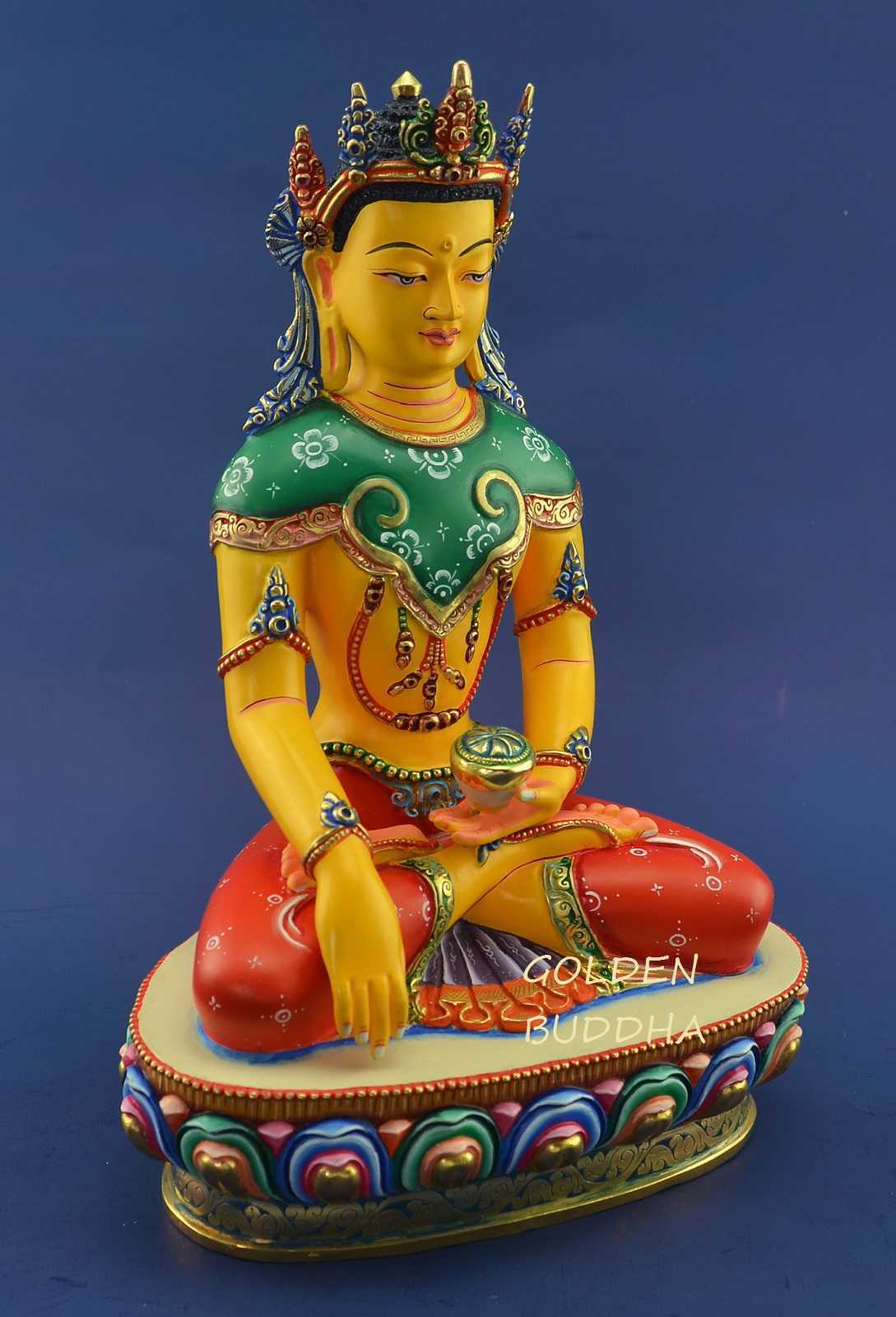
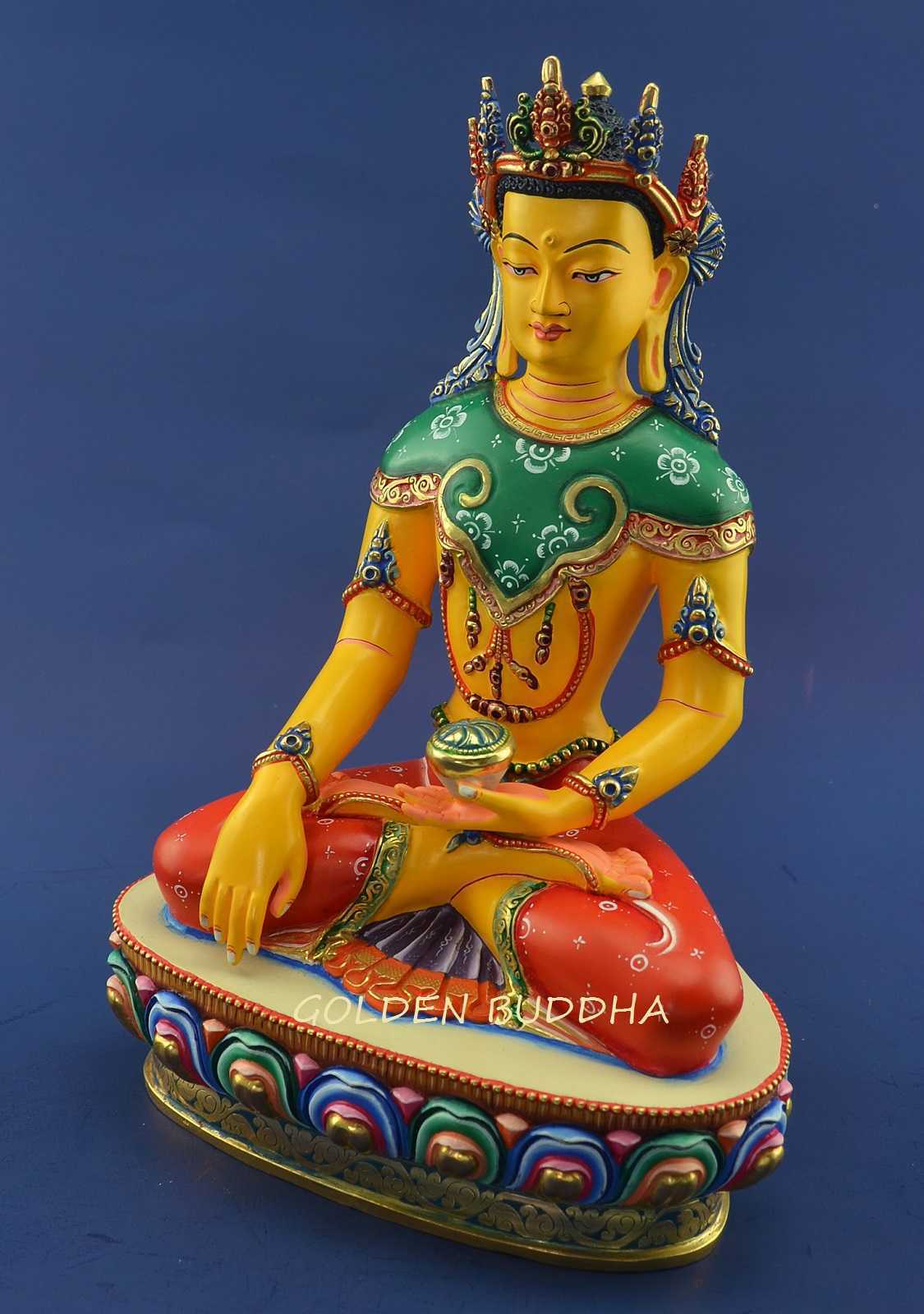
This vibrant Multicolored Shakyamuni sculpture presents the Historical Buddha in an elaborately adorned form, combining traditional Buddhist iconography with a striking polychrome finish. Handmade in Patan, Nepal, the 10.5-inch statue was cast from copper alloy through the traditional lost-wax method. Rich green, red, blue, cream and golden tones define the garments, ornaments, hair and lotus pedestal, while selected crown, jewelry and decorative details are fire gilded in 24K gold.
Shakyamuni sits in the full lotus posture with his right hand lowered in Bhumisparsha mudra, the earth-touching gesture associated with his awakening beneath the Bodhi tree. His left hand rests in Dhyana mudra and supports a small alms bowl. These two gestures identify him as the Buddha of our historical era and unite the decisive moment of enlightenment with the meditative discipline through which it was attained.
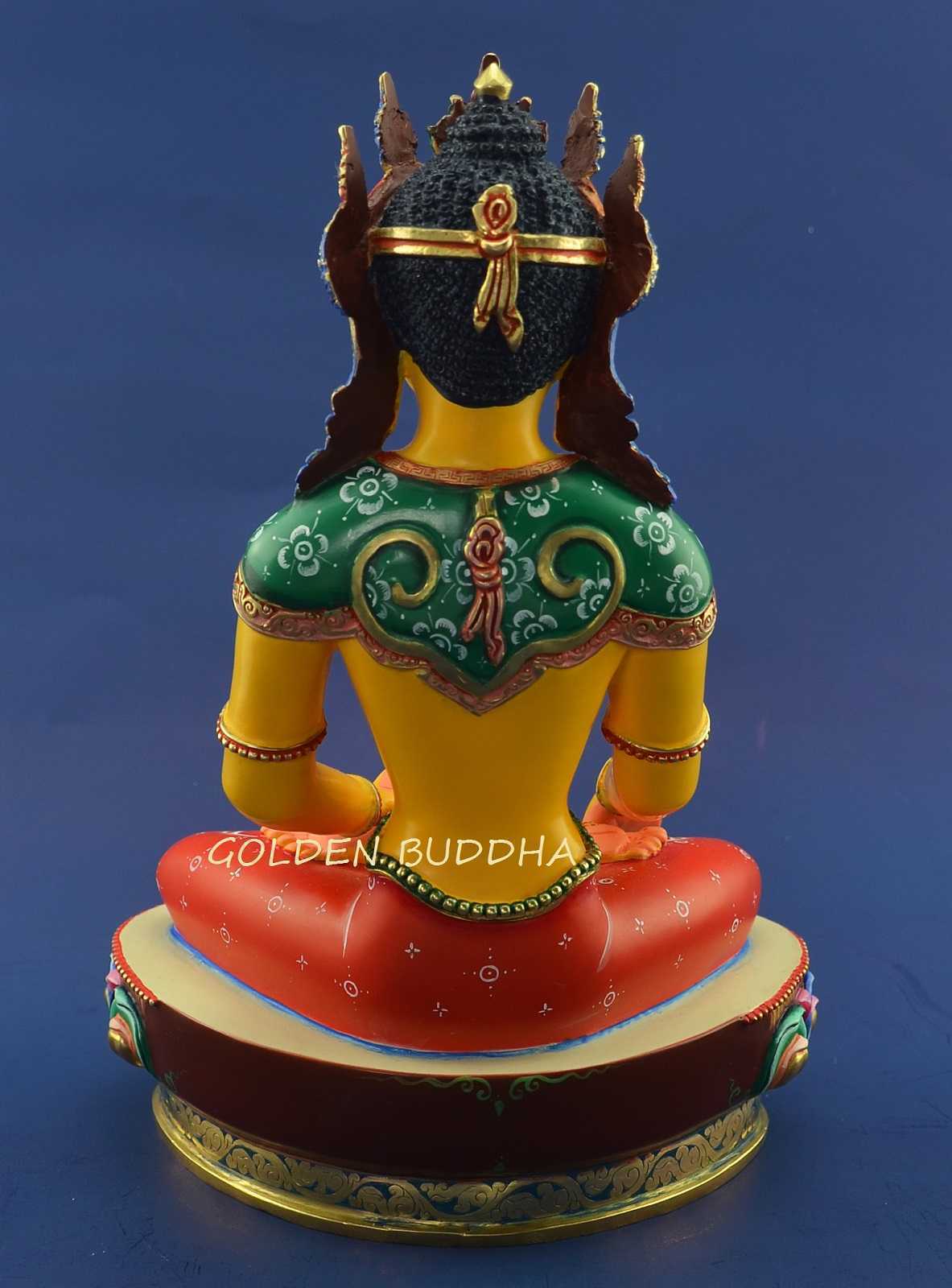
Unlike the simpler monastic form in which Shakyamuni is most often portrayed, this sculpture presents him with an ornate five-point crown, jeweled hair ornaments, earrings, necklaces, armlets and bracelets. A green shoulder covering decorated with white floral motifs frames the upper torso, while the red lower robe is painted with delicate white symbols and scrolling lines. The vivid colors continue around the back of the sculpture, ensuring that the statue is visually complete from every principal viewing angle.
Measuring approximately 10.5 inches high, 7 inches wide and 4.25 inches deep, this Multicolored Shakyamuni sculpture has a strong shrine presence while remaining suitable for a home altar or meditation room. It was created by the same master artisan as the matching Multicolored Medicine Buddha statue and Multicolored Amitabha Buddha statue, allowing the three images to form a visually coordinated and doctrinally meaningful Buddha set.
Multicolored Shakyamuni Sculpture of the Historical Buddha
Shakyamuni Buddha was born as Prince Siddhartha Gautama in Lumbini, within the ancient Shakya kingdom. After encountering sickness, aging and death, he renounced palace life and began searching for a path that could bring suffering to an end. Following years of disciplined meditation and spiritual inquiry, he attained complete awakening beneath the Bodhi tree at Bodh Gaya.
He then spent approximately four decades teaching the Dharma throughout northern India. His teachings explained suffering, its causes, its cessation and the path leading to liberation. For this reason, Shakyamuni is known as the Buddha of our present historical era and the human teacher through whom the Buddhist path became available to the world.
This Multicolored Shakyamuni sculpture combines the historical identity of Siddhartha Gautama with the richly adorned visual language of Himalayan Buddhist art. The crown, jewelry and brilliant colors emphasize the enlightened qualities revealed through his awakening rather than portraying him only as a renunciant monk.
Learn more about the life and awakening of Shakyamuni Buddha, or visit the Shakyamuni Buddha FAQ for explanations of his gestures, attributes and historical significance.
Multicolored Shakyamuni Sculpture ‒ Bhumisparsha Mudra
Shakyamuni’s right hand extends downward over his knee in Bhumisparsha mudra. The palm faces inward and the fingers point toward the ground, recalling the decisive moment when Siddhartha called the earth to witness his right to attain enlightenment.
According to Buddhist tradition, Mara attempted to prevent Siddhartha’s awakening by presenting fear, temptation and doubt. Rather than responding with anger, Siddhartha remained unmoved in meditation. He touched the earth, calling upon it to bear witness to the immeasurable merit he had accumulated through countless lifetimes of practice.
The gesture therefore represents spiritual resolve, the defeat of delusion and the unshakable certainty of awakening. It also grounds enlightenment within direct experience. Shakyamuni does not appeal to an external authority; the earth itself confirms the truth of his realization.
The long downward-pointing fingers create a strong visual line from the shoulder to the throne. Their warm golden surface stands out clearly against the red robe and cream-colored seating platform beneath them.
Dhyana Mudra and the Alms Bowl
Shakyamuni’s left hand rests upon his lap in Dhyana mudra, the gesture of meditation and one-pointed concentration. The open palm supports a small rounded alms bowl decorated in green, gold and red.
Dhyana mudra represents the mental stability developed through sustained meditation. It recalls the disciplined practice that enabled Siddhartha to understand the nature of suffering and attain awakening beneath the Bodhi tree.
The alms bowl symbolizes humility, renunciation and the simple life of a Buddhist mendicant. Although this sculpture presents Shakyamuni with royal ornaments and brilliant color, the bowl preserves his connection with monastic discipline and freedom from attachment to possessions.
The bowl is sometimes interpreted as containing nectars that counteract greed, hatred and ignorance. These three poisons are considered the fundamental mental afflictions from which destructive actions and repeated suffering arise.
Crown and Jewelry of the Adorned Shakyamuni Buddha
The elaborate five-point crown is one of the most distinctive features of this Multicolored Shakyamuni sculpture. Red, blue, green and gold sections rise around the dark Buddha curls, with a larger central ornament positioned above the urna. Smaller gilded details and painted floral forms give each point an individual character.
This adorned presentation differs from the more familiar monastic image of the Historical Buddha. In Himalayan Buddhist art, a crowned Buddha can emphasize the majesty, abundance and universal scope of enlightened realization. The royal ornaments do not indicate attachment to worldly status; they symbolize the complete qualities of Buddhahood.
Long earrings frame Shakyamuni’s face, while jeweled ornaments appear at the upper arms, wrists, waist and neckline. A long red necklace descends over the torso and terminates in several pendant forms. Gold highlights along the beads and settings create bright accents against the yellow body and green shoulder covering.
At the buyer’s request, the crown and jewelry may be further embellished with genuine turquoise and red coral before shipping. The stones can be placed selectively within the existing ornamental settings while preserving the balanced multicolored design.
Ushnisha, Urna and Marks of Buddhahood
The dark textured hair rises into the ushnisha, the cranial protuberance traditionally counted among the major physical marks of a fully awakened Buddha. The elaborate crown surrounds the hair without concealing the rounded upper form visible from the reverse.
A small urna appears between the brows. This mark symbolizes transcendent vision and the Buddha’s ability to perceive the conditions, capacities and needs of sentient beings.
Three horizontal lines appear across the neck, another established feature of Buddhist iconography. These markings contribute to the idealized physical form through which Shakyamuni’s enlightened qualities are represented.
The elongated earlobes recall the heavy royal ornaments Siddhartha wore as a prince. After renouncing palace life, the earrings were removed, but the lengthened lobes remained as a reminder of both his royal origins and his abandonment of worldly privilege.
Multicolored Robes and Symbolic Polychrome Finish
The polychrome treatment gives this Multicolored Shakyamuni sculpture a visual character reminiscent of traditional Tibetan thangkas. Rather than relying upon a single metallic finish, the artisan uses distinct colors to clarify separate garments, ornaments and architectural elements.
A rich green covering extends across the shoulders and upper chest. White floral motifs and small decorative marks are painted across the front and reverse, while red-and-gold borders define the edges around the upper arms and neckline.
The lower robe is painted in a warm red-orange tone and decorated with fine white circles, crescent forms and delicate linear symbols. Green and gold borders trace the garment edges around the knees, waist and folded legs.
The body is finished in a warm golden-yellow tone, establishing a clear contrast with the green upper garment and red robe. Painted blue, red and green details across the jewelry and crown bring the upper portion of the statue into harmony with the multicolored lotus pedestal below.
Hand-Carved Hemlines and Ornamental Borders
Fine raised borders and hand-carved hemlines define the separate garments throughout the sculpture. The green shoulder covering is framed by curling gold edges that sweep inward over the chest before descending into a pointed central panel.
Red and gold bands encircle the upper arms, while additional beaded borders appear at the wrists, waist and neck. These details separate the painted color fields and give the garments a finished textile-like structure.
The lower robe is bordered along the crossed legs with narrow green and gold courses. The carefully controlled lines help preserve the clarity of Shakyamuni’s full lotus posture despite the density of the surrounding color and ornament.
The front and rear of the statue receive related decorative treatment. The shoulder covering continues across the back with white floral patterns and symmetrical curling forms, while the red lower garment carries its painted motifs around the folded legs.
24K Fire-Gilded Details
Selected ornamental details are fire gilded in 24K gold, creating luminous highlights against the painted surfaces. Gold appears throughout the crown, hair ornaments, earrings, necklaces, garment borders, jewelry and lotus pedestal.
The gilding directs the viewer’s attention toward the most important structural and iconographic details. Crown points, jeweled settings and garment edges catch the light, while the broader painted areas retain their saturated red, green and blue tones.
This selective approach allows the gold to function as an accent rather than overwhelming the multicolored finish. The interaction between polished metal and matte pigment gives the statue depth and makes the ornamentation legible from a distance.
Because the sculpture is partly gilded rather than covered uniformly in gold, the polychrome design remains central to its visual identity. The statue combines the brilliance of traditional gilding with the narrative color language of Himalayan painted art.
Full Lotus Posture of the Historical Buddha
Shakyamuni sits in the full lotus posture with both legs crossed and the soles turned upward. The symmetrical arrangement creates a stable triangular foundation beneath the upright torso, crown and hand gestures.
The full lotus posture represents meditative concentration, physical balance and the unshakable quality of awakening. It recalls the posture in which Siddhartha remained beneath the Bodhi tree until he had completely understood the causes and cessation of suffering.
The broad folded legs provide a large field for the red robe and its white painted symbols. Green decorative borders follow the inner edges, while the hands and bowl remain clearly visible at the center and side of the composition.
The stillness of the posture balances the visual energy of the crown, jewelry and multicolored throne. Despite the elaborate finish, the central figure retains the calm composure expected of the Historical Buddha.
Multicolored Shakyamuni Sculpture ‒ Lotus Throne and Ornamental Pedestal
The statue rests upon a broad lotus pedestal decorated in green, blue, red, pink and gold. The upper platform is finished in a pale cream tone and framed by a narrow red beaded border.
Large stylized lotus petals surround the front and sides. Green outer forms frame blue and pink interior layers, while gilded centers create bright focal points within each petal. Small red diamond forms appear between the principal petals and strengthen the repeating rhythm around the throne.
The lotus throne represents purity arising within samsara. Although the lotus develops from muddy water, its blossom opens unstained above the surface. Shakyamuni’s seat therefore symbolizes awakening attained within the human world without remaining bound by its confusion.
The lowest pedestal band is decorated with scrolling gold foliate motifs against a darker green and blue field. This ornamental course continues around the front and reverse and gives the statue a stable architectural foundation.
Finished Across the Front and Reverse
The rear photograph confirms that the multicolored treatment extends throughout the sculpture rather than being limited to the frontal presentation. Shakyamuni’s shoulders, back, arms, hair, crown and lotus throne remain carefully finished from behind.
The dark Buddha curls continue across the full rear of the head, while a horizontal gilded ornament and central red jewel detail secure the crown at the back. Painted crown points rise around the ushnisha and remain individually modeled from every side.
The green shoulder covering extends across the upper back and is decorated with white floral motifs. Two large gold-edged curling forms meet near a central red ornament, creating an organized symmetrical design around the shoulder blades.
The red robe wraps around the folded legs and retains its white painted symbols across the reverse. The pedestal’s colored petals and engraved lower border also continue around the full base, making the statue suitable for freestanding altar placement.
Traditional Lost-Wax Casting in Patan, Nepal
This Multicolored Shakyamuni sculpture was handmade in Patan, Nepal, through the traditional lost-wax casting process. The artisan first creates a detailed wax model according to established Buddhist iconometric proportions, forming the posture, face, hands, alms bowl, crown, jewelry, garments and lotus pedestal.
The wax figure is enclosed within a heat-resistant mould and fired until the wax melts away, leaving a cavity in its form. Molten copper alloy is poured into the mould and allowed to cool. After the mould is removed, the raw casting is chased, filed and refined by hand.
The artisan sharpens the fingers, facial contours, jewelry, crown points, garment borders and lotus petals before preparing the sculpture for its painted and gilded finishes. Individual color fields are applied carefully across the body, robes, ornaments and pedestal.
Selected details are then fire gilded in 24K gold to create contrast and visual emphasis. Because the original wax model is destroyed during casting and the chasing, painting and gilding are completed individually, each handmade statue retains subtle variations.
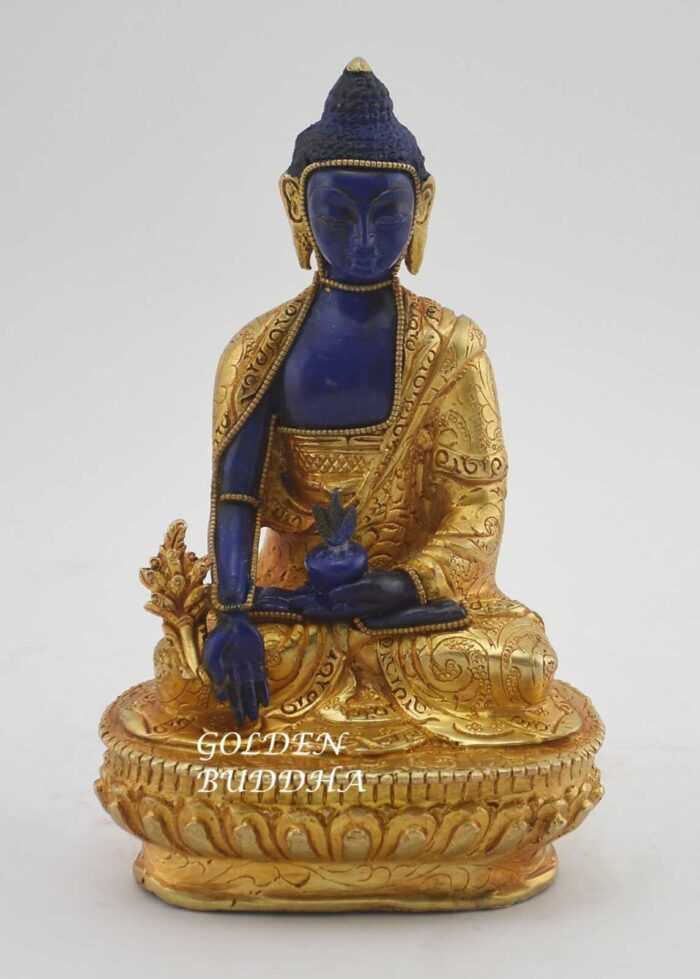
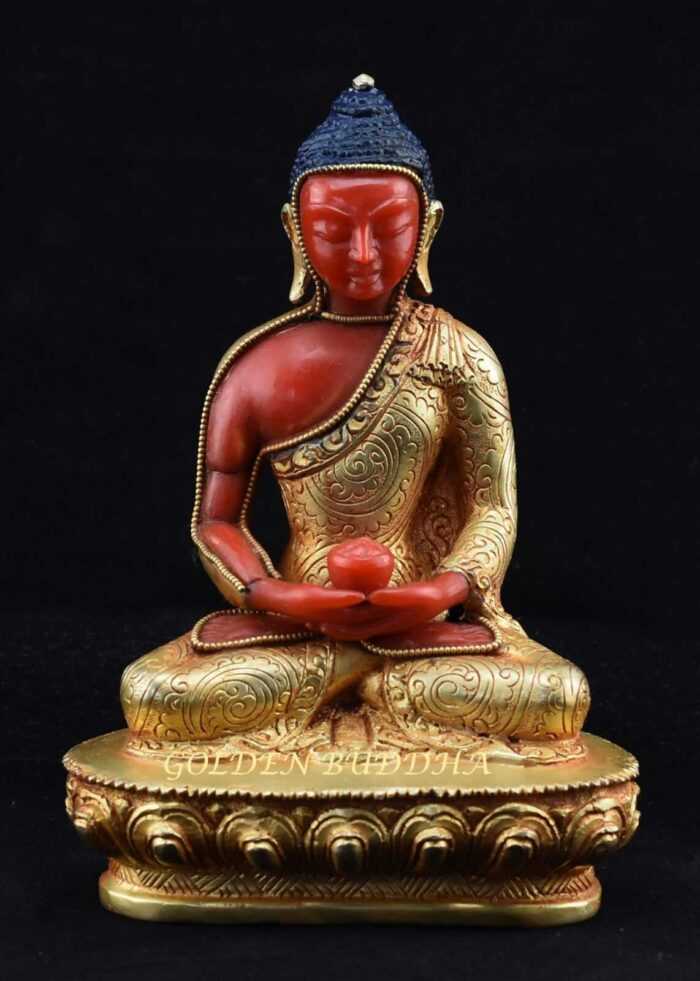
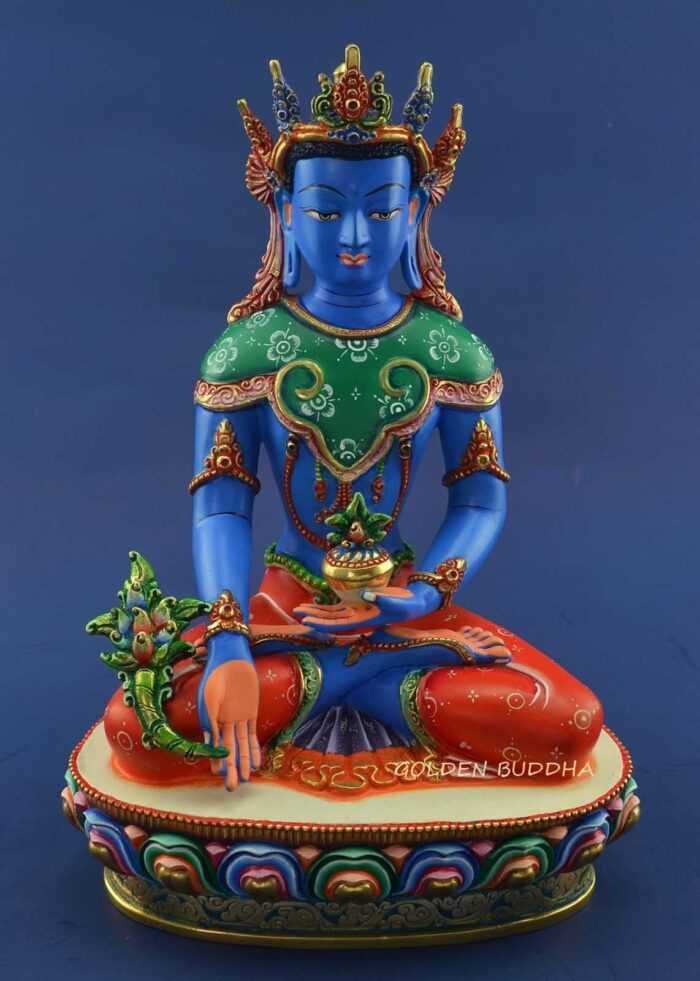
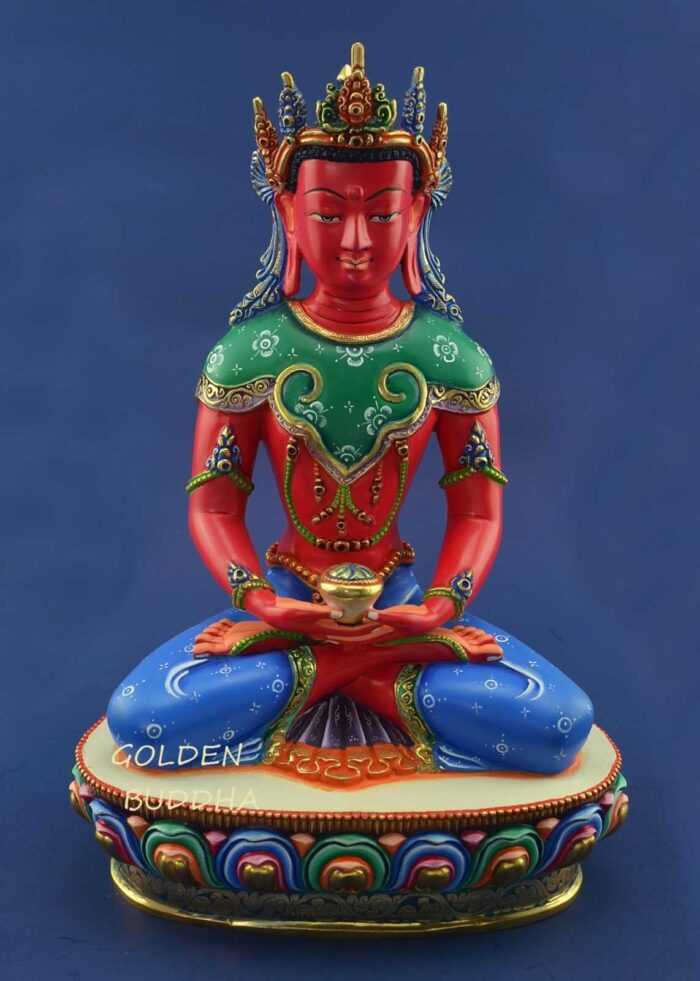
Multicolored Shakyamuni Sculpture, Amitabha and Medicine Buddha Set
This Multicolored Shakyamuni sculpture would form a striking three-piece shrine set with the matching Multicolored Amitabha Buddha statue and Multicolored Medicine Buddha statue. All three images were created by the same master artisan and share copper-alloy construction, traditional lost-wax casting, hand-painted polychrome finishes and selective 24K fire-gilded details.
The statues are closely coordinated in size and visual treatment. Each measures approximately 10.25 to 10.5 inches high and features a multicolored crown, celestial jewelry, richly painted robes and an elaborate lotus pedestal. Their related proportions allow the three Buddhas to appear as a deliberately designed altar ensemble.
The green, red, blue and gold palette repeats across all three figures while allowing each Buddha to retain a distinct iconographic identity. Shakyamuni is recognized by Bhumisparsha mudra and the meditation bowl. Amitabha displays Dhyana mudra with his alms bowl, while Medicine Buddha extends Varada mudra and holds the medicine bowl and myrobalan plant.
Shakyamuni Buddha represents the historical revelation of the Dharma in our world. His awakening and teachings provide the foundation upon which the practices associated with Amitabha and Medicine Buddha are understood.
Amitabha Buddha embodies Infinite Light, discriminating wisdom and the compassionate vows that established Sukhavati, the Western Pure Land. His meditative gesture represents concentration and the aspiration to continue toward awakening under favorable spiritual conditions.
Medicine Buddha embodies healing, clarity and the removal of physical, emotional and spiritual suffering. His bowl and myrobalan plant signify remedies applied with wisdom and compassionate discernment.
Together, the three Buddhas present a coherent progression of Buddhist refuge and practice. Shakyamuni reveals the path, Medicine Buddha supports healing and the removal of obstacles encountered along it, and Amitabha represents compassionate refuge and favorable conditions for continuing toward liberation.
Arranged with Shakyamuni as the central image, the set would honor the Historical Buddha as the teacher of the present era. Medicine Buddha and Amitabha could serve as complementary companions representing healing in this life and confidence in continued spiritual progress. The matching colors, crowns, jewelry and lotus pedestals give the doctrinal ensemble strong visual unity.
Custom-Made Multicolored Shakyamuni Sculptures
A custom-made Shakyamuni Buddha statue may be commissioned in a preferred size, color scheme, finish and degree of ornamentation. Available options include personal shrine images, larger temple-scale sculptures, antiquated oxidized copper finishes, partially gilded statues and images fire gilded in 24K gold.
A custom multicolored version may be created with traditional Himalayan mineral pigments or another coordinated polychrome palette. The colors applied to the body, robes, shoulder covering, crown, jewelry and lotus pedestal can be planned to suit the intended shrine while preserving the statue’s established iconography.
The crown and jewelry may be embellished with genuine turquoise and red coral. Stone placement can remain restrained within selected crown settings and ornaments or be expanded across the necklace, armlets, bracelets and throne according to the commissioned design.
Customers may request smooth painted robes, hand-carved textile patterns, gold-highlighted hemlines or more extensive decorative work around the rear garments and pedestal. Traditional Shakyamuni attributes—including Bhumisparsha mudra, Dhyana mudra, the alms bowl, full lotus posture, urna and ushnisha—are preserved throughout the design process.
Custom statues can be produced for private collectors, home shrines, Dharma centers, Buddhist temples and monasteries. Larger commissions may include deeper lotus-petal carving, more elaborate architectural bases and coordinated rear ornamentation for freestanding display.
A complete three-piece set may also be commissioned with Shakyamuni, the Multicolored Amitabha Buddha statue and the Multicolored Medicine Buddha statue. Their heights, crown designs, pigments, gilded details, robes and lotus pedestals can be planned together so the finished sculptures form a unified shrine ensemble.
Such a custom set would unite the Historical Buddha’s teaching activity with Medicine Buddha’s healing power and Amitabha’s Infinite Light and Pure Land aspiration. Shakyamuni reveals the path to awakening, Medicine Buddha helps remove suffering and obstacles, and Amitabha represents compassionate refuge and continued progress toward liberation. Together, they create a visually vibrant and doctrinally meaningful expression of Buddhist wisdom, healing and hope.
Authentic, Handmade in Nepal
Every statue is handcrafted in Patan, Nepal, using traditional lost wax casting and comes with a certificate of authenticity issued by Nepal’s Department of Archaeology, verifying its materials, technique, and origin.