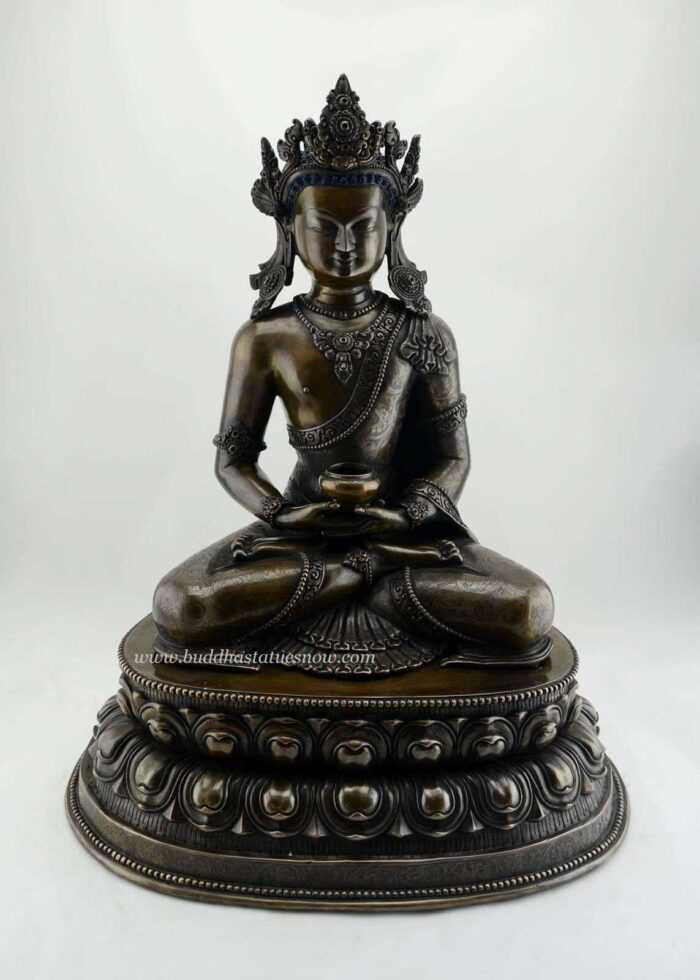

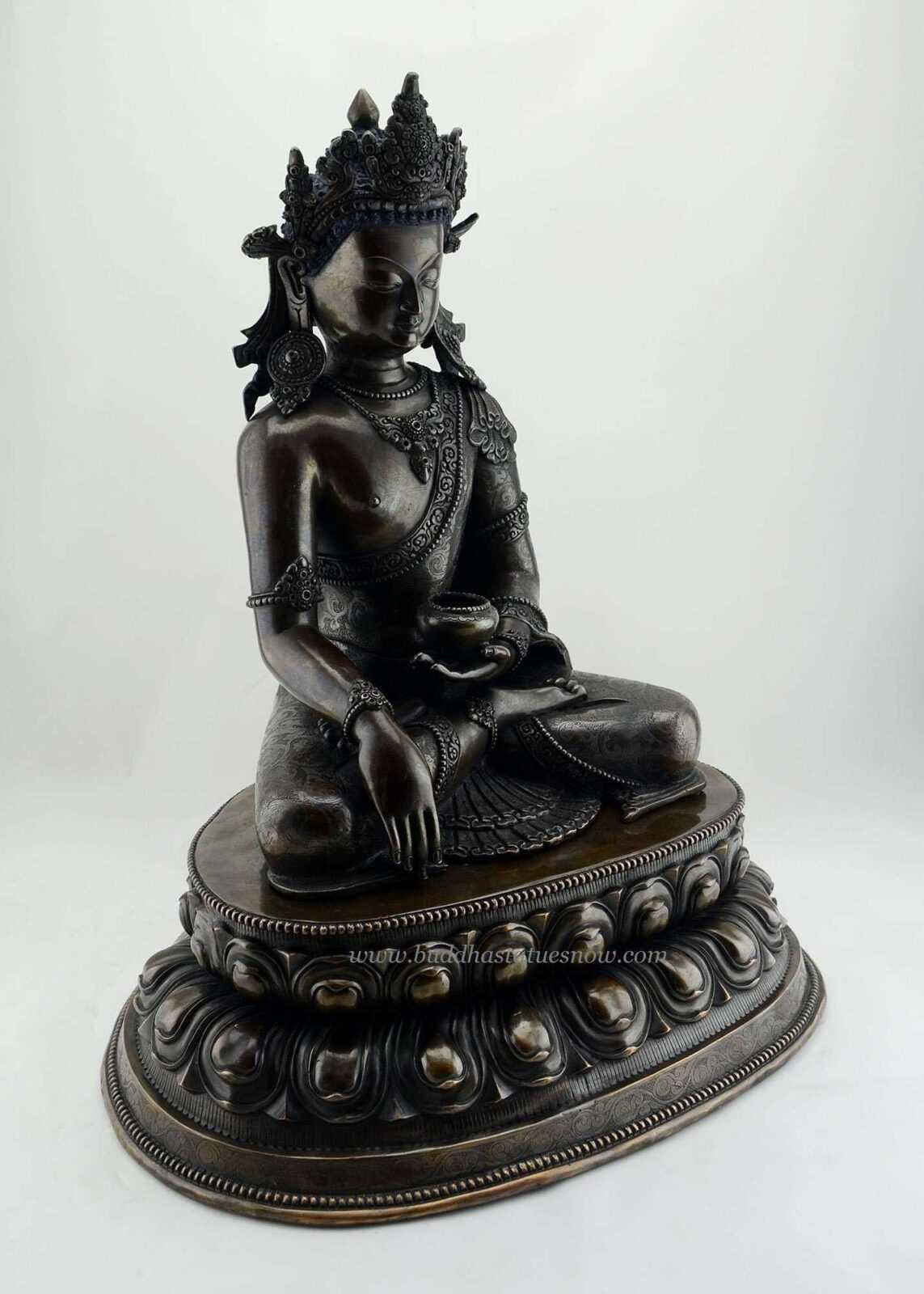
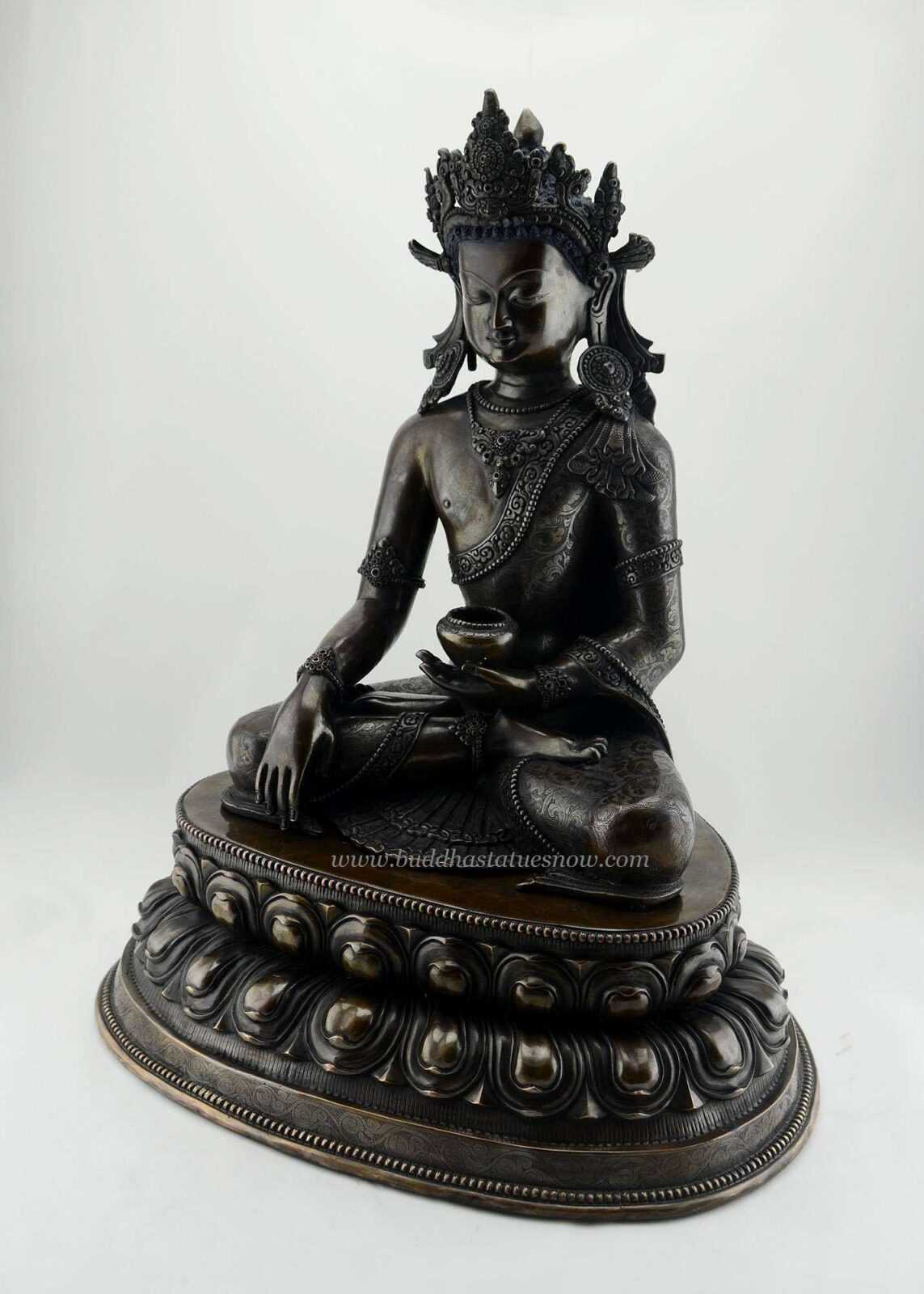
This monumental Crowned Shakyamuni Buddha sculpture portrays the Historical Buddha in an unusually regal and richly ornamented form. Measuring approximately 19 inches high, the statue was handcrafted in Patan, Nepal from copper alloy using the traditional lost-wax casting method. Its deep oxidized finish gives the sculpture the presence of an antiquated Himalayan sacred image, while extensive hand engraving across the robe, crown, jewelry and double lotus throne reveals the extraordinary skill of the Newar master artisan.
Shakyamuni Buddha is most commonly represented in the simple robes of a renunciant monk. In this sculpture, however, he appears crowned and adorned as the sovereign of the Dharma. The elaborate five-point crown, large circular earrings, necklaces, armbands and wrist ornaments express the spiritual majesty of awakening rather than ordinary worldly rank. This crowned form presents Siddhartha Gautama not only as the historical teacher who lived in ancient India, but also as the fully awakened Buddha whose wisdom and teachings remain universally authoritative.
The oxidized copper surface ranges from deep brown to nearly black in the recessed areas, allowing the finely chased patterns to emerge through changes in texture and reflected light. The robe is covered with delicate floral and foliate engraving, including broad patterned panels over the crossed legs and a carefully carved fan-shaped fold spreading between the knees. The dark finish gives the figure an imposing yet contemplative character well suited to a principal home altar, Dharma center or serious collection of Himalayan Buddhist sculpture.
Crowned Shakyamuni Buddha Sculpture Features
The Historical Buddha sits in vajrasana, the full lotus posture, upon a broad double lotus throne. Both feet are turned upward across the lap, establishing the stable triangular composition traditionally associated with meditation and enlightenment. The posture communicates immovable concentration: although the surrounding crown, jewelry and engraved robes are highly elaborate, Shakyamuni remains completely composed at the center of the sculpture.
His right hand reaches downward over the knee in the Bhumisparsha Mudra, or earth-touching gesture. According to Buddhist tradition, Siddhartha Gautama formed this mudra during his final meditation beneath the Bodhi tree. When Mara challenged his right to attain enlightenment, the future Buddha touched the earth and called it to witness the immeasurable merit accumulated through his previous lives. The gesture therefore commemorates the decisive moment when delusion was overcome and Siddhartha became Shakyamuni Buddha.
The left hand rests in the lap in the Dhyana Mudra, the gesture of meditation, while supporting a monastic alms bowl. The bowl recalls Shakyamuni’s life as a renunciant and his freedom from dependence upon wealth, status and material possessions. It also symbolizes the spiritual nourishment of the Dharma—the teachings through which beings may understand suffering, abandon its causes and cultivate the path leading toward liberation.
Together, the two hands unite the historical events of the Buddha’s life with the inner qualities of awakening. The earth-touching hand recalls his victory over Mara and the realization of enlightenment, while the meditative hand and alms bowl express discipline, concentration and freedom from attachment. Learn more about the life of the Historical Shakyamuni Buddha and the symbolism found in traditional depictions of the original teacher.
The Crowned Form of the Historical Buddha
The most distinctive feature of this sculpture is Shakyamuni’s elaborate Bodhisattva-style crown and jewelry. The tall crown rises in five principal sections around a central spire, with layered floral motifs, flame-like points and deeply modeled ornamental borders. A painted blue headband provides a restrained touch of color beneath the crown and separates the dark hair from the oxidized copper face.
Large disc-shaped earrings descend beside the face and are framed by curling fan-like ornaments. A layered necklace rests across the chest, while matching armbands and bracelets repeat the decorative vocabulary of the crown. These adornments do not contradict Shakyamuni’s renunciation. Within Himalayan Buddhist art, the crowned Buddha can represent the complete majesty of enlightenment, the sovereignty of the Dharma and the Buddha’s transcendent qualities beyond his historical monastic appearance.
At the buyer’s request, the crown and jewelry may be embellished with turquoise and red stones before delivery at no additional charge. The color can be applied selectively so that the stones emphasize the raised ornaments without obscuring the sculpture’s dark antiquated finish. Turquoise and red accents would create a traditional Himalayan contrast against the deep oxidized copper surface.
Hand-Engraved Robes and Complete Rear Decoration
The artisan devoted exceptional attention to the robe of this Crowned Shakyamuni Buddha sculpture. Fine floral patterns cover the fabric across the chest, shoulder and folded legs. Decorative borders follow the garment hemlines, while broader engraved fields create the appearance of richly woven Himalayan brocade. The engraving is carefully adapted to the changing contours of the figure, remaining legible as the robe curves over the knees and gathers across the lap.
The front view reveals a particularly elaborate fan-shaped arrangement of robe folds spreading across the seat between the crossed legs. Each radiating pleat has been individually modeled and engraved, creating a strong central axis beneath the alms bowl. Narrow bands of scrollwork frame the larger fabric panels and distinguish one layer of the garment from another.
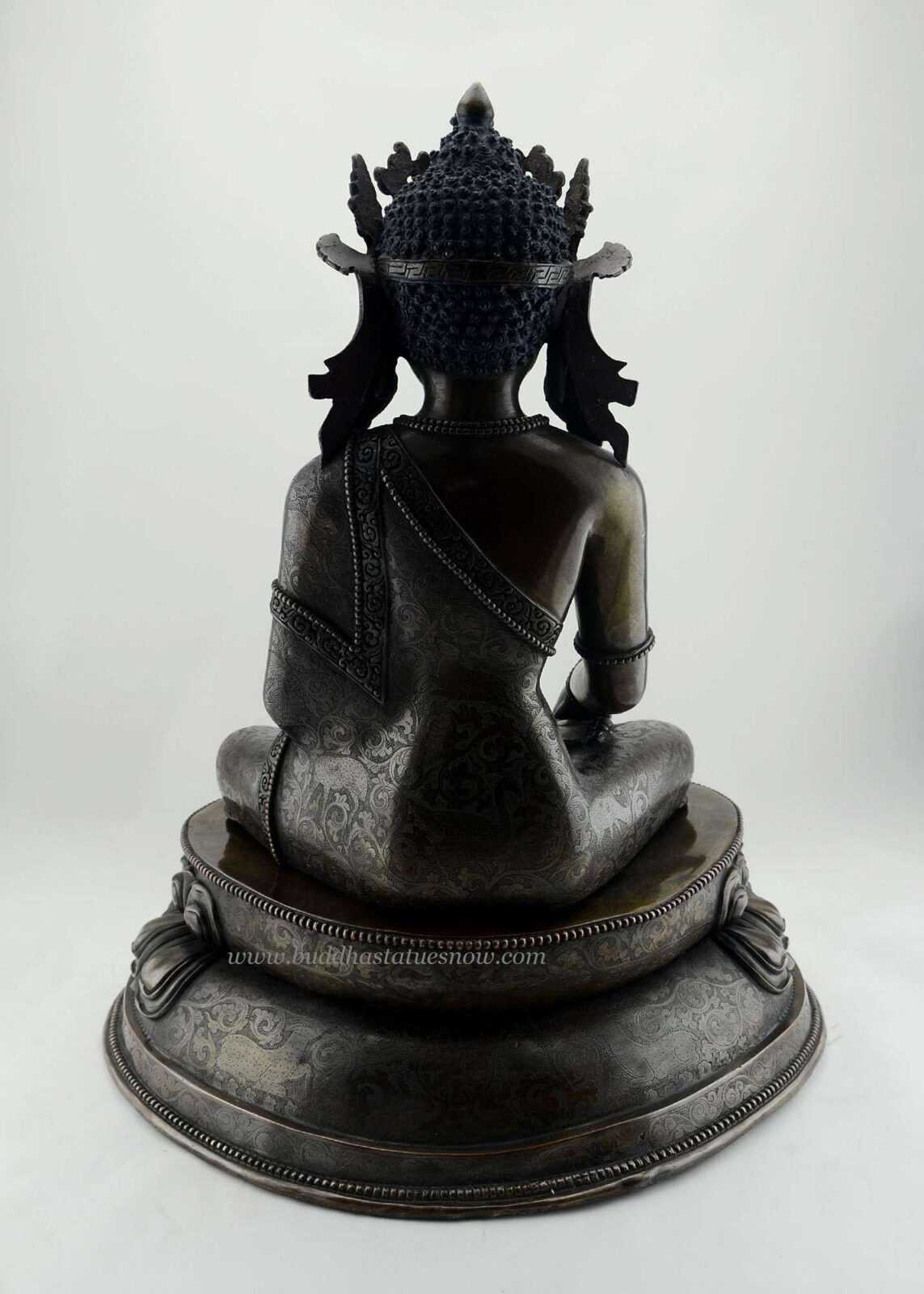
The workmanship continues across the reverse rather than ending at the visible front surfaces. The Buddha’s robe is engraved over the shoulders, back and seated legs with broad botanical patterns and ornamental borders. The back of the head displays carefully rendered strands of hair gathered beneath the crown, while the crown itself remains fully modeled from the rear. This complete treatment in the round makes the sculpture appropriate for an open shrine or display where it may be viewed from multiple directions.
Double Lotus Throne and the Deer Park at Sarnath
Shakyamuni sits upon a substantial double lotus throne formed by two distinct registers of overlapping petals. The upper and lower rows create a broad architectural foundation suited to the statue’s considerable height and width. Each petal has a raised center and deeply carved border, while beaded rims encircle the pedestal above and below the lotus registers.
The rear of the throne contains some of the sculpture’s most meaningful narrative carving. Two deer appear on either side of a Dharma-wheel motif, recalling the Buddha’s first teaching at the Deer Park in Sarnath. After attaining enlightenment at Bodh Gaya, Shakyamuni traveled to Sarnath and taught the Four Noble Truths and the Noble Eightfold Path to his former companions. This event is remembered as the first turning of the Wheel of Dharma.
The deer represent the place where the teaching was delivered, while the wheel signifies the Dharma set in motion by the Buddha. Their placement on the reverse creates a symbolic progression around the sculpture: the Bhumisparsha Mudra at the front recalls enlightenment beneath the Bodhi tree, while the deer and Dharma wheel at the back recall the first transmission of that realization to others. Together, these elements connect awakening with teaching and compassionate activity.
Handcrafted in Patan by Newar Artisans
This sculpture was created in Patan, Nepal, one of the most important historic centers of Himalayan Buddhist metalwork. The artisan first formed a detailed wax model according to established iconometric proportions. The wax figure was then enclosed in a heat-resistant mould and fired so that the wax melted away, leaving a cavity into which molten copper alloy could be poured.
After the metal cooled, the mould was broken and the raw casting was refined entirely by hand. The artisan chased the contours, corrected the surface, deepened the crown and jewelry details, and engraved the extensive textile patterns visible across the robe and throne. The sculpture was then given its rich oxidized finish, allowing the recessed engraving to remain dark while the raised areas develop a softer natural sheen.
Because the wax model is destroyed during casting and the final chasing and engraving are performed individually, each statue retains subtle handmade variations. This sculpture measures approximately 19 inches high, 16 inches wide and 13 inches deep, with an approximate shipping weight of 17 kilograms. Its broad throne and imposing crown give it a substantial altar presence beyond its stated height.
Crowned Shakyamuni and Amitabha Buddha Statue Set
This Crowned Shakyamuni Buddha sculpture forms an exceptional two-piece altar set with the matching Crowned Amitabha Buddha statue. Both sculptures were created in closely matched 19-inch proportions and share the same rich oxidized copper finish, elaborate five-point crowns, Bodhisattva-style jewelry, finely engraved robes and broad double lotus thrones. Their garment decoration and throne carving continue across the reverse, giving the pairing the unity of an intentionally designed devotional ensemble.
The two statues also create a strong doctrinal relationship. Shakyamuni Buddha is the Historical Buddha of our age—the teacher who attained enlightenment beneath the Bodhi tree and revealed the path of the Four Noble Truths and Noble Eightfold Path. Amitabha Buddha is the Buddha of Infinite Light, associated with the Western Pure Land of Sukhavati and the compassionate aspiration to guide beings toward favorable conditions for awakening.
Placed together, the statues unite the historical foundation of Buddhism with the Pure Land expression of enlightened compassion. Shakyamuni represents the appearance of the Dharma in this world and the practical path of ethical conduct, meditation and wisdom. Amitabha represents immeasurable light, discriminating wisdom and the promise of rebirth in conditions especially conducive to spiritual progress. The pairing therefore connects the Buddha who revealed the teachings in our world with the Buddha whose Pure Land offers beings a supportive environment in which to continue toward enlightenment.
Custom-Made Crowned Shakyamuni Buddha Sculptures
A custom-made Crowned Shakyamuni Buddha sculpture may be commissioned for a private shrine, monastery, Dharma center or collection. The statue can be created in a preferred size while preserving the required iconography, including the full lotus posture, Bhumisparsha Mudra, alms bowl, crowned form, engraved robes and double lotus throne.
Available custom options may include a rich oxidized copper finish similar to this sculpture, a lighter antiquated finish, partial gilding, 24K fire gilding, a face hand painted with 18K gold and natural pigments, turquoise and red stone settings, expanded garment engraving or specially commissioned throne symbolism. Decorative scenes such as the deer and Dharma wheel may also be incorporated into the rear of the pedestal as part of the overall design.
A coordinated two-statue commission may also be arranged so that the Crowned Shakyamuni Buddha and the Crowned Amitabha Buddha statue share matching dimensions, crown proportions, robe patterns, oxidized finishes and double lotus thrones. Such a pairing preserves the distinct identity of each Buddha while creating a unified altar arrangement devoted to Shakyamuni’s historical teaching and Amitabha’s infinite light, compassion and Pure Land activity.
Authentic, Handmade in Nepal
Every statue is handcrafted in Patan, Nepal, using traditional lost wax casting and comes with a certificate of authenticity issued by Nepal’s Department of Archaeology, verifying its materials, technique, and origin.