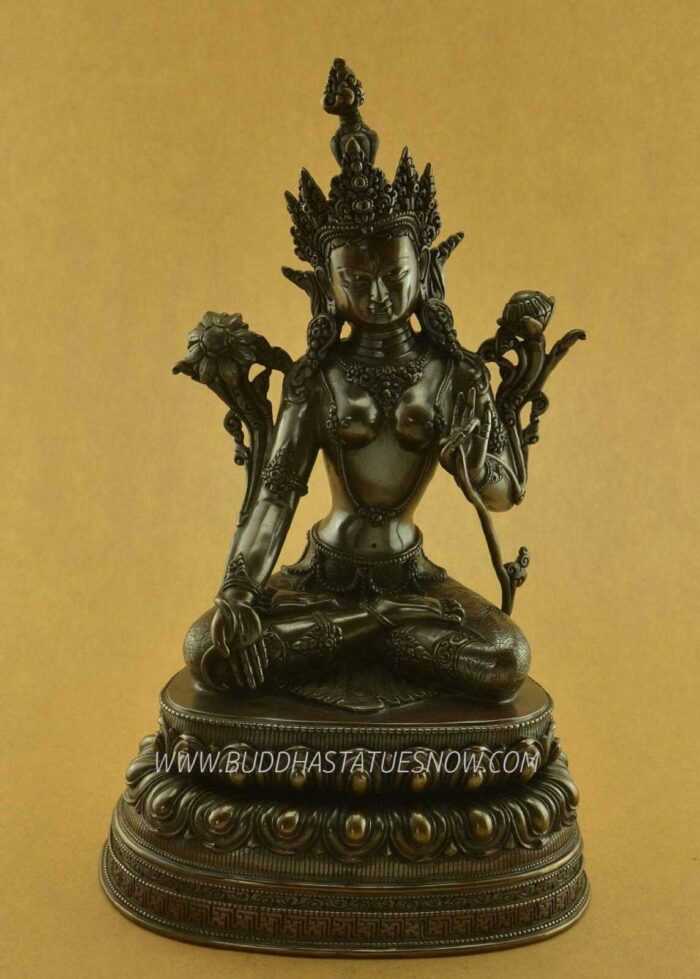
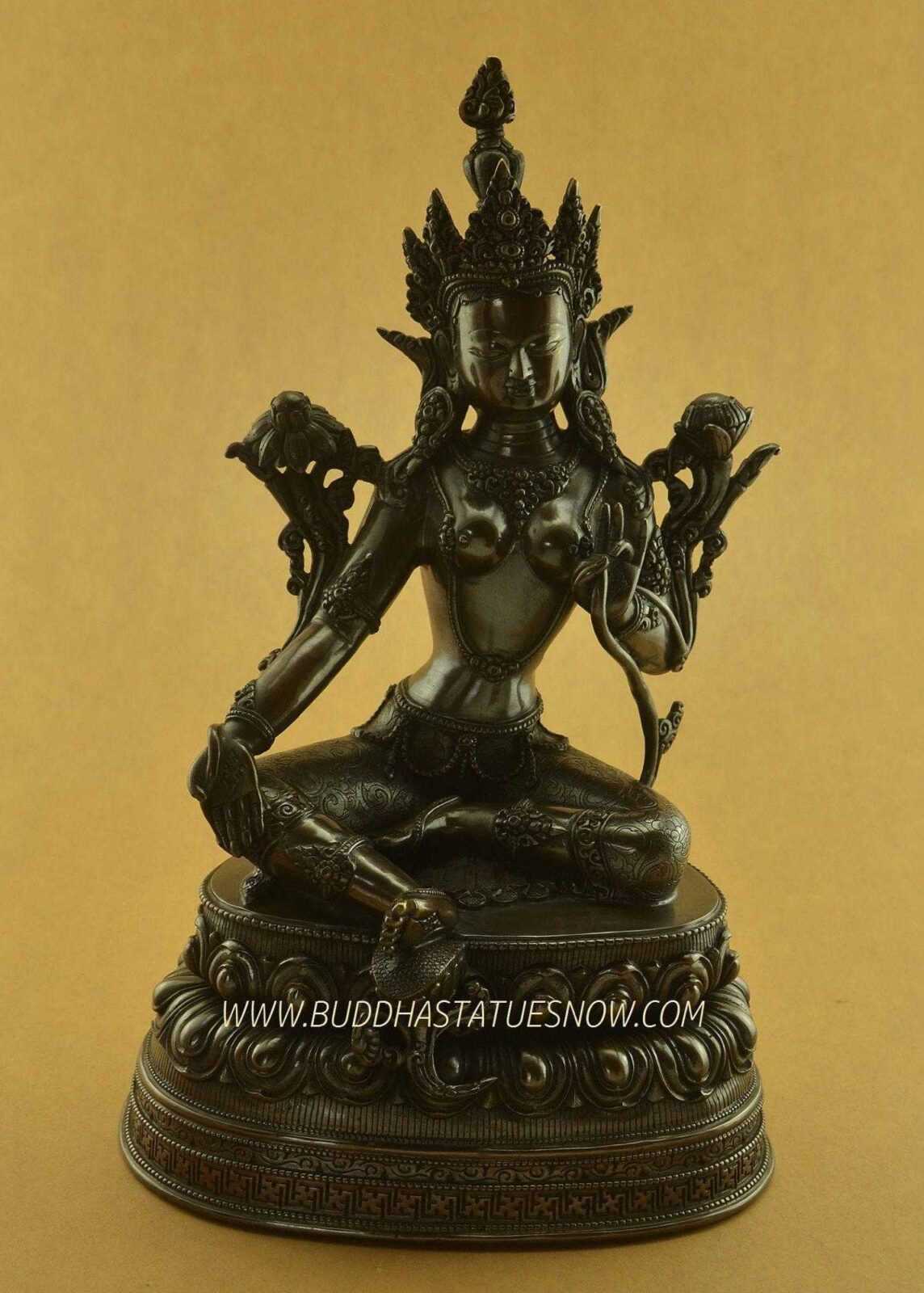
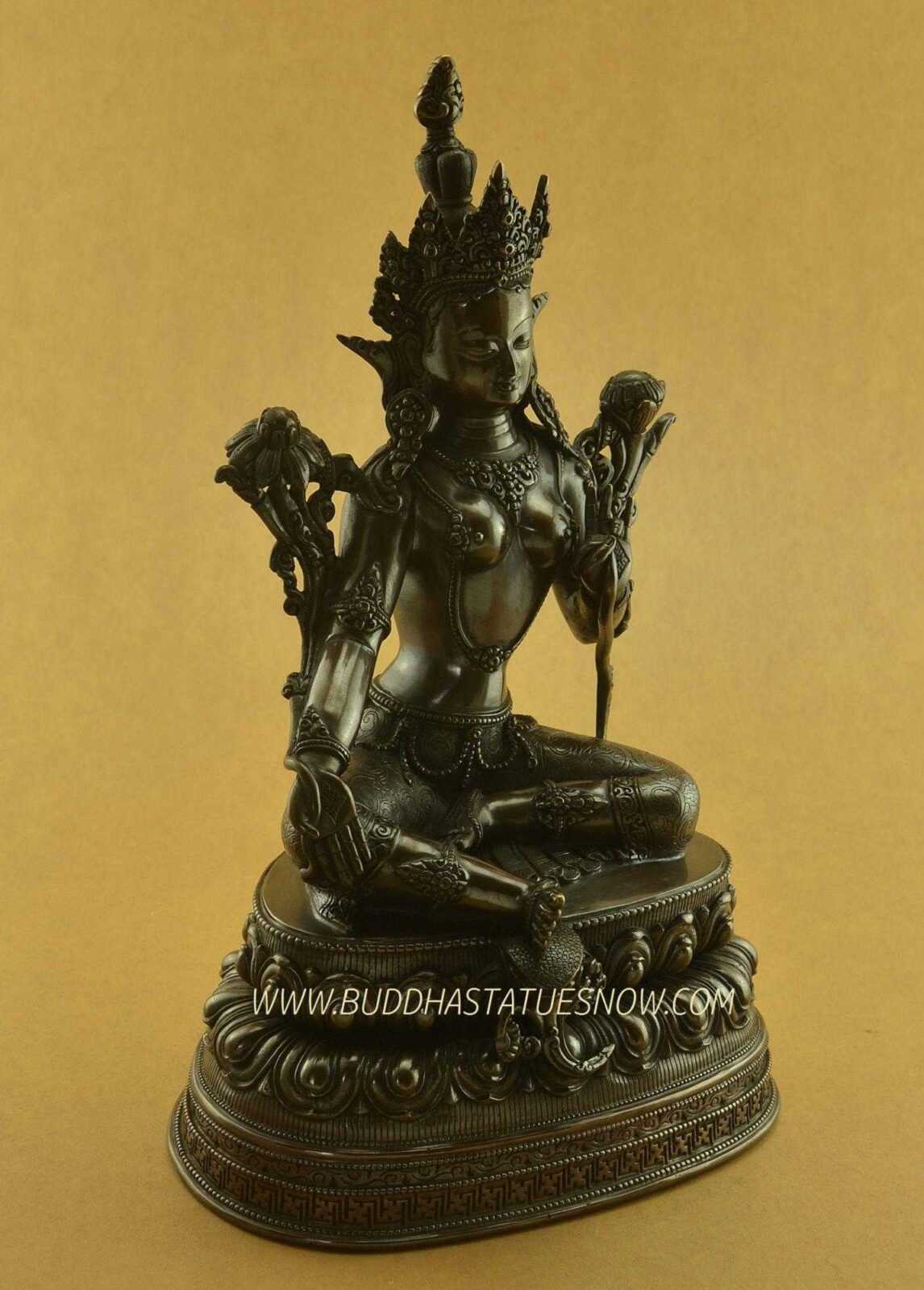
This finely crafted Antiquated Green Tara sculpture portrays Khadiravani Tara, one of the most revered forms of Green Tara in Tibetan Buddhism. Handmade in Patan, Nepal, the 14-inch statue was cast from copper alloy through the traditional lost-wax method and completed with a rich antiquated oxidized finish. The dark copper surface brings depth to the sculpted contours while emphasizing the extensive hand engraving across Tara’s garments, lotus throne and architectural pedestal.
Green Tara sits gracefully in lalitasana, the posture of royal ease, with one leg extended and the other folded upon the throne. Her relaxed yet active posture expresses the defining quality of Green Tara: she remains established in enlightened awareness while always prepared to rise immediately for the benefit of sentient beings. Her serene face, gently inclined head and finely modeled hands balance the elaborate crown, jewelry, lotus blossoms and richly ornamented base.
The sculpture measures approximately 14 inches high, 9 inches wide and 6.5 inches deep, giving it a substantial presence without requiring the space of a larger temple statue. Its carefully finished reverse, engraved back garments and decorated pedestal allow the statue to be displayed freestanding in a home shrine, meditation room or collection of Himalayan Buddhist art. The Bodhisattva crown and jewelry may also be embellished with genuine turquoise and red coral upon request before shipping.
Antiquated Green Tara Sculpture of Khadiravani Tara
Khadiravani Tara is a celebrated manifestation of Green Tara associated with the khadira, or acacia, forest. Her name is commonly understood as “Tara of the Acacia Forest,” recalling the sacred woodland setting in which she appeared to accomplished practitioners. In Tibetan Buddhist art, Khadiravani Tara is represented with the familiar green form, youthful appearance, Bodhisattva ornaments and two utpala lotuses rising beside her shoulders.
Known in Tibetan as Jetsun Dolma, Green Tara embodies the swift compassionate activity of all the Buddhas. She is not merely a symbolic attendant or celestial protector, but an enlightened female Buddha whose activity is directed toward freeing beings from fear, danger and the causes of suffering. Her youthful appearance conveys the freshness and immediacy of awakened compassion, while her poised posture indicates that her response is never delayed.
Green Tara’s mantra, Om Tare Tuttare Ture Svaha, is recited to cultivate courage, remove obstacles and establish a closer connection with her compassionate activity. The syllable Tare is associated with liberation from ordinary suffering, Tuttare with freedom from fear and danger, and Ture with release from deeper spiritual obscurations. Learn more about the Green Tara mantra and meditation practice.
Lalitasana and Tara’s Readiness to Act
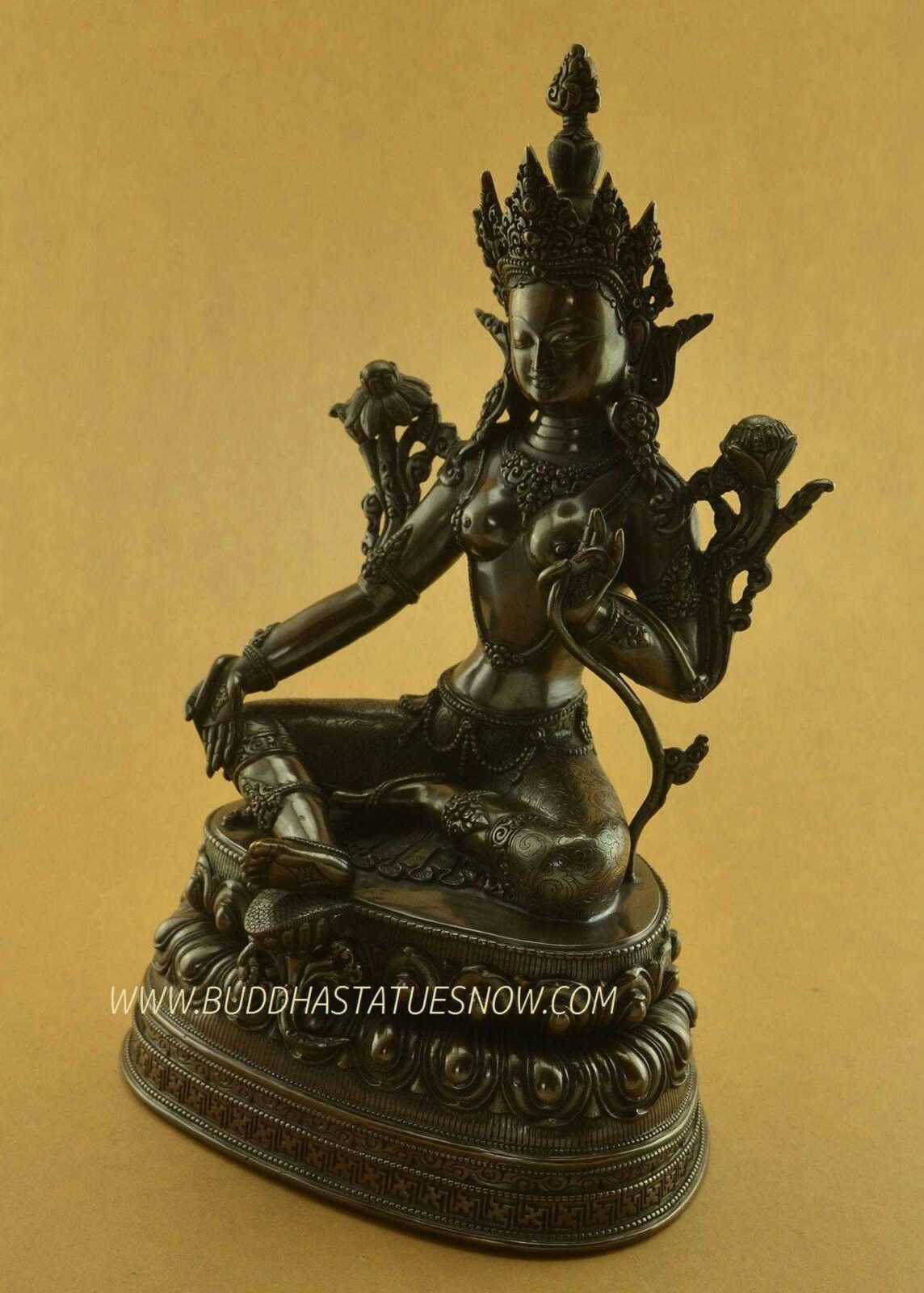
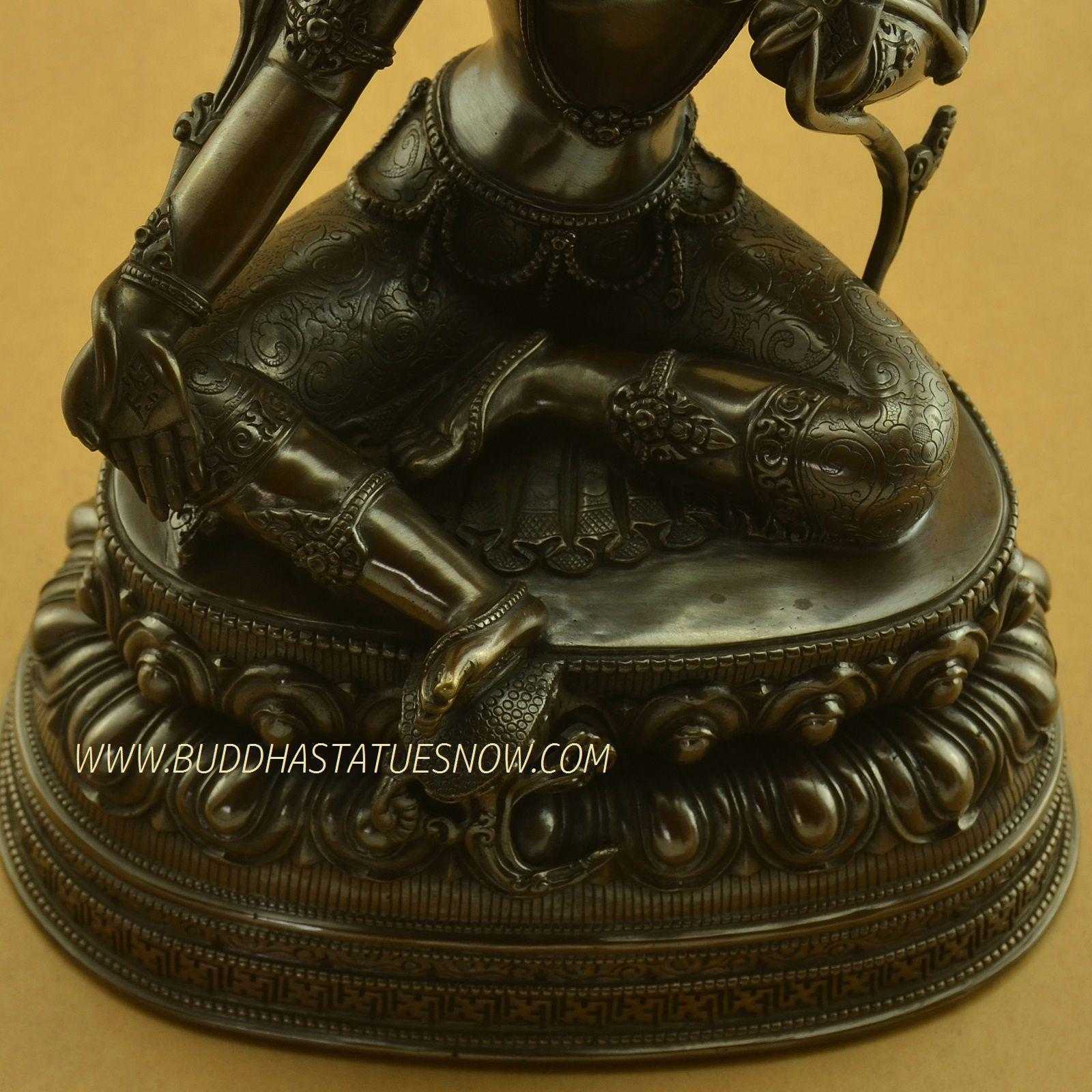
This Antiquated Green Tara sculpture depicts the deity seated in lalitasana, the posture of royal ease. Her left leg remains folded upon the throne while her right leg extends downward and forward. This is one of the most recognizable features of Green Tara iconography and distinguishes her from deities shown with both legs drawn into a closed meditation posture.
The extended leg signifies that Green Tara is ready to rise at once in response to suffering. She remains peaceful and composed, but her compassion is active rather than passive. Her posture therefore unites meditative stability with immediate enlightened action. The delicately extended foot and relaxed knee give the sculpture a sense of movement, suggesting that Tara is poised between serene contemplation and compassionate intervention.
Her lowered right hand displays Varada mudra, the gesture of generosity, blessing and the granting of spiritual attainments. The open palm faces outward toward devotees, expressing her willingness to offer assistance without hesitation. Her raised left hand is held near the heart in a protective and teaching gesture while supporting the stem of an utpala lotus. A guide to the symbolism of Buddhist mudras and sacred hand gestures provides additional context for the meaning of Varada mudra.
Utpala Lotuses and the Path to Awakening
Two utpala lotus stems rise beside Green Tara’s body and curve behind her shoulders. The stems are formed with graceful openwork scrolls rather than simple straight supports, adding visual movement around the upper body and connecting Tara’s hands with the blossoms above. The curling leaves and stems frame her torso without obscuring the smooth modeling of the shoulders and waist.
One lotus appears more fully opened, while the second remains less developed. Together, the blossoms may be understood as complementary stages of spiritual realization. The open flower represents awakened wisdom brought to completion, while the emerging blossom expresses the potential for enlightenment present within every sentient being. Green Tara’s compassionate activity guides practitioners from aspiration and vulnerability toward courage, understanding and realization.
The lotus is especially appropriate to Tara because it emerges from muddy water yet opens unstained above the surface. It symbolizes the possibility of developing wisdom and compassion while still living within the difficulties of samsara. Green Tara does not withdraw from suffering; she enters the circumstances of beings without becoming bound by confusion, fear or attachment. Learn more about Green Tara’s posture, lotus symbolism and traditional iconography.
Bodhisattva Crown and Celestial Ornaments
Khadiravani Tara wears the crown and jewels of an enlightened Bodhisattva. Her elaborate multi-point crown rises around the carefully arranged hair and is surmounted by a high topknot ornament. Fine beaded borders, floral motifs and raised decorative elements give the crown considerable depth while preserving the calm openness of her face.
Long earrings frame the cheeks, and layered necklaces ornament the chest. Additional jewelry appears at the upper arms, wrists, ankles and waist. These ornaments are not intended merely as displays of worldly luxury. In Himalayan Buddhist iconography, Bodhisattva jewelry symbolizes the abundance of enlightened qualities and the six perfections cultivated for the benefit of beings.
The smooth finish of Tara’s face and torso creates an elegant contrast with the detailed crown, necklaces, bracelets and engraved garments. Her expression remains composed and approachable, with lowered eyes suggesting compassionate awareness directed toward devotees. The gentle modeling of the waist and shoulders gives the statue a natural sense of balance despite the density of the surrounding ornamentation.
At the buyer’s request, the crown and jewelry can be decorated with genuine turquoise and red coral before shipment. Turquoise has long been valued in Himalayan culture and visually complements Tara’s association with compassionate activity. Red coral introduces a warm contrast against the dark oxidized copper. These additions are optional, allowing the sculpture to remain in its present antiquated finish or be personalized with traditional stone embellishments.
Fine Engraving Across the Garments
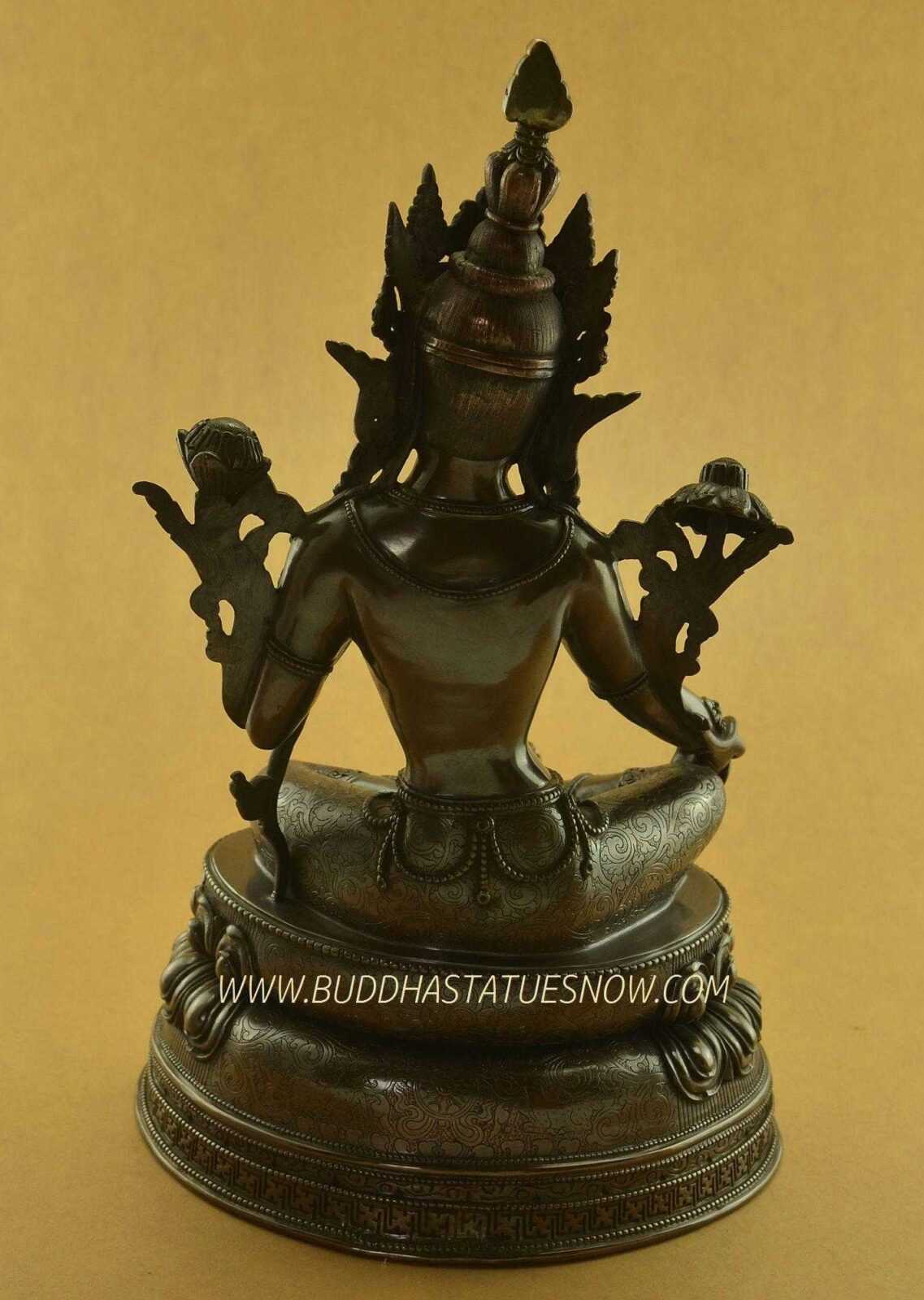
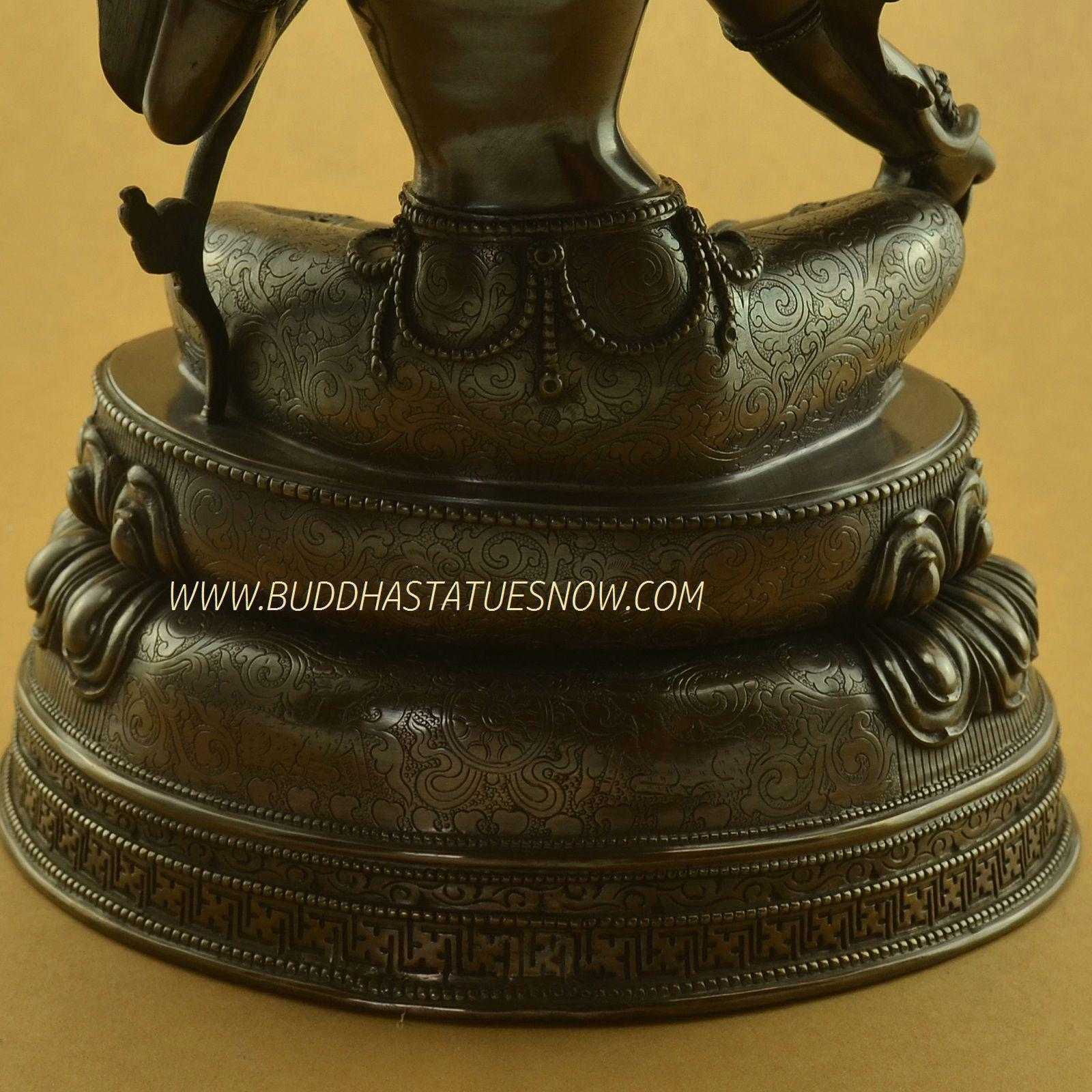
One of the most distinguished features of this Antiquated Green Tara sculpture is the extensive hand engraving across her garments. Flowing foliate scrollwork covers the dhoti around both legs, following the curved surfaces without interrupting the natural modeling of the seated posture. The engraved patterns remain visible from the front, sides and reverse, demonstrating that the decoration was planned for the entire sculpture rather than concentrated only on the frontal view.
The garment around Tara’s waist is bordered with beaded ornament and a decorative belt. Hanging panels descend over the front of the dhoti, while small chains and jeweled elements create additional texture around the hips. The engraved designs continue across the rear of the garment, where swirling floral motifs remain clearly visible beneath the smooth copper surface of the back.
The artisans achieved a refined balance between ornamented and unornamented areas. Tara’s face, torso, arms and back remain comparatively smooth, allowing the dark oxidized copper to reveal the graceful sculptural modeling. The garments and pedestal carry the more intricate decoration, drawing attention toward the lower portion of the composition without overwhelming the deity’s peaceful expression.
Double Lotus Throne and Ornamental Pedestal
Green Tara is seated upon a broad double lotus throne with substantial overlapping petals. The upper surface provides a smooth platform for her extended and folded legs, while the outer rows of petals curve downward around the front and sides. The large rounded petals create a strong visual foundation and complement the fluid lines of Tara’s posture and lotus stems.
The lotus throne is integrated with a lower architectural pedestal decorated with beaded borders, engraved foliate scrollwork and a continuous geometric key-fret pattern. The crisp lower border gives the base a formal architectural character, while the scrolling floral designs above it echo the natural imagery of the lotus blossoms and engraved garments.
The reverse of the throne receives the same level of attention as the front. Floral scrollwork continues around the rear pedestal, and the lower geometric border remains uninterrupted. This complete treatment allows the sculpture to be placed away from a wall or viewed from several directions without exposing an unfinished surface.
The double lotus throne also carries doctrinal meaning. The lotus represents purity arising within samsara, while the two rows of petals create a visual transition between the earthly architectural base and Tara’s enlightened body. The broad pedestal gives the 14-inch sculpture physical stability and sufficient visual weight to support the open posture, projecting leg and shoulder lotuses.
Rich Antiquated Green Tara Sculpture ‒ Oxidized Copper Finish
The dark oxidized surface gives this Green Tara image the appearance of an established Himalayan shrine sculpture. Rather than concealing the metal beneath a uniform layer of gilding, the antiquated finish allows the copper alloy to remain central to the visual character of the statue. Variations in reflected light reveal the modeling of the face, shoulders, torso and limbs while deepening the recessed areas around the crown, jewelry and engraved designs.
The polished high points catch the light, while the deeper oxidized recesses increase the definition of the hand-carved patterns. This tonal contrast is especially effective across the dhoti and lotus pedestal, where the engraved scrollwork becomes visible without requiring painted color. The result is dignified and understated, making the sculpture particularly suitable for collectors who prefer traditional dark copper finishes.
A small gold-toned highlight appears near the extended foot, introducing a restrained point of contrast within the otherwise dark composition. The overall finish remains cohesive from the crown to the base, preserving the rich antiquated appearance requested for a coordinated shrine ensemble.
Finished on Every Visible Side
The rear photograph reveals the quality of workmanship beyond the frontal presentation. Tara’s back is smoothly modeled, with the shoulder blades, waist and upper arms clearly defined. A fine beaded necklace descends across the upper back, while the crown, high hair ornament and flowing lotus stems remain fully sculpted from behind.
The engraved dhoti continues around both legs, and the rear waist ornaments are carefully arranged rather than simplified. The double lotus throne and lower pedestal carry complete floral and geometric decoration across the reverse. This full treatment is particularly desirable for a freestanding shrine statue because it demonstrates that the artisan regarded the image as a complete sacred object rather than a front-facing decorative figure.
The depth created by the shoulder lotuses, crown projections and relaxed arm positions also gives the statue a strong three-dimensional presence. It may be appreciated from the sides and back as well as from the principal frontal viewpoint, where Tara’s posture and compassionate gestures remain the visual focus.
Traditional Lost-Wax Casting in Patan, Nepal
This Khadiravani Tara sculpture was handmade by Newar artisans in Patan, Nepal, a historic center of Himalayan sacred metalwork. The production begins with a wax model formed according to traditional Buddhist iconometric proportions. The artisan establishes the posture, facial expression, hand gestures, crown, jewelry, lotus stems and throne before preparing the model for casting.
The wax form is enclosed in a heat-resistant mould and fired, allowing the wax to melt away and leave a hollow cavity. Molten copper alloy is then poured into the mould. Once the casting has cooled, the mould is broken and the metal sculpture is refined by hand. The artisan chases the surface, sharpens the facial features and jewelry, corrects minor casting irregularities and completes the separate ornamental elements.
The foliate patterns across the dhoti, waist ornaments, lotus throne and architectural pedestal are engraved after casting. The copper alloy is then carefully oxidized to achieve the dark antiquated finish. Raised areas may be polished selectively so that reflected light reveals the contours and decorative patterns. Learn more about the Shakya artisans and the traditional lost-wax casting process.
The Eight Great Fears and Green Tara’s Protection
Green Tara is traditionally invoked for protection from the Eight Great Fears. These may be understood as external dangers, but Tibetan Buddhist teachings also interpret them as symbols of the inner afflictions that obstruct spiritual progress. Lions represent pride, elephants symbolize ignorance, fire corresponds to anger, snakes represent jealousy, thieves signify distorted views, imprisonment reflects attachment, floods symbolize desire and harmful spirits represent doubt.
Tara’s protection therefore extends beyond rescue from immediate danger. Her practice helps devotees recognize and transform the mental habits that repeatedly produce fear and suffering. Her extended leg expresses readiness, her open hand offers refuge and her raised hand encourages confidence. Explore the traditional meaning of the Eight Great Fears associated with Green Tara.
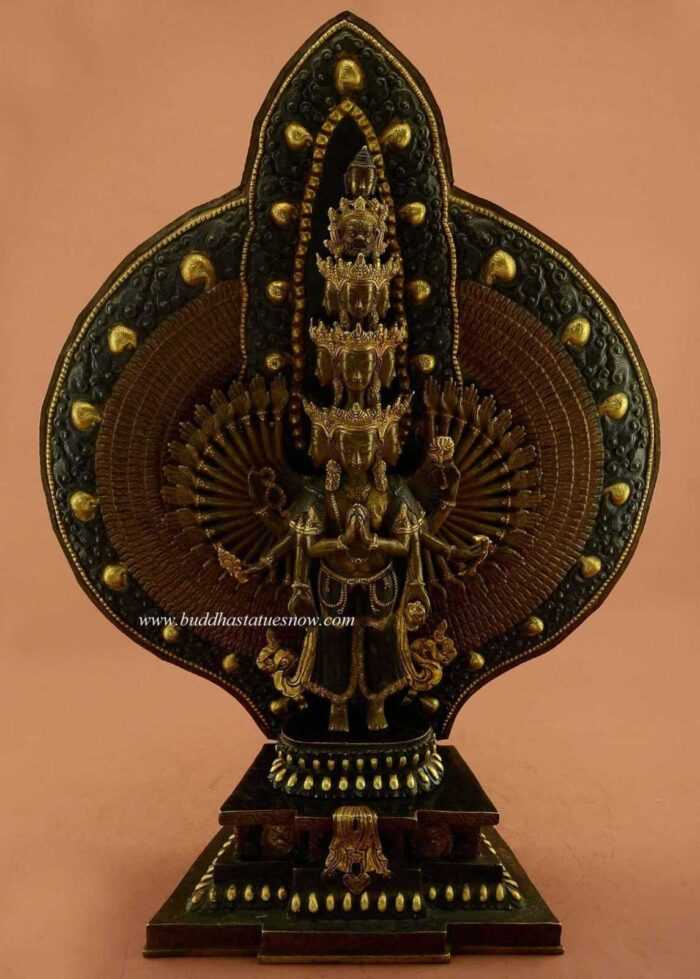
Antiquated Green Tara Sculpture, White Tara and 1000 Armed Avalokiteshvara Shrine Set
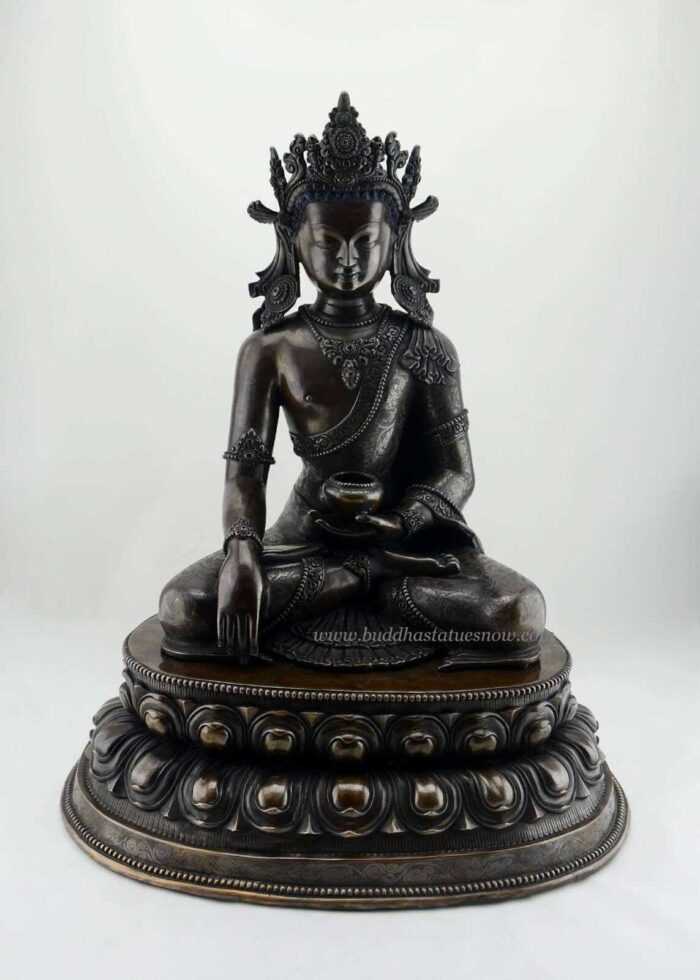
This Antiquated Green Tara sculpture would form a harmonious three-piece shrine set with the matching Antiquated White Tara statue and the 1000 Armed Avalokiteshvara statue. The similar proportions, dark oxidized copper finishes, elaborate Bodhisattva crowns and traditional Newar craftsmanship give the three sculptures strong visual unity.
Green Tara and White Tara share finely engraved garments, ornamental jewelry and richly decorated double lotus thrones. Their related scale and antiquated surfaces allow them to serve as balanced flanking figures. The taller Avalokiteshvara sculpture would occupy the center, where its eleven heads, expansive arrangement of compassionate arms and selective 24K fire-gilded details would create an impressive focal point against the darker Tara statues.
The three deities also form a meaningful doctrinal ensemble. Avalokiteshvara embodies universal compassion—the awakened capacity to perceive and respond to the suffering of all beings. Green Tara represents that compassion becoming swift and fearless action, immediately removing dangers and obstacles. White Tara expresses compassion through healing, longevity, serenity and the preservation of favorable conditions for Dharma practice.
Together, the statues present three complementary dimensions of enlightened compassion. Avalokiteshvara perceives suffering and generates the limitless Bodhisattva vow. Green Tara responds without delay. White Tara heals, nurtures and sustains life over the course of the spiritual path. Arranged with Avalokiteshvara as the taller centerpiece, the group would symbolize compassion that sees suffering, acts to relieve it and preserves the conditions necessary for continued practice and realization.
Custom-Made Antiquated Green Tara Sculptures and Shrine Sets
A custom-made Green Tara sculpture may be commissioned in a preferred size, finish and level of ornamentation. Available options include smaller personal shrine images, larger temple-scale sculptures, rich antiquated oxidized copper finishes, silver-highlighted surfaces and statues fire gilded in 24K gold. The face may also be hand painted with 18K gold and natural pigments when appropriate to the requested finish.
The crown, necklaces, earrings and other ornaments may be embellished with genuine turquoise and red coral. Customers may request restrained stone placement similar to traditional Himalayan examples or more extensive decoration across the crown and jewelry. Garment engravings, lotus-petal patterns and pedestal borders may also be adapted according to the size and artistic character of the commission.
Custom Khadiravani Tara sculptures can be produced for private collectors, home shrines, Dharma centers and monasteries. Larger commissions may include more elaborate double lotus thrones, deeper hand engraving, specialized antiquated finishes or coordinated proportions designed for an existing altar. Traditional iconographic features—including lalitasana, Varada mudra, the raised protective hand and two utpala lotuses—are preserved throughout the design process.
A complete custom three-piece shrine set may also be commissioned with Green Tara, the Antiquated White Tara statue and the 1000 Armed Avalokiteshvara statue. The heights, oxidized finishes, crown proportions, engraving styles and lotus bases can be coordinated so the completed group appears as an intentionally unified ensemble. Avalokiteshvara may be made several inches taller as the central image, while Green Tara and White Tara are proportioned as complementary companions representing swift action, healing and long life.
Authentic, Handmade in Nepal
Every statue is handcrafted in Patan, Nepal, using traditional lost wax casting and comes with a certificate of authenticity issued by Nepal’s Department of Archaeology, verifying its materials, technique, and origin.