
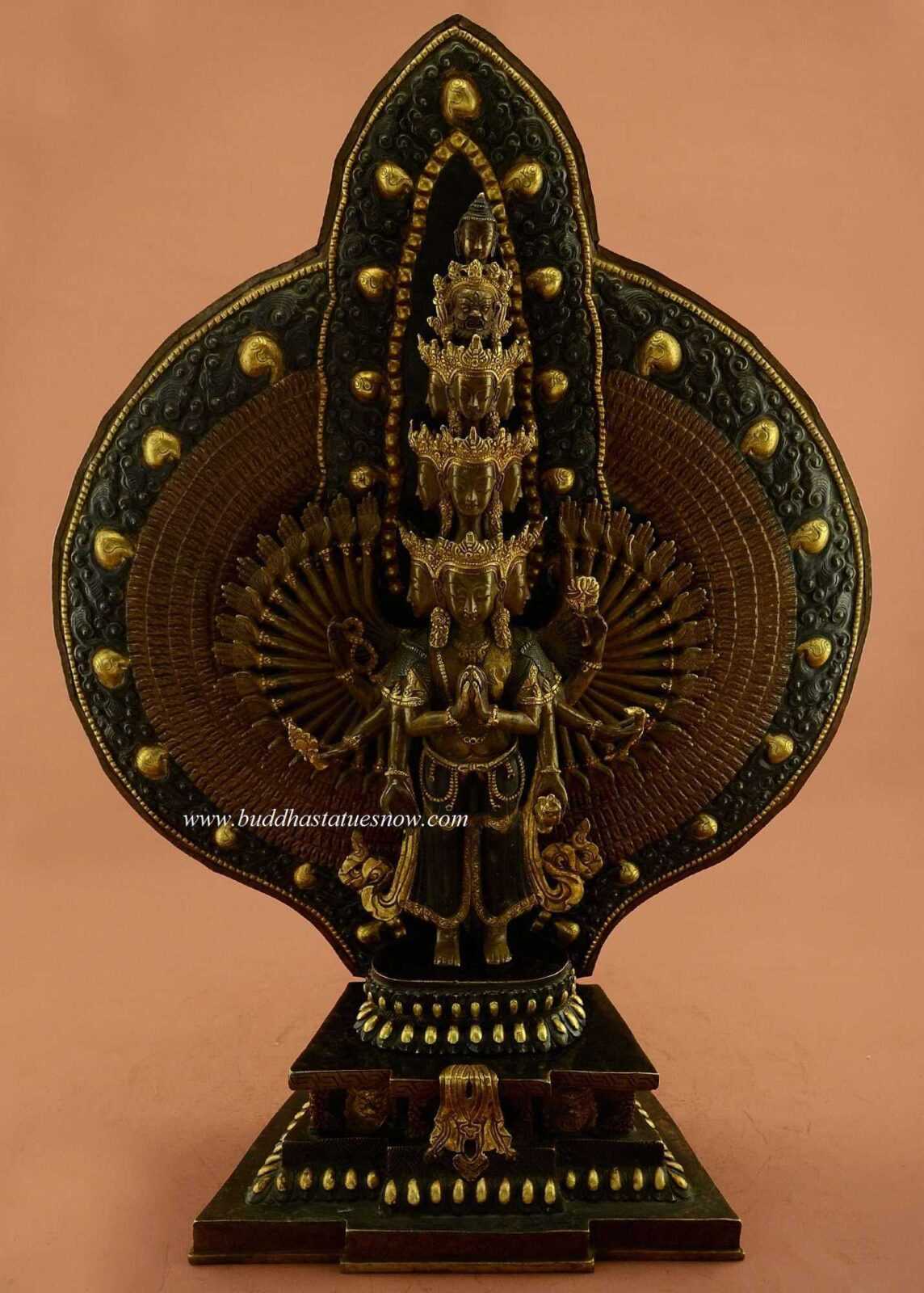
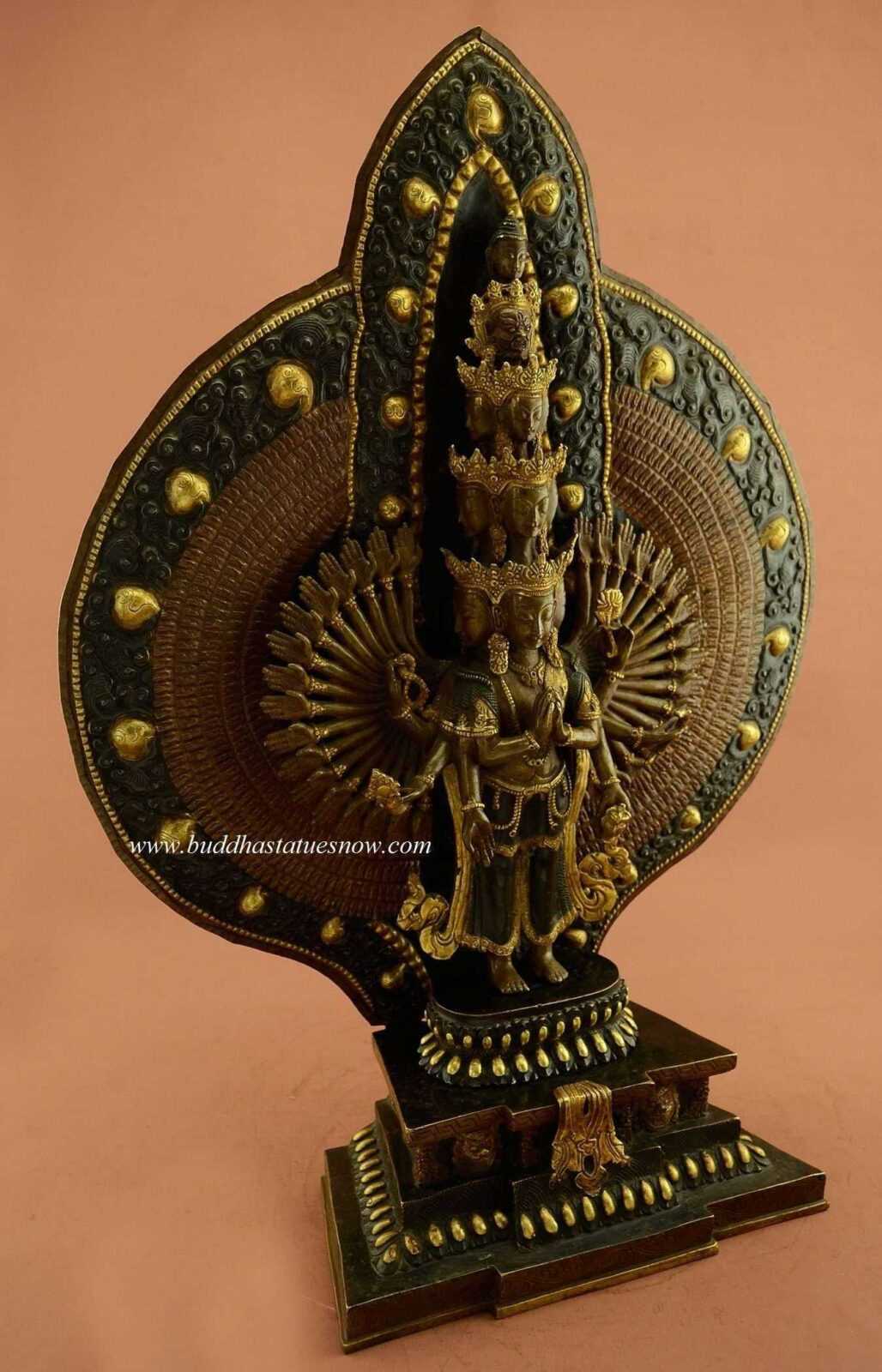
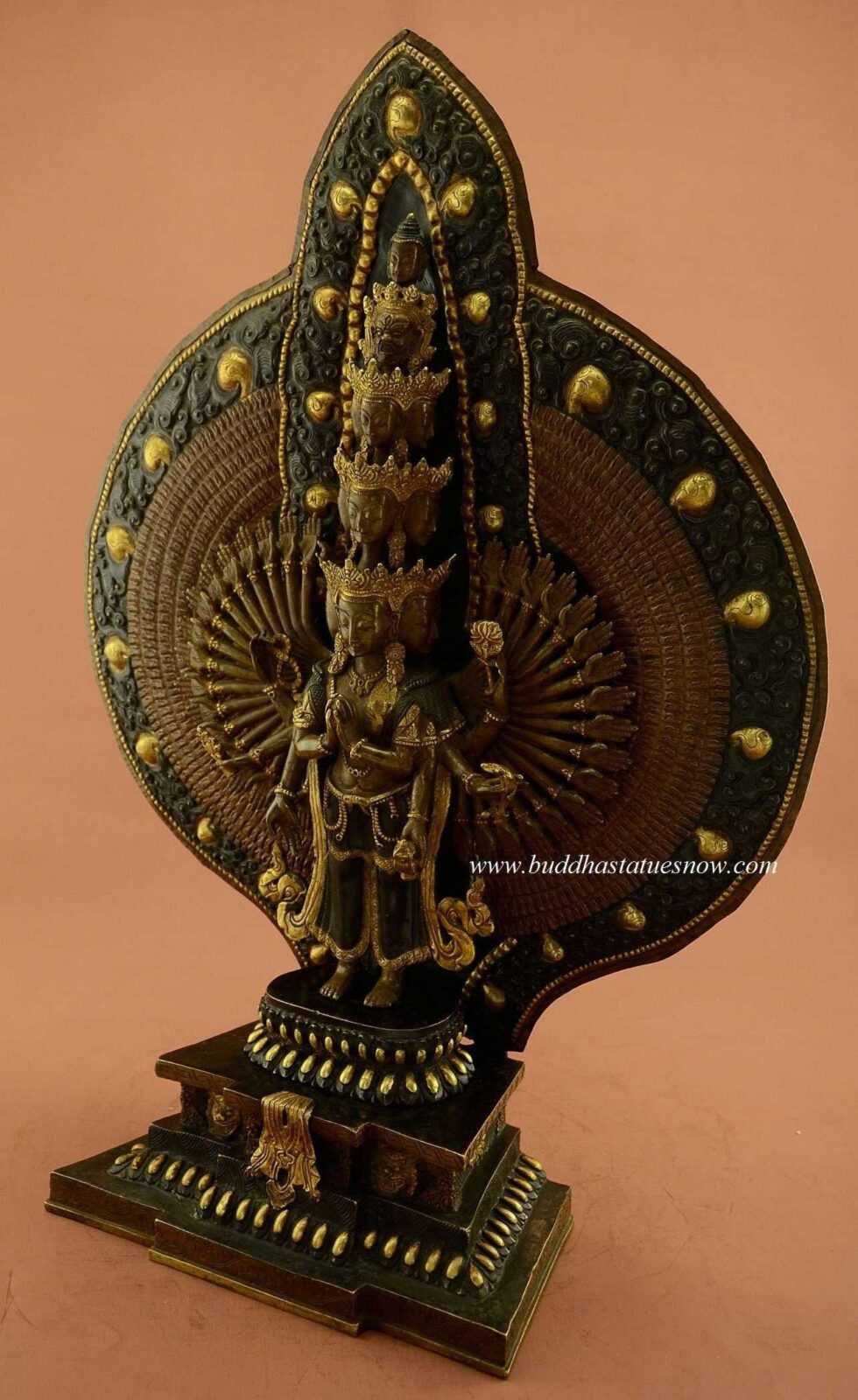
This extraordinary 20.25-inch 1000 Armed Avalokiteshvara Statue portrays Sahasrabhuja Avalokiteshvara, the thousand-armed manifestation of the Bodhisattva of Compassion. Handmade in Patan, Nepal from copper alloy through the traditional lost-wax casting method, the sculpture combines a deep antiquated oxidized finish with carefully placed 24K fire-gilded details. The gilded crowns, jewelry, garment borders, lotus petals, beaded trim and raised ornaments shine against the dark copper body and aureole, creating a dramatic contrast that helps define the statue’s complex sacred iconography.
Avalokiteshvara stands at the center of a broad aureole surrounded by the traditional radiating representation of his thousand compassionate arms. Eleven heads rise above the principal face in successive tiers, culminating in the image of Amitabha Buddha at the summit. The central figure remains dark and contemplative, while the 24K gold accents guide the eye toward his crowns, ornaments, principal hands and sacred attributes. This selective gilding preserves the antiquated character of the copper alloy while illuminating the enlightened qualities represented by the sculpture.
Unlike a conventional standing Bodhisattva image, this sculpture possesses impressive physical depth. The projecting arms, layered heads, substantial aureole and removable copper-alloy backing create a commanding three-dimensional presence from the front, sides and reverse. Avalokiteshvara stands upon a single lotus pedestal supported by a stepped architectural plinth, giving the wide and vertically complex composition a stable foundation suitable for a principal home altar, Buddhist temple, Dharma center or collection of authentic Himalayan sacred art.
1000 Armed Avalokiteshvara Statue and the Bodhisattva of Compassion
Avalokiteshvara is the great Bodhisattva who embodies the compassion of all the Buddhas. Known as Chenrezig in Tibetan Buddhism, he represents the awakened intention to perceive suffering wherever it occurs and to respond with wisdom, patience and effective compassionate action. His thousand-armed form expresses the immeasurable reach of this activity: no direction, realm or category of sentient being lies beyond his concern.
According to the traditional account, Avalokiteshvara vowed that he would not rest until every sentient being had been freed from suffering. After working for an immeasurable period, he looked upon the world and saw that countless beings still remained trapped in samsara. The overwhelming force of his compassionate vow caused his body to break apart. His spiritual source, Amitabha Buddha, restored him in a more powerful form, giving him eleven heads and a thousand arms so that he could observe suffering in every direction and extend assistance wherever it was needed.
The story does not portray compassion as a failure. Instead, it teaches that the Bodhisattva vow transforms difficulty into greater capacity. Avalokiteshvara emerges with more eyes to perceive suffering, more hands to assist beings and an expanded ability to act without abandoning his original promise. Learn more about the meaning and symbolism of Avalokiteshvara in our detailed guide to the Bodhisattva of Compassion.
Eleven Heads and the All-Seeing Compassionate Gaze
The eleven heads rise in a carefully organized vertical sequence above Avalokiteshvara’s principal face. They represent his ability to observe the suffering of beings throughout the ten directions while remaining established in complete awakened awareness. The faces look outward from different levels, expressing compassion that is not restricted to a single perspective or place.
The uppermost peaceful head represents Amitabha Buddha, identifying Avalokiteshvara with the lotus family of enlightened compassion. Beneath Amitabha appears a powerful wrathful face traditionally associated with Vajrapani. This forceful expression does not represent ordinary anger. It symbolizes the compassionate strength needed to overcome severe obstacles, delusion and harmful forces that cannot be pacified through gentle means alone.
The principal face remains calm despite the immense scope of Avalokiteshvara’s vow. His lowered gaze expresses attentive compassion joined with meditative stability rather than distress. Enlightened compassion perceives suffering clearly without becoming overwhelmed by it because it is inseparable from wisdom and the realization of emptiness.
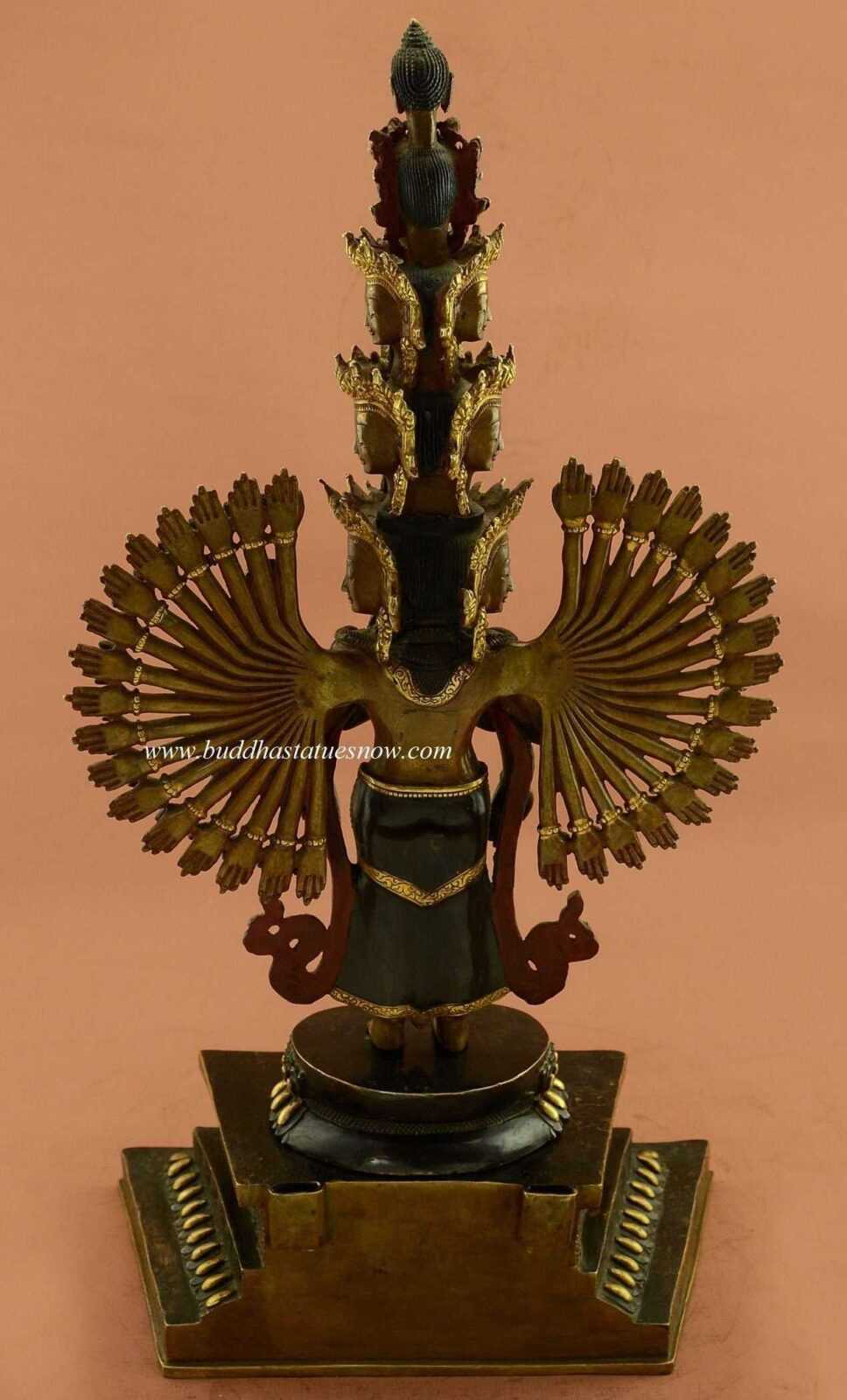
The heads are sculpted fully in the round. Their crowns, hair, facial contours and profiles remain defined when viewed from behind, rather than forming a flat frontal arrangement. Painted red details appear beneath portions of the upper crest and along selected ribbons, adding restrained color against the oxidized copper and fire-gilded ornamentation.
The Thousand Arms and Eyes of Avalokiteshvara
A broad fan of hands radiates behind the central body, forming the traditional symbolic representation of Avalokiteshvara’s thousand arms. The repeated hands extend outward in every direction, transforming the entire composition into a visual expression of compassionate activity without limit. Rather than indicating physical power alone, the multitude of arms represents the countless skillful methods an enlightened Bodhisattva can use to benefit beings according to their individual circumstances.
In the traditional iconography of Sahasrabhuja Avalokiteshvara, the hands are commonly associated with an eye in each palm. The hand signifies compassionate action and skillful means, while the eye represents the wisdom that perceives the true nature of suffering. Together they teach that effective compassion must be guided by insight. Compassion without wisdom may be misdirected, while wisdom without compassion remains incomplete.
The five fingers of each hand may also be associated with the five method perfections: generosity, ethical discipline, patience, joyful diligence and meditation. The eye represents the sixth perfection of transcendent wisdom. The thousand hands therefore symbolize the complete Bodhisattva path extended outward for the welfare of innumerable beings.
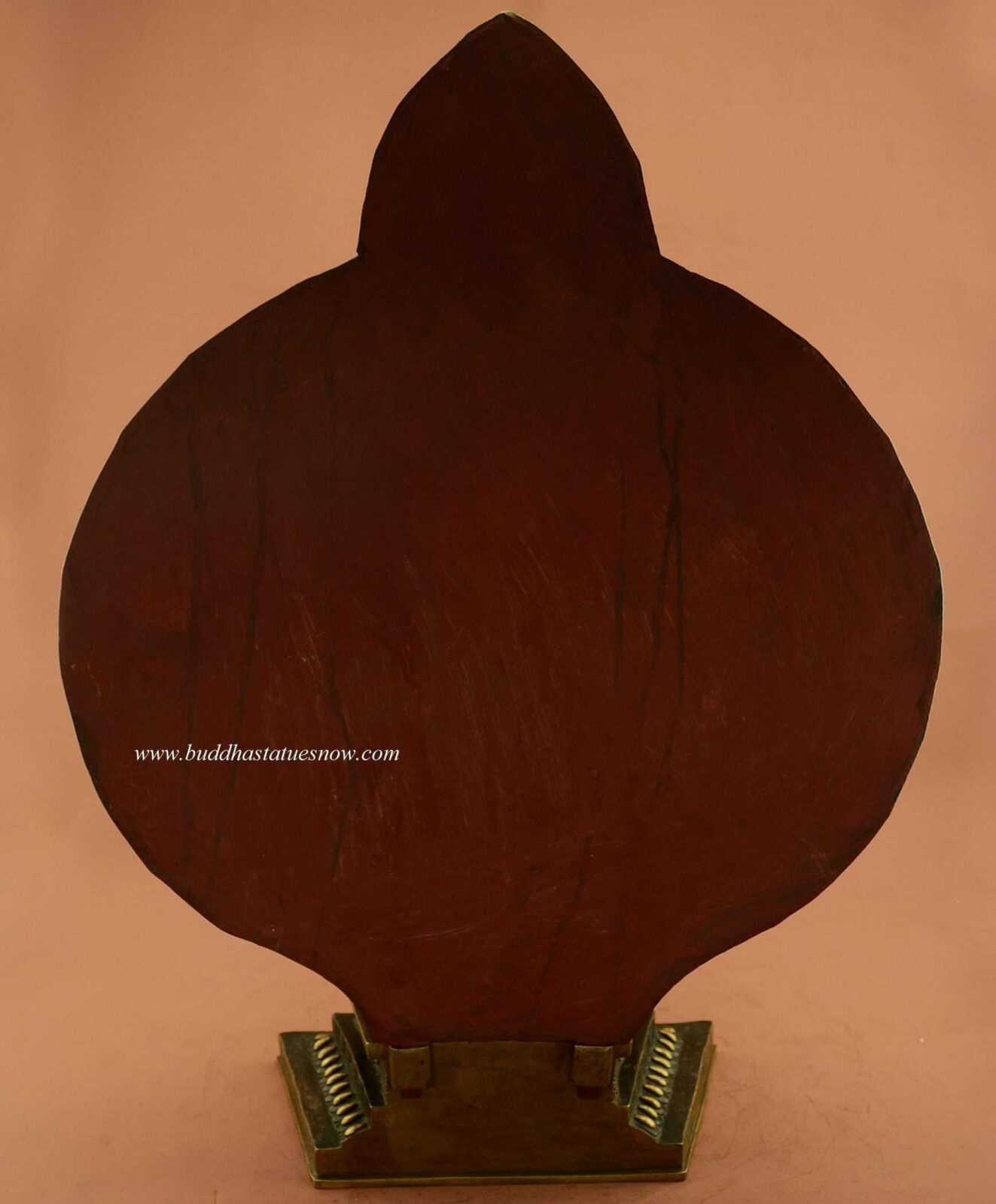
When the removable backing panel is taken away, the reverse reveals the individually modeled arms, hands and structural metalwork supporting the radiating composition. Each element has been carefully positioned to preserve the balanced fan-like silhouette. The complexity of the rear construction demonstrates the considerable technical skill required to cast, assemble and stabilize a multi-armed image of this scale.
Cintamani Jewel, Mala and Lotus Attributes
Avalokiteshvara’s two principal hands meet before his heart in a devotional gesture surrounding the cintamani, or wish-fulfilling jewel. The jewel should not be understood simply as an object that grants ordinary material desires. In Buddhist symbolism, it represents the awakened qualities capable of fulfilling the deepest wish of sentient beings: liberation from ignorance, suffering and cyclic existence.
Its position at the heart reveals that Avalokiteshvara’s activity arises from an enlightened intention centered entirely upon the welfare of others. The joined hands also express reverence for Amitabha Buddha, whose image appears at the summit of the eleven heads and whose lotus family Avalokiteshvara represents.
A prominent outer hand holds a mala associated with the continuous recitation of the Avalokiteshvara mantra, Om Mani Padme Hum. The circular succession of beads suggests uninterrupted compassionate practice. Avalokiteshvara does not respond only occasionally; his activity continues ceaselessly for as long as suffering remains.
Another principal hand supports a lotus blossom. The lotus rises from muddy water yet opens above the surface without becoming stained by it. It therefore symbolizes the possibility of awakening within samsara and the ability of an enlightened being to enter difficult circumstances without becoming bound by confusion, attachment or despair.
Antiquated Copper with 24K Fire-Gilded Details
The contrasting finish is one of the most compelling artistic features of this 1000 Armed Avalokiteshvara Statue. Most of the body, arms, heads, aureole and architectural base retain a dark antiquated oxidized copper surface. Selected sacred and ornamental details are fire gilded in 24K gold, allowing the gold to function as a carefully controlled highlight rather than covering the entire composition.
The gilding draws attention to the elaborate crowns, earrings, necklaces, bracelets, garment borders and principal attributes. Gold-tipped lotus petals form a luminous band beneath the standing deity, while raised gilded bosses punctuate the darker ornamental border surrounding the aureole. Fine gold beading follows selected edges and architectural courses throughout the pedestal.
The dark recessed surfaces preserve the contemplative gravity of an antiquated Himalayan sacred image. By contrast, the gilded details catch surrounding light and help separate the principal figure and symbols from the dense array of hands, heads and decorative elements. This treatment is particularly effective for Sahasrabhuja Avalokiteshvara because it creates clarity within one of Tibetan Buddhism’s most visually complex iconographic forms.
Decorated Copper-Alloy Aureole and Removable Backing
Avalokiteshvara is enclosed within a large leaf-shaped aureole cast from copper alloy. The frame expands around the radiating arms and rises to a pointed crest above the eleven heads. Closely spaced lines across the inner field reinforce the outward movement of compassionate activity, while the darker outer border is decorated with scrolling foliate and cloud motifs.
Raised 24K fire-gilded bosses appear at regular intervals around the aureole, creating a measured ornamental rhythm. Gilded beaded borders trace portions of the inner and outer contours, separating the dark decorative field from the central deity and producing a strong temple-like silhouette around Amitabha Buddha at the summit.
A removable copper-alloy backing panel follows the full outline of the aureole. When fitted in place, it provides a clean finished reverse and protects the intricate arrangement of arms and supporting metalwork. The panel may be removed to reveal the individually modeled hands, layered heads and structural construction from behind.
The copper-alloy backing carries subtle hand-worked texture that reflects light while preserving the smooth overall silhouette of the aureole. Its detachable construction combines practical protection with access to the elaborate craftsmanship concealed within the thousand-arm assembly. This feature also contributes to the sculpture’s substantial physical depth and commanding three-dimensional presence.
Single Lotus Pedestal and Architectural Plinth
Avalokiteshvara stands upon a compact single lotus pedestal rather than a double lotus throne. A row of downward-facing lotus petals forms the transition between the standing figure and the stepped architectural base. Gold highlights on the petals create a bright visual band beneath the dark copper body.
The lotus is one of Buddhism’s most enduring symbols. Although its roots grow beneath muddy water, the blossom rises above the surface unstained. It therefore represents awakened purity arising within samsara and reflects Avalokiteshvara’s ability to work within the suffering of the world without becoming corrupted by it.
The lotus rests upon a substantial rectangular plinth formed from several stepped levels with projecting corners. Small kirtimukha-style masks appear beneath the upper ledge, while the front center is decorated with a gilded hanging textile motif. Gold-tipped leaf forms and beaded courses define the architectural levels of the lower base.
The geometric form of the plinth contrasts with the rounded lotus petals, flowing robes and curved aureole. Its broad foundation provides the visual and physical stability required for the tall central figure, multi-layered heads, wide fan of arms and removable copper-alloy backing.
Traditional Lost-Wax Casting in Patan, Nepal
This complex sculpture was created by master Newar artisans in Patan, Nepal through the traditional lost-wax casting method. The process begins with carefully formed wax components prepared according to established Himalayan iconometric proportions. A statue with eleven heads, multiple principal arms, a radiating representation of the thousand hands, a large aureole and a stepped architectural base requires considerably more planning and assembly than a conventional standing figure.
The wax components are enclosed within heat-resistant moulds and fired so that the wax melts away, leaving cavities into which molten copper alloy can be poured. After the metal cools, the moulds are broken and the separate castings are chased, filed, refined and joined by hand. The artisan then sharpens the crowns, facial features, fingers, jewelry, garments and decorative borders.
The eleven heads, radiating hand assembly, removable copper-alloy aureole backing and architectural plinth must be carefully balanced so that the completed image remains structurally secure. Selected surfaces are prepared for 24K fire gilding, while the remaining copper alloy receives its deep antiquated oxidized finish.
Because the wax models are destroyed during casting and the assembly, engraving and finishing are performed individually, each handmade statue possesses subtle variations. These variations are an inherent characteristic of traditional Newar metalwork and distinguish the sculpture from mechanically reproduced religious objects.
1000 Armed Avalokiteshvara Statue, White Tara and Green Tara Shrine Set
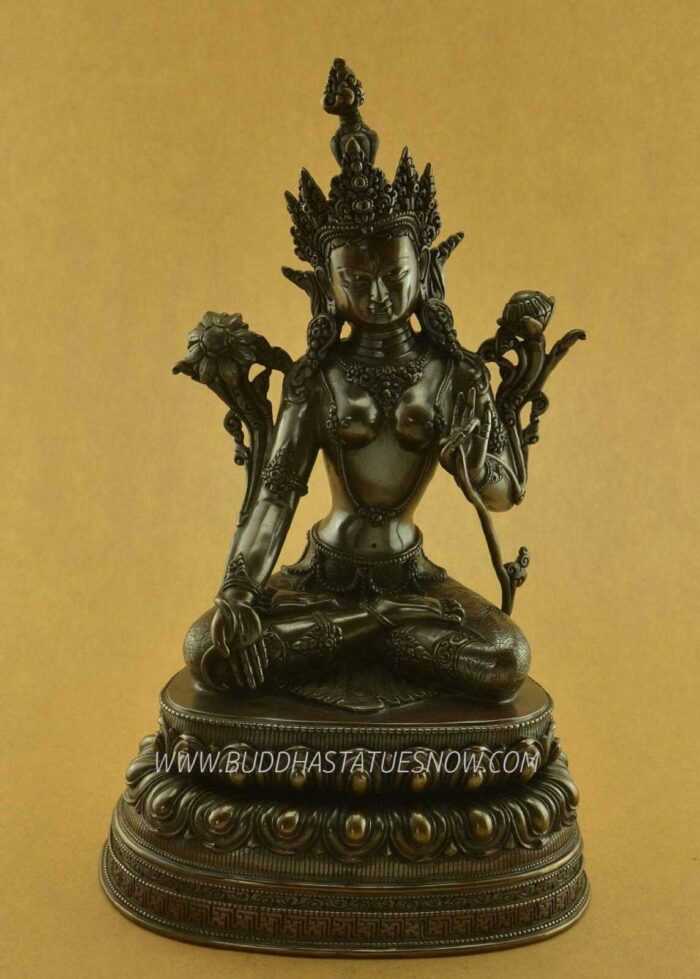
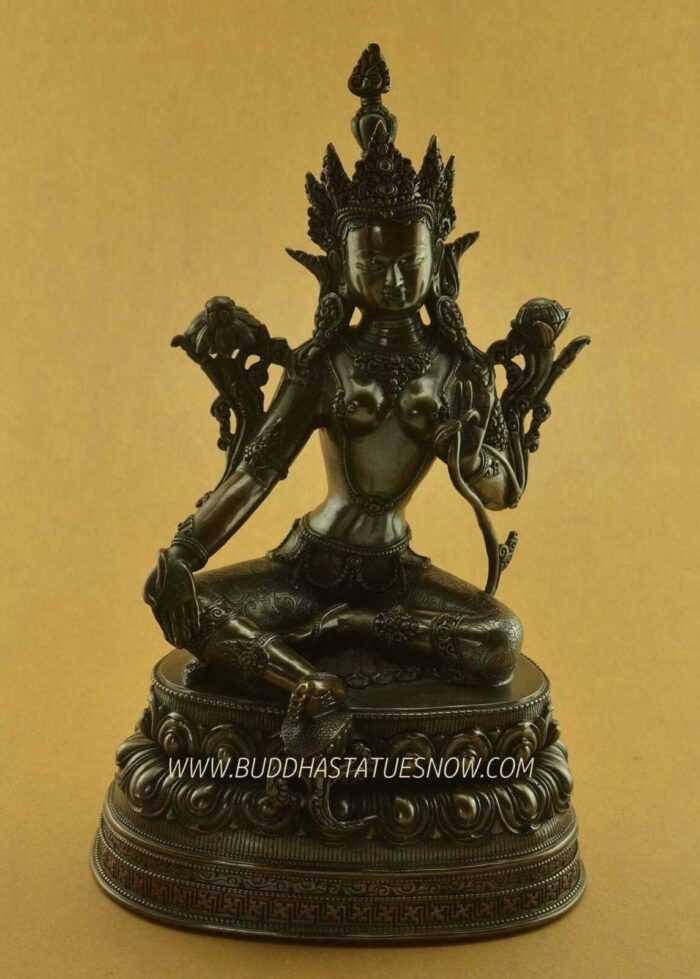
This 1000 Armed Avalokiteshvara Statue would form a visually commanding three-piece shrine set with the matching Antiquated White Tara statue and Antiquated Green Tara statue. Avalokiteshvara would serve naturally as the centerpiece because his 20.25-inch height, broad aureole and radiating arm assembly give him greater vertical and visual prominence. The slightly smaller Tara sculptures would provide balanced flanking figures.
All three statues share dark, richly antiquated copper-alloy finishes and the elaborate crowns and jewelry of celestial Bodhisattvas. White Tara and Green Tara feature finely engraved garments, decorative hemlines and carefully modeled lotus thrones. Avalokiteshvara introduces contrasting 24K fire-gilded details across the crowns, jewelry, lotus petals, aureole and architectural plinth. These gold accents would distinguish the central image while preserving the visual unity created by the related dark copper surfaces.
The three deities also create an exceptionally strong doctrinal arrangement. Avalokiteshvara embodies universal compassion itself—the awakened intention to perceive and relieve the suffering of every sentient being. Green Tara represents compassion in swift action, responding immediately to fear, danger and spiritual obstacles. White Tara expresses compassion through healing, serenity, longevity and the patient nurturing of life.
Together they present compassion in three complementary dimensions. Avalokiteshvara perceives suffering and generates the limitless Bodhisattva vow. Green Tara transforms that compassionate intention into immediate protective activity. White Tara sustains beings through healing, long life and the restoration of favorable conditions for continued Dharma practice.
Arranged with Avalokiteshvara at the center, Green Tara on one side and White Tara on the other, the set would symbolize compassion that sees suffering, responds to suffering and supports practitioners throughout the path toward liberation. The compatible heights, oxidized finishes, Bodhisattva crowns and traditional Newar craftsmanship would also give the three sculptures the visual coherence of an intentionally planned altar ensemble.
Custom Made 1000 Armed Avalokiteshvara Statue
A custom made 1000 Armed Avalokiteshvara Statue may be commissioned for a private shrine, Buddhist temple, monastery or Dharma center. The sculpture can be created at a preferred scale while preserving the essential iconography of Sahasrabhuja Avalokiteshvara, including the eleven heads, traditional radiating representation of the thousand arms, principal hands, cintamani jewel, mala, lotus and Amitabha Buddha at the summit.
Available options may include an antiquated oxidized copper finish similar to this statue, expanded 24K fire-gilded detailing, complete 24K fire gilding, gemstone settings, alternative aureole designs or more elaborate architectural plinth carving. The removable copper-alloy backing, density of the hand arrangement and placement of gilded borders may also be adapted according to the size and intended shrine environment.
Larger temple-scale versions may be commissioned for monasteries and Dharma centers, along with other forms of Avalokiteshvara such as four-armed Chenrezig or specialized multi-armed manifestations. Each commission is developed with attention to correct iconographic proportions, traditional copper-alloy casting and the practical structural requirements of the finished statue.
A complete custom shrine set may also be arranged so that Avalokiteshvara, the Antiquated White Tara statue and the Antiquated Green Tara statue share coordinated heights, oxidized copper finishes, crown proportions, engraving styles and lotus-pedestal details. Avalokiteshvara may be made several inches taller as the central figure, while both Tara statues are proportioned as harmonious companions. The finished ensemble would unite universal compassion, swift protective action, healing and longevity in a visually balanced and doctrinally coherent altar arrangement.
Authentic, Handmade in Nepal
Every statue is handcrafted in Patan, Nepal, using traditional lost wax casting and comes with a certificate of authenticity issued by Nepal’s Department of Archaeology, verifying its materials, technique, and origin.
Reviews
There are no reviews yet.