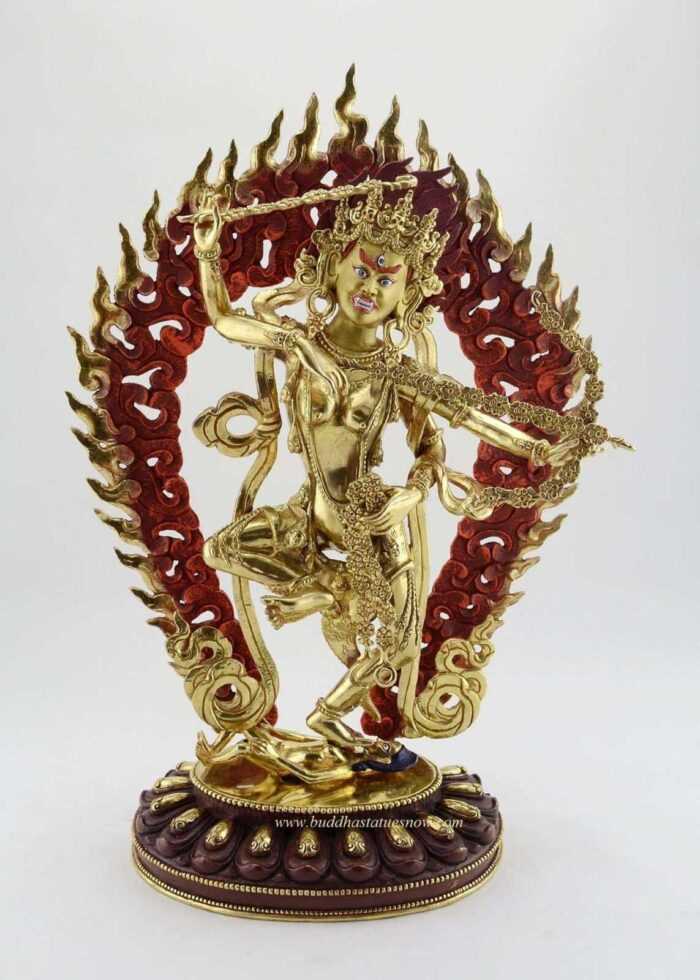

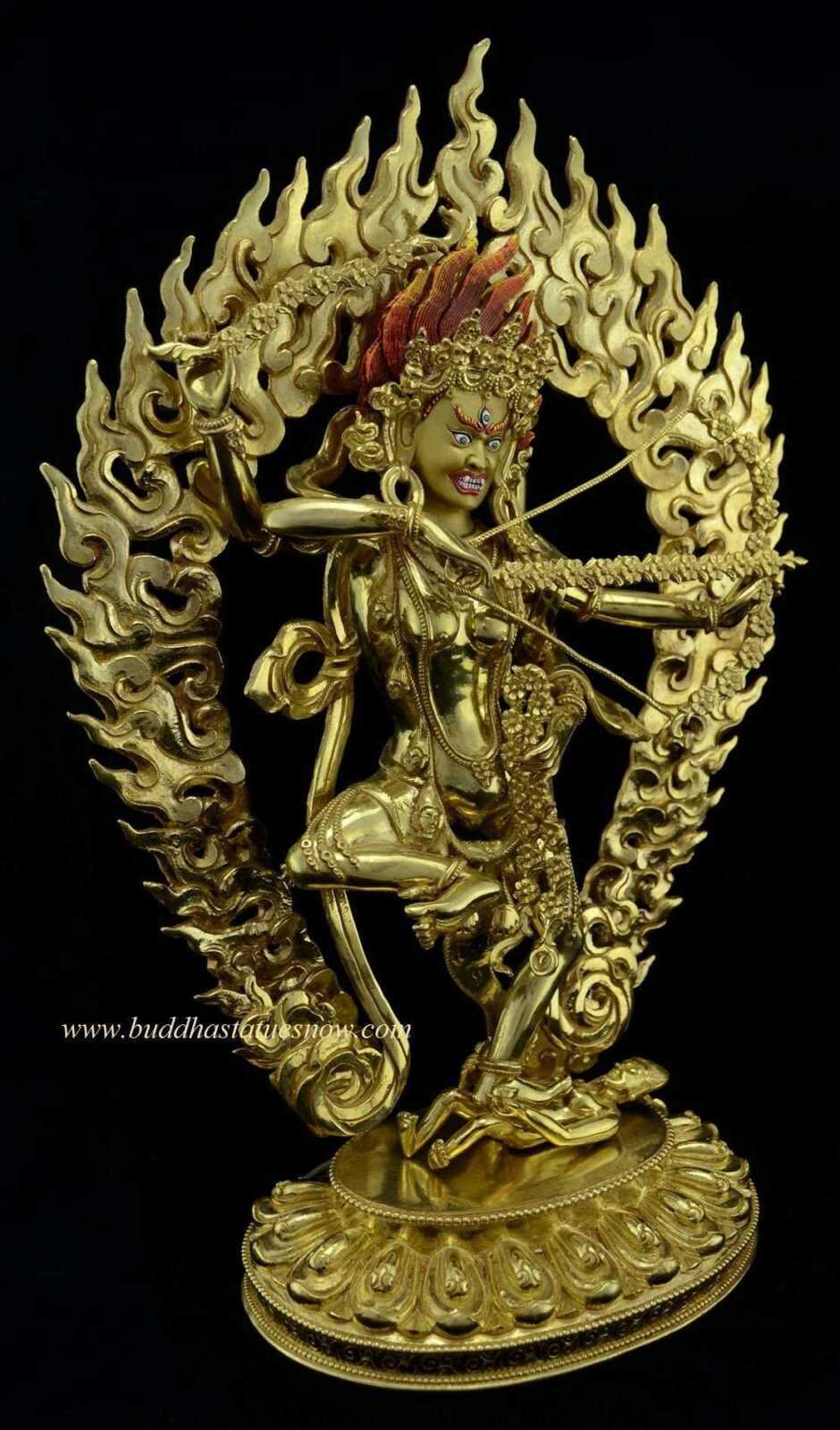
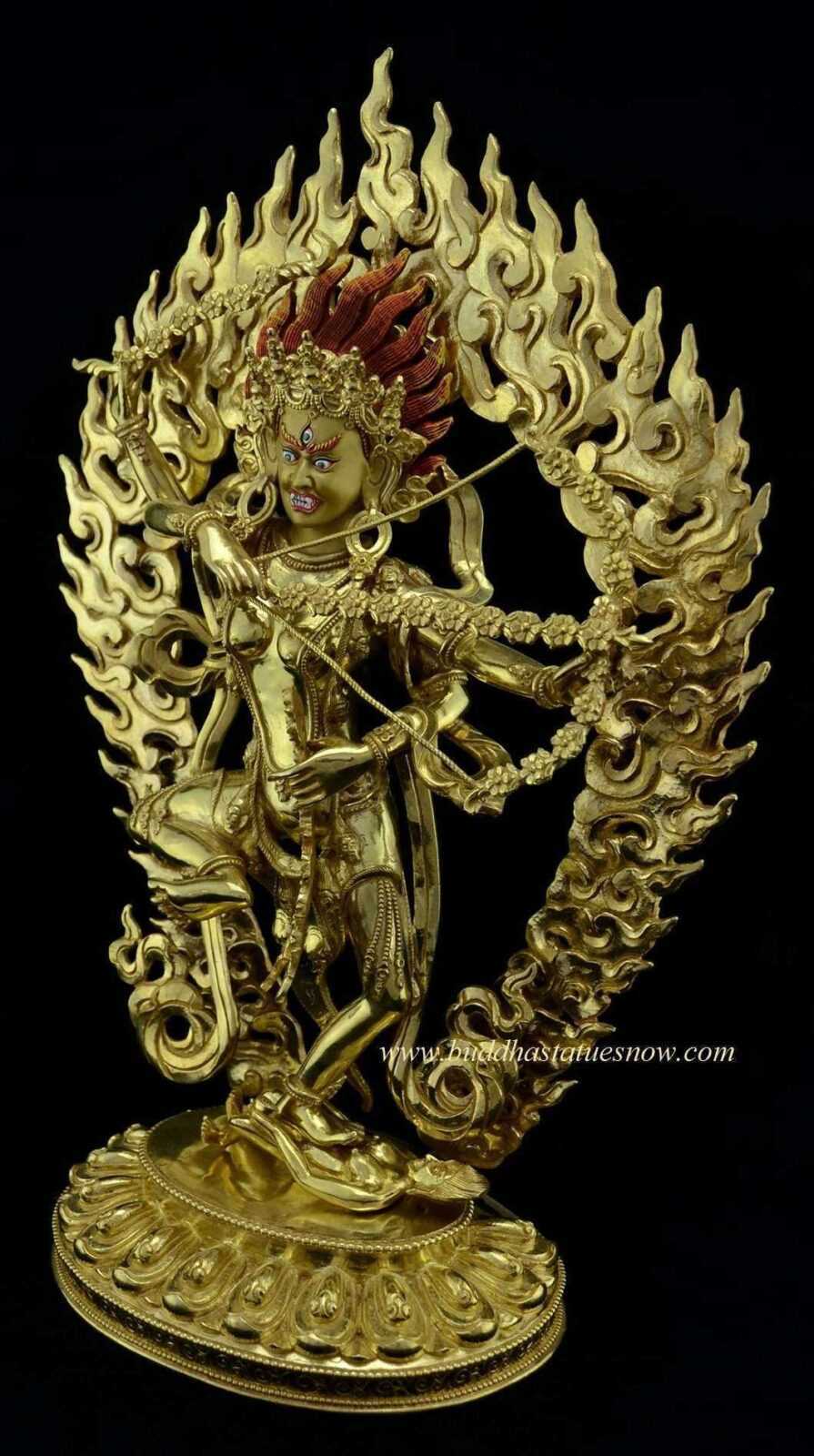

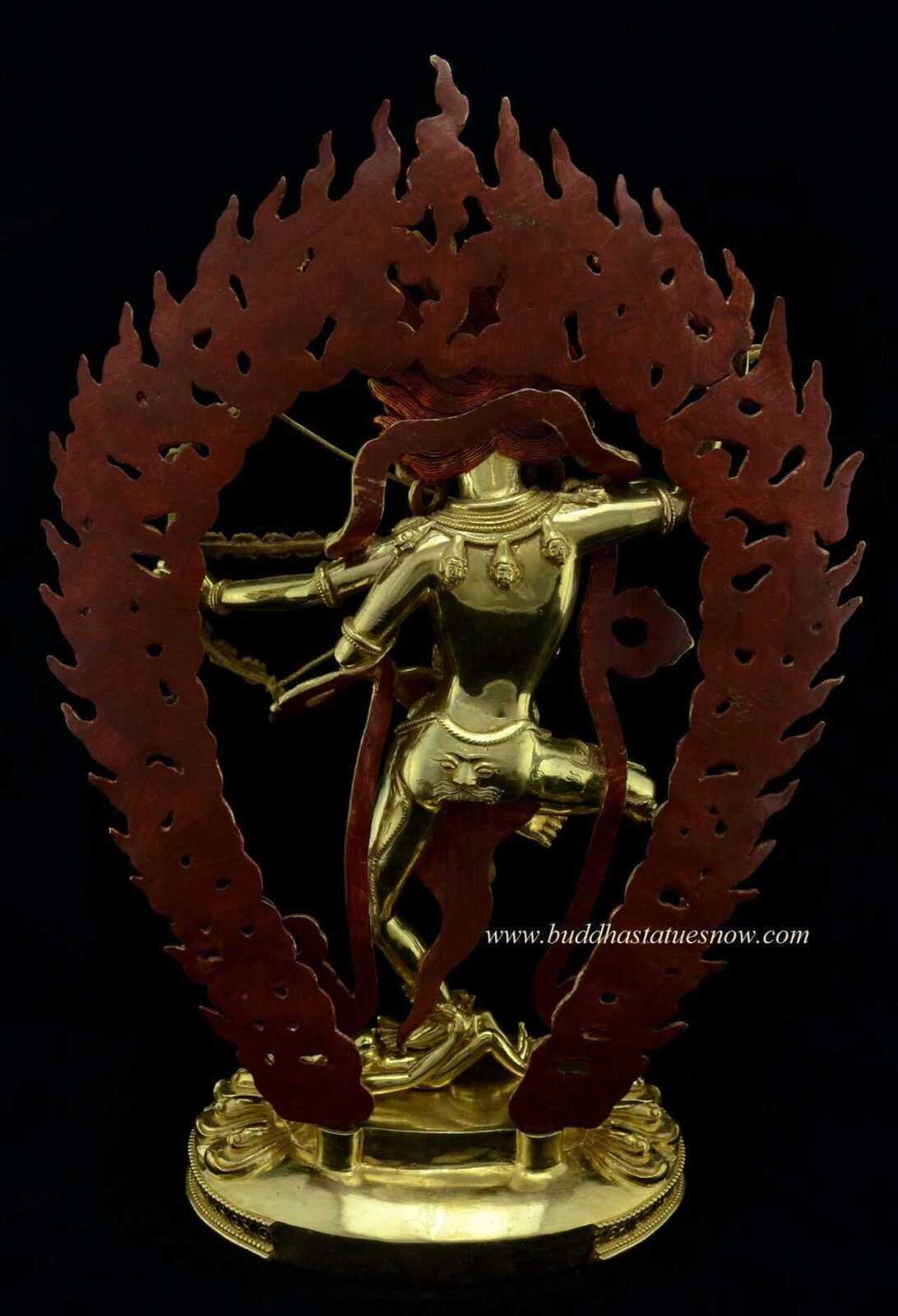
This magnificent 15.75-inch Kurukulla Statue portrays Dancing Red Tara, the captivating female tantric deity also known as Rigjema, “She Who Causes Knowledge.” Handmade in Patan, Nepal by skilled Newar artisans, the sculpture is cast in copper alloy using the traditional lost-wax method and extensively fire gilded in 24K gold. Her face is hand painted with 18K gold and natural pigments, bringing exceptional definition to her three eyes, arched brows, exposed teeth, and intensely focused expression. Rising behind her is an elaborate removable mandorla of swirling flames that surrounds the dancing figure with the fire of awakened awareness. Learn more about Red Tara and Kurukulla in our guide to Tara symbolism and iconography.
Kurukulla in Ardhaparyanka Posture
Kurukulla appears in the dynamic Ardhaparyanka posture, creating the unmistakable dancing silhouette of this form. One leg supports her movement upon the base while the opposite leg bends sharply upward, giving the sculpture a remarkable sense of suspended motion. Beneath her feet is a subdued figure, representing the subjugation of obstructive forces. Her flame-like red hair rises dramatically behind her crown, while long ribbons, garlands, ornaments, and the surrounding flames reinforce the sculpture’s rhythmic movement. The result is an unusually animated representation of Kurukulla in which virtually every element appears to participate in her dance.
Iconography of a Kurukulla Statue
Kurukulla has four arms, each associated with her magnetizing enlightened activity. Her principal hands draw a flower bow and arrow across her body. Another hand raises a flower-covered hook, while the remaining hand holds her flower noose. Together these implements symbolize attracting, gathering, and directing energies toward enlightened purposes. Rather than suppressing desire, Kurukulla represents its transformation into a powerful force directed toward awakening. Her three eyes express extraordinary awareness, while her elaborate crown, large circular earrings, ornaments, garland, and fierce expression reveal her tantric character. Our comprehensive guide to Tara statues and their meanings provides additional background on the different manifestations of Tara.
Kurukulla is especially associated with the magnetizing activity of enlightened beings. Her practice concerns attraction not merely in the ordinary sense, but the ability to draw beings, circumstances, and beneficial conditions toward the Dharma. Her mantra, Om Kurukulle Hrih Svaha, incorporates the seed syllable Hrih. More information about its significance can be found in our section on the Red Tara mantra.
Kurukulla Statue and Vajravarahi Pairing
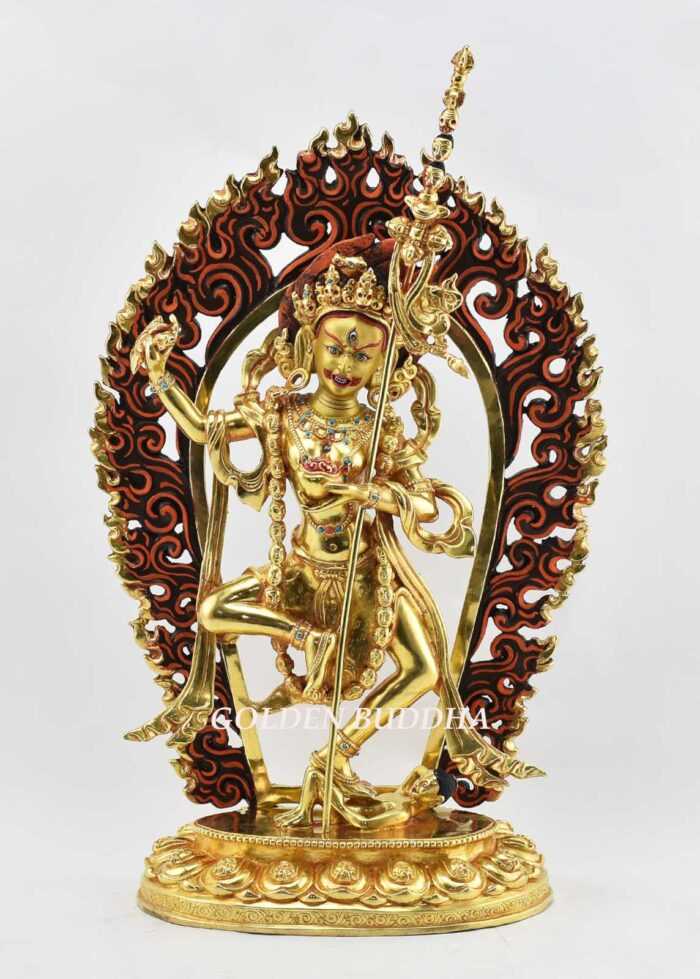
This Kurukulla forms an exceptional visual pairing with our masterpiece Vajravarahi statue. Both female tantric deities are represented in Ardhaparyanka posture, giving the two sculptures closely related dancing silhouettes. Their raised legs, sweeping ornaments, fierce expressions, and dramatic flaming aureoles create visual symmetry when displayed together. Spiritually, their identities remain distinct but complementary: Kurukulla embodies magnetizing enlightened activity and the transformation of desire, while Vajravarahi embodies penetrating wisdom and the transformation of ignorance.
Craftsmanship and Consecration
Close inspection reveals exceptionally detailed Newar metalwork throughout the sculpture. Individual flowers form Kurukulla’s bow, noose, and garlands; fine engraved patterns decorate her garments; and the openwork mandorla is composed of layered curling flames. Beneath the figure is an ornate lotus pedestal with deeply modeled petals and decorative borders. Optional turquoise and red coral gemstones may be embedded upon request to introduce traditional Himalayan color accents.
A consecration opening is incorporated into the statue so its hollow interior may be traditionally filled with mantras, sacred substances, relics, and other appropriate materials before being sealed and blessed. Collectors preparing the sculpture for altar use can learn more about our Buddhist statue filling, blessing, and consecration process.
Custom Made Kurukulla Statues
Collectors seeking another size or artistic treatment may also commission a custom Kurukulla handmade in Nepal. Through our custom statue service, dimensions, gilding, antiquated finishes, gemstone embellishments, and selected decorative details can be coordinated while preserving Kurukulla’s essential traditional iconography. A commission can also be planned specifically to create a visually balanced Kurukulla and Vajravarahi set. Explore our custom Tibetan Buddhist statue service for additional information.
Authentic, Handmade in Nepal
Every statue is handcrafted in Patan, Nepal, using traditional lost wax casting and comes with a certificate of authenticity issued by Nepal’s Department of Archaeology, verifying its materials, technique, and origin.