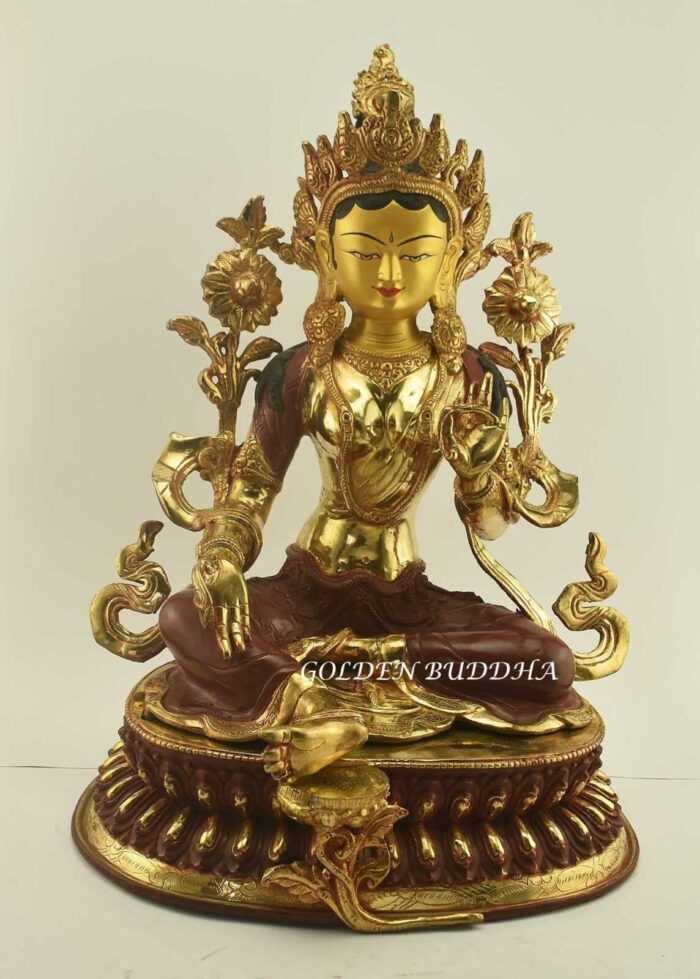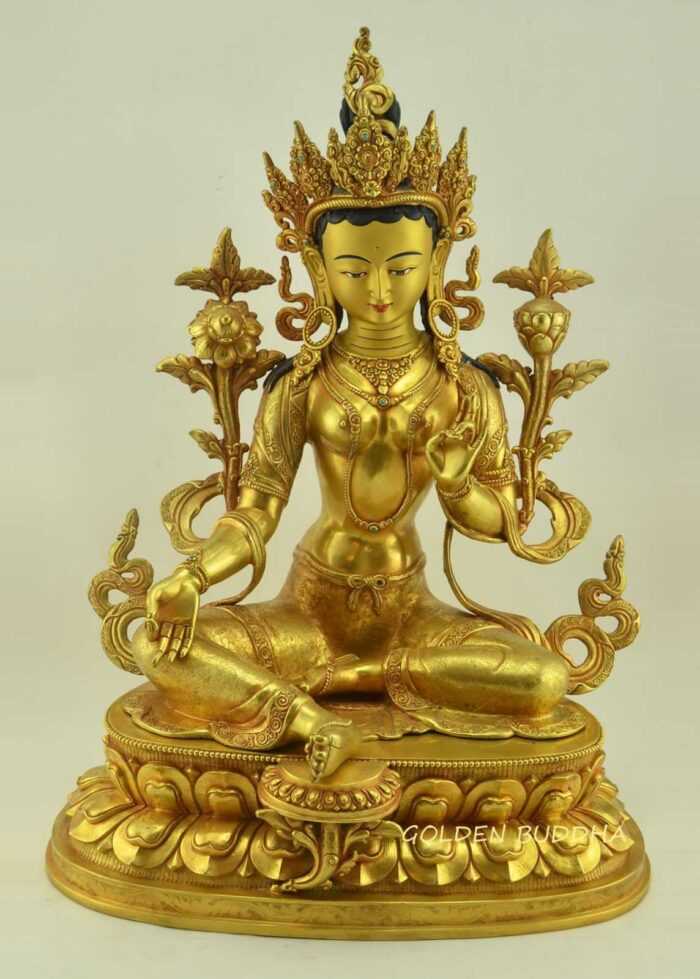

This magnificent 18-inch Khadiravani Tara sculpture portrays Green Tara, known in Tibet as Jetsun Dolma, in an unusually substantial and richly ornamented form. Handmade from copper alloy by master Newar artisans in Patan, Nepal using the traditional lost wax casting method, the sculpture combines 24K gold fire gilding with a contrasting antiquated copper finish. Her face is hand painted with 18K gold and natural pigments, while turquoise and red coral gemstones enliven the crown, necklaces, bracelets and other Bodhisattva ornaments. At 18 inches high, 12.5 inches wide and 11 inches deep, the statue has the presence required for a prominent shrine, meditation room or Himalayan art collection.
Khadiravani Tara Sculpture – Tara of the Acacia Forest
Khadiravani Tara, meaning “Tara of the Acacia Forest,” is an important manifestation of Green Tara associated with swift compassionate activity, fearlessness and liberation from obstacles. Known devotionally as Jetsun Dolma, she represents compassion that does not remain passive but immediately responds to suffering. Our guide to Green Tara’s meaning and symbolism explores her role as the Mother of Liberation and one of the most widely revered forms of Tara in Tibetan Buddhism.
The artisan has portrayed Tara in lalitasana, the posture of royal ease. Her left leg remains folded inward while the right leg extends forward, with her foot resting upon a small lotus support. The combination of contemplation and movement is fundamental to Green Tara’s iconography: she possesses the serenity of awakened wisdom yet remains poised to rise immediately in response to sentient beings. Learn more about Green Tara’s posture, mudras and sacred attributes.
Lotus Flowers, Mudras and Bodhisattva Ornaments
Two tall flowering lotus stems rise beside Tara’s shoulders, creating an elegant frame around her upper body. Her lowered right hand extends across her knee in Varada Mudra, the gesture of generosity and compassionate giving. Her raised left hand forms Tara’s characteristic gesture of protection while delicately holding a lotus stem between the fingers. Together these gestures express her willingness to grant blessings while protecting practitioners from both external dangers and the inner obscurations that obstruct awakening.
This sculpture is particularly distinguished by its ornamental workmanship. Tara wears an elaborate multi-leaf Bodhisattva crown set with turquoise and red coral, accompanied by large earrings, layered necklaces, bracelets and jeweled arm ornaments. Fine engraved borders follow her garments, while long celestial ribbons descend behind her shoulders and curve gracefully around the figure. The darker antiquated treatment of the lower garments provides a striking contrast with the luminous gold of her torso, hands, ornaments and lotus stems.
Green Tara – Swift Protection from the Eight Great Fears
Green Tara is traditionally invoked for protection against the Eight Great Fears. These are understood both as external dangers and as inner afflictions such as pride, ignorance, anger, jealousy, attachment and distorted views. Her extended right leg therefore carries more than aesthetic significance: it visually communicates Tara’s defining quality of compassionate action, always prepared to intervene for the benefit of beings.
Khadiravani Tara and Lokeshvara Companion Statues
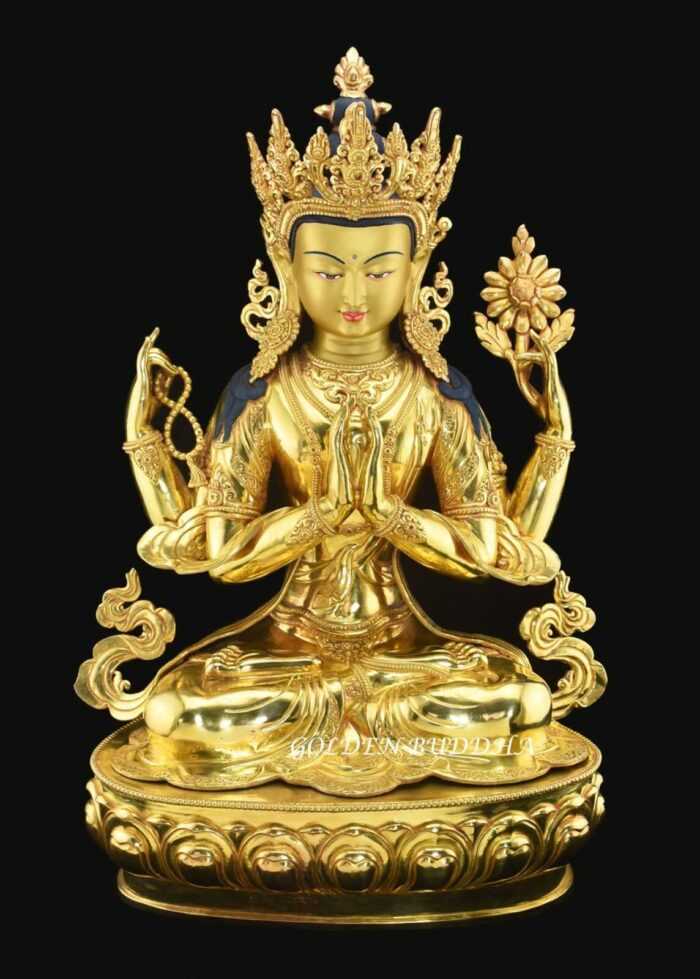
This Khadiravani Tara sculpture makes a particularly meaningful companion to our 24K gold gilded Lokeshvara statue. Their copper-alloy construction, brilliant gold surfaces, traditionally painted faces, elaborate Bodhisattva ornaments and complementary scale create visual continuity for a shrine arrangement. Their doctrinal relationship is even stronger: Lokeshvara, or Avalokiteshvara, embodies immeasurable compassion, while Tara represents compassion transformed into swift enlightened activity. Tibetan tradition associates Tara’s manifestation directly with Avalokiteshvara’s compassion, making the two deities a naturally complementary pairing.
Custom Made Tara and Lokeshvara Statues
For a monastery, Dharma center or private shrine, our artisans can create custom Tibetan Buddhist statues based upon this Khadiravani Tara design. Buyers may commission specific dimensions, gilding treatments, antiquated finishes, gemstone ornamentation and coordinated companion statues. A custom Tara and Lokeshvara pairing can be planned with complementary proportions, pedestal treatments and decorative finishes while preserving the distinct sacred attributes of each deity, creating a unified shrine centered upon universal compassion and its active expression.
Authentic, Handmade in Nepal
Every statue is handcrafted in Patan, Nepal, using traditional lost wax casting and comes with a certificate of authenticity issued by Nepal’s Department of Archaeology, verifying its materials, technique, and origin.