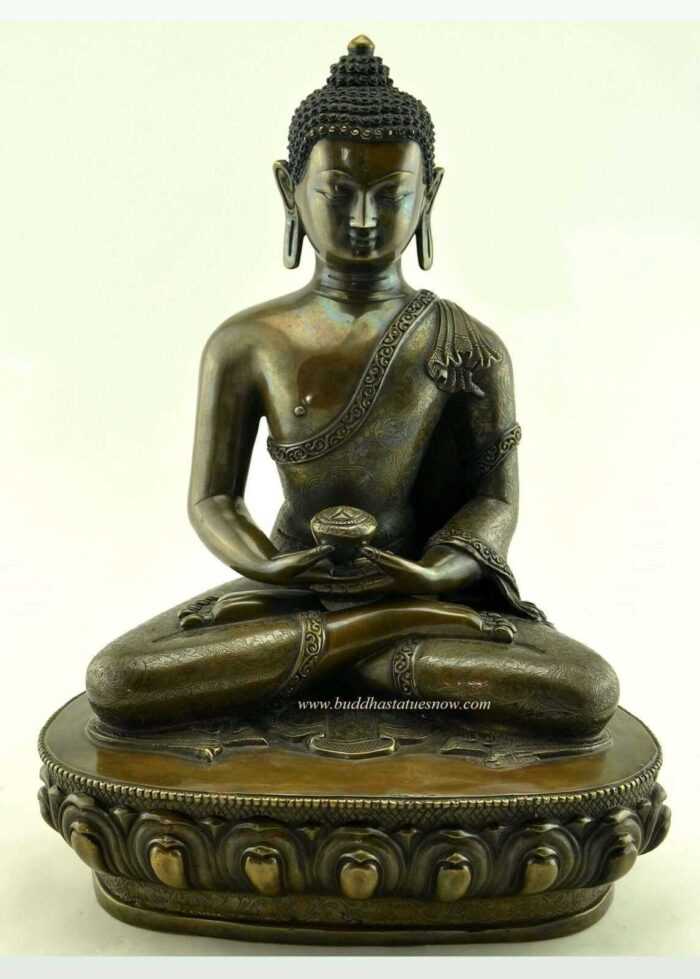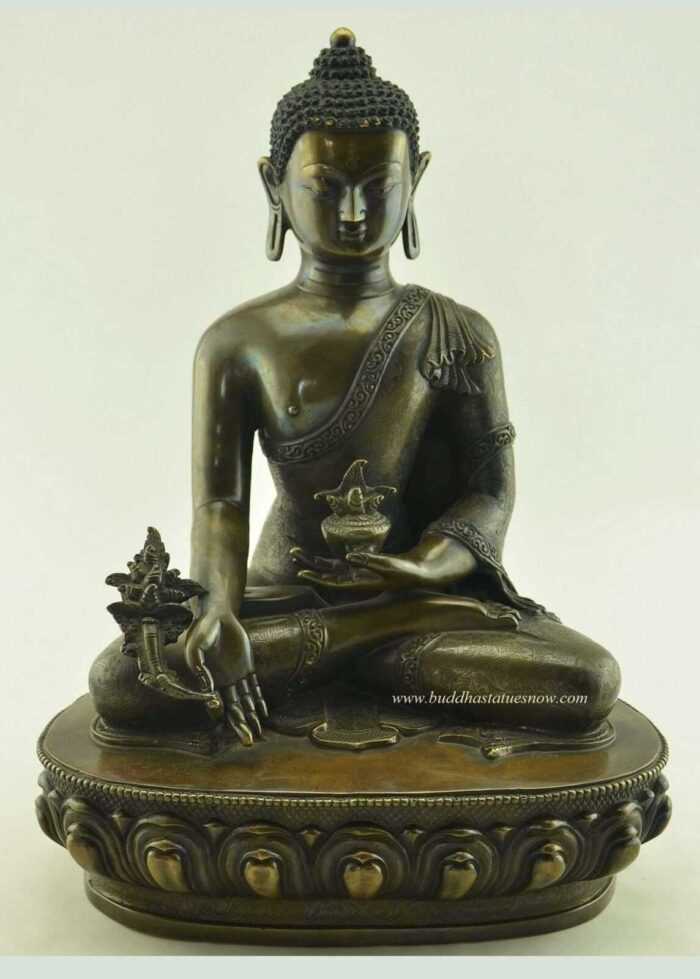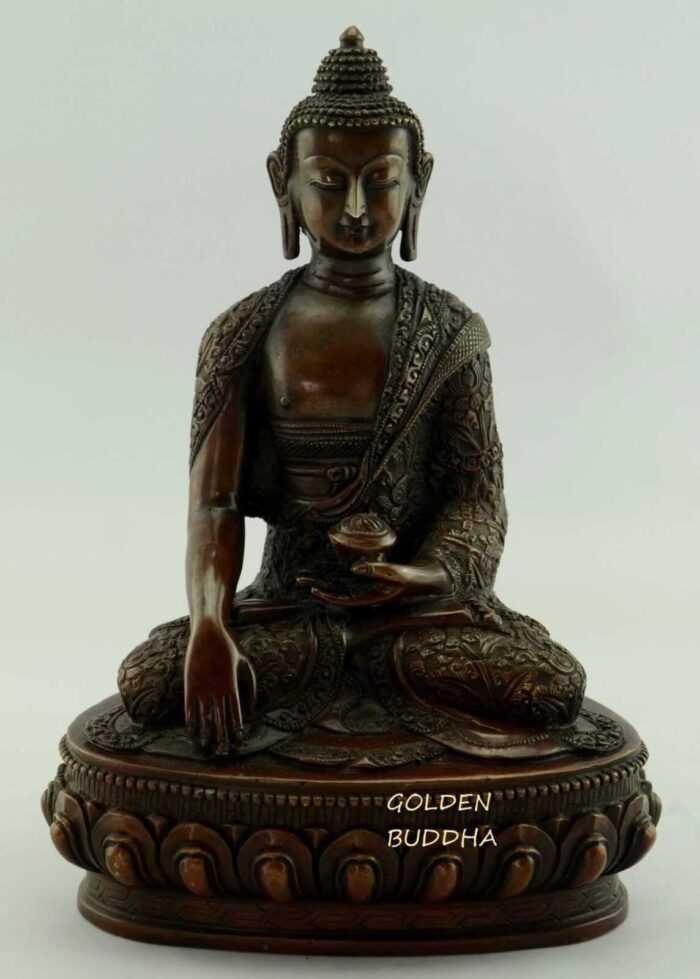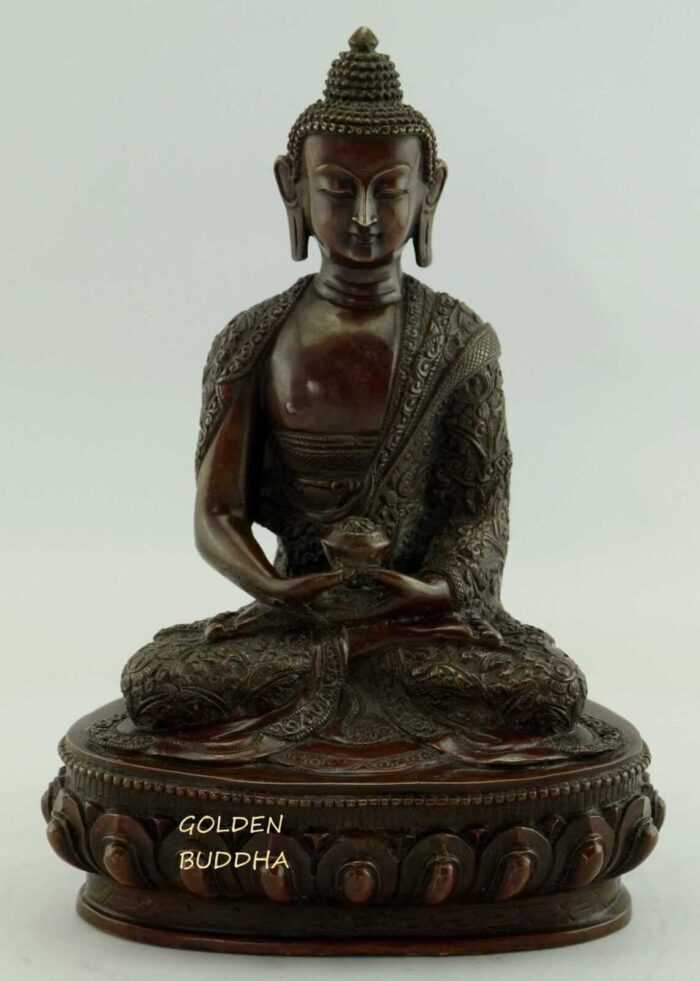


This exceptional 8.75″ Oxidized Medicine Buddha sculpture represents Bhaisajyaguru, the Buddha of Healing, in a richly detailed monastic form. Handcrafted from copper alloy by a master Newar artisan in Patan, Nepal, the sculpture was created through the traditional lost-wax casting method and finished entirely in warm oxidized copper. The deep reddish-brown surface settles naturally into the carved recesses, revealing the extraordinary foliate patterns, flowers, scrolling vines, and ornamental borders engraved throughout the robes and lotus throne. Without gilding or painted facial details, the craftsmanship of the copper alloy remains fully visible and gives the statue the contemplative character of an older Himalayan shrine image.
The elaborate engraving is the defining artistic feature of this Oxidized Medicine Buddha sculpture. Botanical patterns cover the shoulder garment, sleeve, lap, folded legs, and the long monastic robe descending across the back. The artisan has also decorated the reverse of the single lotus throne with dense foliate scrollwork rather than leaving it plain. This comprehensive workmanship makes the sculpture visually complete from every direction and particularly suitable for an open altar, shrine room, meditation center, or display where the reverse remains visible.
Oxidized Medicine Buddha Sculpture Meaning
Medicine Buddha is known in Sanskrit as Bhaisajyaguru and in Tibetan as Sangye Menla. He embodies the healing activity of awakened wisdom and is approached for assistance with physical illness, emotional suffering, harmful habits, karmic obstacles, and the deeper mental afflictions that sustain dissatisfaction. His practice does not replace appropriate medical treatment. Rather, it complements practical care by addressing the mental, ethical, and spiritual conditions that influence how suffering is experienced and transformed.
Buddhist teachings often compare the Buddha to a skilled physician, suffering to an illness, the Dharma to the prescribed medicine, and diligent practice to the treatment through which recovery becomes possible. This analogy closely reflects the Four Noble Truths: suffering is recognized, its causes are diagnosed, freedom from suffering is understood to be possible, and the path provides the method for achieving that freedom. Medicine Buddha gives this healing dimension of the Dharma a distinct visual form. Learn more about his vows, mantra, and practice in our guide to Medicine Buddha meaning and healing symbolism.
Varada Mudra and the Myrobalan Plant
Medicine Buddha sits in the full lotus posture with his right hand extended over the knee in the Varada mudra, the gesture of generosity, blessings, and compassionate giving. The open palm faces outward toward sentient beings, expressing his readiness to provide whatever form of assistance will be genuinely beneficial. Between his fingers he holds the stem of the myrobalan plant, which rises beside the right knee in a sculpted arrangement of leaves and medicinal fruit.
Myrobalan has long been used in Himalayan and Ayurvedic medicine and is the principal botanical attribute identifying Medicine Buddha. Within Buddhist iconography, it also represents the wisdom capable of recognizing and treating suffering at its source. The plant therefore joins the meaning of a physical remedy with the spiritual medicine of the Dharma. Its natural branching form provides a graceful counterpoint to the ordered patterns engraved across the robes and pedestal.
Medicine Bowl and the Three Healing Nectars
His left hand rests in the lap in the Dhyana mudra, the gesture of meditation, concentration, and inner equilibrium. Supported within the open palm is the traditional medicine bowl, from which a sculpted healing emblem rises. The vessel is understood to contain medicinal nectar that counteracts the three poisons of ignorance, attachment, and hatred. These mental afflictions are regarded as the underlying causes from which harmful actions, emotional turmoil, and continuing suffering develop.
The positions of the two hands unite compassionate activity with contemplative wisdom. The right hand reaches toward the world with the medicinal plant, while the left remains centered in meditation with the healing bowl. Together they express the principle that lasting healing requires both direct care and a clear understanding of causes and conditions. This balanced iconography makes the sculpture especially suitable for Medicine Buddha mantra practice, healing prayers, meditation, and the dedication of merit for those experiencing illness.
Finely Engraved Foliate Monastic Robes
Medicine Buddha wears the robes of an ordained Buddhist monk rather than a Bodhisattva crown or celestial jewelry. The simple monastic garment has been transformed through exceptionally dense hand engraving. Flowering vines, curling leaves, botanical scrollwork, patterned borders, and textile-like panels cover the shoulder, sleeve, torso, lap, and both crossed legs. Narrow bands of repeating ornament frame the larger compositions and follow the natural folds of the garment.
The craftsmanship becomes even more impressive when the sculpture is viewed from behind. A continuous field of flowering plants and scrolling foliage covers the broad rear robe from the neckline to the lower hem. The engraved designs follow the structure of the cloth rather than appearing as an unrelated surface pattern, giving the copper robe the appearance of an elaborate sacred brocade. Darker oxidation remains within the recessed carving, creating a subtle contrast against the gently burnished raised surfaces.
The unpainted face complements this richly worked garment. Medicine Buddha’s gently lowered eyes, restrained smile, elongated earlobes, three neck lines, tightly curled hair, and prominent ushnisha are modeled directly in the copper alloy. The uncluttered face and upper chest provide a peaceful visual center surrounded by the more elaborate engraving of the robes.
Engraved Single Lotus Throne
The Buddha is seated upon a substantial single lotus throne formed by a continuous register of rounded petals beneath a precisely modeled beaded rim. The petals symbolize purity arising within the conditions of samsara. Just as a lotus grows through muddy water without becoming stained, wisdom and compassion may develop amid illness, uncertainty, and the difficulties of conditioned life.
The reverse of the pedestal is particularly distinctive. A broad band of finely engraved foliate ornamentation continues around the back, linking the lotus throne visually with the botanical designs covering the robe. The artisan has therefore treated the pedestal as an integral part of the sculpture rather than merely as a support beneath the figure. This all-around detailing demonstrates the quality of the lost-wax casting, hand chasing, engraving, and finishing for which the sacred metalworkers of Patan are renowned.
A Matching Oxidized Medicine Buddha, Shakyamuni and Amitabha Set
This Oxidized Medicine Buddha sculpture forms a harmonious three-piece altar arrangement with our Antiquated Shakyamuni Buddha sculpture and Antiquated Amitabha Buddha sculpture. All three sculptures were created by the same master artisan and share closely coordinated proportions, copper-alloy casting, rich oxidized finishes, unpainted faces, traditional monastic robes, dense hand-carved foliate engraving, and corresponding single lotus thrones. Their common materials and decorative language allow them to form a visually unified shrine while retaining the distinctive mudras and attributes of each Buddha.
The three Buddhas also create a meaningful doctrinal grouping. The Antiquated Shakyamuni Buddha sculpture represents the historical teacher who attained enlightenment and revealed the Dharma path beyond suffering. Medicine Buddha embodies the healing application of awakened wisdom and supports the relief of illness, mental affliction, harmful karma, and spiritual obstacles. The Antiquated Amitabha Buddha sculpture represents Infinite Light and the compassionate vows that established Sukhavati as a favorable realm for continued progress toward awakening. Displayed together, Shakyamuni reveals the path, Medicine Buddha supports healing and restoration along the journey, and Amitabha represents the aspiration for favorable rebirth and the eventual completion of spiritual practice.
Custom Made Oxidized Medicine Buddha Sculptures
Collectors, practitioners, monasteries, healing centers, and Dharma organizations may commission a custom made Tibetan Buddhist statue inspired by this Medicine Buddha design. A custom sculpture may be created in a different size with a deep oxidized copper finish, a lighter antiquated bronze-colored finish over the copper-alloy casting, selective 24K fire gilding, or a fully fire-gilded surface. Available options may include personalized foliate engraving, alternative robe patterns, a different lotus throne, adjusted proportions, distinctive facial modeling, or refinements to the myrobalan plant and medicine bowl.
A coordinated Medicine Buddha, Shakyamuni, and Amitabha set may also be commissioned so that all three sculptures share the same dimensions, oxidized finish, engraving style, monastic robes, facial character, and lotus-pedestal proportions. Commissioning the figures together allows the artisan to preserve their visual continuity while expressing their complementary spiritual roles: Shakyamuni as the teacher of the path, Medicine Buddha as the healer of suffering and its causes, and Amitabha as the Buddha of Infinite Light whose vows support continued progress toward enlightenment. Every custom statue is individually cast, chased, engraved, and finished by hand in Nepal according to traditional Himalayan iconographic proportions.
Authentic, Handmade in Nepal
Every statue is handcrafted in Patan, Nepal, using traditional lost wax casting and comes with a certificate of authenticity issued by Nepal’s Department of Archaeology, verifying its materials, technique, and origin.