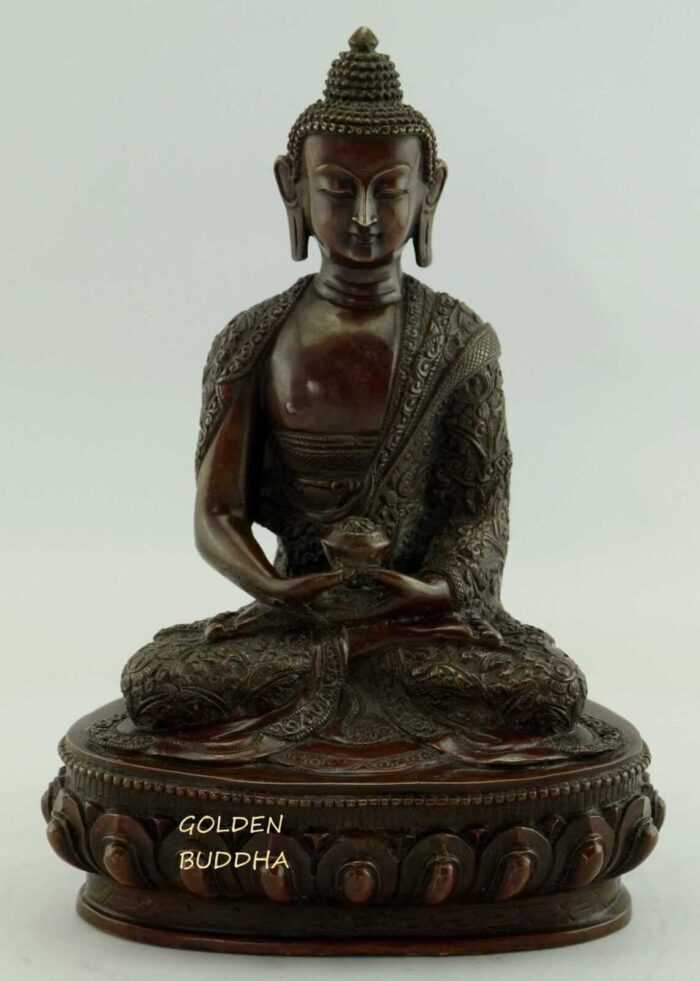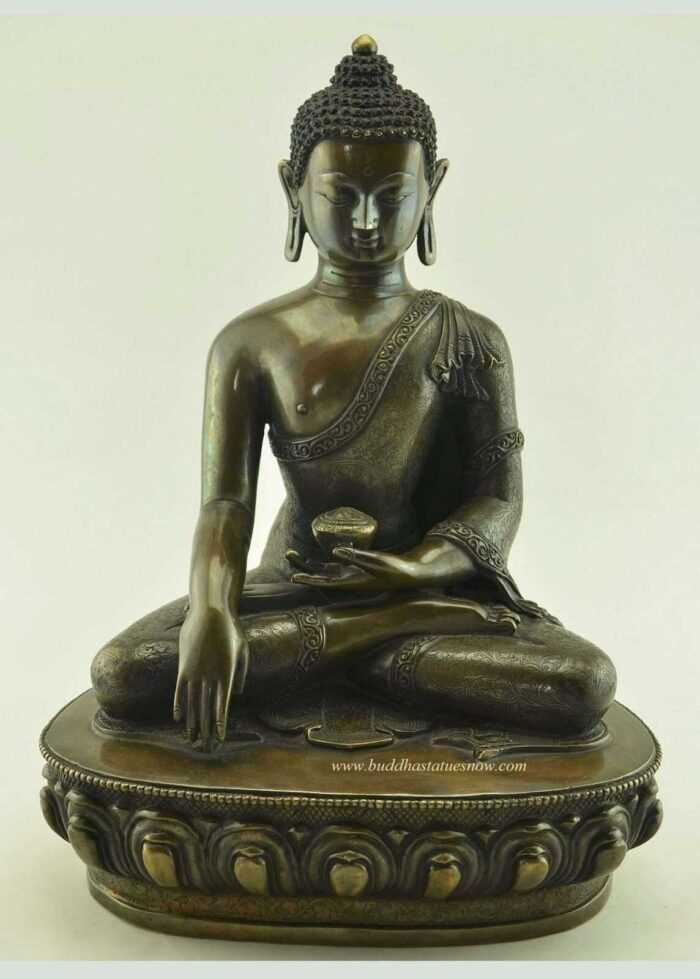

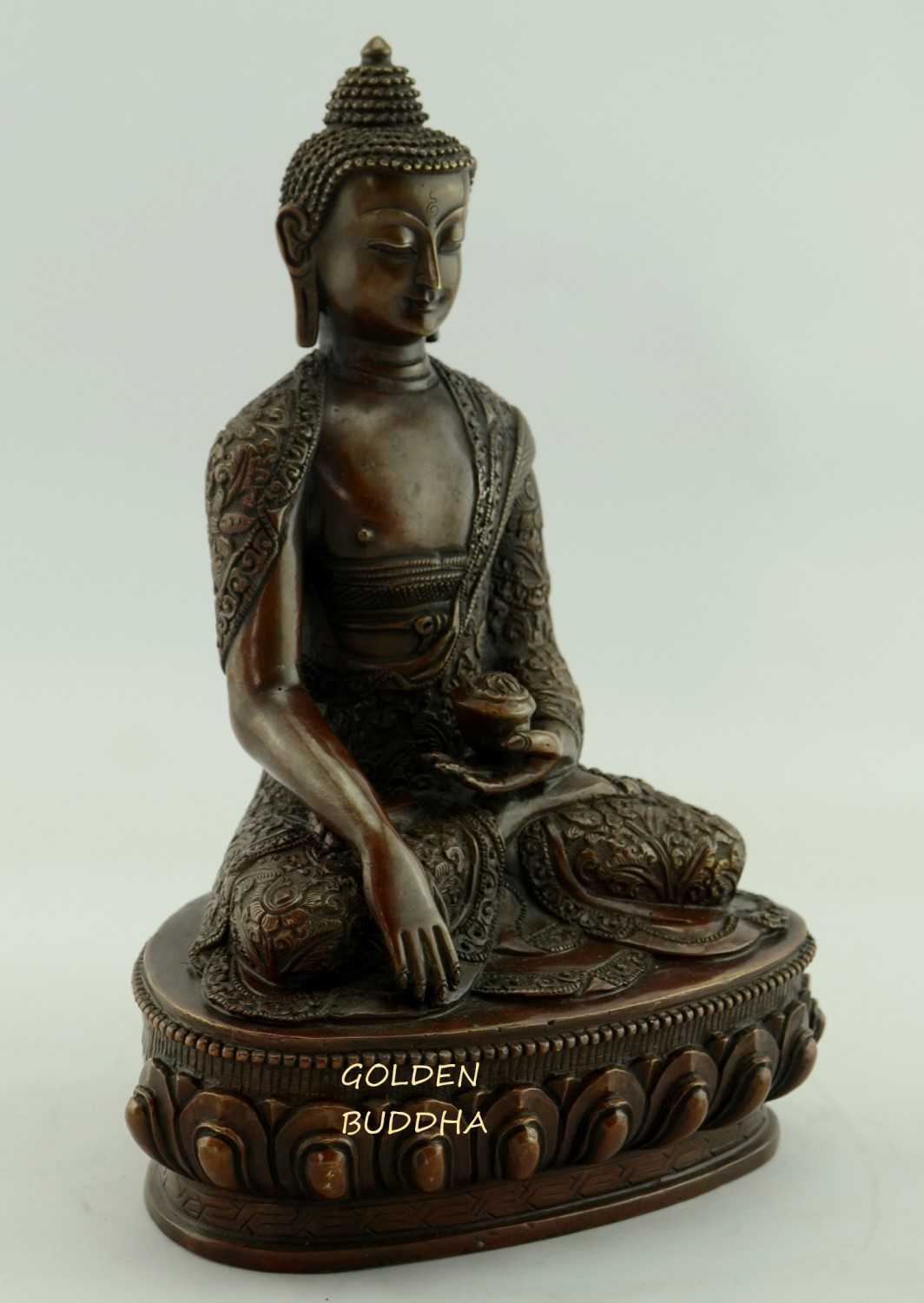
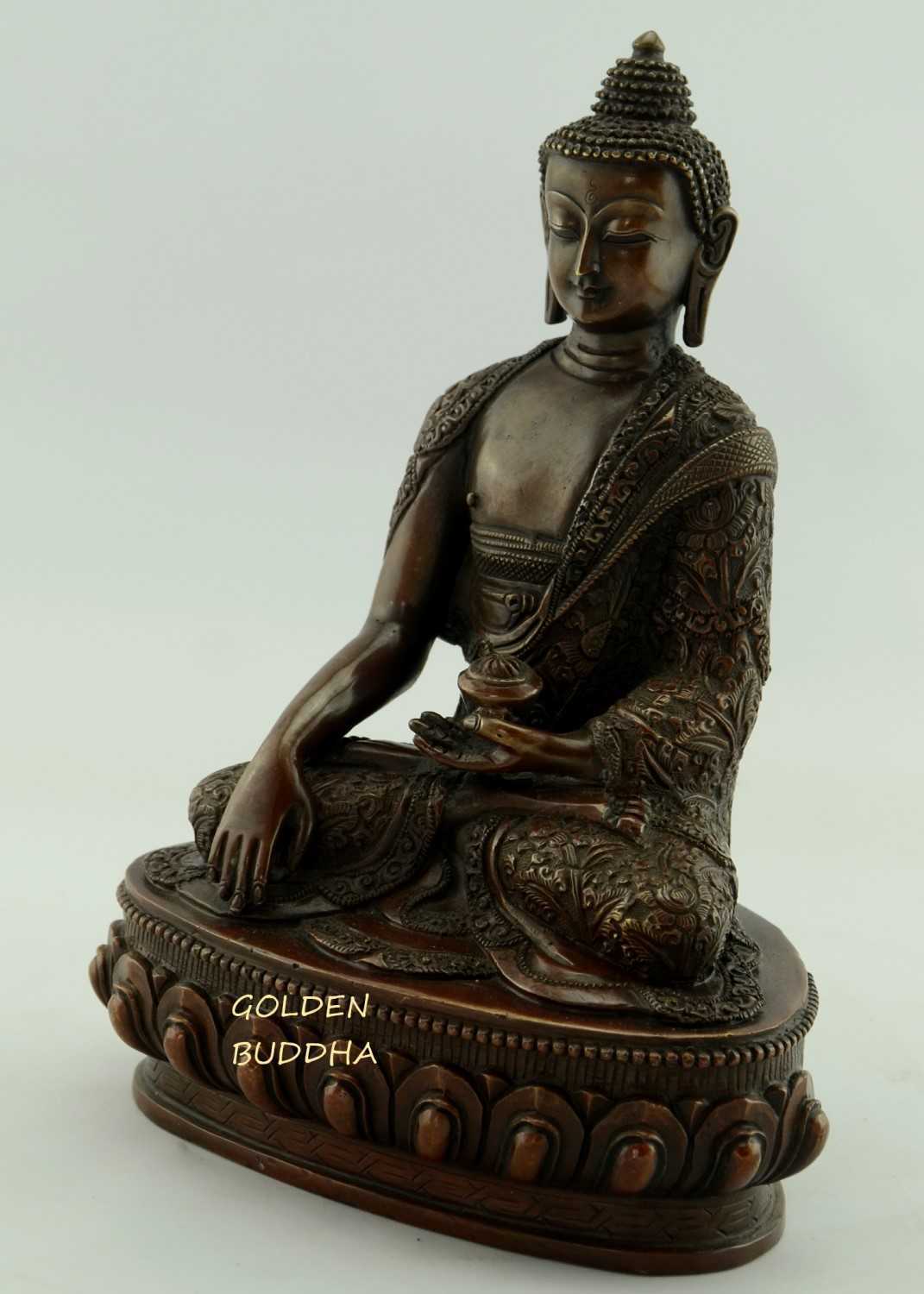
This exceptional 8.75″ Antiquated Shakyamuni Buddha sculpture portrays the historical Buddha in the moment of his awakening beneath the Bodhi tree. Handcrafted from copper alloy by a master Newar artisan in Patan, Nepal, the sculpture was created through the traditional lost-wax casting method and given a rich oxidized copper finish. Deep reddish-brown tones and darker recesses emphasize the extraordinary hand-carved foliate decoration covering the monastic robes, crossed legs, shoulder covering, and lotus throne. Without gold gilding or painted facial details, the sculpture presents Shakyamuni through the natural warmth and visual depth of antiquated copper.
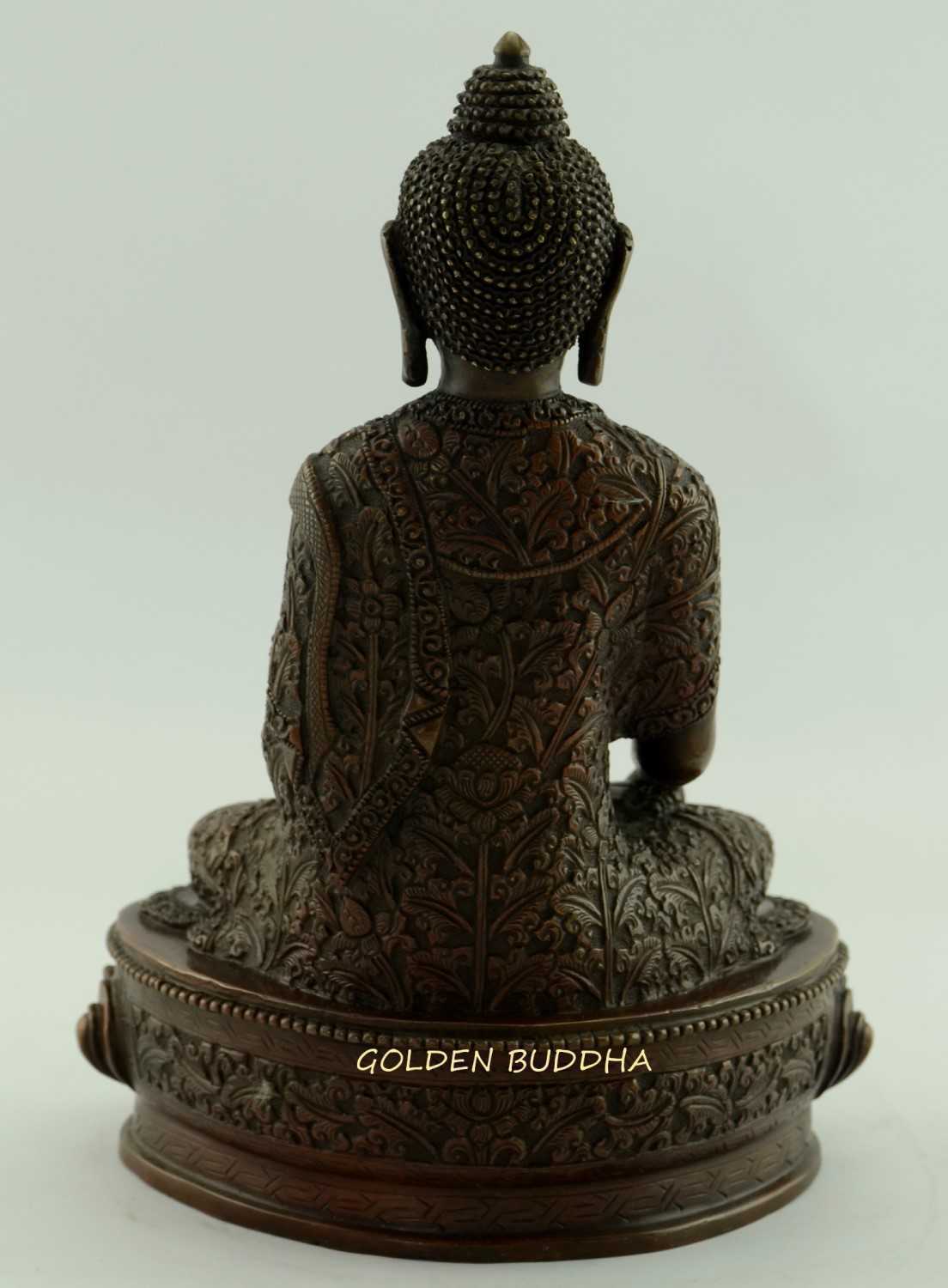
The extensive engraving is the defining artistic feature of this Antiquated Shakyamuni Buddha sculpture. Flowing vines, blossoms, curling leaves, textured panels, and ornamental borders transform the monastic garment into the appearance of a sacred brocade rendered in metal. The decoration continues across the sleeves and lap before covering nearly the entire robe visible from behind. Dense botanical patterns also extend around the reverse of the lotus throne, demonstrating that the sculpture was conceived as a complete devotional object rather than only as a front-facing display piece.
Meaning of the Antiquated Shakyamuni Buddha Sculpture
Shakyamuni Buddha was born as Prince Siddhartha Gautama into the Shakya royal family. Although protected by privilege and material comfort during his youth, Siddhartha eventually encountered the realities of aging, illness, and death. Recognizing that worldly success could not provide lasting freedom from suffering, he renounced palace life and began searching for a path to liberation.
After studying meditation and practicing severe asceticism, Siddhartha understood that neither indulgence nor self-denial could lead to complete awakening. He adopted the Middle Way and sat beneath the Bodhi tree at Bodh Gaya, resolving not to rise until he had discovered the truth. His realization revealed the nature of suffering, its causes, its cessation, and the path leading beyond it. Shakyamuni subsequently taught the Dharma for the benefit of sentient beings, beginning with the Four Noble Truths and Noble Eightfold Path.
Bhumisparsha Mudra and Victory over Mara
Shakyamuni extends his right hand over the knee in the Bhumisparsha mudra, the earth-touching gesture. The palm faces inward while the fingers reach downward toward the ground. According to Buddhist tradition, Mara challenged Siddhartha’s right to occupy the seat of enlightenment and confronted him with temptation, fear, pride, and doubt. Siddhartha responded by touching the earth and calling it to witness the merit accumulated through his innumerable previous lives.
The earth bore witness, Mara’s challenge was overcome, and Siddhartha attained complete enlightenment. The gesture therefore represents unshakable resolve, victory over delusion, and realization grounded in direct experience. It is the most recognizable mudra associated with the historical Buddha. Learn more about the Bhumisparsha mudra and other Shakyamuni Buddha hand gestures in our complete guide.
Dhyana Mudra and the Monastic Alms Bowl
His left hand rests in the lap in the Dhyana mudra, the gesture of meditation, concentration, and inner equilibrium. A lidded alms bowl rests within the open palm. The bowl recalls Shakyamuni’s renunciation of royal privilege and his willingness to live simply while devoting himself to awakening and the welfare of all beings.
The alms bowl may also be understood as containing the nectar of the Dharma, the spiritual nourishment that counteracts ignorance, attachment, and aversion. Its placement in the still left hand creates a meaningful balance with the active earth-touching gesture of the right. Together, the hands unite meditative discipline with decisive realization: the inward cultivation through which the mind is understood and the outward declaration that awakening has been attained.
Hand-Engraved Foliate Monastic Robes
The Buddha wears the robes of an ordained monk rather than a Bodhisattva crown or celestial jewelry. The artisan has enriched these monastic garments with an unusually dense program of foliate engraving. Large flowering vines and curling leaves cover the shoulder wrap, sleeve, torso, lap, and both folded legs. Narrow scrolling borders separate the larger compositions, while a finely crosshatched panel over the shoulder introduces another textile-like texture.
The craftsmanship is especially striking from behind. A continuous field of flowers, stems, leaves, and ornamental scrollwork covers the broad rear garment from the neckline to the lower hem. The engraving follows the natural structure and fall of the robe, giving the surface the appearance of richly embroidered ceremonial fabric rather than decoration applied without regard to the sculpture’s form. Dark oxidation remains within the carved recesses, making the raised motifs visible through subtle variations in the copper finish.
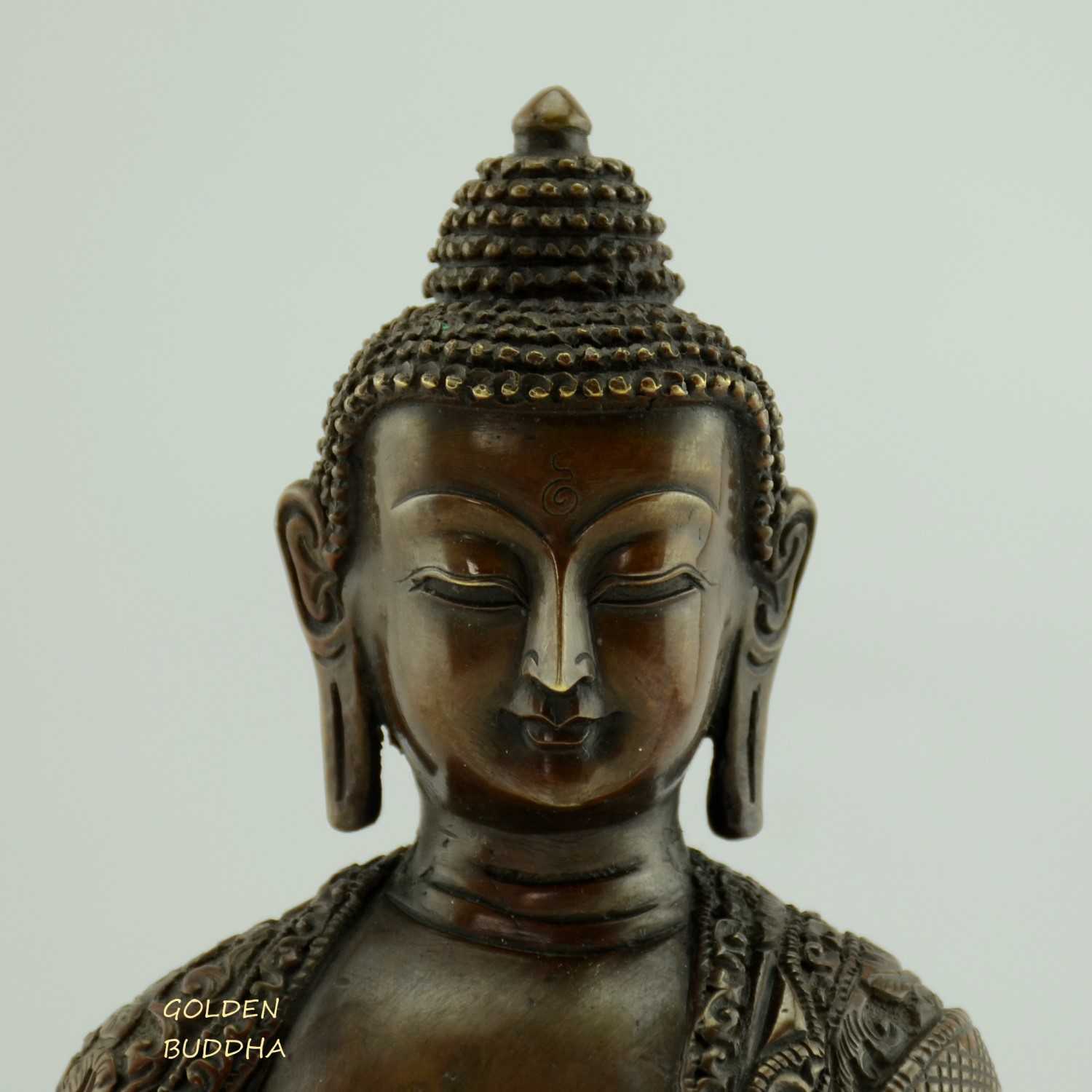
The face and uncovered chest provide a calm visual counterpoint to the elaborate robe. Shakyamuni’s gently lowered eyes, restrained smile, elongated earlobes, three neck lines, tightly curled hair, and tiered ushnisha are modeled directly in the copper alloy. The urna between the brows represents transcendent wisdom, while the elongated earlobes recall the royal ornaments worn before his renunciation. Explore these traditional attributes in our guide to the physical characteristics of the Buddha.
Engraved Single Lotus Throne
Shakyamuni sits in the full lotus posture upon a substantial single lotus throne. A continuous register of rounded petals surrounds the oval pedestal beneath a precisely modeled beaded rim. The lotus symbolizes purity arising within samsara: just as the flower grows through muddy water without becoming stained, wisdom and compassion may develop amid the uncertainty and suffering of conditioned life.
The rear of the pedestal contains a broad band of finely engraved botanical ornamentation that visually continues the foliate decoration of the robe. Additional geometric carving follows the lowest border of the base. By decorating the back of the throne rather than leaving it plain, the artisan created a sculpture suitable for an open altar where its workmanship may be appreciated from several directions.
A Matching Antiquated Shakyamuni, Medicine Buddha and Amitabha Set
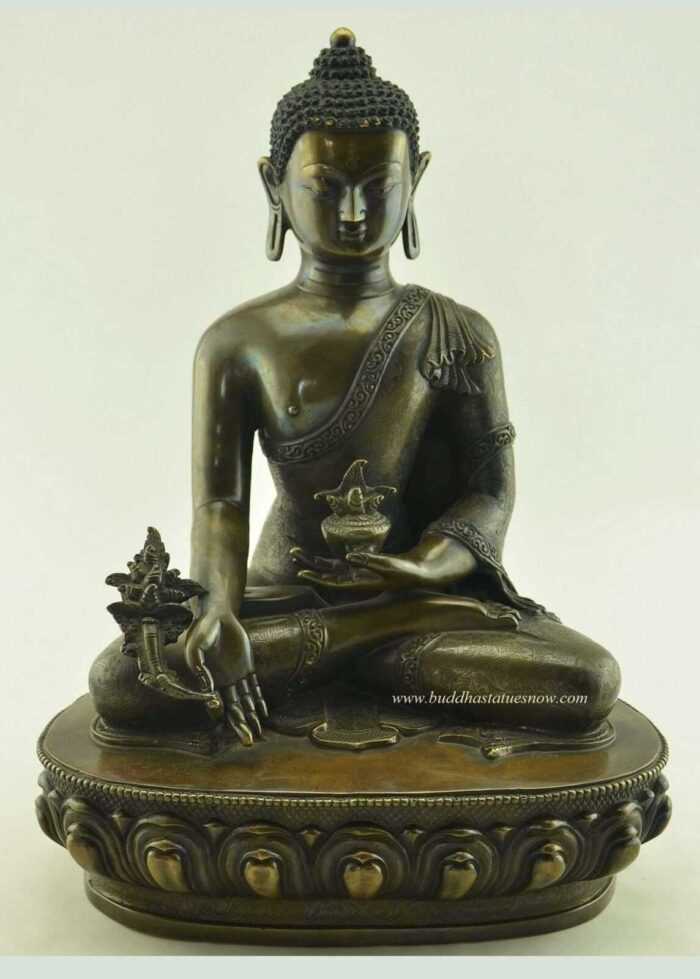
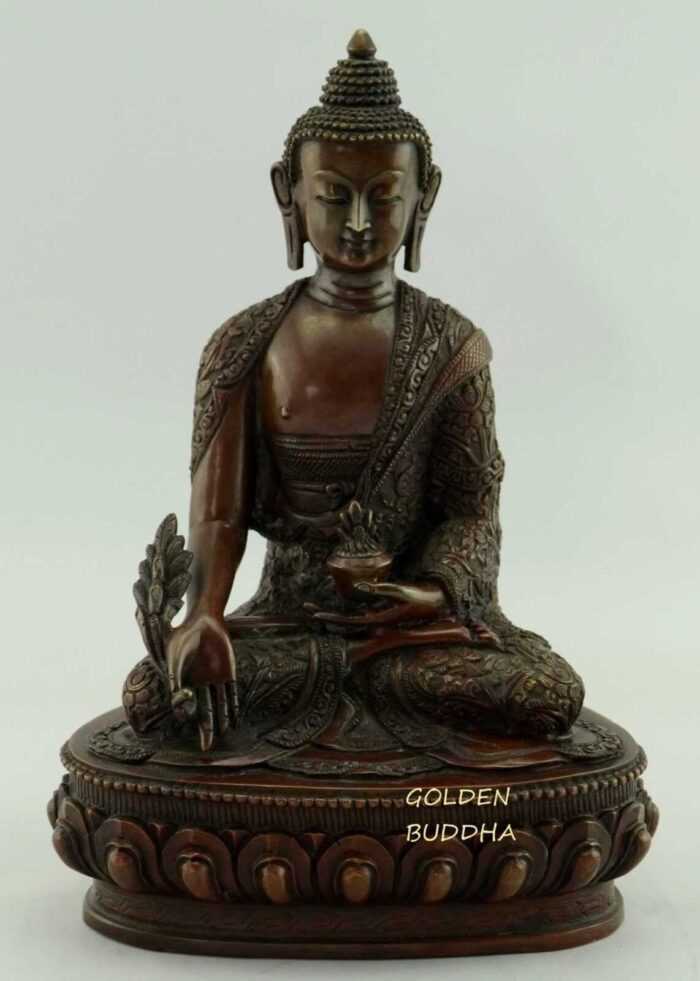
This Antiquated Shakyamuni Buddha sculpture forms a harmonious three-piece altar arrangement with our Oxidized Medicine Buddha sculpture and Antiquated Amitabha Buddha sculpture. All three works were created by the same master artisan and share copper-alloy casting, rich oxidized finishes, unpainted faces, monastic robes, dense foliate engraving, balanced proportions, and corresponding single lotus thrones. Their common materials and decorative language allow them to form a visually unified shrine while preserving the distinctive mudras and attributes of each Buddha.
The three Buddhas also create a meaningful doctrinal combination. Shakyamuni is the historical teacher who attained enlightenment in our world and revealed the Dharma path beyond suffering. The Oxidized Medicine Buddha sculpture embodies the healing activity of awakened wisdom and is associated with relief from illness, mental affliction, harmful karma, and spiritual obstacles. The Antiquated Amitabha Buddha sculpture represents Infinite Light and the compassionate vows that established Sukhavati as a favorable realm for continued progress toward awakening. Displayed together, Shakyamuni reveals the path, Medicine Buddha supports healing and restoration along the journey, and Amitabha represents the aspiration for favorable rebirth and eventual enlightenment.
Custom Made Antiquated Shakyamuni Buddha Sculptures
Collectors, practitioners, monasteries, and Dharma centers may commission a custom made Tibetan Buddhist statue inspired by this design. A custom Shakyamuni sculpture may be created in another size with a deep oxidized copper finish, a lighter antiquated bronze-colored finish over the copper-alloy casting, selective 24K fire gilding, or a fully fire-gilded surface. Available options may include personalized foliate engraving, alternative robe patterns, a different lotus throne, adjusted proportions, or distinctive facial modeling.
A coordinated Shakyamuni, Medicine Buddha, and Amitabha set may also be commissioned so that all three sculptures share the same dimensions, oxidized finish, foliate engraving, monastic robe style, facial character, and lotus-pedestal proportions. Commissioning the figures together allows the artisan to maintain their visual continuity while expressing their complementary spiritual roles. Every custom statue is individually cast, chased, engraved, and finished by hand in Nepal according to traditional Himalayan iconographic proportions.
Authentic, Handmade in Nepal
Every statue is handcrafted in Patan, Nepal, using traditional lost wax casting and comes with a certificate of authenticity issued by Nepal’s Department of Archaeology, verifying its materials, technique, and origin.