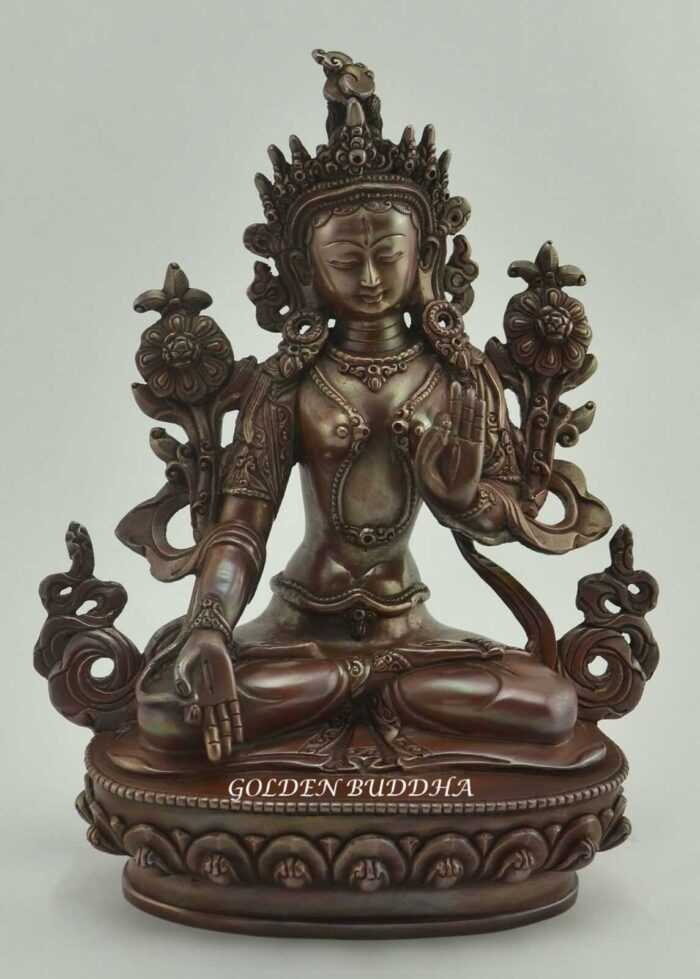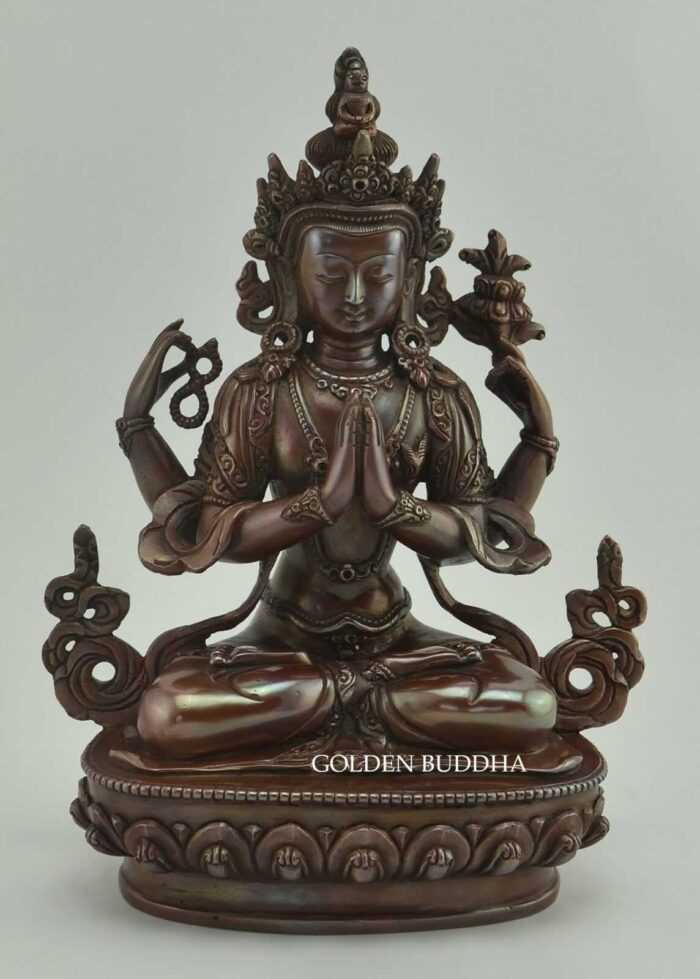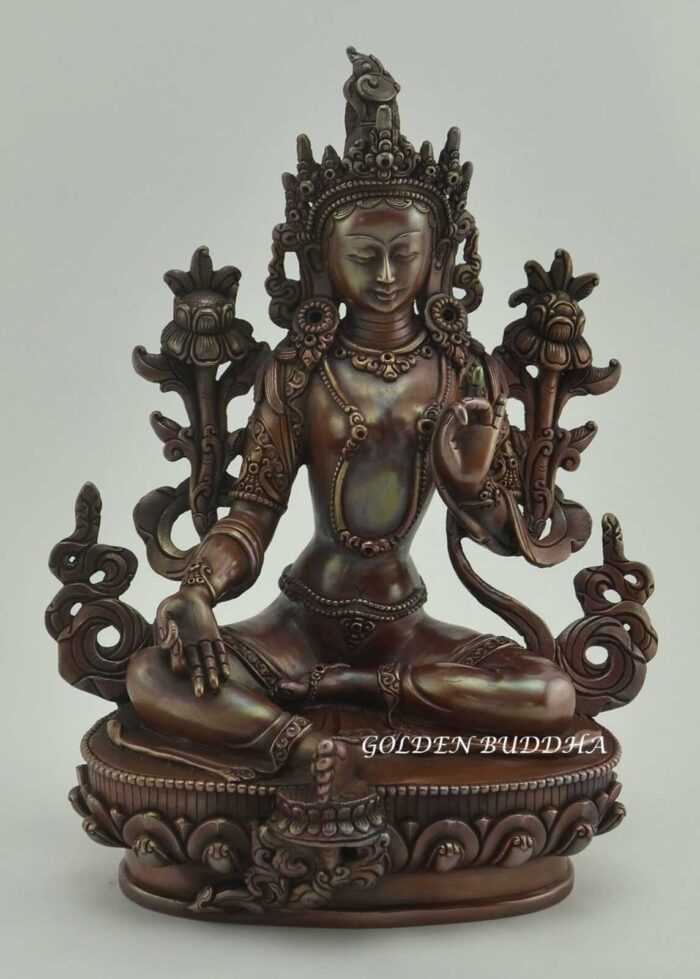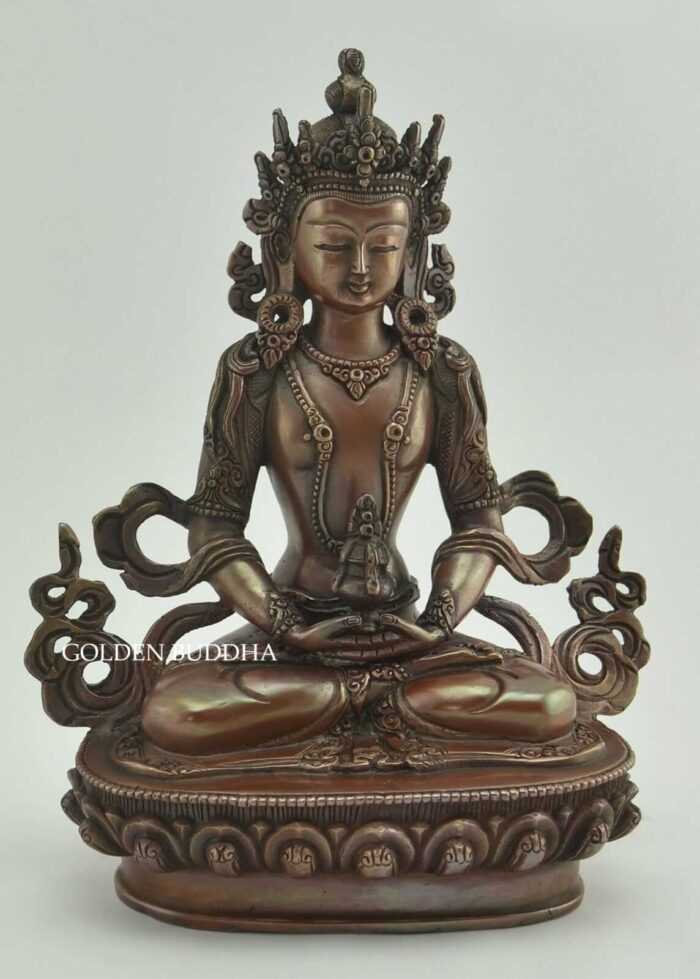
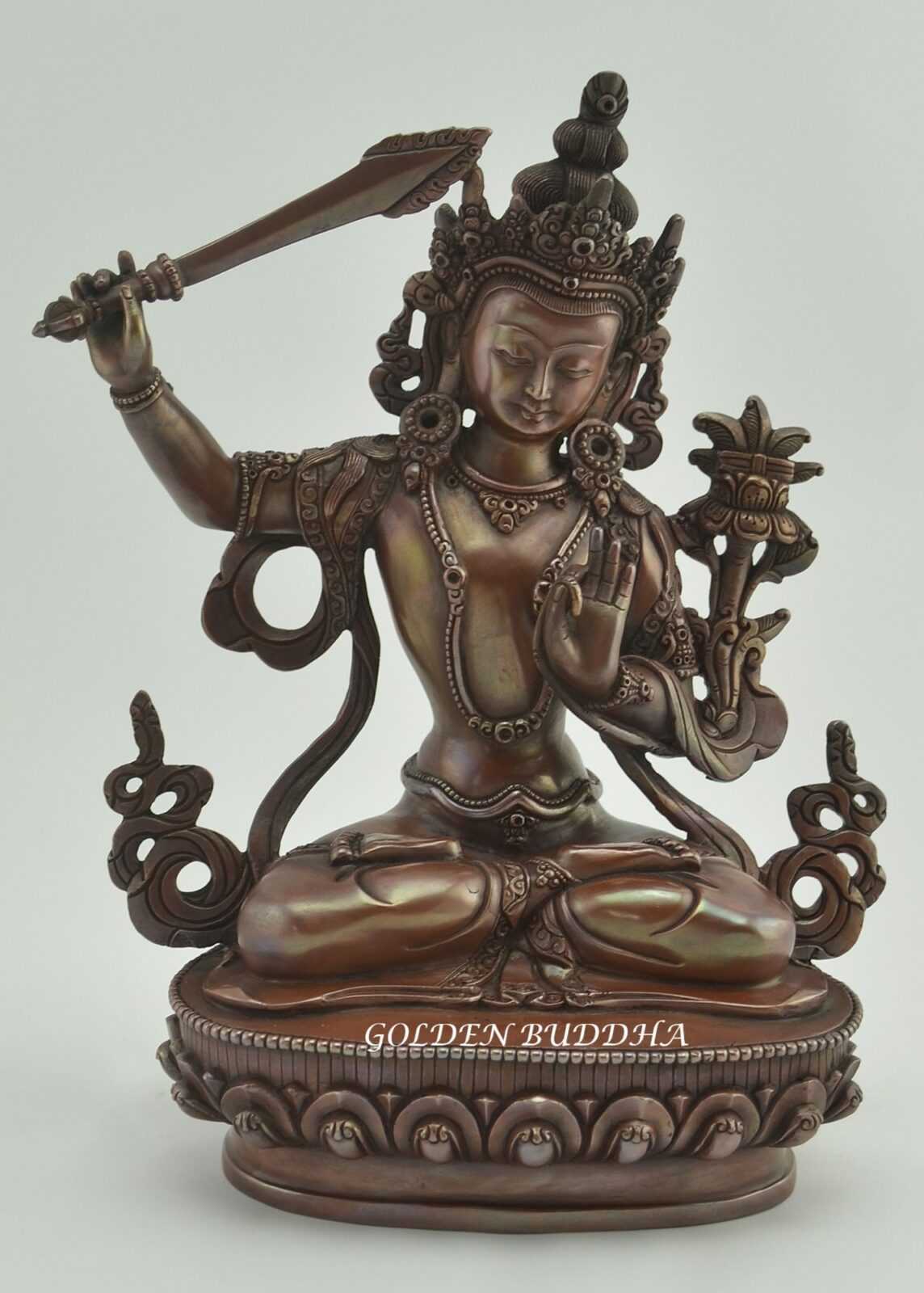

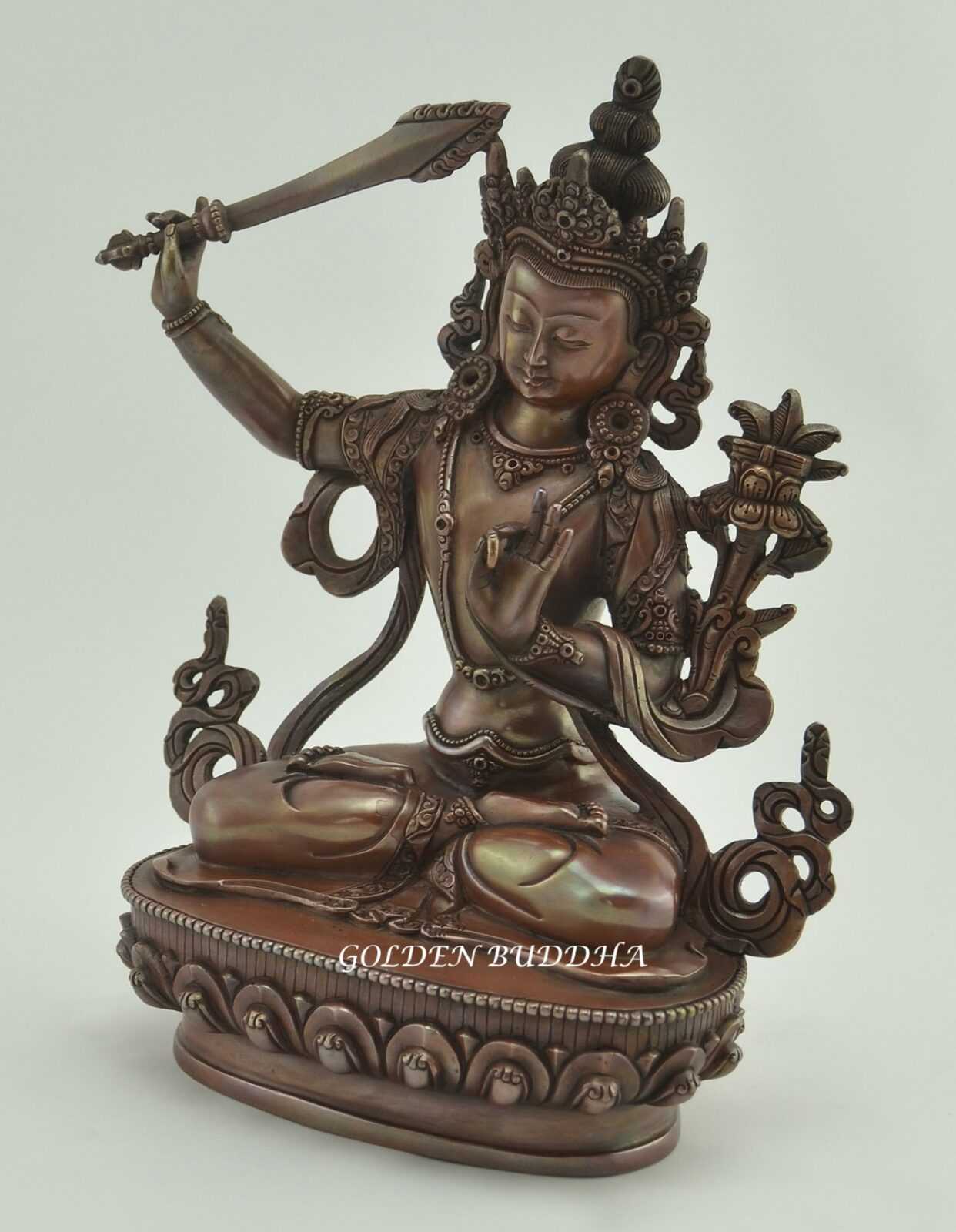

This 9″ Oxidized Manjushri statue was handcrafted from copper alloy in Patan, Nepal, by a master Newar artisan using the traditional lost wax casting method. The sculpture is finished in warm oxidized copper, with subtle brown, reddish, and softly iridescent tones appearing across the figure. This restrained finish draws attention to Manjushri’s elegant proportions, youthful expression, hand-carved Bodhisattva ornaments, and commanding Sword of Wisdom without relying upon gold gilding or painted decoration.
The artisan has dressed Manjushri in the crown and jewelry of a celestial Bodhisattva. His tall five-pointed crown surrounds a carefully modeled topknot, while large circular earrings, layered necklaces, bracelets, armlets, and a fitted waist ornament enrich the figure. Raised scrolling borders appear along the shoulder covering, sleeves, dhoti, and decorative bands. Long celestial scarves pass around the arms and form broad curling loops behind the body, creating movement around the otherwise stable and meditative composition. At the buyer’s request, suitable settings in the crown and ornaments may be embellished with turquoise and red coral stones before delivery at no additional charge.
Oxidized Manjushri Statue Iconography
Manjushri, known in Tibetan as Jampelyang, embodies the transcendent wisdom of all enlightened beings. He is traditionally portrayed with youthful features to express the freshness and clarity of awakened awareness. His calm, slightly lowered gaze suggests wisdom that is neither rigid nor merely intellectual, but grounded in direct insight into the true nature of reality. This symbolism has made Manjushri especially important to monks, teachers, translators, meditators, scholars, and students seeking greater understanding. Our guide to Manjushri’s wisdom, mantra, and symbolism explains his wider role in Mahayana and Tibetan Buddhism.
His raised right hand firmly holds the Sword of Wisdom above his head. The sword does not represent physical violence. Its sharp blade symbolizes enlightened insight cutting through ignorance, mistaken views, mental confusion, and attachment to deceptive appearances. The upward sweep of the arm and long blade introduces a strong diagonal element into the composition, expressing wisdom as an active power that decisively separates clarity from delusion. Learn more about the meaning of Manjushri’s Sword of Wisdom.
Manjushri’s left hand is raised near the heart in the Vitarka mudra, the gesture of teaching, explanation, and reasoned discussion of the Dharma. His fingers also hold the stem of an utpala lotus rising beside the left shoulder. Resting upon the blossom is the Prajnaparamita Sutra, the Perfection of Wisdom scripture. The sword and scripture form a complementary pair: the sword represents direct realization that cuts through ignorance, while the sacred text represents the teachings that guide study, contemplation, and meditative insight.
Manjushri and the Perfection of Wisdom
In Buddhist teaching, wisdom is not simply the accumulation of information. Manjushri represents prajna, the insight that directly understands emptiness, dependent origination, and the absence of a permanent, independently existing self. This realization allows a practitioner to engage with the world compassionately without being deceived by fixed concepts or grasping at temporary appearances as permanent realities.
Manjushri is closely associated with the Prajnaparamita literature, a body of Mahayana teachings devoted to transcendent wisdom. The scripture supported by the lotus beside his shoulder identifies the figure with this profound tradition. The lotus rises from muddy water without becoming stained, illustrating how wisdom may develop within samsara while remaining free from confusion. The combination of lotus, book, teaching gesture, and raised sword expresses the progression from studying the Dharma to contemplating its meaning and finally realizing it through direct meditative experience.
Copper Alloy Craftsmanship and Lotus Throne
The Oxidized Manjushri statue sits in the full lotus posture upon a single lotus throne. A broad course of rounded lotus petals surrounds the pedestal, with recessed details emphasized by the darker oxidized finish. The throne’s beaded upper rim and smooth lower foundation provide a stable visual base for the more elaborate crown, sword, lotus, jewelry, and flowing scarves above.
Viewed from behind, the sculpture reveals the careful modeling of Manjushri’s gathered hair, crown, shoulder covering, arm ornaments, celestial ribbons, and sword. Engraved scrollwork follows the borders of the shoulder wrap and garment, while the broad central area of the back remains comparatively smooth. This balance between decorated borders and open copper surfaces allows the natural variations of the oxidized finish to remain visible. The craftsmanship continues around the pedestal, making the statue suitable for an open shrine or display where it may be appreciated from several directions. Browse our collection of Manjushri statues to compare different sizes and artistic finishes.
Manjushri, Green Tara and Chenrezig Statue Set
This Oxidized Manjushri statue may be displayed as part of a coordinated three-piece shrine with our Oxidized Green Tara statue and handmade Chenrezig statue. All three sculptures were created by the same Nepali master artisan and share complementary antiquated copper alloy finishes, hand-carved garment borders, refined Bodhisattva ornaments, flowing scarves, and closely related lotus thrones. Their similar scale, coloring, and workmanship allow the three figures to form a visually unified altar arrangement.
The three Bodhisattvas also form a meaningful doctrinal combination. Manjushri embodies the wisdom that correctly understands emptiness and dependent origination. Chenrezig, or Avalokiteshvara, personifies the limitless compassion that responds to the suffering of all beings. Green Tara expresses swift compassionate activity, overcoming fear, obstacles, and conditions that delay beneficial action. Together, Manjushri provides clear understanding, Chenrezig provides the compassionate motivation to benefit others, and Green Tara transforms wisdom and compassion into immediate enlightened activity. The arrangement therefore presents three complementary dimensions of the Buddhist path: knowing what must be done, caring deeply enough to act, and responding without hesitation.
Filling, Blessing and Consecration
The statue includes a consecration opening so that it may be filled with sacred texts, printed mantras, incense, medicinal substances, precious materials, and other traditional contents before being blessed according to the owner’s Buddhist lineage. Filling and consecration prepare the handcrafted image for formal use as an object of meditation, devotional practice, study, and veneration. Our guide to Buddha statue filling, blessing, and consecration explains the customary process and the available preparation options.
Custom Made Manjushri and Matching Bodhisattva Statues
Collectors, practitioners, monasteries, and Dharma centers may commission a custom made Tibetan Buddhist statue based upon this Manjushri design. A custom Manjushri statue may be produced in a different size, with an oxidized, partly gilded, or 24K fire-gilded finish, and with personalized crown details, garment engraving, stone embellishment, facial treatment, sword design, or lotus pedestal proportions.
Matching Green Tara and Chenrezig statues may also be commissioned together so that all three figures share the same height, copper finish, throne dimensions, decorative borders, and overall altar presence. Such a custom set may be planned specifically around the doctrinal relationship between Manjushri’s wisdom, Chenrezig’s boundless compassion, and Green Tara’s swift removal of obstacles. Each sculpture is individually cast from copper alloy and finished by hand in Nepal according to traditional Himalayan Buddhist iconographic proportions.
Authentic, Handmade in Nepal
Every statue is handcrafted in Patan, Nepal, using traditional lost wax casting and comes with a certificate of authenticity issued by Nepal’s Department of Archaeology, verifying its materials, technique, and origin.