
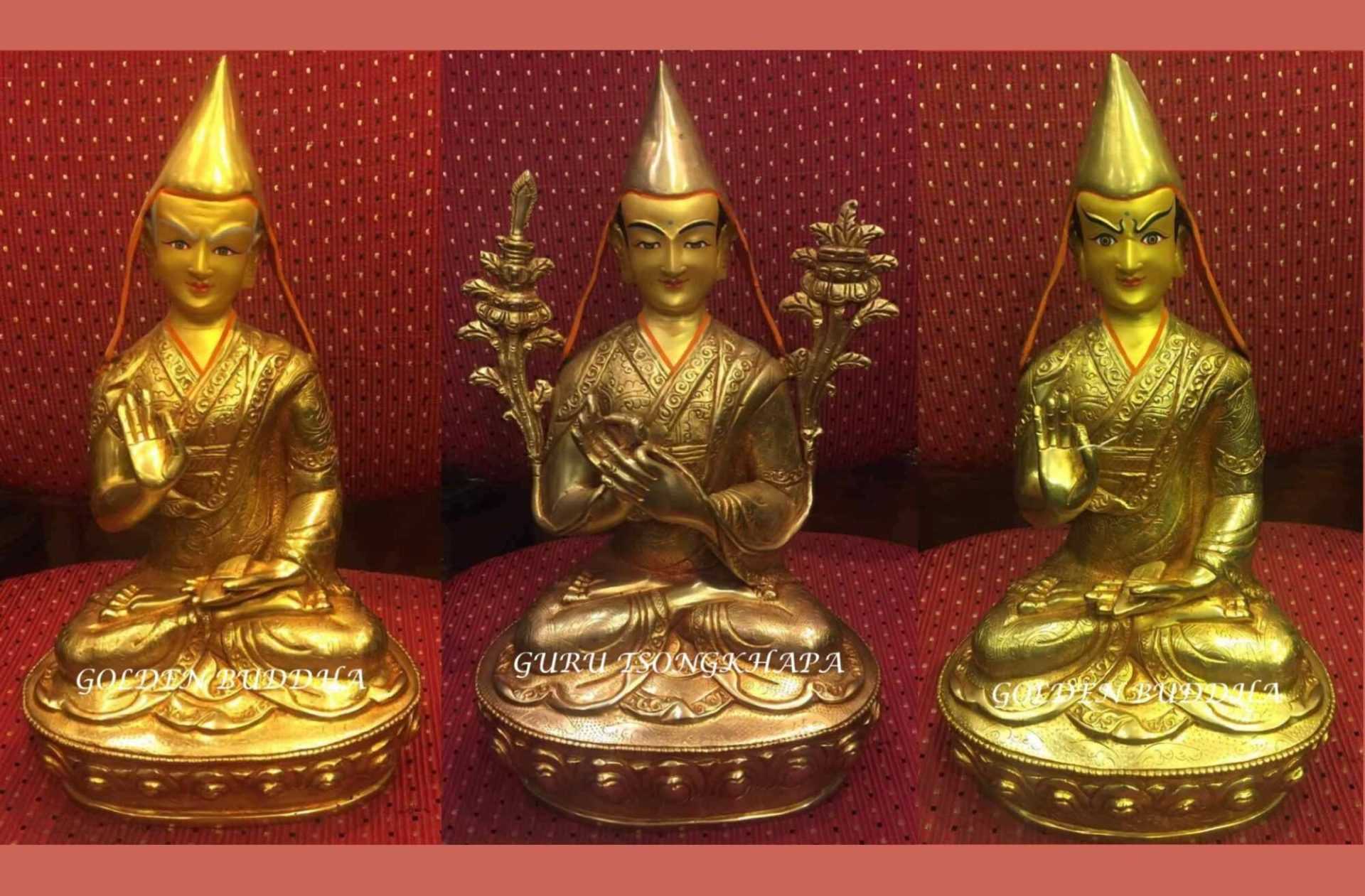
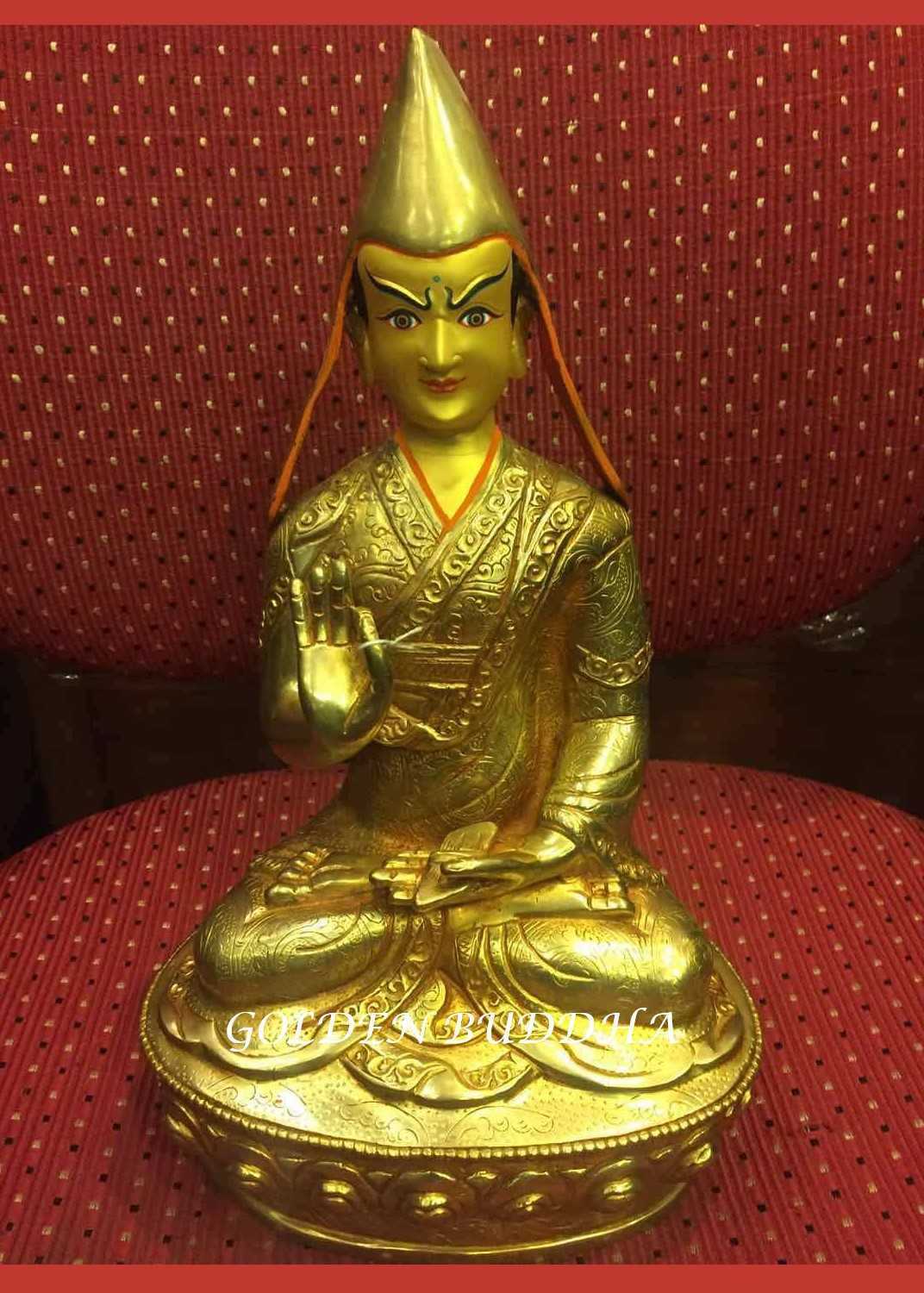
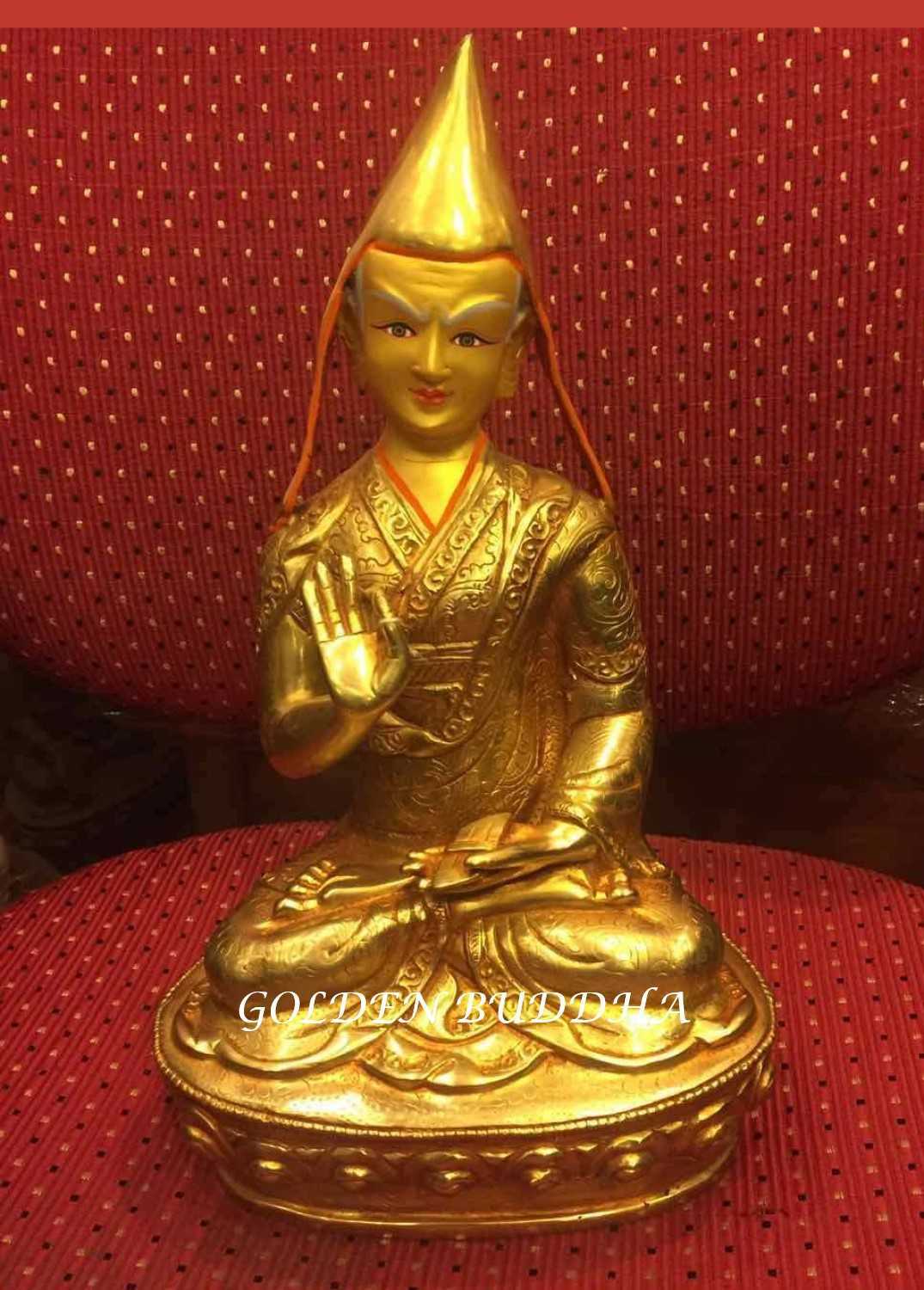
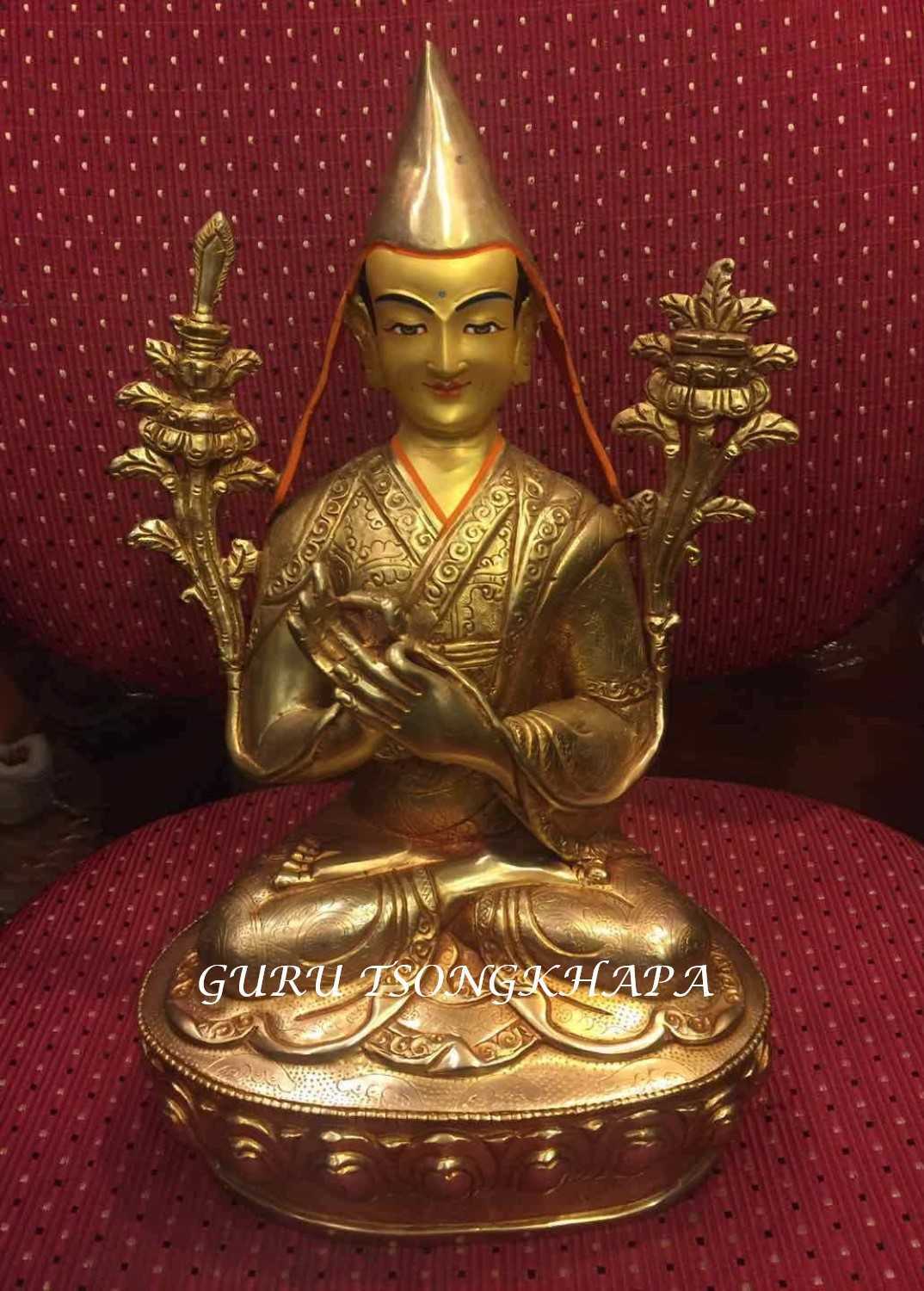
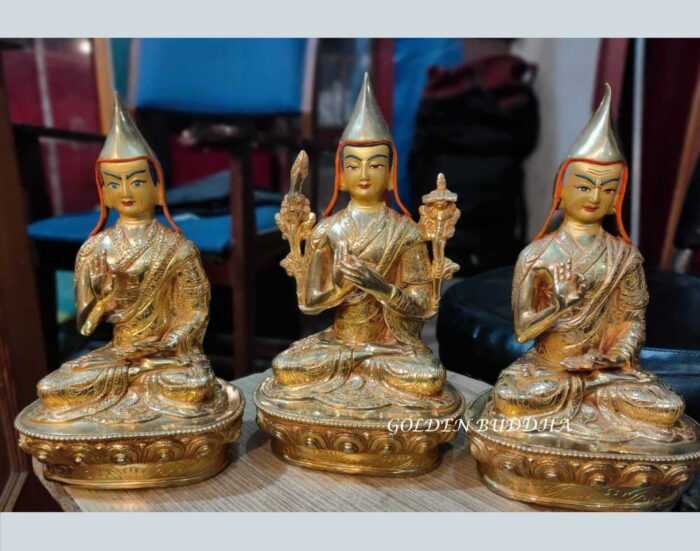
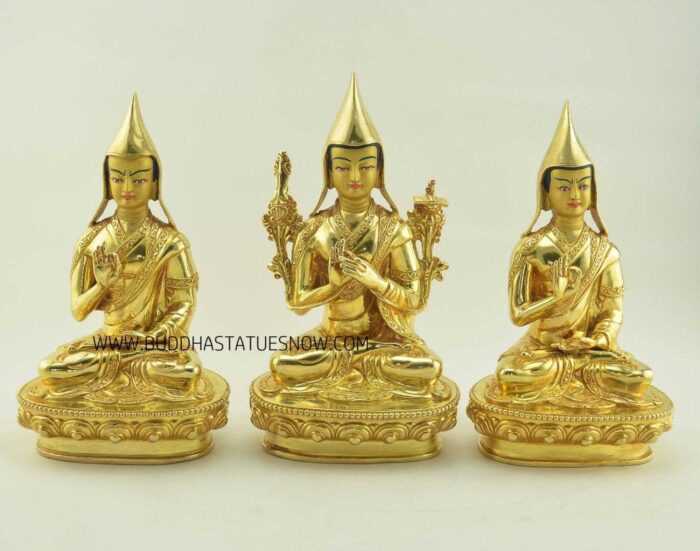
This substantial 12.5-inch Je Tsongkhapa Statue with Disciples depicts Je Tsongkhapa, Lobsang Drakpa (1357–1419), together with his two principal disciples, Gyaltsab Je and Khedrub Je. Handmade in Patan, Nepal from copper alloy using the traditional lost-wax casting method, all three figures are fire gilded in 24K gold with faces hand painted in 18K gold and natural pigments. The photographs show an exceptionally ornate Gelug lineage trio, distinguished by tall pointed pandita hats, richly engraved monastic robes, coordinated lotus thrones and finely modeled mudras. With Tsongkhapa measuring 12.5 inches and each disciple 10.25 inches high, the set has the scale and visual presence to serve as the principal lineage image on a home altar, Dharma-center shrine or monastery display.
Je Tsongkhapa Statue Set | Master and Two Spiritual Sons
Je Tsongkhapa, also called Je Rinpoche, founded the Gelug tradition and became one of Tibet’s most influential scholar-practitioners. His two great disciples continued the lineage after his death: Gyaltsab Je became his immediate successor as Ganden Tripa, followed by Khedrub Je. In the conventional three-figure arrangement, Gyaltsab Je sits to Tsongkhapa’s right, the viewer’s left, while Khedrub Je occupies Tsongkhapa’s left, the viewer’s right. Together they form one of the most recognizable lineage groups in Tibetan Buddhist art. Learn more about Je Tsongkhapa and the Gelug tradition.
Traditional Gelug Iconography
Tsongkhapa occupies the central and tallest position, wearing the distinctive pointed Gelug pandita hat. His hands meet before his heart in the Dharmachakra mudra, symbolizing teaching and turning the Wheel of Dharma. Two flowering lotus stems rise beside his shoulders. The lotus over his right shoulder supports Manjushri’s sword of wisdom, while the opposite blossom carries the Prajnaparamita scripture of perfected wisdom. These attributes reflect the Tibetan Buddhist tradition that reveres Tsongkhapa as an emanation of Manjushri.
Both disciples also wear pointed Gelug hats and the layered robes of ordained monks. Each raises the right hand to display Vitarka mudra of teaching and Dharma transmission, while a small scripture rests in the left hand at the lap. Their parallel postures give the flanking figures visual balance while retaining distinct facial expressions. Read more about Gyaltsab Je and Khedrub Je and their place in the Gelug lineage.
Je Tsongkhapa Statue Set | Extensive Hand Engraving
One of the most remarkable features of this set is the extensive ornamental work covering all three figures. Scrolling floral and cloud-like patterns fill the robes across the chest, sleeves, lap and lower garments, while additional decorative borders follow the layered textile edges. The engraving continues around the figures rather than being restricted to the front, giving the statues a richly finished appearance from multiple viewing angles. The lotus thrones repeat the same visual language through raised lotus-petal carvings, beaded borders and engraved decorative registers. The result is a carefully coordinated trio rather than three independently styled statues.
24K Gold Fire Gilding and Hand-Painted Faces
The brilliant gold finish emphasizes both the elaborate engraving and the ceremonial character of the group. Each copper-alloy statue is traditionally fire gilded in 24K gold, including the robes, hands, attributes, pandita hats and lotus thrones. The faces receive a separate hand-painted treatment using 18K gold and natural pigments, with carefully defined eyes, brows and lips. Subtle red edging beneath the hats introduces a restrained accent against the otherwise unified gold surface.
Je Tsongkhapa Statue Set | Filling and Consecration in Kathmandu
For practitioners preparing this lineage set for devotional use, traditional statue filling, blessing and consecration in Kathmandu, Nepal can be arranged before shipment. Appropriate mantra rolls, sacred substances and other traditional materials can be placed within the hollow copper-alloy figures before sealing and ritual blessing. Having all three statues prepared together maintains the devotional unity of Tsongkhapa and his two principal disciples as a complete Gelug altar group.
Custom Tibetan Buddhist Statues
Collectors, monasteries and Dharma centers requiring different dimensions or finishes may also commission custom Tibetan Buddhist statues handmade in Nepal. A custom Tsongkhapa trio can be planned as a complete ensemble so Je Tsongkhapa, Gyaltsab Je and Khedrub Je share proportional sizing, matching pandita hats, coordinated robe engravings and consistent lotus-throne designs. Options can include alternate sizes, full or partial 24K gold fire gilding and other traditional finishes while maintaining the established iconography of the Gelug lineage.
Authentic, Handmade in Nepal
Every statue is handcrafted in Patan, Nepal, using traditional lost wax casting and comes with a certificate of authenticity issued by Nepal’s Department of Archaeology, verifying its materials, technique, and origin.
Reviews
There are no reviews yet.