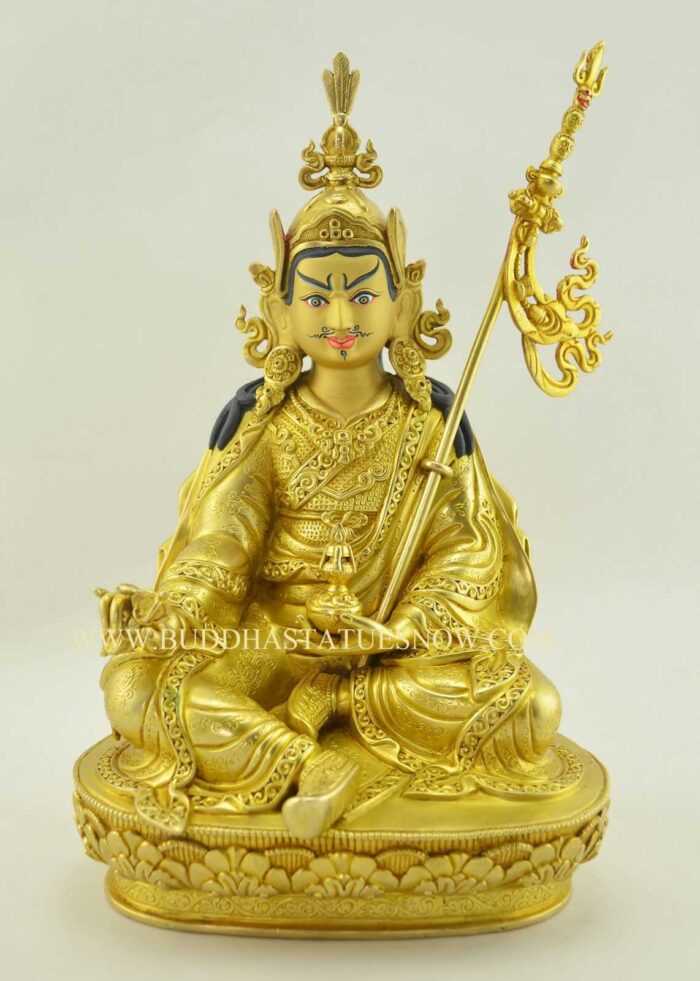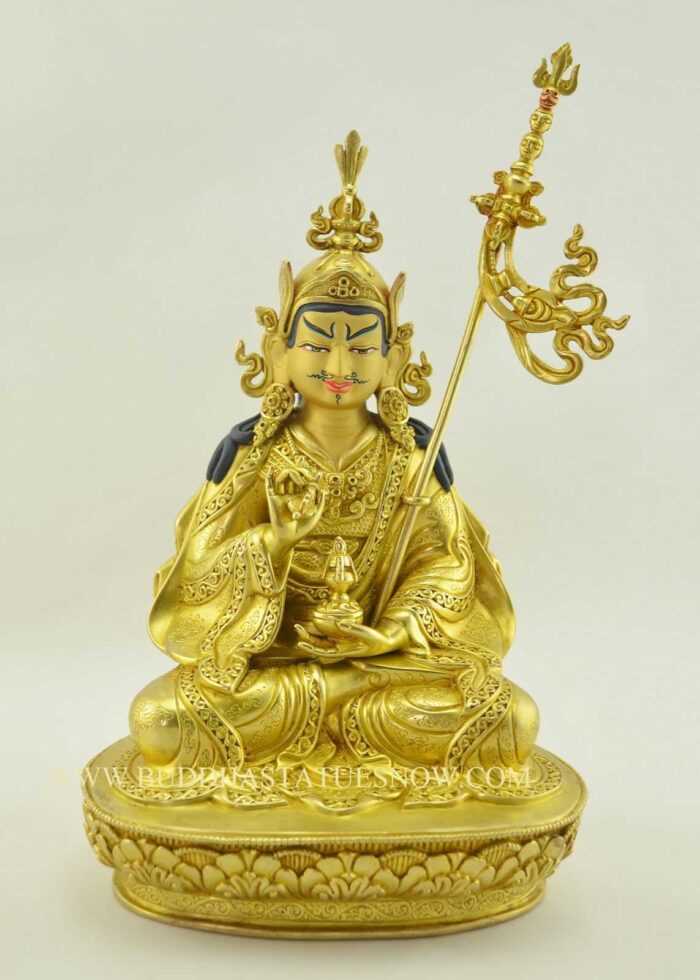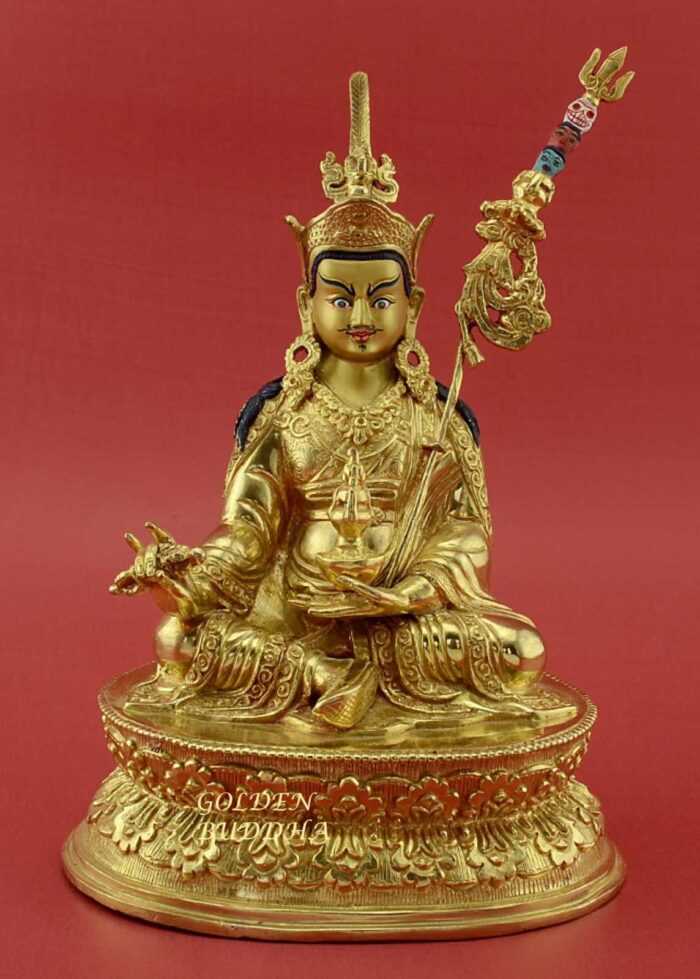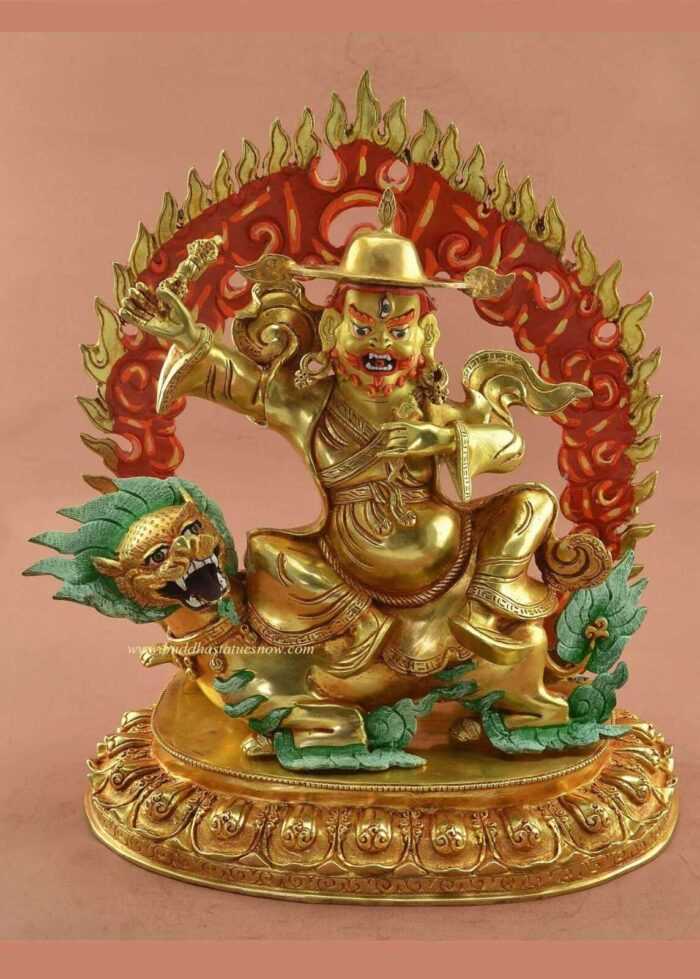
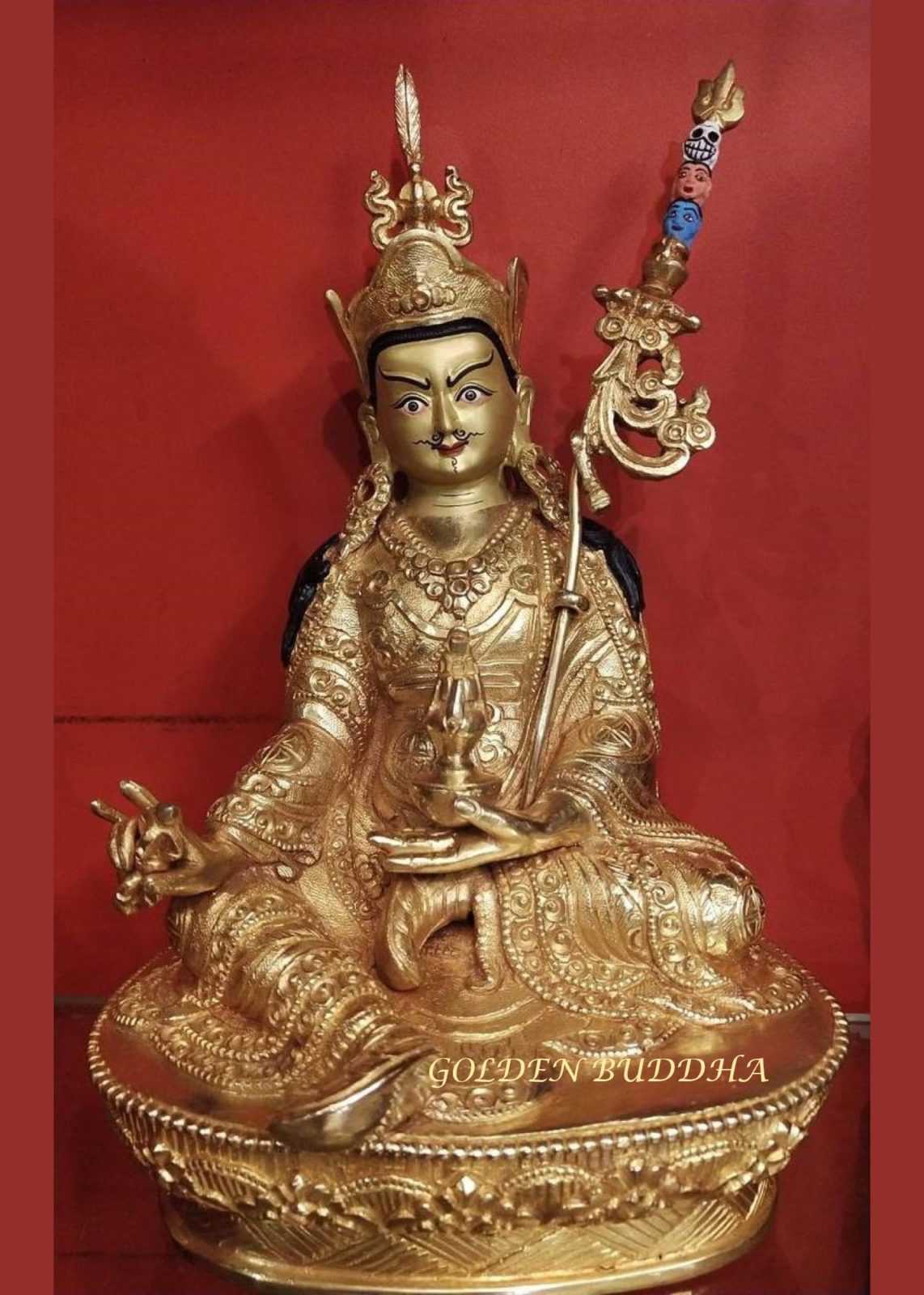
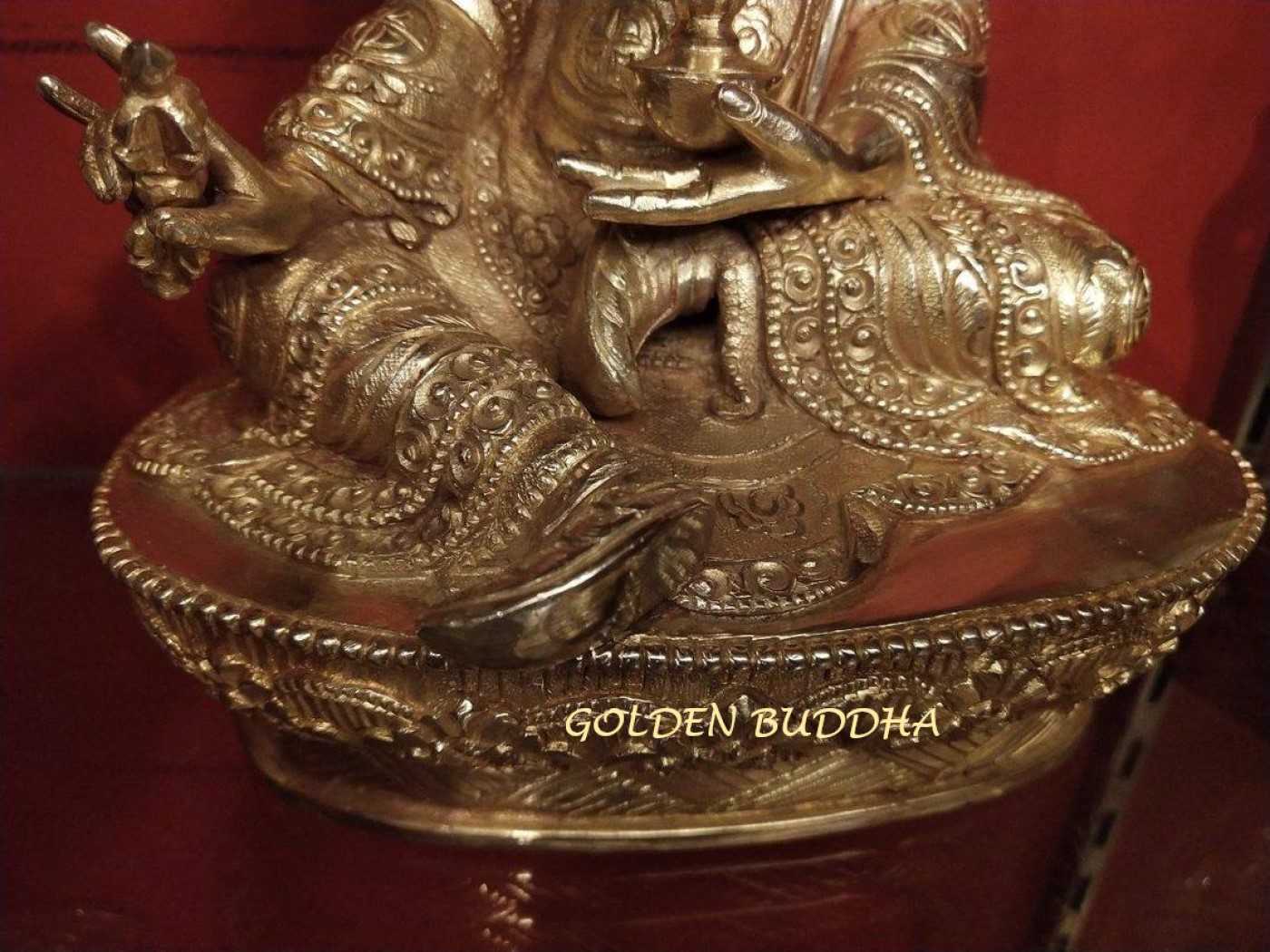
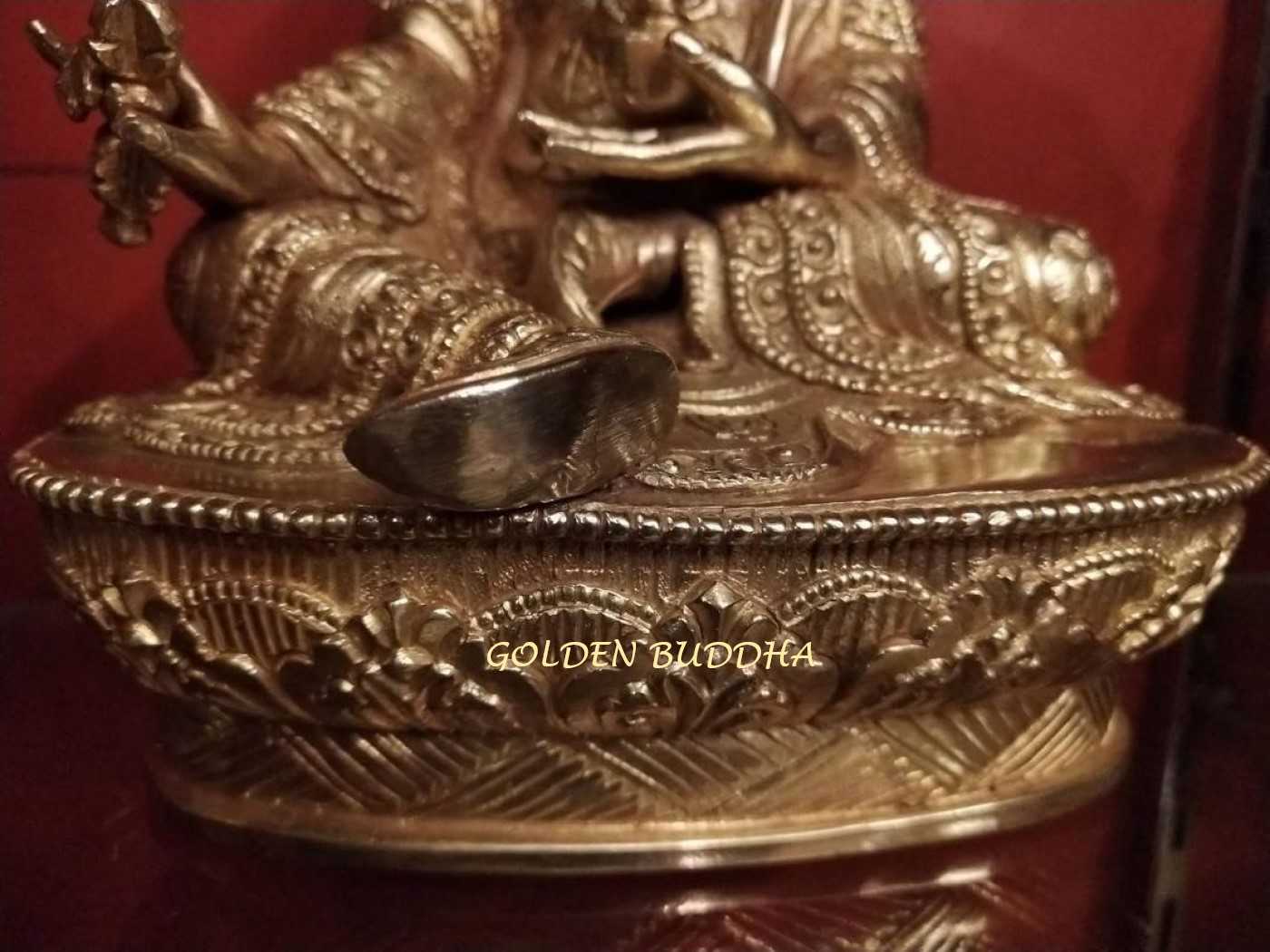
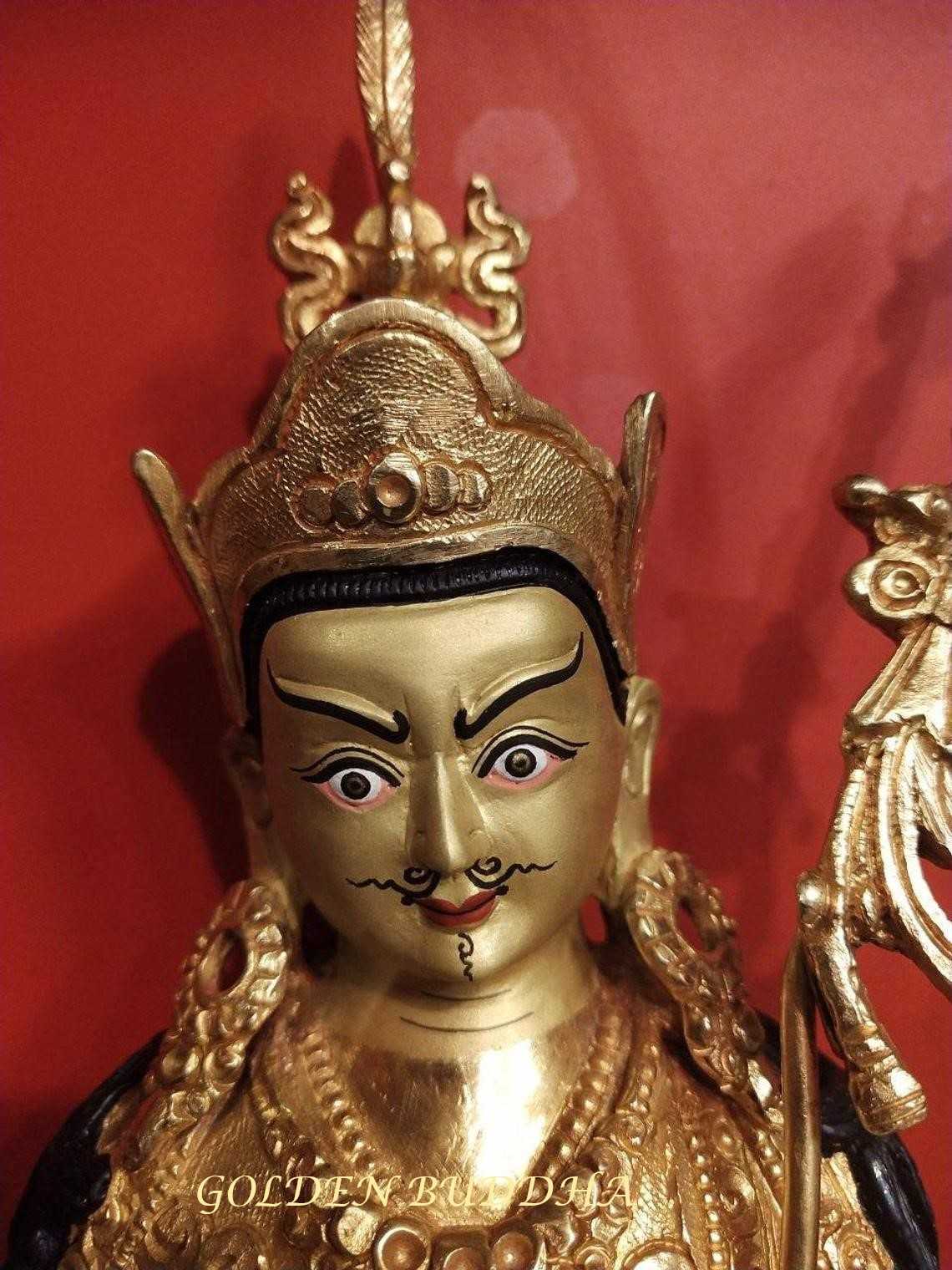

This magnificent Guru Rinpoche Sculpture portrays Padmasambhava, “The Lotus Born,” in an exceptionally detailed 9-inch representation handcrafted in Nepal. Cast from copper alloy using the traditional lost wax method, the sculpture is fire gilded in 24K gold, while the face is separately hand painted with 18K gold and natural pigments. Elaborate repoussé work, engraved ornamentation, scrollwork hemlines, and symbolic details extend across the robes and lotus throne. The craftsmanship continues around the back, where a carved lotus motif, auspicious ornamentation, and a vajra motif on the rear of the throne make this sculpture richly finished from every viewing angle.
Guru Rinpoche Sculpture and the Lotus Born Master
Guru Rinpoche, also known as Padmasambhava, occupies an extraordinary place in Tibetan Buddhism. His Sanskrit name means “Lotus Born,” referring to traditional accounts of his miraculous appearance in Oddiyana. During the eighth century, the great Buddhist scholar Śāntarakṣita invited Padmasambhava to Tibet, where he became instrumental in overcoming obstacles associated with the establishment of Samye, Tibet’s first Buddhist monastery. His teachings became especially foundational to the Nyingma tradition, whose practitioners honor him as the Second Buddha. Discover more about Guru Rinpoche and the life of Padmasambhava in our detailed guide.
Symbolism of Padmasambhava “The Lotus Born”
The sculpture preserves the principal attributes that identify Padmasambhava. His right hand holds the vajra, the “diamond” or “thunderbolt” associated with indestructibility and skillful means. His left hand rests in his lap supporting the kapala skull cup containing the longevity vase. Rising beside his left shoulder is the khatvanga, crowned by three vividly painted impaled heads representing the three realms of desire, form, and formlessness that the realized master has transcended. His distinctive lotus hat is surmounted by the vulture feather signifying realization of the highest view. Each attribute carries a specific doctrinal meaning explored further in our guide to Guru Rinpoche statue meaning and iconography.
Handcrafted Details of the Guru Rinpoche Sculpture
Particular attention has been devoted to the robes and throne. Raised repoussé ornamentation gives depth to the front of the sculpture, while scrolling patterns follow the robe hemlines and continue across the seated figure. The rear is equally elaborate: fine texturing covers the robe, decorative motifs descend symmetrically across its surface, and a lotus is prominently carved beneath the shoulders. Below, the lotus throne combines raised petal work with extensive engraving, including a vajra motif on its reverse. These details distinguish the piece from simpler gilded representations and demonstrate the traditional emphasis on finishing a sacred sculpture in the round.
Guru Rinpoche and Amitabha Buddha
This sculpture forms a particularly meaningful altar pairing with our 24K gold gilded Amitabha Buddha statue. In Tibetan Buddhist tradition, Guru Rinpoche is understood as a speech emanation of Amitabha, the Buddha of Infinite Light. Displaying them together therefore connects Padmasambhava’s historical and tantric activity with his enlightened source. Amitabha may be positioned slightly higher or to Guru Rinpoche’s left, emphasizing this spiritual relationship. Their complementary gilded finishes, lotus thrones, serene yet distinct iconography, and shared doctrinal connection also make them visually harmonious altar companions.
For collectors or practitioners seeking a coordinated pair, custom dimensions and finishes can also be commissioned through our custom Tibetan Buddhist statues service. A custom Guru Rinpoche and Amitabha pairing can be planned with complementary proportions, gilding, lotus thrones, and artistic detailing while maintaining the correct iconography of each figure. Amitabha embodies infinite light, discriminating wisdom, and the enlightened Buddha family from which Padmasambhava is traditionally understood to emanate, while Guru Rinpoche embodies the dynamic transmission and activity of Vajrayana teachings. Together they create a doctrinally meaningful relationship between enlightened source and manifested tantric master.
Authentic, Handmade in Nepal
Every statue is handcrafted in Patan, Nepal, using traditional lost wax casting and comes with a certificate of authenticity issued by Nepal’s Department of Archaeology, verifying its materials, technique, and origin.