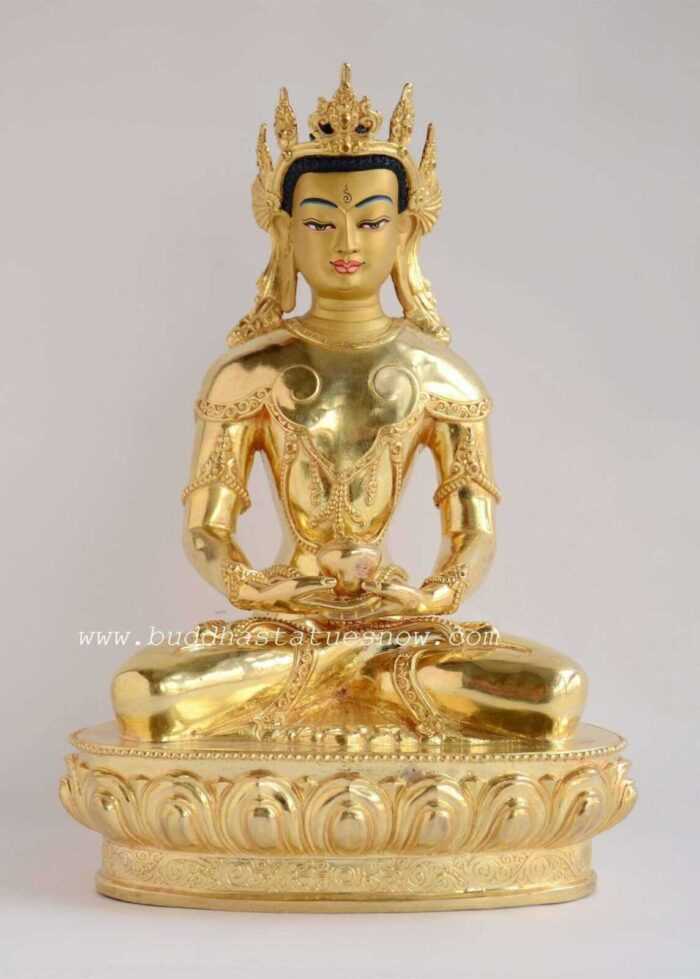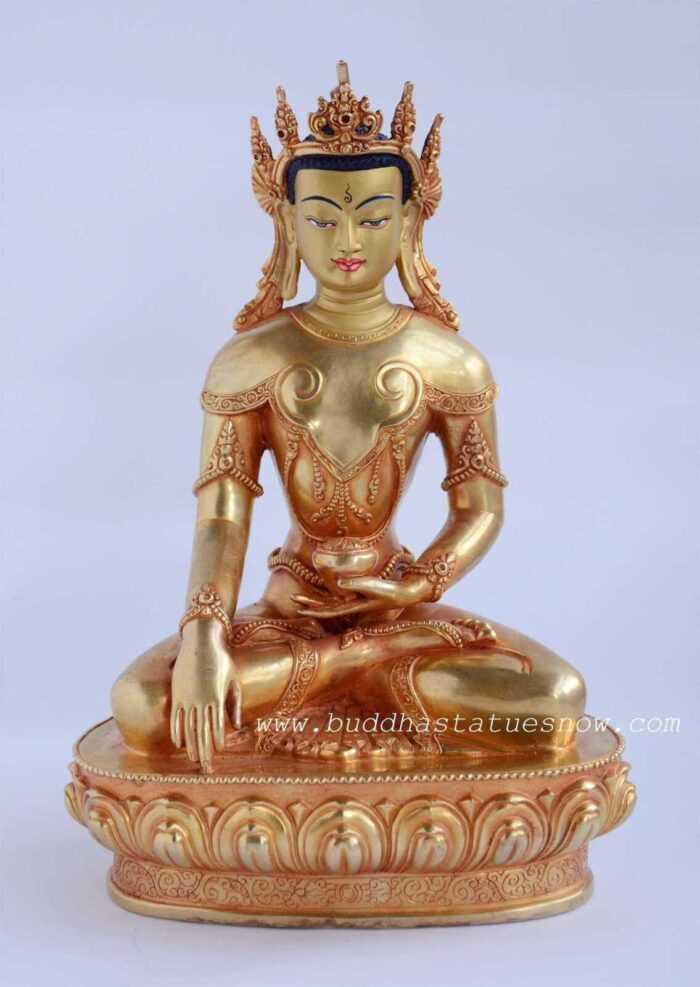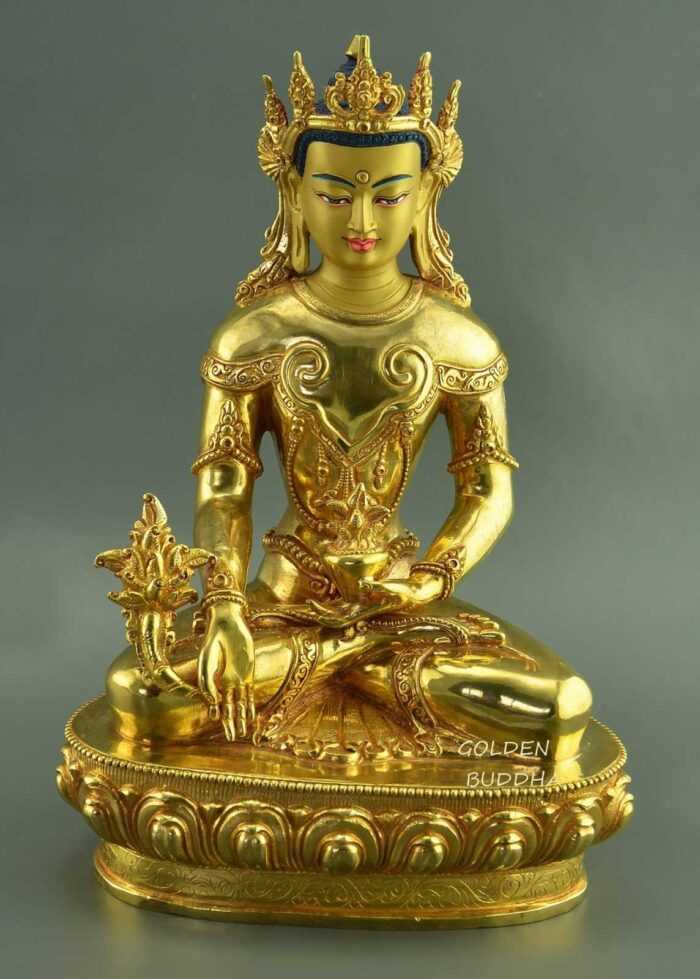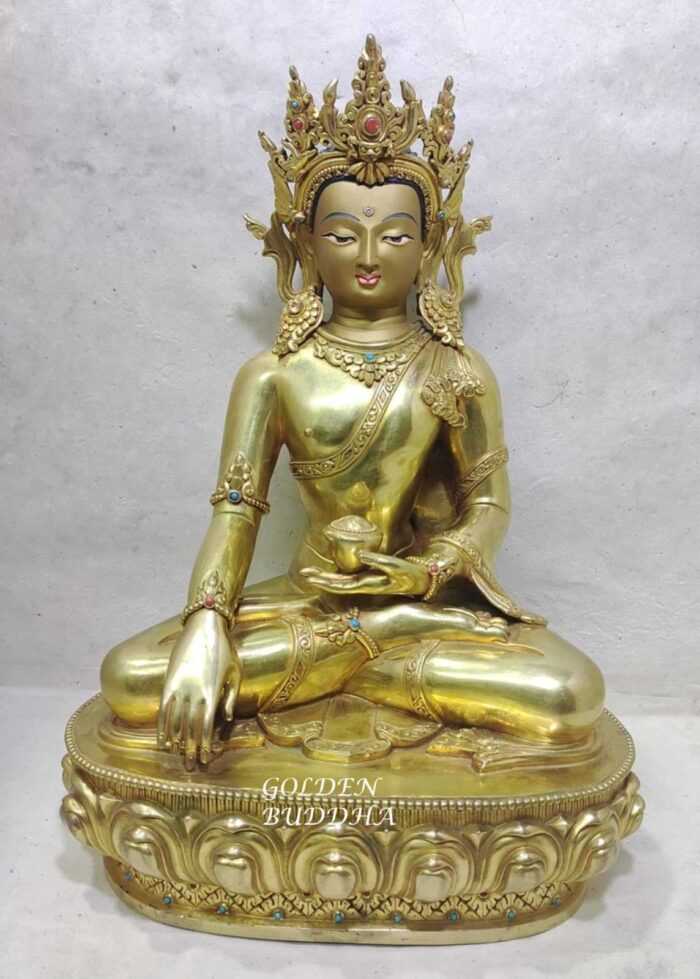
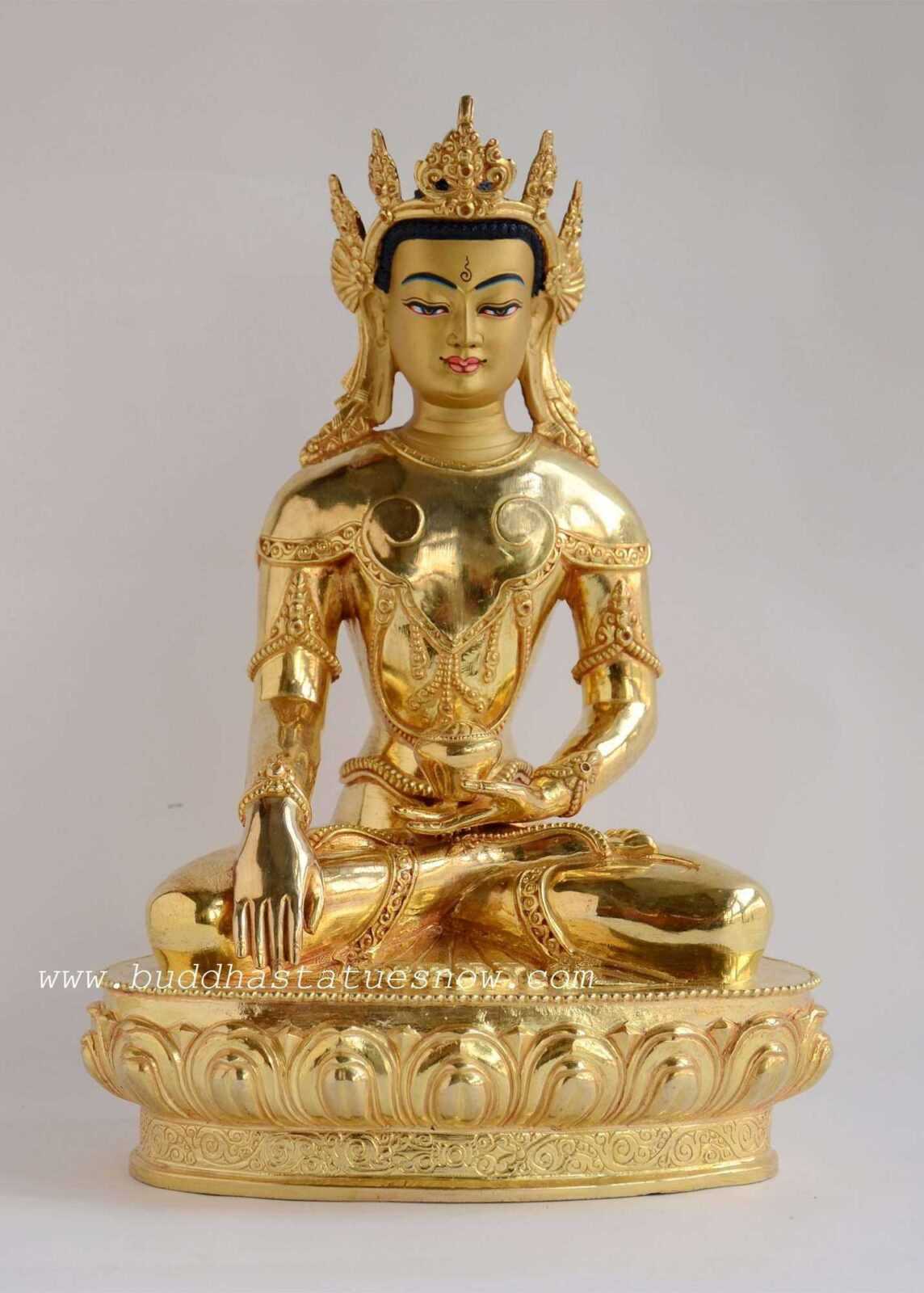

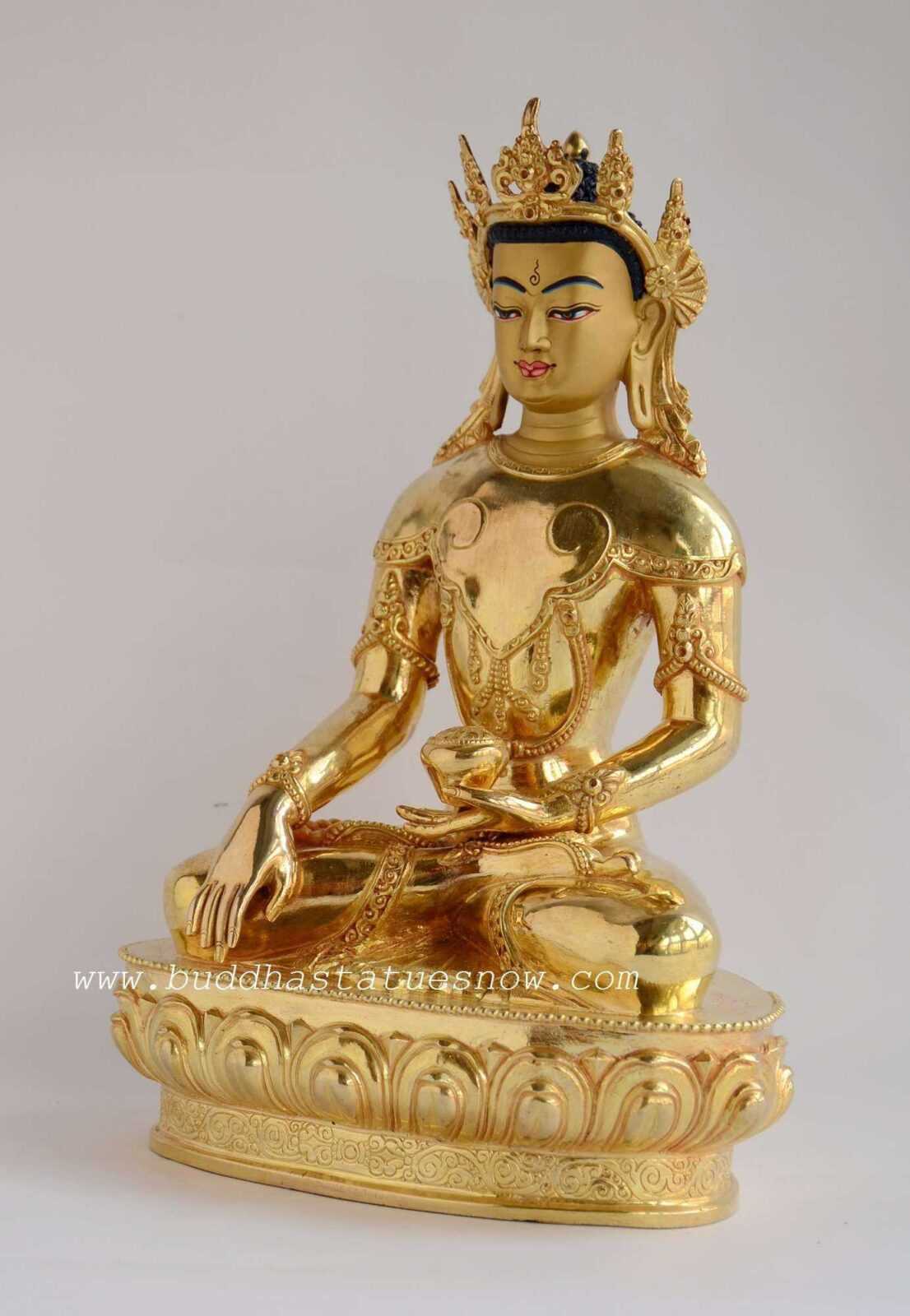
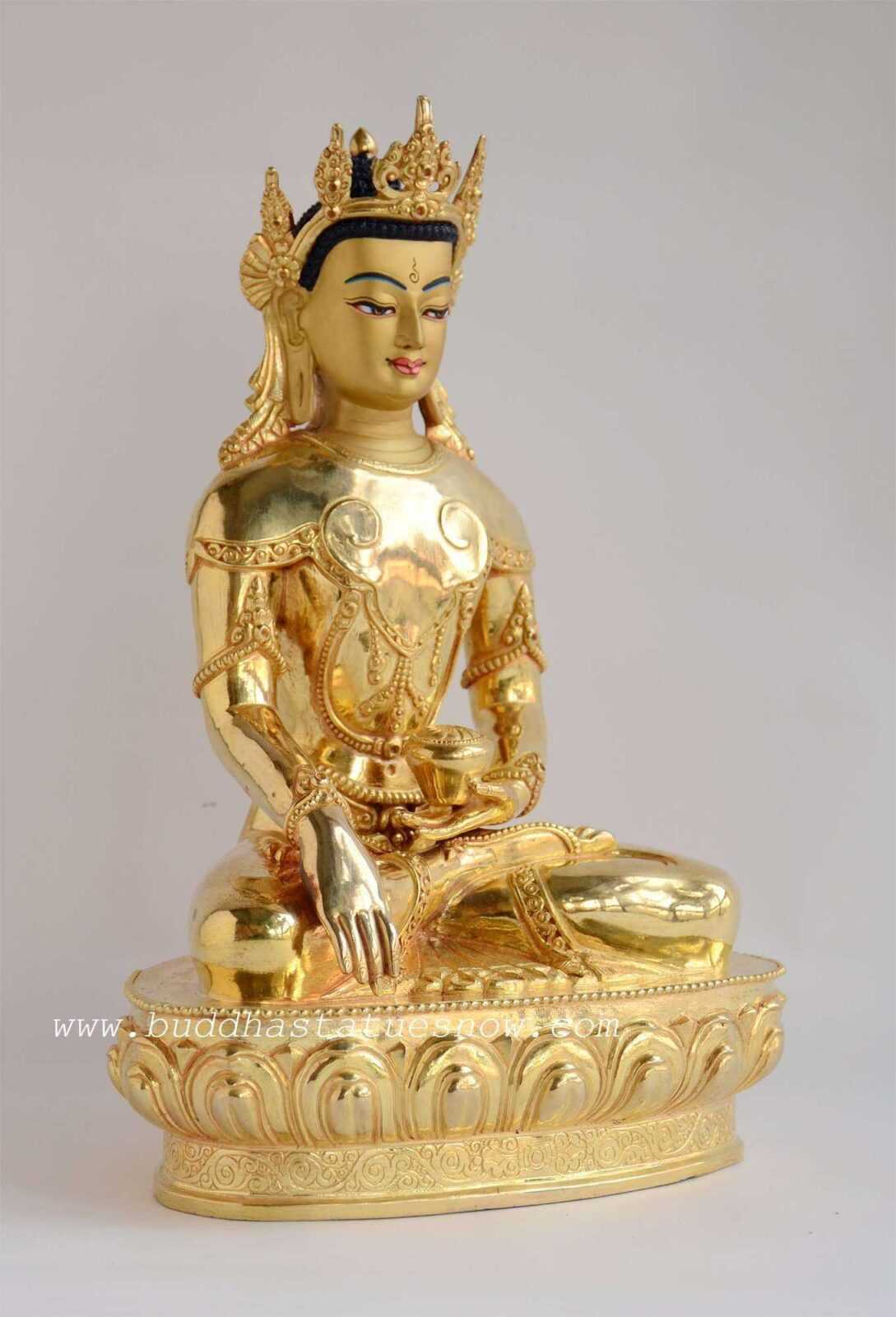
This radiant 10″ crowned Shakyamuni Buddha statue presents the historical Buddha in the majestic ornaments of an enlightened sovereign. Handcrafted from copper alloy by a master Newar artisan in Patan, Nepal, the sculpture was created through the traditional lost-wax casting method and fire gilded in pure 24K gold. Its brilliant, high-luster surface reflects light across the smooth body, elaborate crown, Bodhisattva jewelry, robe borders, ritual bowl, and lotus throne, giving the statue a luminous presence well suited to a home altar, meditation room, monastery, or Dharma center.
Although Shakyamuni is commonly portrayed in the plain robes of a renunciant monk, this crowned Shakyamuni Buddha statue honors him as the King of the Dharma—the awakened teacher whose realization and instruction illuminate the path beyond suffering. A finely sculpted crown frames his hand-painted face, while ornamental side panels descend beside the ears and rest against the shoulders. The urna between his brows, elongated earlobes, dark hairline, softly outlined eyes, red lips, and three lines at the neck preserve the traditional marks of Buddhahood beneath the regal presentation.
Crowned Shakyamuni Buddha Statue and the King of the Dharma
The Bodhisattva crown and jewelry do not contradict Shakyamuni’s renunciation of palace life. Instead, they express his enlightened status after awakening and recall the immeasurable merit accumulated during his previous lives as a Bodhisattva. Having relinquished royal privilege as Prince Siddhartha, he attained a sovereignty far greater than worldly authority: mastery over ignorance, craving, and the causes of suffering. The crowned form therefore combines the historical teacher with the transcendent dignity of a fully awakened Buddha.
The crown is composed of a prominent central ornament surrounded by ascending flame-like points, with finely worked side elements framing the face. Broad shoulder ornaments, upper-arm bands, bracelets, a long beaded necklace, and an engraved chest panel complete the royal presentation. At the buyer’s request, suitable settings in the crown and jewelry may be embellished with turquoise or red coral stones before delivery at no additional charge. These traditional Himalayan stones would create a vivid contrast with the mirror-bright gold while adding another layer of color to the sacred ornamentation.
Bhumisparsha Mudra and Shakyamuni’s Enlightenment
Shakyamuni sits in the full lotus posture while displaying the Bhumisparsha mudra, or earth-touching gesture. His right hand extends over the knee with the fingers directed downward toward the earth. This gesture recalls the decisive moment beneath the Bodhi tree when Mara challenged Siddhartha Gautama’s right to attain enlightenment. Rather than answering with words, Siddhartha touched the ground and called the earth to witness the virtue and merit accumulated throughout his countless previous lives.
The earth responded as his witness, and the forces of distraction, fear, and temptation were overcome. The earth-touching mudra consequently symbolizes unshakable resolve, the defeat of delusion, and the direct realization through which Siddhartha became Shakyamuni Buddha. Its downward movement provides a graceful visual counterbalance to the upright torso and tall crown. Explore the meaning of the Bhumisparsha mudra and other Shakyamuni hand gestures in our complete guide.
Alms Bowl, Meditation and Renunciation
His left hand rests in the lap in the Dhyana mudra, the gesture of meditation and inner equilibrium, while supporting a small lidded alms bowl. The vessel recalls the life of simplicity adopted by Prince Siddhartha after leaving the palace. By exchanging royal wealth for the bowl of a wandering seeker, he demonstrated that liberation cannot be secured through possessions, social rank, or sensory pleasure.
In Buddhist iconography, the bowl may also be understood as containing the nectar that counteracts the three poisons of ignorance, attachment, and aversion. The pairing of the alms bowl with the Bhumisparsha mudra connects two central episodes in Shakyamuni’s life: his renunciation of worldly privilege and his ultimate victory beneath the Bodhi tree. Read more about Shakyamuni Buddha’s place in the Buddhist pantheon, or browse our collection of Shakyamuni Buddha statues.
High-Luster Gilding and Engraved Ornamentation
The brilliant finish is one of the defining qualities of this crowned Shakyamuni Buddha statue. Rather than the softened warmth of an antiquated patina, the 24K fire gilding has been polished to a clear, reflective luster. Broad areas of the torso and folded legs remain smooth, allowing the gold to glow uninterrupted, while carefully placed engraved borders articulate the crown, shoulder ornaments, armlets, chest adornment, robe hemlines, and waistband.
The chest ornament descends in a pointed panel filled with symmetrical foliate engraving, surrounded by raised beaded borders. Repeating scroll patterns follow the shoulder bands and upper-arm ornaments, while finer details appear around the bracelets and waist. The craftsmanship continues around the reverse, where curled ornamental forms decorate the shoulder covering and a central pendant descends between them. These restrained engravings give structure to the reflective surface without diminishing the statue’s uncluttered, ceremonial character.
Single Lotus Throne and Full Lotus Posture
Shakyamuni sits in the full lotus posture upon a substantial single lotus throne. The tightly interlocked legs express meditative stability and the unwavering concentration necessary for awakening. A continuous row of tall, rounded petals surrounds the throne, each petal rising from the pedestal in a clean rhythmic sequence. Beneath them, a broad lower band is enriched with finely engraved scrolling foliage that continues around the full circumference of the base.
The lotus represents purity arising within the conditions of samsara. Just as a lotus grows through muddy water without being stained, Shakyamuni attained complete awakening while living within the same conditioned world experienced by all beings. The simple, symmetrical throne provides a stable architectural foundation for the crowned figure above and closely corresponds to the pedestal used for the matching Amitabha sculpture.
A Matching Crowned Shakyamuni and Amitabha Statue Set
This crowned Shakyamuni Buddha statue forms a harmonious two-piece altar set with our gold-gilded crowned Amitabha Buddha statue. Both sculptures were created by the same master artisan and share the same 10-inch height, copper-alloy casting, bright 24K fire-gilded finish, regal Bodhisattva crown and jewelry, engraved ornamental borders, balanced proportions, and closely matched single lotus throne. Their common scale and reflective gold surface allow them to be displayed together without either figure visually overpowering the other.
The pair is also doctrinally meaningful. Shakyamuni is the historical Buddha who appeared in our world, attained awakening beneath the Bodhi tree, and taught the path leading beyond suffering. Amitabha is the Buddha of Infinite Light, whose vows established the Pure Land of Sukhavati as an exceptionally favorable realm for continuing toward enlightenment. Displayed together, Shakyamuni represents the teacher who revealed the Dharma in this world, while Amitabha embodies the compassionate promise of favorable rebirth and continued practice. The pairing therefore connects the historical source of Buddhist teaching with the Pure Land aspiration cultivated by countless practitioners.
Custom Made Crowned Shakyamuni Buddha Statues
Collectors, practitioners, monasteries, and Dharma centers may commission a custom made Tibetan Buddhist statue based upon this crowned Shakyamuni design. A custom crowned Shakyamuni Buddha statue may be produced in a different size with a brilliant 24K fire-gilded finish, a softer antiquated gold surface, selective gilding, or an oxidized treatment over the copper-alloy casting. Options may include additional foliate engraving, alternative robe-border patterns, hand-painted facial details, customized crown ornamentation, and turquoise or red coral settings in the jewelry.
A matching crowned Shakyamuni and Amitabha pair may also be commissioned together so that both statues share identical dimensions, gilding, crown design, jewelry, pedestal proportions, and decorative language. Commissioning the two figures as a coordinated set allows the artisan to preserve their visual harmony while expressing their complementary attributes: Shakyamuni as the historical teacher of the path and Amitabha as the Buddha of Infinite Light who welcomes devoted practitioners to Sukhavati. Each custom sculpture is individually cast, carved, gilded, painted, and finished by hand in Nepal according to traditional Himalayan iconographic proportions.
Authentic, Handmade in Nepal
Every statue is handcrafted in Patan, Nepal, using traditional lost wax casting and comes with a certificate of authenticity issued by Nepal’s Department of Archaeology, verifying its materials, technique, and origin.