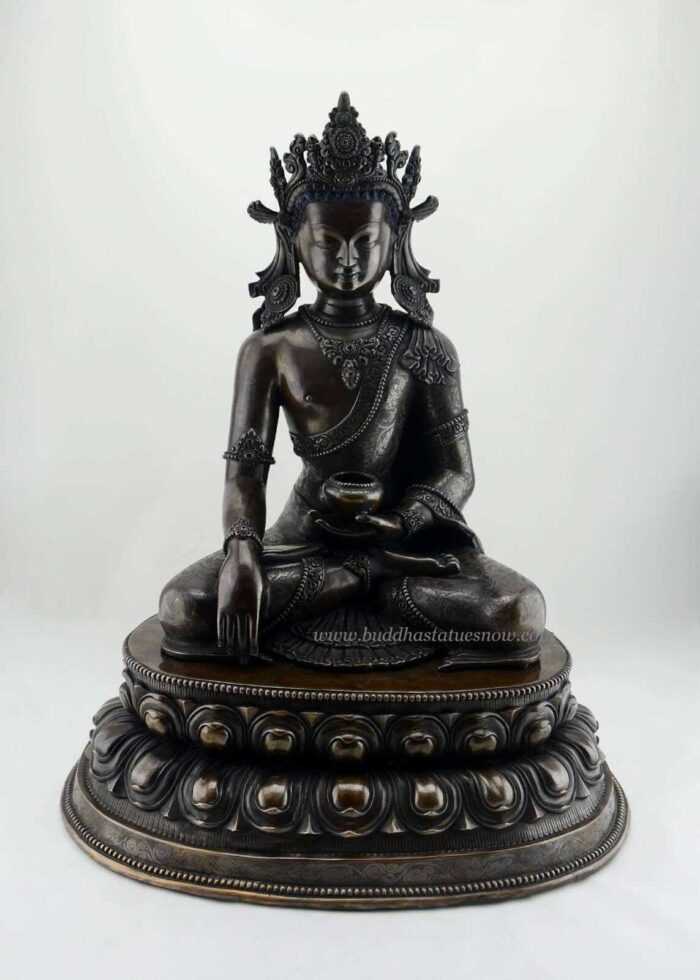
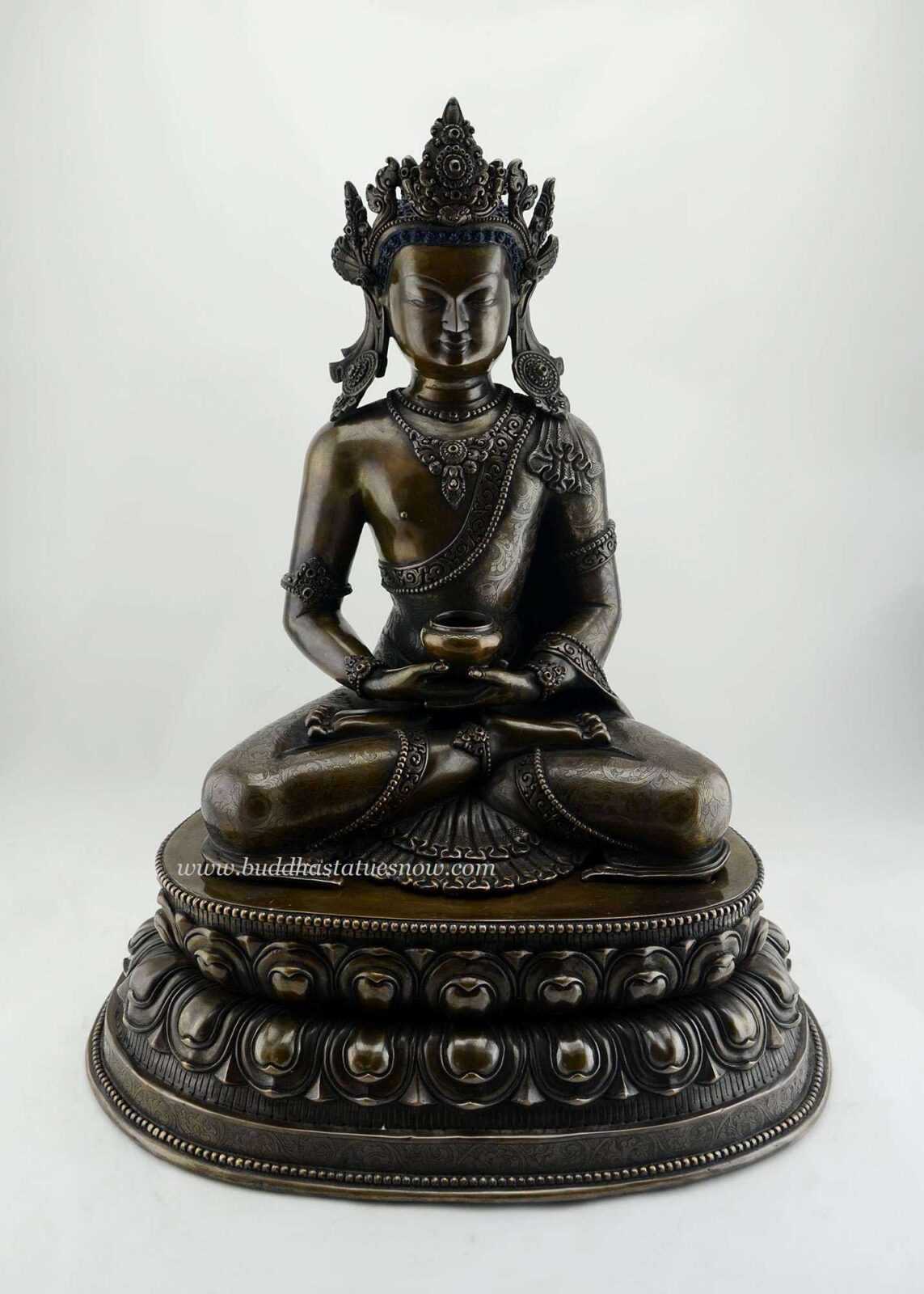
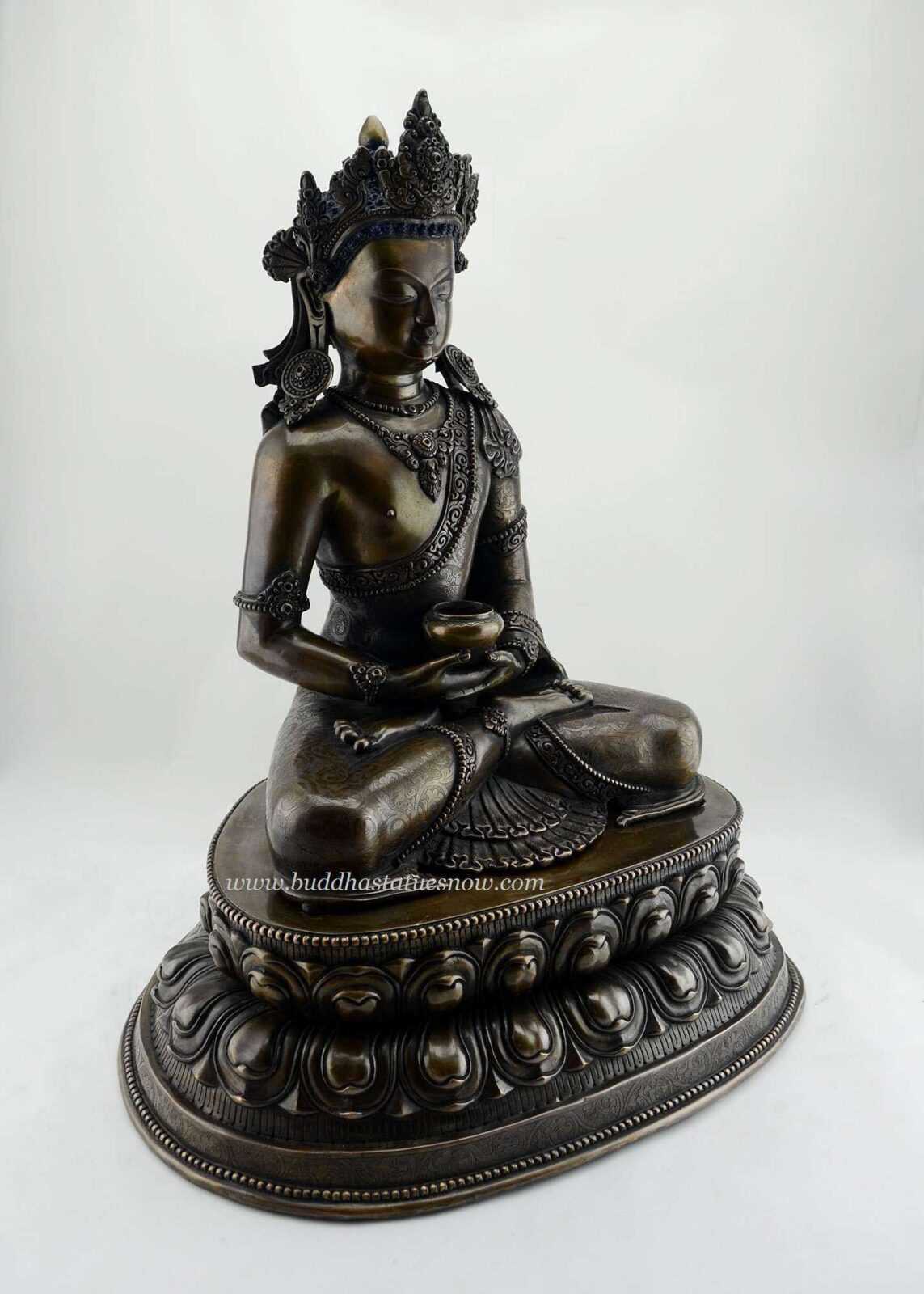
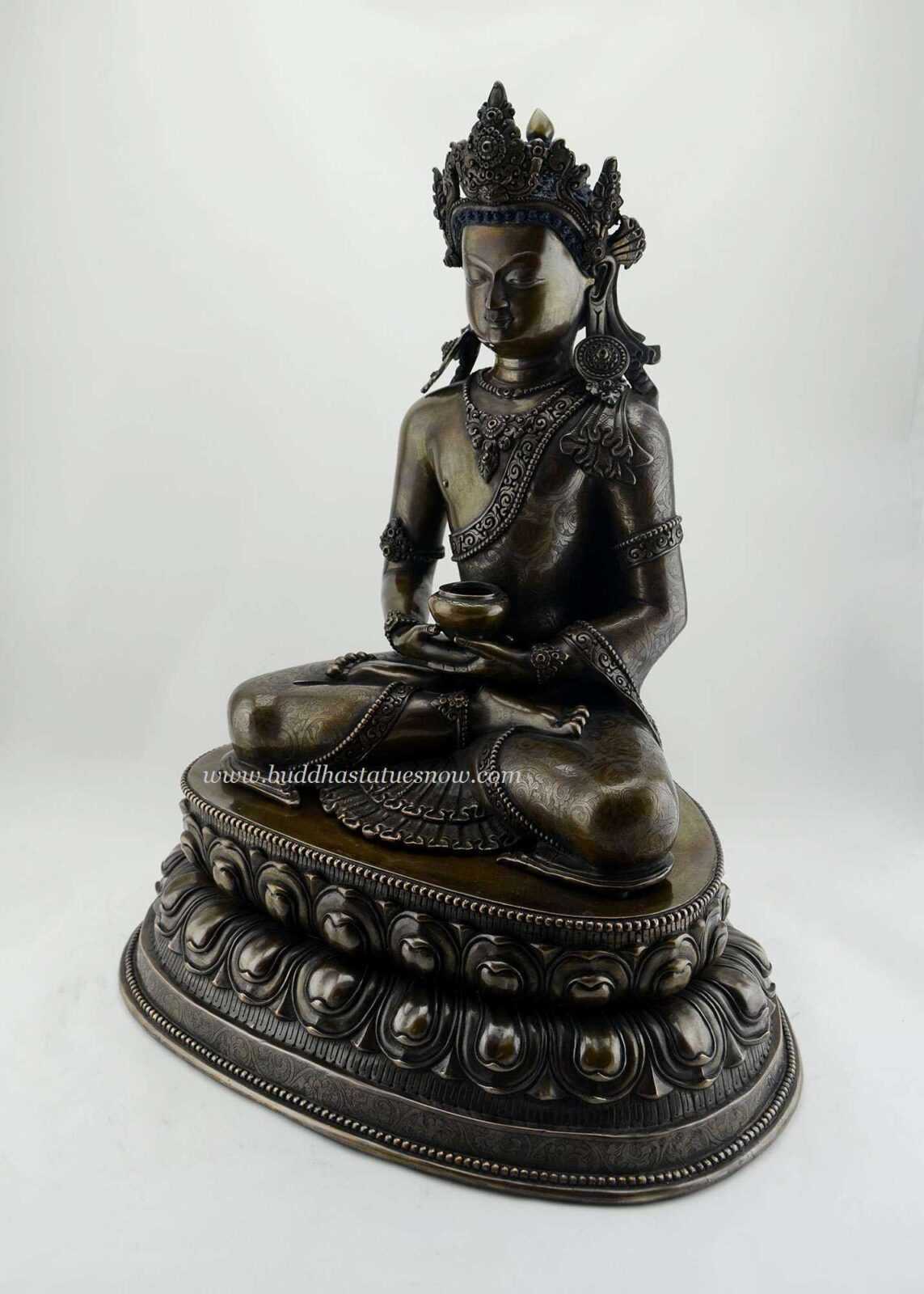

This magnificent Crowned Amitabha Buddha statue portrays the Buddha of Infinite Light in a richly ornamented celestial form. Measuring approximately 19 inches high, the sculpture was handmade in Patan, Nepal from copper alloy using the traditional lost-wax casting method. Its dark oxidized finish gives Amitabha the dignified presence of an antiquated Himalayan sacred image, while intricate hand engraving covers the robe, garment borders and substantial double lotus throne.
Although Amitabha is often represented in simple monastic robes, this sculpture presents him wearing an elaborate five-point crown, large circular earrings, layered necklaces, armbands and bracelets. These ornaments identify him in a regal, celestial manifestation rather than as an earthly ruler. They symbolize the inexhaustible qualities of Buddhahood, the spiritual richness of enlightenment and Amitabha’s sovereignty within the lotus family of the Five Dhyani Buddhas.
The deep oxidized copper finish moves between warm brown highlights and nearly black recessed areas. This natural variation allows the raised jewelry, robe borders and engraved textile patterns to emerge through changes in light rather than through bright gilding. The result is visually restrained yet highly detailed, making the statue especially appropriate for a principal home altar, Buddhist center or collection of authentic Himalayan Buddhist art.
Crowned Amitabha Buddha Statue Features
Amitabha sits in vajrasana, the full lotus posture, with both feet turned upward across the lap. The stable triangular form created by the crossed legs represents unwavering meditation and the perfect equilibrium of an awakened mind. His shoulders remain relaxed, his torso upright and his gaze gently lowered, conveying a state of profound stillness without withdrawal from the suffering of sentient beings.
Both hands rest in the lap in the Dhyana Mudra, the gesture of meditation. The right hand lies above the left with the palms facing upward, creating a balanced oval beneath the alms bowl. This mudra represents meditative absorption, concentration and the union of wisdom with compassionate awareness. It is one of Amitabha Buddha’s most recognizable iconographic features.
An alms bowl rests at the center of his open palms. The bowl recalls the discipline and humility of the Buddhist path, but in Amitabha’s iconography it may also be understood as containing the nectar of spiritual nourishment. It therefore points beyond physical sustenance toward the Dharma that relieves ignorance and guides beings toward liberation. Learn more about the meaning and symbolism of Amitabha Buddha statues.
Amitabha Buddha, Infinite Light and the Pure Land
Amitabha means “Infinite Light,” while his related name Amitayus means “Infinite Life.” In Tibetan Buddhism, Amitabha is known as Opame; in East Asian traditions he is also called Amida or Amituofo. He presides over Sukhavati, the Western Pure Land created through his immeasurable merit and compassionate vows.
Sukhavati is described as an environment especially favorable for hearing the Dharma and progressing toward enlightenment. Pure Land practice is therefore not simply a wish to escape the difficulties of the present world. It expresses confidence in Amitabha’s vows and the aspiration to be reborn under conditions where distraction and adversity no longer obstruct spiritual development.
Amitabha belongs to the lotus family and is associated with discriminating wisdom. This awakened wisdom recognizes the unique qualities of each phenomenon without becoming trapped by attachment or desire. In this way, the very mental energy that ordinarily produces craving can be transformed into lucid appreciation and compassionate discernment. Answers to common doctrinal questions are available in our Amitabha Buddha FAQ.
The Crowned Celestial Form of Amitabha
The tall Bodhisattva-style crown is one of the defining features of this Crowned Amitabha Buddha statue. Five principal sections rise around a prominent central spire, enriched with circular medallions, scrolling leaves and flame-shaped points. A narrow indigo-colored band separates the crown from the dark curled hair and introduces a restrained touch of traditional Himalayan color.
Large disc earrings descend beside Amitabha’s face and are framed by fan-shaped ornaments. A broad jeweled necklace rests across the chest, while a second ornamental strand follows the edge of the robe. Matching armbands and bracelets complete the celestial adornments. Their raised forms are carefully modeled but retain the same oxidized finish as the body, preserving the statue’s unified antiquated appearance.
At the buyer’s request, the crown and jewelry may be embellished with turquoise and red stones before delivery at no additional charge. Red is particularly appropriate for Amitabha and the lotus family, while turquoise provides a traditional Himalayan contrast against the dark copper. The stones can be placed selectively so that they emphasize the crown and ornaments without overwhelming the finely engraved metalwork.
Hand-Engraved Robe and Textile Detailing
Fine floral and foliate engraving extends across Amitabha’s robe, creating the appearance of ceremonial brocade rendered in copper alloy. The patterned fabric passes diagonally over the left shoulder, follows the torso and spreads across the crossed legs. Narrow scrolling borders distinguish the robe’s hemlines from the broader engraved fields.
At the center of the seat, the garment opens into a carefully modeled fan-shaped arrangement of folds. The radiating pleats create a strong visual axis beneath the alms bowl and give structure to the broad seated composition. Beaded borders and engraved bands continue around the wrists, upper arms and lower garment, linking the textiles with Amitabha’s crown and jewelry.
The reverse photographs reveal that this decoration was completed fully in the round. Foliate engraving continues across the shoulder, upper back and seated legs, while a decorated border follows the robe diagonally across the torso. The rear of the crown and the individual curls of Amitabha’s hair are also carefully modeled, allowing the statue to be displayed where it can be viewed from several directions.
Engraved Double Lotus Throne
Amitabha rests upon a substantial double lotus throne formed by two complete registers of overlapping petals. The smaller upper petals support the seated Buddha, while the larger lower petals expand outward to create a broad architectural foundation. Raised centers, recessed outlines and surrounding beaded rims give each petal a strong sculptural presence.
Engraving continues around the circular surfaces above, between and below the lotus registers. Fine scrolling motifs decorate the lower border, while the rear of the pedestal is covered with floral and textile-like patterns. Unlike the matching Crowned Shakyamuni sculpture, whose rear throne includes deer and Dharma-wheel symbolism connected with the first teaching at Sarnath, this Amitabha throne emphasizes extensive ornamental engraving suited to the Buddha of the Western Pure Land.
The double lotus carries an important symbolic meaning. A lotus grows from muddy water but opens above the surface without being stained by its surroundings. It therefore represents awakened purity arising within samsara. The two-tiered throne elevates Amitabha visually and reinforces his status as an especially venerated Buddha whose wisdom remains untouched by attachment and confusion.
Traditional Lost-Wax Casting in Patan, Nepal
This Crowned Amitabha Buddha statue was created by Newar artisans in Patan, Nepal, an historic center of Himalayan Buddhist metalwork. The process begins with a detailed wax model formed according to traditional iconometric proportions. The model is enclosed within a heat-resistant mould and fired so that the wax melts away, leaving a hollow space into which molten copper alloy is poured.
After the metal cools, the mould is broken and the casting is refined by hand. The artisan chases the contours, cleans the surface, defines the crown and jewelry, and engraves the extensive textile designs across the robe and throne. The completed copper-alloy sculpture is then treated to develop its dark oxidized finish.
Because the original wax model is destroyed and the chasing and engraving are individually completed, each statue retains subtle handmade variations. This sculpture measures approximately 19 inches high, 16 inches wide and 13 inches deep, with an approximate shipping weight of 20 kilograms. Its broad double lotus throne and tall crown give it an imposing presence suitable for a substantial shrine or dedicated meditation space.
Crowned Amitabha and Shakyamuni Buddha Statue Set
This Crowned Amitabha Buddha statue forms a beautifully coordinated two-piece altar set with the matching Crowned Shakyamuni Buddha sculpture. Both statues share the same 19-inch scale, rich oxidized copper finish, elaborate five-point crowns, Bodhisattva-style jewelry, engraved robes and broad double lotus thrones. Their complementary proportions and closely related workmanship give the pair the unity of an intentionally designed devotional ensemble.
The two figures remain immediately distinguishable through their mudras and attributes. Amitabha holds an alms bowl with both hands in the Dhyana Mudra, emphasizing meditation, infinite light and the Pure Land of Sukhavati. Shakyamuni extends his right hand in the earth-touching gesture while supporting his bowl with the left, recalling his enlightenment beneath the Bodhi tree. The deer and Dharma wheel carved into the back of Shakyamuni’s throne commemorate his first teaching at Sarnath, while Amitabha’s throne carries extensive ornamental engraving associated with his celestial presentation.
Doctrinally, the pairing joins the historical source of the Buddhist teachings with the compassionate Pure Land tradition. Shakyamuni Buddha appeared in our world, attained enlightenment and taught the Four Noble Truths, dependent origination and the Noble Eightfold Path. Amitabha Buddha embodies infinite light and the vows that established Sukhavati as a favorable environment for continuing toward awakening.
Together, they represent a complementary path: Shakyamuni reveals the Dharma and teaches practitioners how suffering may be overcome, while Amitabha offers a Pure Land aspiration centered on faith, remembrance, ethical conduct and accumulated merit. The set is therefore appropriate for an altar honoring both the Historical Buddha’s teaching activity and Amitabha’s compassionate vows.
Custom-Made Crowned Amitabha Buddha Statues
A custom-made Crowned Amitabha Buddha statue may be commissioned for a private shrine, temple, Dharma center or Buddhist art collection. The sculpture can be recreated in a preferred size while preserving Amitabha’s essential iconography, including the full lotus posture, Dhyana Mudra, alms bowl, celestial crown, jeweled ornaments and double lotus throne.
Custom finishes may include dark oxidized copper similar to this statue, a lighter antiquated finish, partial gilding or 24K fire gilding. The face may be hand painted with 18K gold and natural pigments when appropriate, and the crown and jewelry may be embellished with turquoise and red stones. Additional robe engraving, personalized throne ornamentation and variations in the density of the decorative carving may also be discussed with the artisan.
A coordinated two-statue commission may also be arranged so that Amitabha and the Crowned Shakyamuni Buddha sculpture share matching dimensions, crown proportions, oxidized finishes, robe patterns and double lotus pedestals. The completed set would preserve Amitabha’s contemplative Pure Land identity and Shakyamuni’s earth-touching historical iconography while uniting both Buddhas through closely matched craftsmanship and ornamentation.
Authentic, Handmade in Nepal
Every statue is handcrafted in Patan, Nepal, using traditional lost wax casting and comes with a certificate of authenticity issued by Nepal’s Department of Archaeology, verifying its materials, technique, and origin.