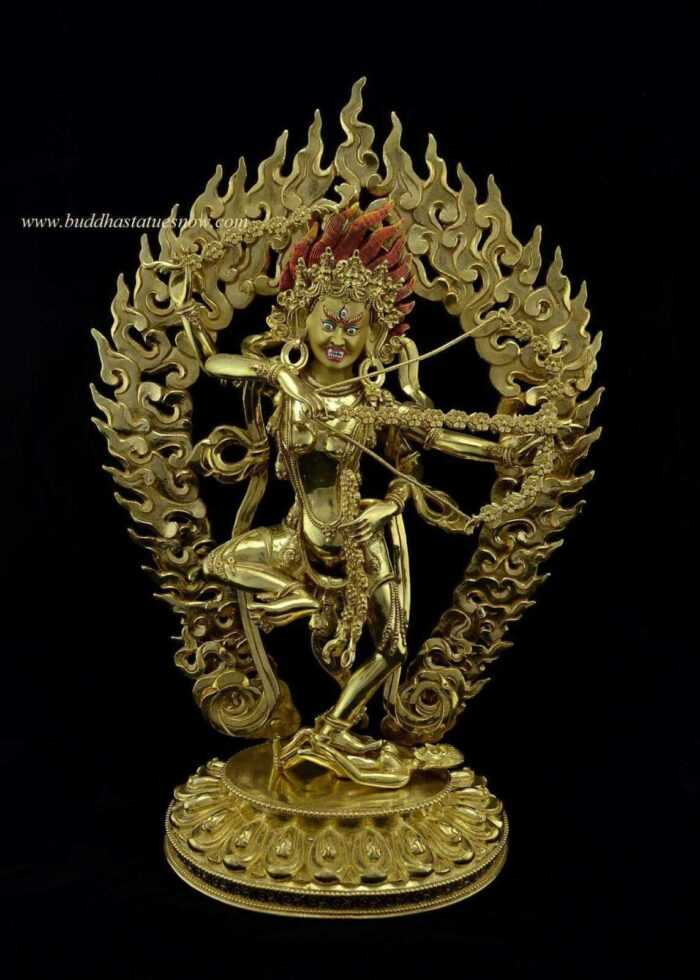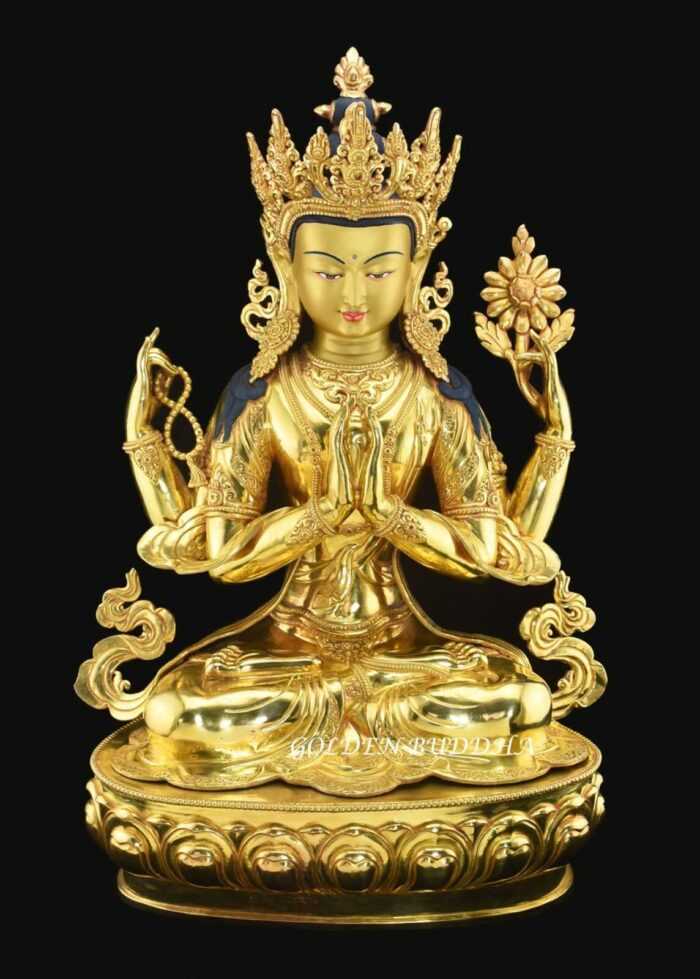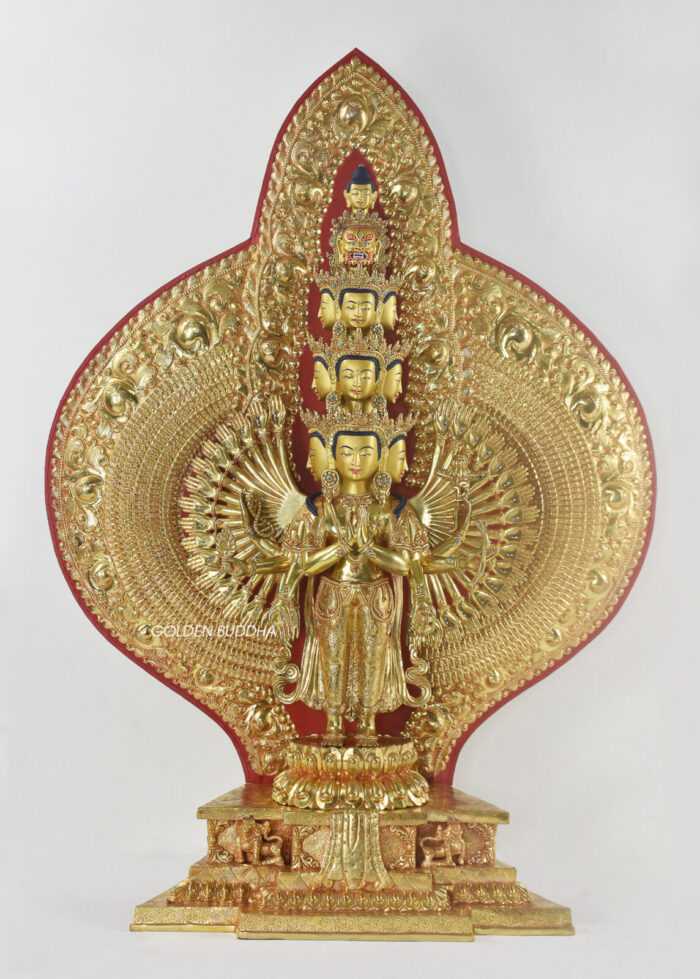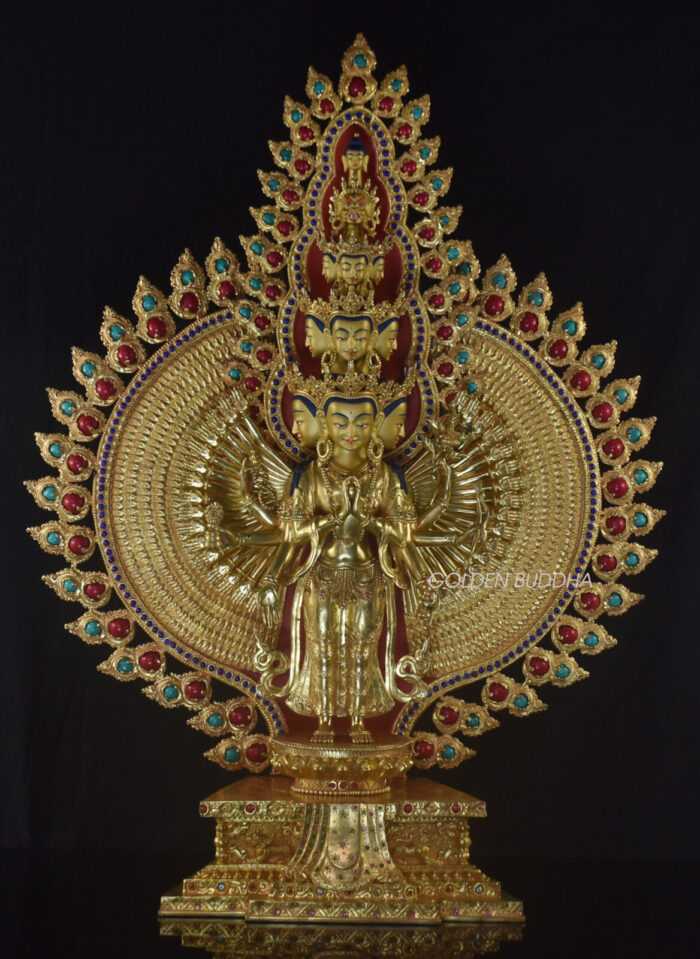
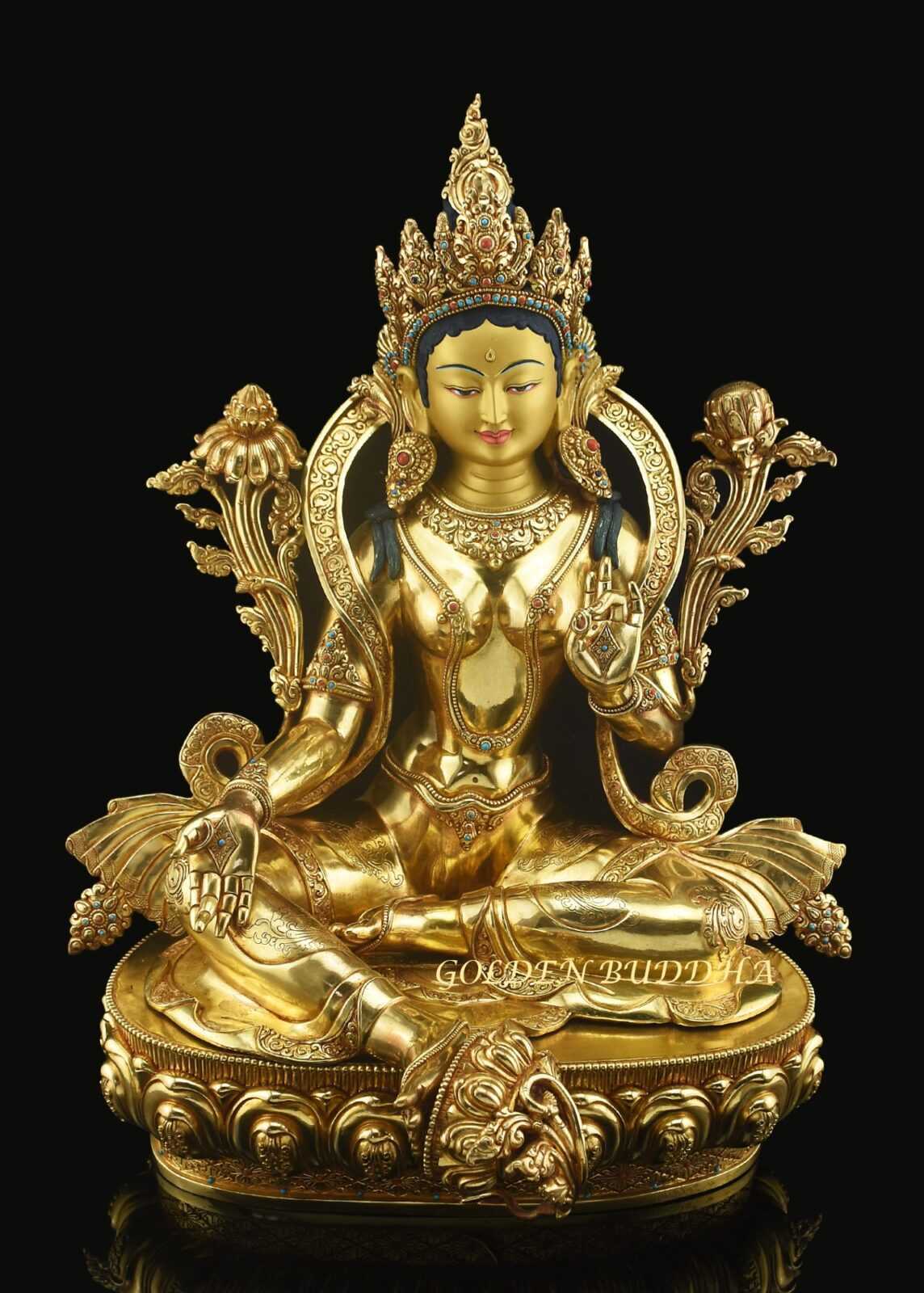
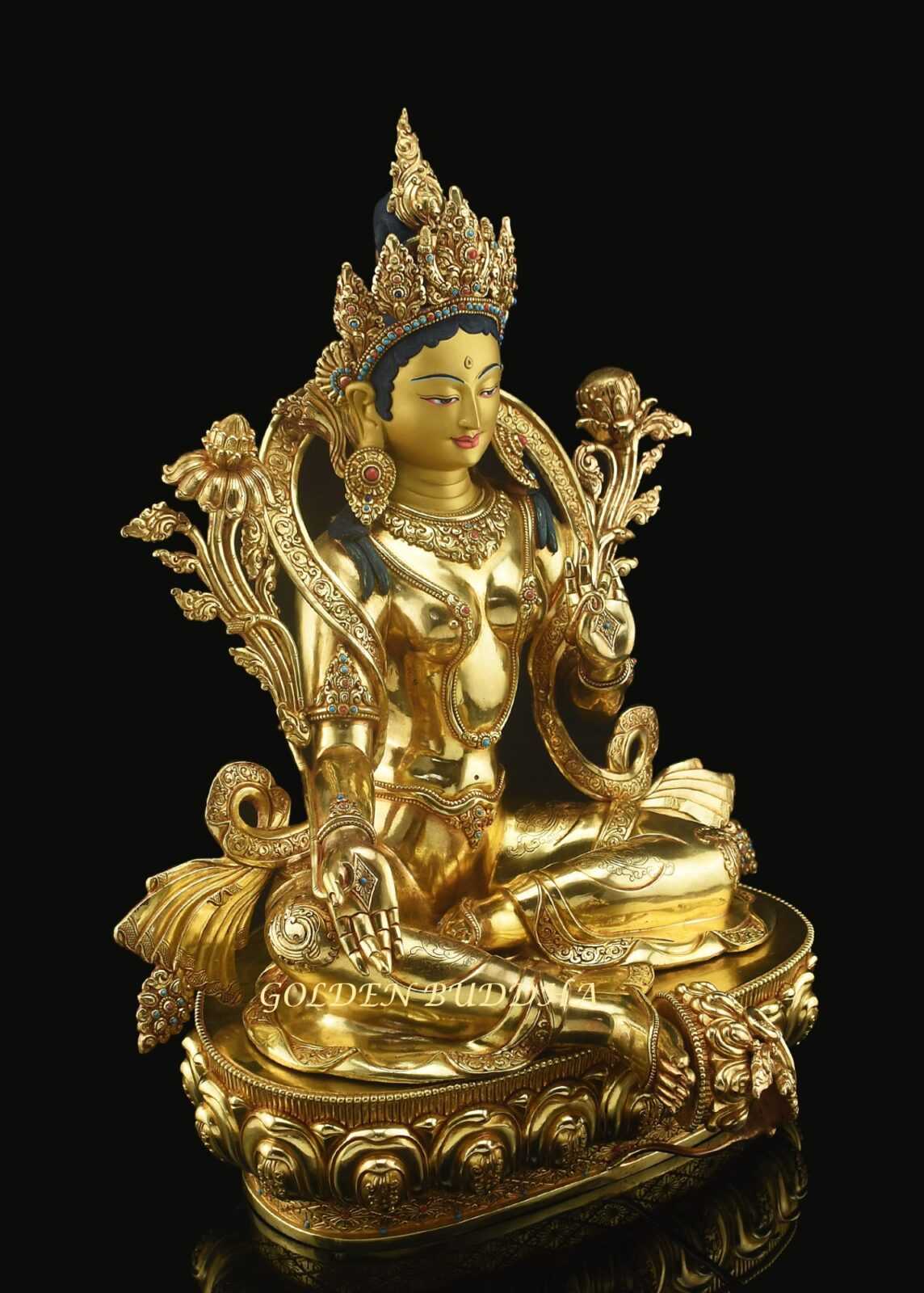
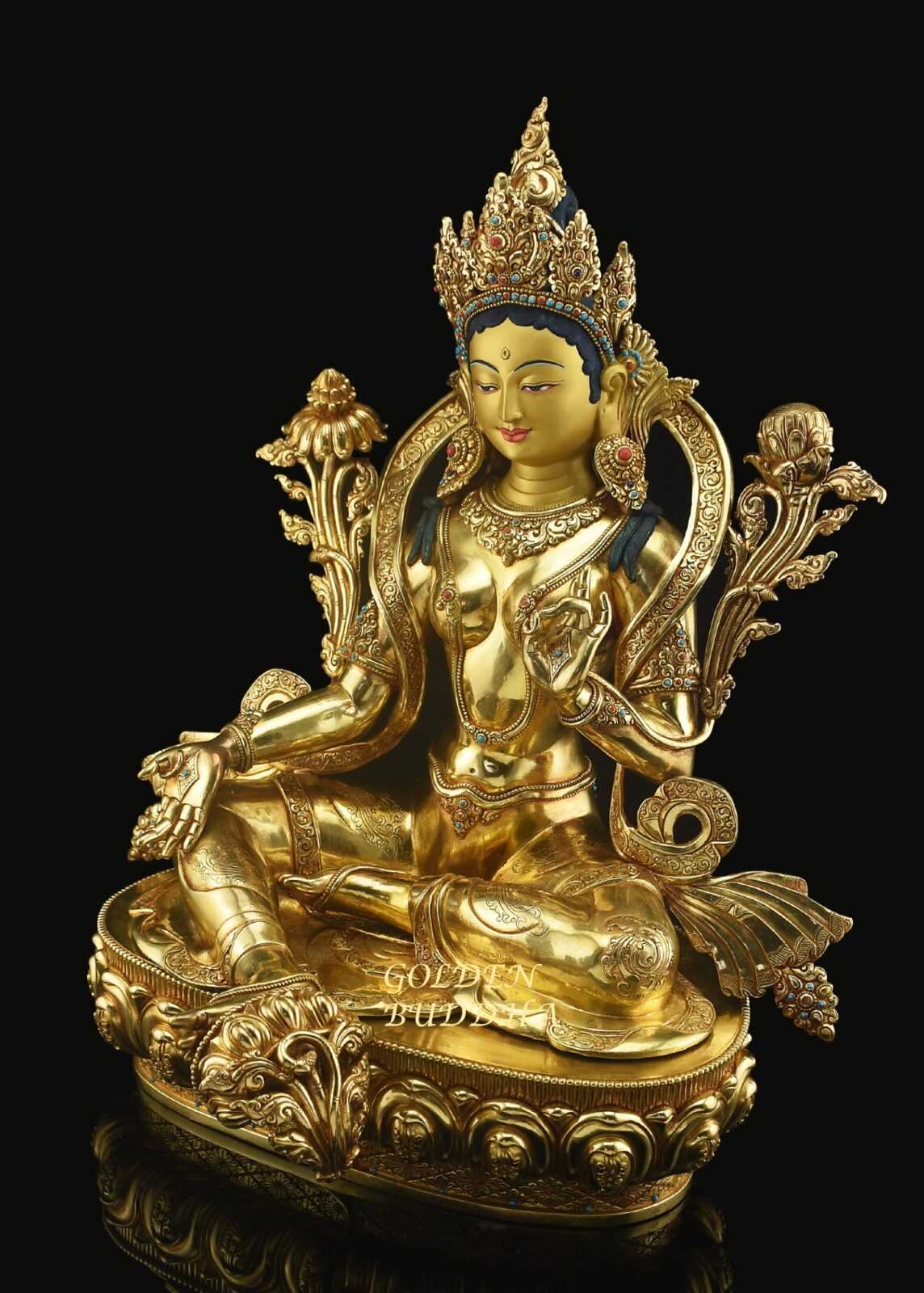
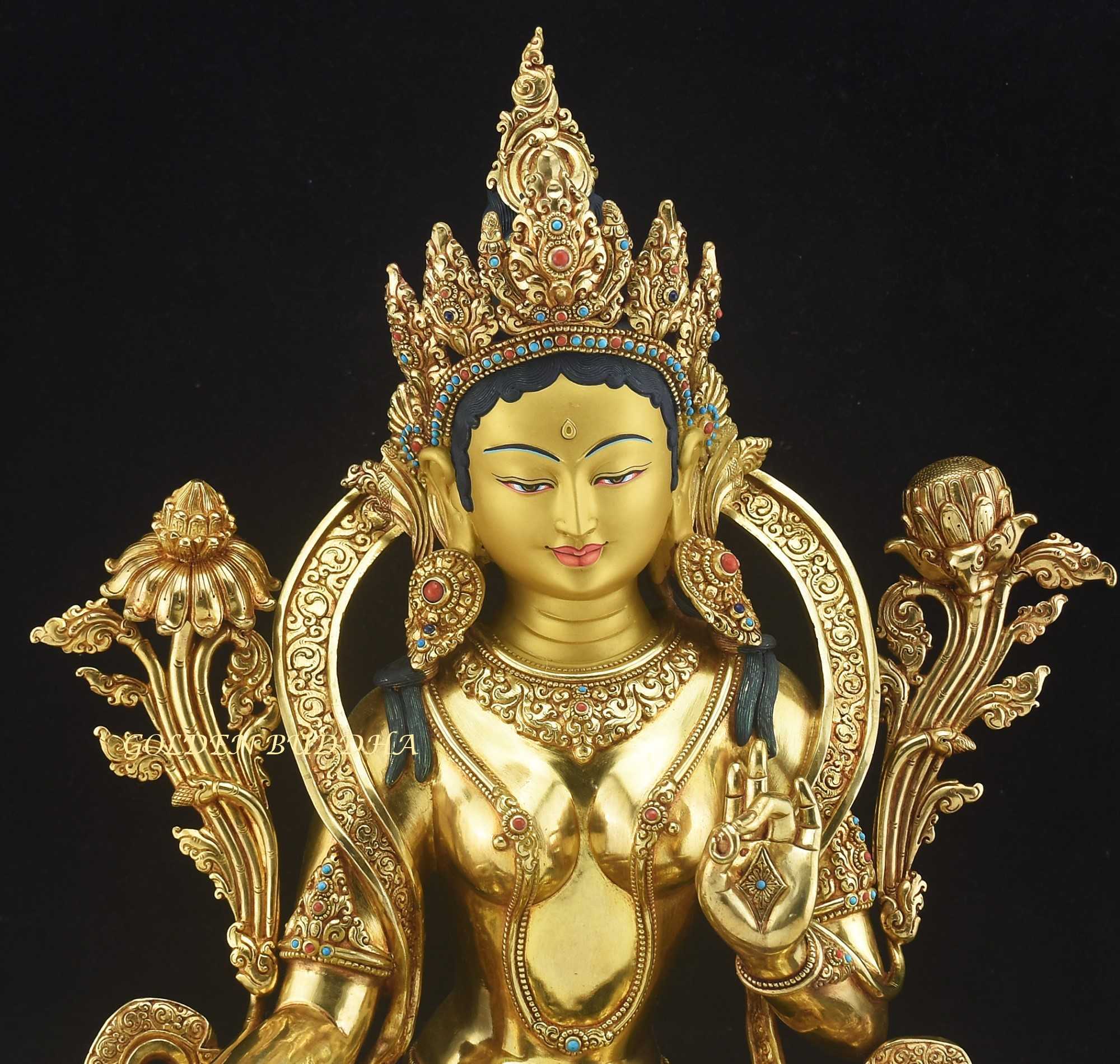
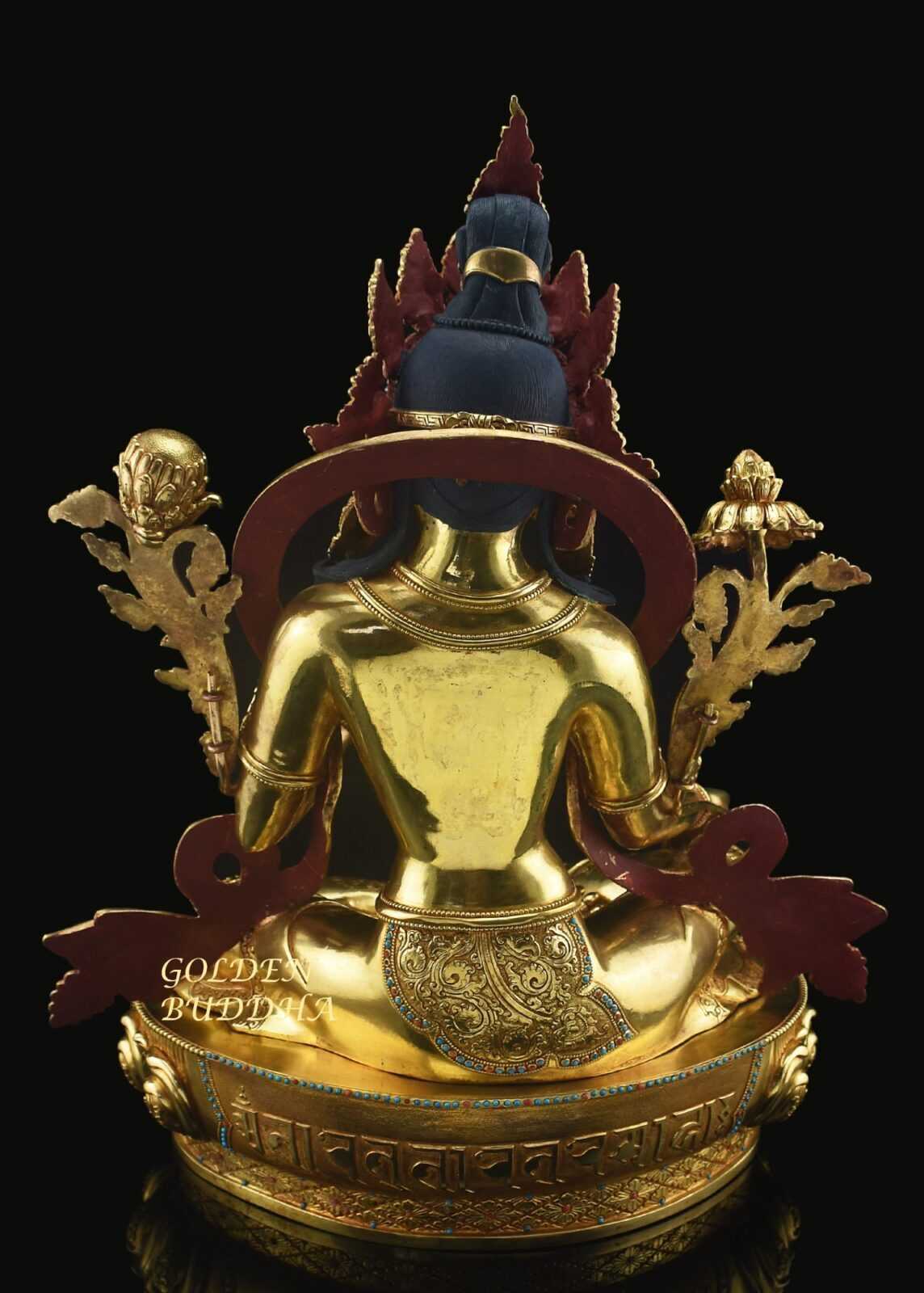
An elaborate crown set with turquoise and red coral immediately distinguishes this magnificent 18.5″ Khadiravani Tara statue as a masterpiece of traditional Himalayan Buddhist art. The copper alloy sculpture was handcrafted in Patan, Nepal by a master Newar artisan using the traditional lost wax sculpting method and then fire gilded in 24K pure gold. Genuine turquoise and red coral stones are already embedded throughout the Bodhisattva crown, necklaces, earrings, armbands, bracelets, girdle, garments, and pedestal. These stones are an integral part of the finished sculpture and create brilliant accents against the warm golden surface.
The front and rear views reveal extensive hand engraving across Tara’s flowing dhoti, celestial scarves, Bodhisattva jewelry, and lotus throne. Floral scrollwork follows the contours of her crossed legs, while delicate turquoise inlays trace the borders of the garment and the upper edge of the pedestal. The reverse is finished with equal care: the engraved panel of her lower garment remains fully visible beneath the smooth gilded back, and a line of turquoise stones continues around the throne. Her face is traditionally hand painted in real gold, allowing the artisan to create finely outlined eyes, arched brows, a softly painted mouth, and a serene expression that would be difficult to achieve through fire gilding alone.
Khadiravani means “Tara of the Khadira Acacia Forest,” identifying a revered form of Green Tara associated with swift compassion, protection, and liberation from fear. She is known as the Mother of Liberation because her compassionate activity is joined with direct insight into emptiness. Rather than merely suppressing fear, Tara represents the wisdom that recognizes its changing and insubstantial nature. Her practice encourages devotees to respond to suffering with courage, generosity, and compassionate action. Learn more about the Green Tara mantra and practice in our complete guide to Tara symbolism.
Khadiravani Tara Statue Mudras and Lotus Flowers
The lowered right hand of this Khadiravani Tara statue displays the Varada mudra, the gesture of generosity and the granting of blessings. Her palm opens toward devotees while the fingers extend gracefully over her right knee. A vajra is engraved in the center of the palm, combining Tara’s gift-giving activity with the indestructible nature of enlightened wisdom and compassion. The same hand delicately holds the stem of the lotus that rises beside her right shoulder.
Her raised left hand forms a gesture of reassurance while holding the stem of a second lotus. The photographs show one fully open lotus flower and one closed lotus bud. The open blossom beside her right shoulder represents enlightened qualities that have already reached complete expression. The closed bud beside her left shoulder represents the awakened potential that remains within sentient beings and gradually unfolds through ethical conduct, meditation, and wisdom. Together, the two flowers express both accomplished enlightenment and the possibility of awakening that is still developing along the Dharma path.
Khadiravani Tara Statue in Lalitasana
Green Tara is seated in lalitasana, the graceful posture of royal ease. Her left leg remains folded in meditative composure, while her right leg extends forward and rests upon a separate lotus support. This posture communicates Tara’s distinctive balance of contemplation and immediate action. The folded leg represents the stability and wisdom cultivated through meditation, while the extended leg shows that she is prepared to rise without hesitation whenever beings call upon her for assistance.
The large oval lotus throne is constructed with deeply modeled petals, a finely beaded upper rim, and extensive floral ornamentation around the lower register. Flowing scarves form broad loops beside her body before curling into decorative scrolls near the throne. These projecting elements, together with the flowers, crown points, jewelry, and extended foot, demonstrate the technical difficulty of casting such a complex figure through the lost wax method. The finished composition remains balanced despite its many finely sculpted details.
Green Tara and Lokeshvara Monastic Pair
This Green Tara statue would form an impressive shrine pair with our 24.5″ Lokeshvara statue. Both are substantial copper alloy sculptures from Patan with 24K fire-gilded finishes, gold-painted faces, elaborate Bodhisattva crowns, refined jewelry, open lotus imagery, and flowing celestial scarves. Their symbolism is equally complementary. Lokeshvara, also known as Chenrezig or Avalokiteshvara, embodies limitless compassion for all sentient beings, while Green Tara represents the swift and active expression of that compassion. Displayed together, Lokeshvara may serve as the taller central figure, with Tara beside him as the compassionate activity that moves immediately into the world. Their six-inch difference in height creates a natural visual hierarchy without making the Tara appear secondary in craftsmanship or presence.
Custom Green Tara Statue Commissions
Collectors, monasteries, Dharma centers, and practitioners may also commission a custom Tibetan Buddhist statue inspired by this Khadiravani Tara statue. A commission may be adjusted for a particular altar through the selection of height, pedestal proportions, degree of 24K fire gilding, engraving patterns, gemstone placement, facial painting, and complementary figures. A coordinated Tara and Lokeshvara pair can also be commissioned with matching crowns, lotus pedestals, gemstone colors, and surface finishes. Progress photographs may document the wax model, copper alloy casting, hand chasing, engraving, gilding, gemstone setting, and face painting. Because the individually sculpted wax model is destroyed during casting, every commissioned sculpture retains its own handcrafted character rather than becoming an identical mechanical reproduction.
Authentic, Handmade in Nepal
Every statue is handcrafted in Patan, Nepal, using traditional lost wax casting and comes with a certificate of authenticity issued by Nepal’s Department of Archaeology, verifying its materials, technique, and origin.