
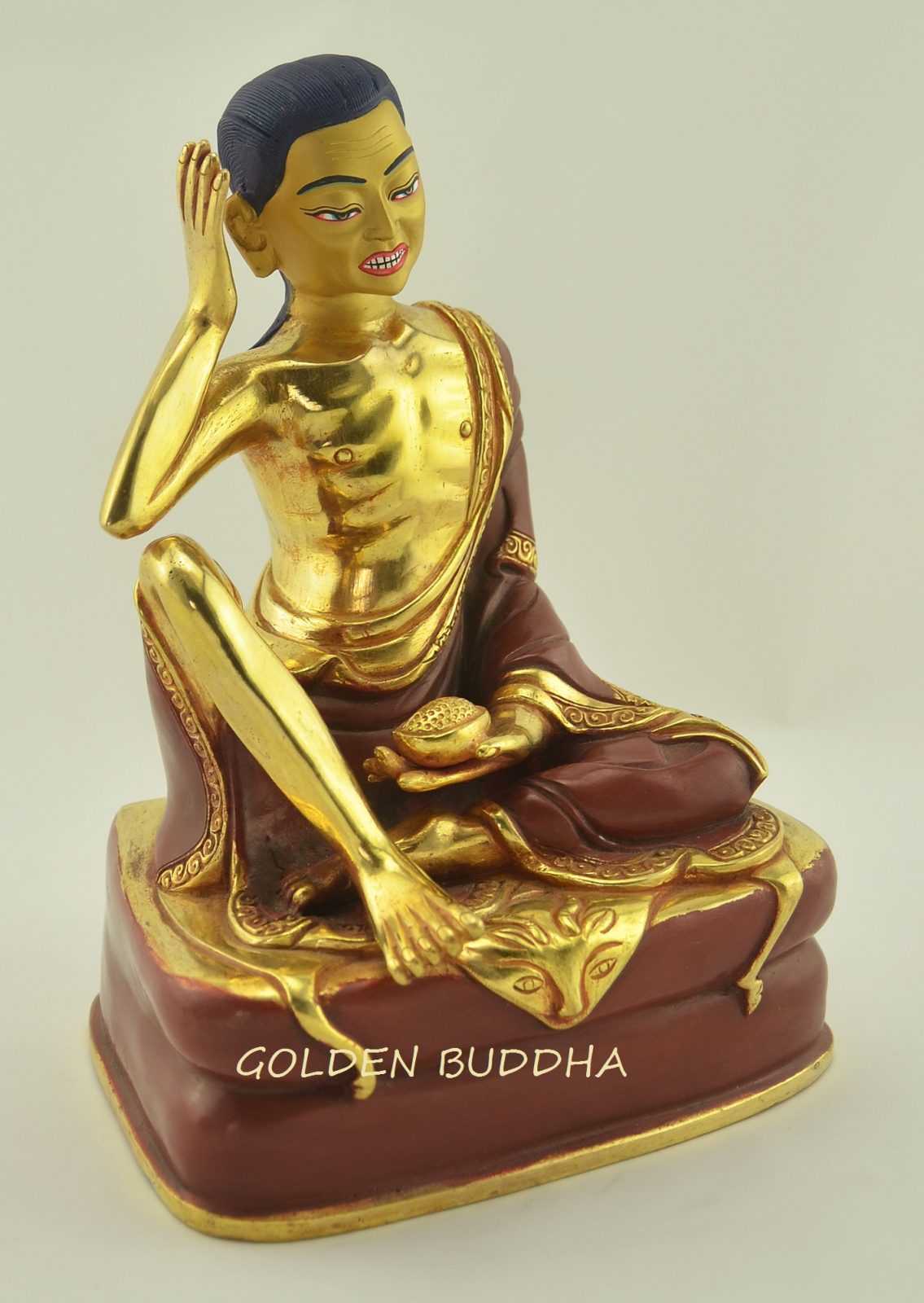
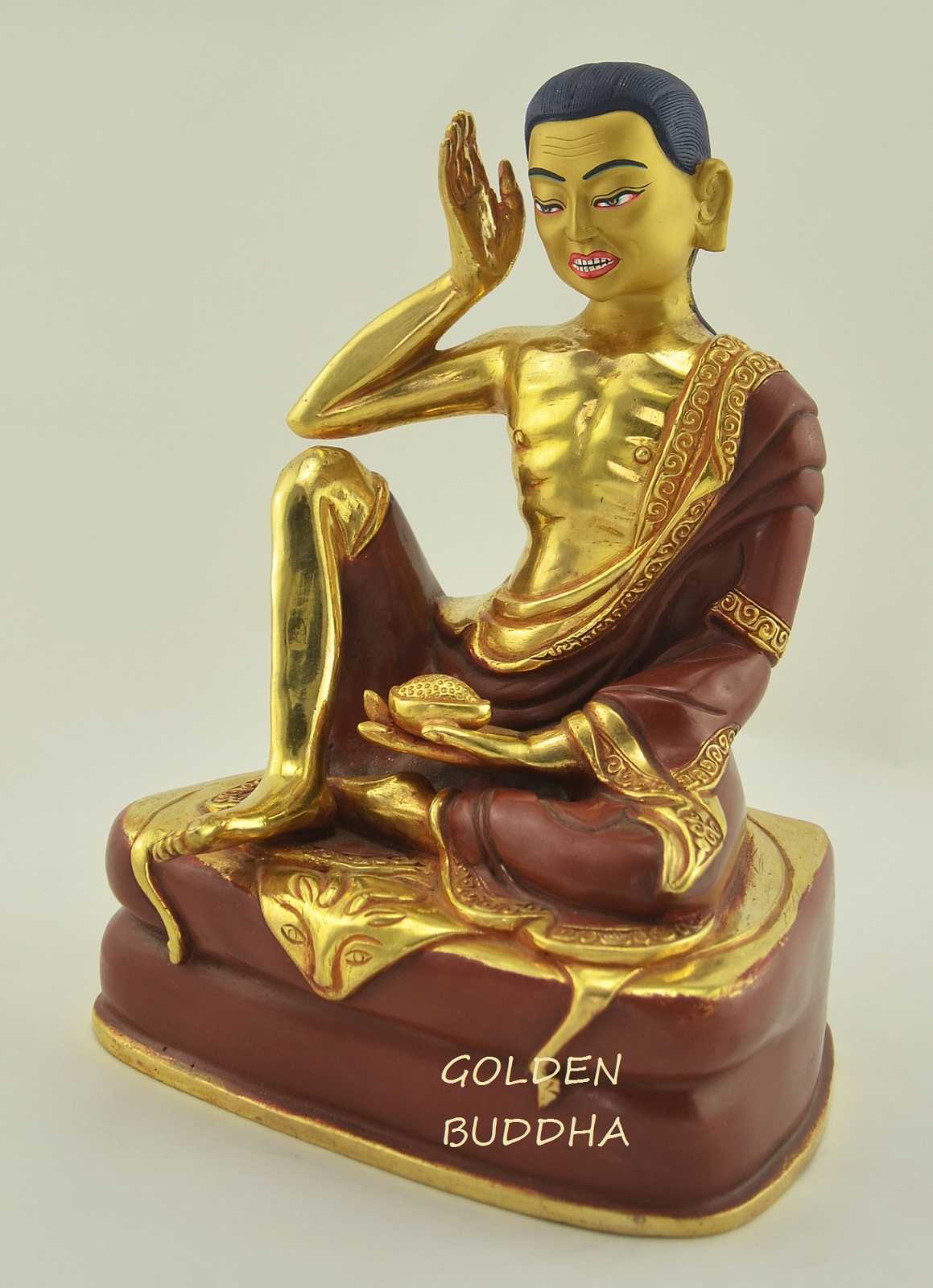
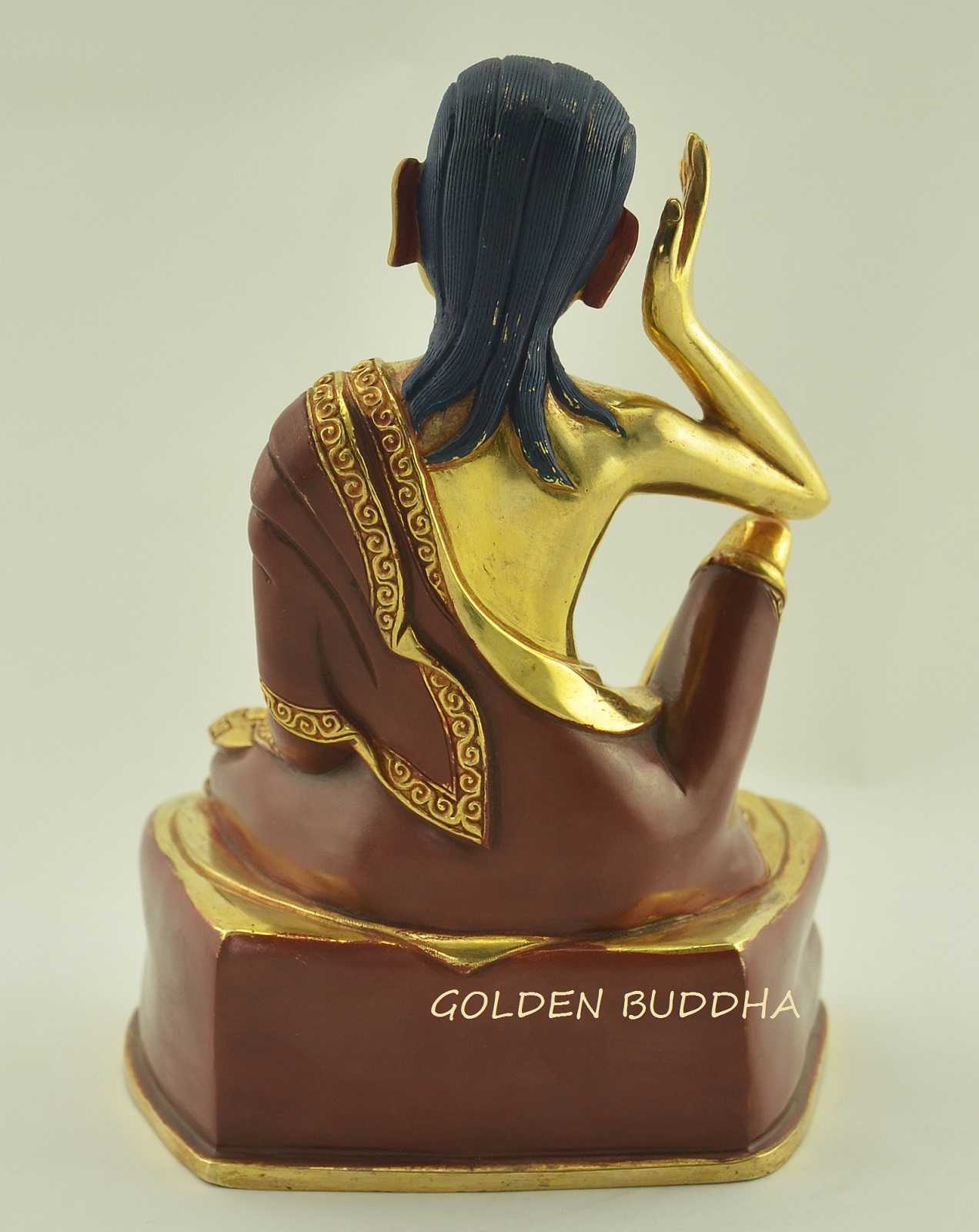
Milarepa’s life of uncompromising retreat is expressed unusually well in this 7-inch Handmade Guru Milarepa Statue. Rather than presenting an idealized royal or monastic figure, the artisan has emphasized the physical character of a Himalayan yogi: a narrow waist, clearly modeled ribs, one leg drawn upward and a concentrated face whose slightly parted mouth suggests the songs for which Milarepa became famous. His right hand rises beside his ear in his unmistakable listening gesture, while the left supports a kapala skull cup. Beneath him is an animal-skin meditation seat, with the stylized head projecting prominently from the front of the cushion. The result is immediately recognizable as Jetsun Milarepa even before the history of the figure is known.
Handmade Guru Milarepa Statue | A Himalayan Meditation Yogi
The sculpture was handmade in Nepal from copper alloy using the traditional lost-wax casting method. Its finish deliberately divides the composition between luminous and subdued surfaces. Milarepa’s exposed torso, arms, raised leg, hands and face are fire gilded in 24K gold, while the robe and broad meditation cushion retain deep reddish-brown antiquated oxidized tones. Fine gilded scroll borders trace the edge of the robe and continue around the sleeve, providing ornament without overwhelming the austerity appropriate to a cave hermit. His face is separately hand painted with 18K gold and natural pigments, with sharply defined eyes, eyebrows, lips and individually painted teeth.
Milarepa, also known as Thöpaga, “Delightful to Hear,” and Jetsun, “Venerable Lord,” became one of the most celebrated practitioners in the history of Tibetan Buddhism. Traditional biographies recount his transformation from a young man burdened by destructive actions into an accomplished yogi under the uncompromising guidance of Guru Marpa Lotsawa. After receiving the Kagyu transmissions, Milarepa withdrew for prolonged meditation in Himalayan caves, where his mastery of practices including tummo allowed him to live with extremely little protection from the cold. His name “Milarepa” is traditionally associated with the simple cotton clothing worn by an accomplished practitioner of inner heat.
The Listening Gesture, Kapala and Yogic Seat
Milarepa’s raised right hand is the defining visual signature of the statue. Held beside the ear, it evokes both listening and the spontaneous songs through which he communicated realization to disciples. His left hand rests lower across the lap and supports a kapala, connecting the image with the ritual world of Vajrayana practice. His asymmetric seated posture is equally characteristic: one knee rises sharply while the opposite leg folds beneath him, abandoning the formal symmetrical lotus posture seen in Buddha images. The exposed rib cage reinforces the ascetic character of the composition. Although accounts describe Milarepa’s skin becoming greenish after surviving for long periods on nettles, this particular statue does not reproduce that coloration; its exposed body is intentionally presented in luminous gold.
Guru Milarepa, Marpa and Gampopa | The Mar-Mi-Dag Triad
This statue becomes especially significant when paired with Marpa and Guru Gampopa. Together they form the Mar-Mi-Dag succession: Marpa transmitted the Indian teachings into Tibet, Milarepa brought those instructions to realization through intensive yogic practice, and Gampopa received the lineage from Milarepa before joining it with his Kadampa training and establishing an enduring monastic framework. The three therefore represent transmission, realization and institutional continuation within the early Kagyu tradition. For a three-statue shrine, Marpa may be placed on the viewer’s left, Milarepa prominently in the center, and Gampopa on the viewer’s right, creating an altar that visually follows the living succession from teacher to disciple.
Filling and Consecration in Kathmandu, Nepal
Practitioners preparing the sculpture for an active Kagyu shrine may arrange traditional filling and consecration in Kathmandu before shipment. Sacred mantra rolls and appropriate ritual substances can be installed within the hollow copper-alloy figure before it is sealed and blessed. More information is available through our Buddha statue filling and consecration service in Nepal.
Custom Handmade Guru Milarepa Statues
Collectors, Dharma centers and Kagyu practitioners may also commission custom Tibetan Buddhist statues handmade in Nepal. Marpa, Milarepa and Gampopa can be created as a coordinated lineage group with compatible dimensions, throne proportions and complementary gilded or antiquated finishes, allowing the three masters to form a deliberately unified Mar-Mi-Dag altar rather than a collection assembled from visually unrelated sculptures.
Authentic, Handmade in Nepal
Every statue is handcrafted in Patan, Nepal, using traditional lost wax casting and comes with a certificate of authenticity issued by Nepal’s Department of Archaeology, verifying its materials, technique, and origin.