

Guru Rinpoche statues portray one of the most extraordinary figures in the history of world religion — the Tantric master Padmasambhava, revered by Tibetan Buddhists as the Second Buddha and the founding father of Tibetan Buddhism. His story begins not in Tibet but in the ancient pure land of Oddiyana, travels along the mountain passes of the Himalayas, and culminates in the most consequential religious transformation in Tibetan history — a transformation that shaped the spiritual character of an entire civilization and produced a living tradition that continues to this day.
To understand the Guru Rinpoche statue meaning is to understand the origin of Tibetan Buddhism itself — a dramatic story involving the collision of two ancient religions, a decisive Tibetan king, a demon-haunted monastery, and an enigmatic Indian tantric master whose influence on Buddhist practice was so profound that Vajrayana practitioners still venerate him as a living Buddha today. The story also explains why authentic Padmasambhava statues handcrafted in Nepal have been the preferred devotional objects of Tibetan monasteries for over a thousand years.
Contents
- Bon Religion — Tibet’s Ancient Spiritual Tradition
- Bon Religion & Tibetan Buddhism Timeline
- Buddhism First Introduced to Tibet
- The Allure of Vajrayana in Tibet
- Santaraksita Arrives in Tibet
- Guru Rinpoche — The Lotus Born Master
- Samye Monastery — Tibet’s First Buddhist Temple
- King Trisong Detsen Chooses Tantric Buddhism
- The Terma Tradition — Hidden Spiritual Treasures
- Guru Rinpoche Statue Meaning & Iconography
- Nepali Lost Wax Sculpture — Origin & Evolution
- The Shakya Caste — Guardians of Sacred Sculpture
- Fire Gilding — The 24K Gold Standard
- Tibetan Buddhism — Destruction & Renaissance
- Frequently Asked Questions About Guru Rinpoche
Bon Religion — Tibet’s Ancient Spiritual Tradition
The ebb and flow between the Bon Religion and Tibetan Buddhism occurred over a 400-year period between the 7th and 11th centuries CE. The Bon Religion was deeply entrenched in Tibet for over 18,000 years before the arrival of Buddhism — making it one of the oldest continuous spiritual traditions on earth. As a result, Buddhism would encounter fierce resistance from the established Bon order when it first arrived in the Land of Snows.
This prolonged conflict between the two religions induced significant political upheaval — including the assassination of two Tibetan monarchs. Eventually, Tibetan Buddhism prevailed and was accepted by Tibetan culture. However, the process left permanent marks on both traditions. When a new religion is introduced into a different culture, the new religion must adapt — and Tibet was no different. Buddhism was eventually adopted by Tibet, but with distinctly Tibetan characteristics that set it apart from every other Buddhist tradition in the world.
Tongpa Shenrab is to the Bon Religion what Shakyamuni Buddha is to Buddhism — its founding sage. His original Bon teachings were believed to occur over 18,000 years ago in the Zhang Zhung Kingdom of Western Tibet. In this Bon stronghold, the two religions created an enduring fusion still visible today in the trance ceremonies performed by spirit mediums — who still invoke local Bon spirits but now incorporate Buddhist deities alongside them in their practice.
Bon Religion & Tibetan Buddhism Timeline
| Tongpa Shenrab gives Bon teachings in Zhang Zhung Kingdom | c. 16,000 BCE |
| King Songtsen Gampo marries Buddhist princesses from Nepal and China | c. 625 CE |
| Santaraksita arrives in Tibet, begins sutra translations | c. 763 CE |
| Guru Rinpoche (Padmasambhava) arrives — Samye Monastery completed | 767 CE |
| King Trisong Detsen chooses Tantric Buddhism as national religion | 767 CE |
| Buddhist King Ralpachen murdered — Bon King Langdarma reinstated | 836 CE |
| King Langdarma assassinated by Buddhist monk — Tibetan Buddhism restored | 842 CE |
| Lost wax sculpture emerges in Nepal — Shakya artisans begin supplying Tibet | c. 10th century CE |
| Buddhist Renaissance in Tibet — four major schools established | 11th century CE — Present |
Buddhism First Introduced to Tibet
It is a common misconception that Indian Buddhist masters first introduced Buddhism to Tibet. In fact, it was the marriage of the Tibetan King Songtsen Gampo in the 7th century CE — to both Chinese Princess Wencheng and a Nepali Princess Bhrikuti — that resulted in Tibet’s formal introduction to Buddhism. Both princesses were devout Buddhists who each brought a solid gold Buddha statue to Tibet as part of their dowry. They then zealously competed to build Buddhist temples and monuments throughout Tibet.
Both of these original gold Buddha statues can still be seen inside the Jokhang Temple and Ramoche Temple in Lhasa — among the most sacred objects in all of Tibetan Buddhism. Their presence in Tibet for over 1,400 years is a testament to the durability and spiritual power of authentic gold-gilded Buddhist statuary — the same tradition that continues today in the workshops of Patan, Nepal.
The Allure of Vajrayana in Tibet
In contrast with Theravada and Mahayana Buddhism, Vajrayana Buddhism — the Diamond Vehicle — is the new branch of the Buddhist tradition. The word Vajrayana combines two Sanskrit words: vajra (diamond or thunderbolt) and yana (vehicle). The allure of Vajrayana is its expediency — it offers a fast-track method that can result in achieving Buddhahood in a single lifetime, rather than across countless rebirths.
Vajrayana Buddhism was first developed by ancient Indian masters known as mahasiddhas — wandering tantric adepts whose methods were deliberately provocative and controversial. They practiced meditation in open-air charnel grounds, incorporated mantras, mandalas, mudras, and deity visualization, and pursued the attainment of magical powers known as siddhis. Their practices were openly hostile to the existing monastic order — and yet it was precisely these methods that captured the imagination of the Tibetan king and transformed the entire spiritual culture of Tibet.
The wrathful and semi-wrathful deities of Tibetan Buddhism — depicted in some of the most dramatic Himalayan Buddhist art ever created — are a direct inheritance from the mahasiddha tradition. What the early Tibetan missionaries found in this tradition was not chaos but power: the power to subdue demons, purify karma, and achieve liberation through means that seemed impossible to orthodox Buddhism.
Santaraksita Arrives in Tibet
Santaraksita was among the most accomplished Indian Buddhist scholars of his age — a great abbot of Nalanda University, the premier center of Buddhist learning in India. At the behest of the Tibetan King Trisong Detsen, he traveled to Tibet from Northern India sometime before 767 CE. His mission was to translate the Buddhist teachings into the Tibetan language and establish the systematic study of the Dharma. The Tibetan king, deeply influenced by the intellectual clarity of Santaraksita’s sutra-based approach, initially embraced the monastic tradition he represented.
However, Santaraksita was an honest man. He recognized that his own methods — grounded in scholarly translation and monastic discipline — were insufficient to overcome the powerful indigenous spirit forces of Tibet that were actively obstructing the establishment of Buddhism. It was Santaraksita himself who recommended calling upon Padmasambhava — a decision that would change the course of Tibetan history. The elements Santaraksita introduced into Tibetan Buddhism were significant: systematic translation of the Dharma, the formal monastic order, and the philosophical framework of Madhyamaka Buddhism. But it was the Tantric power of his colleague that won the king’s heart.
Guru Rinpoche — The Lotus Born Master
Guru Rinpoche — also known as Padmasambhava (Sanskrit: “Lotus Born”) — is one of the most extraordinary figures in Buddhist history. When asked to identify himself, he declared: “My father is Samantabhadra, the Primordial Buddha. My mother is Samantabhadri. I am the glorious Samantabhadra.” He claimed to have been born miraculously from a lotus flower in the lake of Dhanakosha in Oddiyana — a mysterious pure land described as the “land of the Dakinis” in Tibetan Buddhist cosmology. Padmasambhava means “Lotus Born” and he is revered by Tibetan Buddhists as the Second Buddha — equal in spiritual attainment to Shakyamuni Buddha himself.
His reputation for possessing extraordinary spiritual powers of persuasion — siddhis — preceded him throughout the Buddhist world. He was a consummate Tantric master who had mastered every dimension of Vajrayana practice: the Anuttarayoga Tantras, the Dzogchen teachings, and the complete body of mahasiddha transmission. It was precisely this mastery that Santaraksita recognized as essential for establishing Buddhism in Tibet — where the indigenous Bon spirits required not intellectual argument but Tantric power to be subdued.

Samye Monastery — Tibet’s First Buddhist Temple
An auspicious location was chosen for the construction of Tibet’s first Buddhist monastery at Samye. However, every time construction reached a certain stage the structure would inexplicably collapse. The workers assumed that a local demon was haunting the construction grounds — and Santaraksita, recognizing that his sutra methods were insufficient against such forces, requested the assistance of Padmasambhava.
Guru Rinpoche arrived and performed the Vajrakilaya dance and implemented the “rite of namkha” — secret tantric rituals that harnessed and redirected the powerful spirit forces inhabiting the site. As a result of these sacred rituals, the obstruction at Samye was completely removed. The ground was purified, construction was completed without further incident, and Samye Monastery — Tibet’s first Buddhist monastery — was consecrated in 767 CE.
The completion of Samye laid the foundation of the first school of Tibetan Buddhism — the Nyingma school (“Ancient Ones”) — of which Padmasambhava is the recognized founder. The Nyingma school is the oldest of Tibet’s four major Buddhist schools and the one most closely identified with the Tantric transmission introduced by Guru Rinpoche. Samye itself has served as an important metaphor throughout Tibetan history: it has been destroyed by fire, earthquake, war, and the Chinese Cultural Revolution — only to be rebuilt again and again, just as Tibetan Buddhism itself has been repeatedly suppressed and reborn.
King Trisong Detsen Chooses Tantric Buddhism
The teachings of Santaraksita were grounded in the sutra method — the scholarly, philosophical approach based on the Buddha’s original discourses. These teachings were intellectually rigorous and spiritually profound. However, it was the Tantric methods of Guru Rinpoche that had visibly, dramatically, and unmistakably demonstrated their power in the real world. Where Santaraksita’s scholarship had failed to subdue the spirits of Samye, Padmasambhava’s Tantric ritual had succeeded in a single night.
King Trisong Detsen drew the natural conclusion: Tantric Buddhism would become the national religion of Tibet. This was a decision of enormous historical consequence. It meant that every subsequent development of Tibetan Buddhist culture — its art, music, ritual, philosophy, and monastic practice — would be shaped by the Tantric transmission. The wrathful deities, the elaborate visualizations, the mandalas, the guru-student relationship, and the emphasis on direct experiential realization over mere scholarly understanding — all of these defining features of Tibetan Buddhism flow directly from the king’s decision to follow Guru Rinpoche’s path.
The Terma Tradition — Hidden Spiritual Treasures
One of Guru Rinpoche’s most visionary contributions to Tibetan Buddhism was the Terma tradition — the practice of hiding spiritual treasures for future discovery. Foreseeing the inevitable persecution of Buddhism that would arrive in the 9th century under the anti-Buddhist King Langdarma, Padmasambhava systematically encoded the most profound Vajrayana teachings in a secret script known as dakini script and concealed them in physical locations throughout Tibet — in caves, rocks, lakes, and sacred sites — as well as within the mindstreams of his most advanced disciples.
These hidden teachings are called terma (Tibetan: “treasure”). The practitioners who discover and decode them — called tertons (treasure revealers) — must be spiritually qualified to receive the transmission. The Terma tradition effectively ensured the survival of the most essential Vajrayana teachings across centuries of persecution, invasion, and cultural upheaval. His consort and spiritual partner Yeshe Tsogyal assisted in concealing these terma — her role in preserving Tibetan Buddhism is considered equal in importance to Guru Rinpoche’s own teaching activity. Without the terma, much of Tibetan Buddhism’s highest teaching would have been permanently lost.
Guru Rinpoche Statue Meaning & Iconography
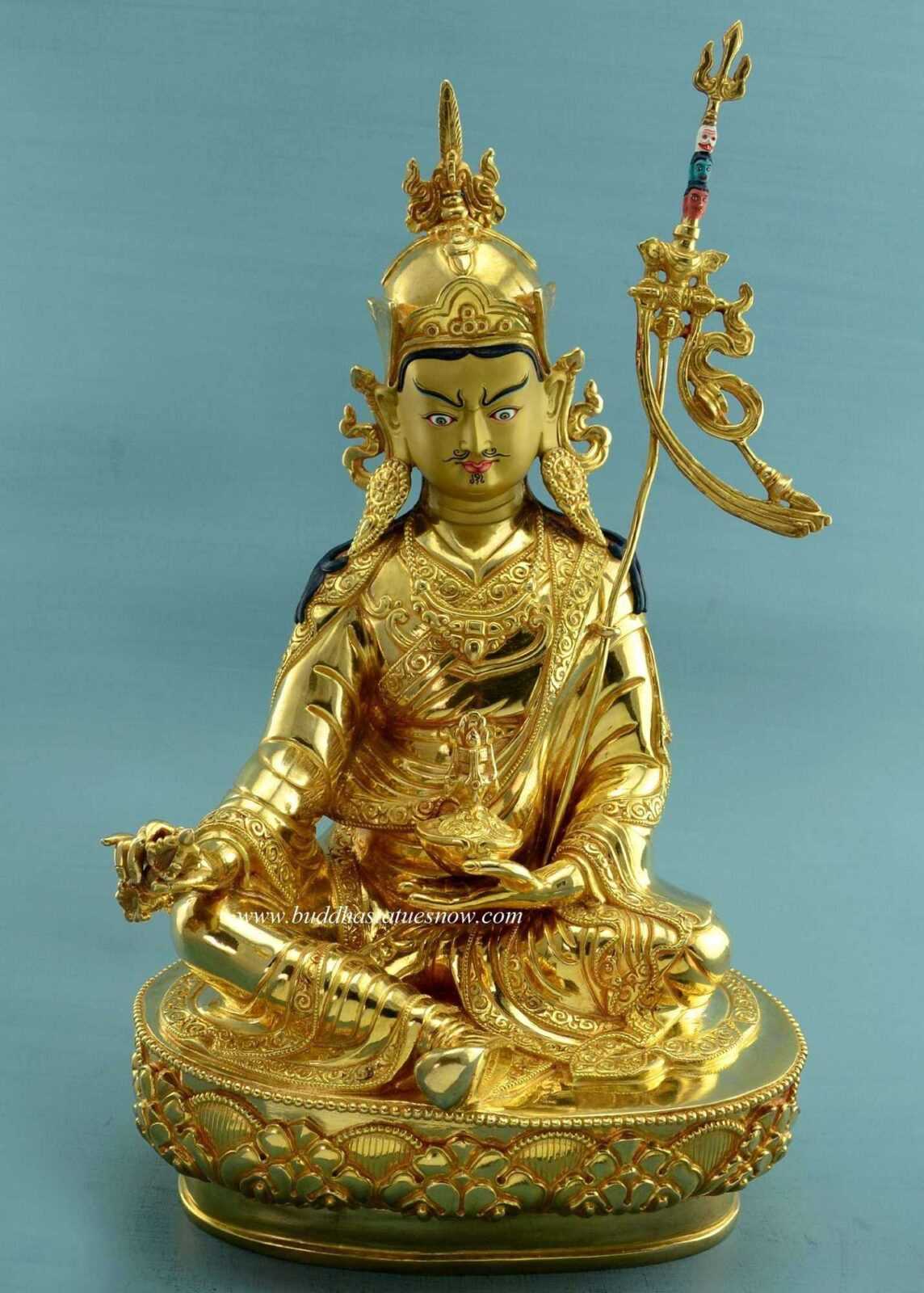
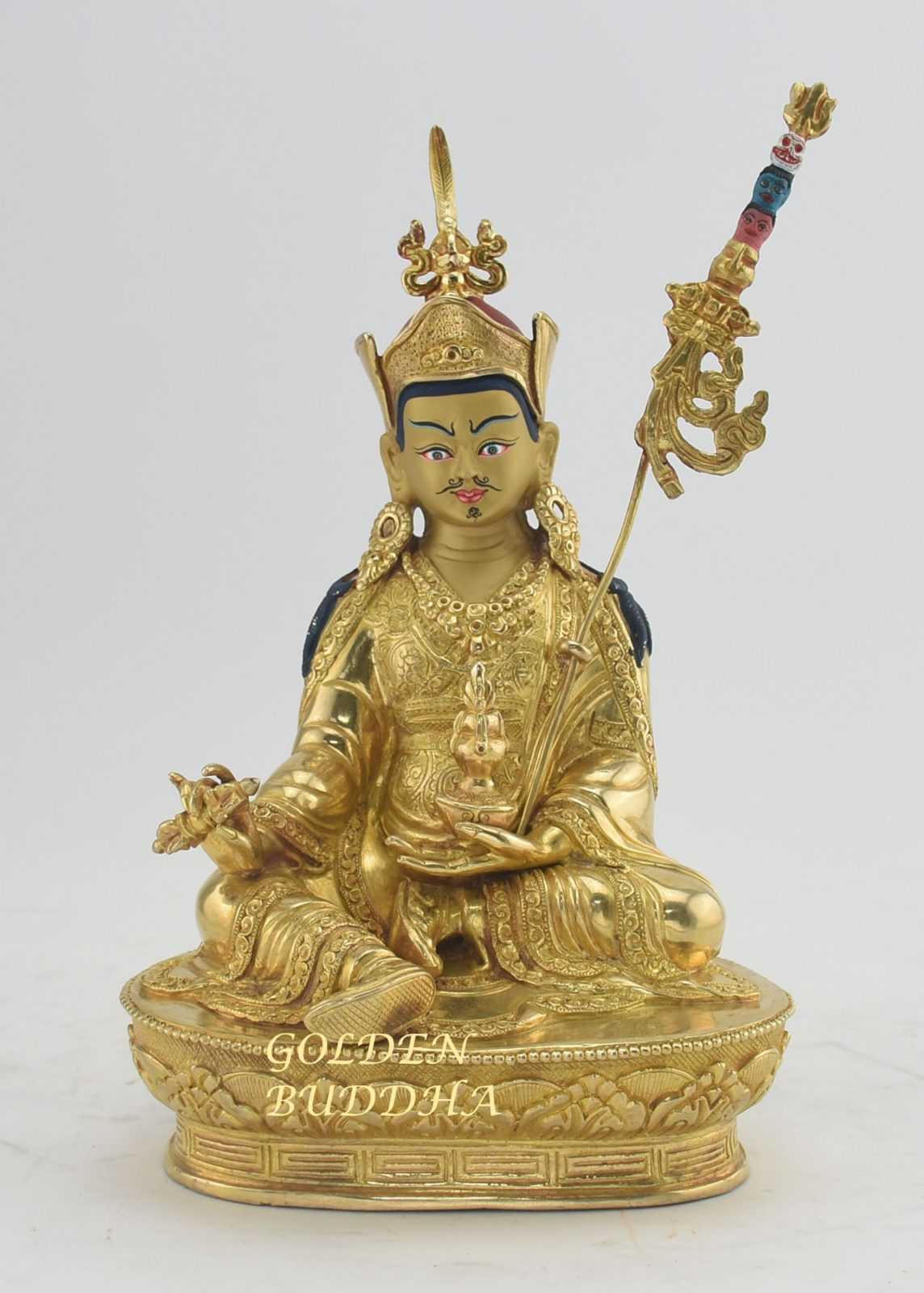
Every element of an authentic Guru Rinpoche statue encodes specific meaning drawn from the Tantric tradition he founded. Understanding this iconography transforms the statue from a devotional object into a complete visual teaching about the nature of Tantric realization:
The Khatvanga Staff: The most distinctive attribute of Guru Rinpoche statues is the khatvanga — a mystical tantric staff held upright in the left hand or resting against his shoulder. Impaled on the tip of the khatvanga are three severed heads — one freshly severed, one decomposing, and one a dry skull. These three heads represent his complete liberation from the three realms: the realm of desire, the realm of form, and the formless realm. Their impalement on the staff symbolizes that all three realms of conditioned existence have been vanquished by his realization. The khatvanga is also understood to represent his consort Mandarava — the realization of emptiness in feminine form. Inside the skull cup at the khatvanga’s base is the vase of immortality containing the deathless nectar of wisdom.
The Vajra: In his right hand, Guru Rinpoche holds a five-pointed vajra (thunderbolt scepter). The vajra represents the masculine principle of compassion and skillful means — the indestructibility of the diamond and the unstoppable force of the thunderbolt. As the preferred weapon of the Vedic God Indra, it entered Buddhist iconography as a symbol of spiritual power and the conquest of ignorance. In Guru Rinpoche’s hands it specifically represents his mastery of the Vajrayana teachings and his role as the supreme Tantric master of the age.
The Skull Cup (Kapala): The left hand in Dhyana mudra holds a skull cup (kapala) containing the immortality vase — filled with the deathless nectar of wisdom. The skull cup is one of the most characteristic implements of Tantric Buddhism, representing the transformation of death itself into the path of liberation. In Guru Rinpoche’s hands it communicates his mastery over the cycle of death and rebirth.
The Lotus Hat: Guru Rinpoche’s iconic five-petaled hat represents the five petals of the lotus blossom — symbol of purity arising from the muddy waters of samsara. Atop the hat is a vulture feather, which specifically symbolizes his realization of the highest view — the Dzogchen teaching of the primordial, unborn nature of the mind. The vulture feathers of Guru Rinpoche’s hat are one of the most immediately recognizable iconographic features, distinguishing him from all other Tibetan Buddhist masters.
Nepali Lost Wax Sculpture — Origin & Evolution
The traditional lost wax sculpting method (cire perdue) first emerged in Nepal during the 10th century CE — exactly the period when Tibetan Buddhism was undergoing its great renaissance after the persecutions of King Langdarma. This timing was not coincidental: the revival of Tibetan Buddhism created an enormous demand for high-quality Buddhist statues, and the master artisans of the Kathmandu Valley were uniquely positioned to meet it. For many centuries, Nepali artisans have been the preferred source of the Tibetan monasteries seeking the finest sculptures made to their specifications.
The lost wax method allows the most intricate wax replica of a Buddhist deity to be cast into permanent metal form with extraordinary precision. The process begins with a master sculptor creating a perfect wax model of the deity by hand — every detail of the iconography, proportion, facial expression, ornaments, and mudra must be executed correctly before casting begins. This requires deep knowledge of Buddhist iconography, not merely technical skill. The wax model is then coated with a special clay mixture that hardens into a mold. When the mold is fired, the wax melts and drains out through a small hole in the base — leaving a perfect hollow impression of the deity in fired clay. Molten metal alloy (typically copper and tin) is then poured into the mold and allowed to cool. When the clay mold is carefully broken away, the statue is revealed within — an original, non-reproducible creation that embodies both the artisan’s skill and the spiritual power of the deity it represents.
The Shakya Caste — Guardians of Sacred Sculpture
Over the centuries, three master artisan castes in the Kathmandu Valley — the Shakya, the Tamrakar, and the Swarnakar — became the dominant producers of traditional Nepali Buddhist statuary. Of these three, the Shakya caste achieved the most extraordinary historical distinction: they are direct descendants of the Buddha’s own family lineage.
The word Shakya derives from Sanskrit meaning “the one who is capable.” The history of the Shakya caste dates back to the Vedic age — predating the birth of Gautama Buddha himself. Shakyamuni Buddha was born into the Shakya Kingdom in northern India (modern Lumbini, Nepal), making the Shakya artisans of Patan direct descendants of the historical Buddha’s own clan. This extraordinary genealogical connection between the artisans and the very person whose image they sculpt is considered spiritually significant throughout the Tibetan Buddhist world — one of the reasons Tibetan monasteries have preferred Patan-made statues for over a thousand years.
Located in the southeastern portion of the Kathmandu Valley — Patan (Lalitpur) — the descendants of these three castes remain the world’s foremost producers of traditional Buddhist statuary. Each master artisan guards their finest techniques as fiercely guarded family secrets, passed from parent to child across generations. The result is a living transmission of both technical mastery and sacred iconographic knowledge that no factory or mass-production facility can replicate.
Fire Gilding — The 24K Gold Standard
The finest Guru Rinpoche statues and other Nepali Buddhist sculpture are finished using the traditional fire gilding method — the same technique used to produce statues for the great Tibetan monasteries for over a thousand years. The process: a mixture of mercury and 18K gold is evenly spread over the statue’s surface by hand. Extreme heat is then applied uniformly using a flame torch — the mercury evaporates completely along with any remaining impurities in the gold, leaving a flawless 24K pure gold finish bonded directly to the copper alloy surface of the statue.
The primary benefit of 24K fire gilding over all other gilding methods is its permanence: a 24K fire-gilded statue will never tarnish and retains its brilliant golden luster indefinitely. The luminous warmth of 24K gold applied through this ancient method has a depth and radiance that electroplating, gold paint, and lesser-karat gilding simply cannot reproduce. A well-made, fully fire-gilded Guru Rinpoche statue will look as luminous in a hundred years as the day it left the workshop in Patan.
The final step in creating an authentic Padmasambhava statue is hand face painting — applying real gold pigment by brush to bring the deity’s eyes, lips, and subtle facial features to vivid life. This is where the master artisan’s most refined skill is expressed: the face of a great statue must convey serenity, power, wisdom, and compassion simultaneously — a quality that cannot be mechanically reproduced and that distinguishes genuine Patan-made statues from all imitations.
Tibetan Buddhism — Destruction & Renaissance
Like the Samye Monastery itself, Tibetan Buddhism has been repeatedly destroyed and reborn. In 836 CE, the Buddhist King was assassinated and the anti-Buddhist King Langdarma reinstated Bon Religion — only to be killed himself by a Buddhist monk in 842 CE, after which Tibetan Buddhism returned. In the 11th century, after a period of fragmentation, Indian Buddhist masters were once again invited to Tibet — initiating a great renaissance that produced the four major schools of Tibetan Buddhism: the Nyingma (founded by Guru Rinpoche), the Kagyu, the Sakya, and the Gelug.
In the 13th century the Mongols invaded and initially destroyed many monasteries — only to convert to Tibetan Buddhism under the influence of Sakya scholar Pandita Gunga Gyaltsen. In the 20th century the Chinese Communist takeover of Tibet in 1959 came closest to permanently destroying Tibetan Buddhism — hundreds of monasteries were razed, thousands of monks imprisoned, and countless sacred images and texts destroyed. Yet on March 17, 1959, the 14th Dalai Lama escaped into exile in India where he has reestablished the foundation of Tibetan Buddhist culture and practice at Dharamshala.
Guru Rinpoche foresaw all of this. His Terma tradition was specifically designed to preserve the deepest teachings through exactly these kinds of catastrophic interruptions. And the tradition of Nepali sculpture — the handcrafted Guru Rinpoche statues produced in the workshops of Patan for over a thousand years — has been an indispensable part of that preservation, providing the physical forms through which practitioners continue to invoke his presence and his blessing in every country where Tibetan Buddhism has taken root.
Frequently Asked Questions About Guru Rinpoche
Who is Guru Rinpoche and why is he called the Second Buddha?
Guru Rinpoche (Padmasambhava — “Lotus Born”) is the 8th century Indian Tantric master who founded Tibetan Buddhism and established it as the national religion of Tibet. He is called the Second Buddha by Tibetan Buddhists — particularly in the Nyingma school — because he is considered to have achieved the same level of enlightenment as Shakyamuni Buddha, with the specific purpose of transmitting the Vajrayana teachings to Tibet at a time when no other teacher had the spiritual power to do so. He claimed his father was Samantabhadra (the Primordial Buddha) and his mother Samantabhadri, identifying himself as the embodiment of primordial wisdom. His founding role in Tibetan Buddhism is unmatched by any other single historical figure.
What does a Guru Rinpoche statue represent?
A Guru Rinpoche statue represents Padmasambhava — the founding father of Tibetan Buddhism, revered as the Second Buddha. Every iconographic element carries specific meaning: the khatvanga staff with three impaled heads represents his liberation from the three realms of existence; the vajra in his right hand represents compassion and indestructible spiritual power; the skull cup (kapala) in his left hand with the immortality vase contains the deathless nectar of wisdom; the five-petaled lotus hat represents purity; and the vulture feather on top of the hat represents his realization of the highest view — the Dzogchen teaching of primordial awareness. Placing a Guru Rinpoche statue on a home altar or meditation space connects the practitioner to his Tantric lineage and supports the invocation of his protective blessing.
What is the difference between Guru Rinpoche and Padmasambhava?
Guru Rinpoche and Padmasambhava are two names for the same person. Padmasambhava is the Sanskrit name meaning “Lotus Born” — referring to his miraculous birth from a lotus flower in the pure land of Oddiyana. Guru Rinpoche is the Tibetan honorific title meaning “Precious Teacher” — the name by which Tibetan Buddhists most commonly refer to him in devotional practice. Both names appear regularly in Buddhist texts, statues, and thangkas. In the Nyingma school he is also sometimes called Guru Pema, Urgyen Rinpoche, or simply “Precious Master.” All refer to the same figure — the founder of Tibetan Buddhism and the transmitter of the Vajrayana teachings to Tibet.
Why did King Trisong Detsen choose Tantric Buddhism over the sutra approach?
King Trisong Detsen chose Tantric Buddhism because Guru Rinpoche’s methods produced visible, dramatic results where Santaraksita’s sutra approach had failed. When constructing Tibet’s first Buddhist monastery at Samye, the work was repeatedly obstructed by powerful indigenous spirits. Santaraksita’s scholarly sutra methods could not subdue them. Guru Rinpoche, summoned at Santaraksita’s own recommendation, performed the Vajrakilaya ritual dance and the rite of namkha — secret Tantric practices that successfully removed the spirit obstruction in a single night, allowing construction to be completed. The king drew the obvious conclusion: the Tantric approach had power the sutra approach lacked. This decision permanently shaped Tibetan Buddhism as a Tantric tradition — the most elaborate and systematically developed esoteric Buddhist tradition in the world.
What is a Terma and what is a Terton?
A Terma (Tibetan: “treasure”) is a Vajrayana teaching hidden by Guru Rinpoche and his consort Yeshe Tsogyal for future discovery at a more auspicious time. Guru Rinpoche foresaw that Buddhism would face persecution in Tibet and systematically encoded the most profound teachings in a secret dakini script, hiding them in physical locations (caves, rocks, lakes, sacred sites) and within the mindstreams of his most advanced disciples. A Terton (treasure revealer) is a spiritually qualified practitioner who discovers and decodes these hidden teachings when the time is right. The Terma tradition has been one of the primary sources of new teaching revelations in the Nyingma school throughout Tibetan history, and continues to produce living transmissions today — making Guru Rinpoche’s influence on Tibetan Buddhism effectively ongoing rather than limited to the 8th century.
Are Guru Rinpoche statues from Nepal authentic?
The artisan city of Patan (Lalitpur) in Nepal’s Kathmandu Valley has been the world center for handcrafted Himalayan Buddhist statuary for over a thousand years — and Guru Rinpoche statues from Nepal produced by the traditional Shakya craftsmen of Patan are among the finest Buddhist devotional objects available worldwide. Each statue is created using the lost-wax casting method, finished with 24K fire gilding, and hand face painted using real gold — the same standard used for monastery-quality statues for over a millennium. All statues are certified by the Department of Archaeology in Kathmandu, and consecration (rabne) at a recognized Kathmandu monastery is available upon request. Browse our complete collection of authentic Guru Rinpoche statues from Nepal.