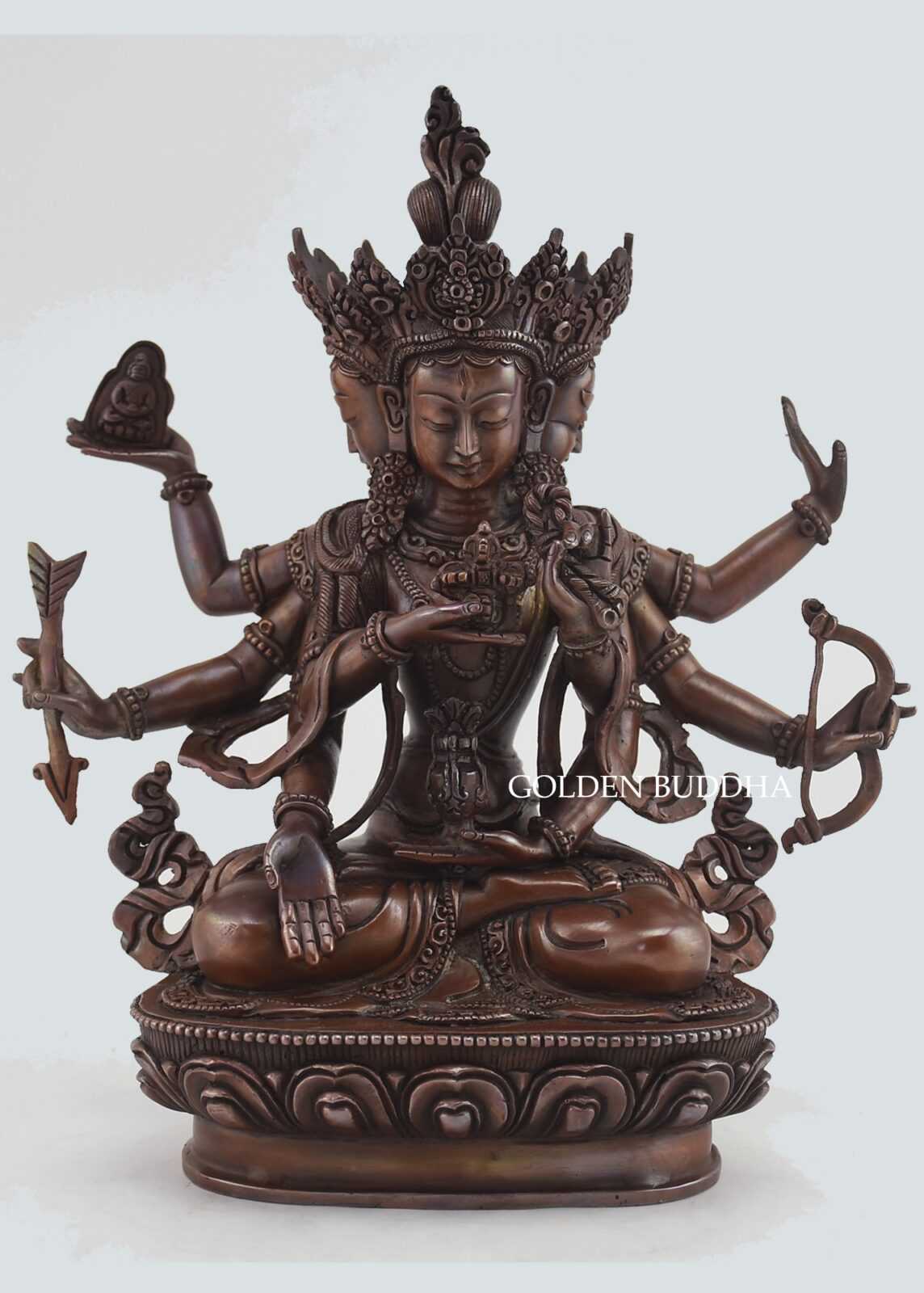
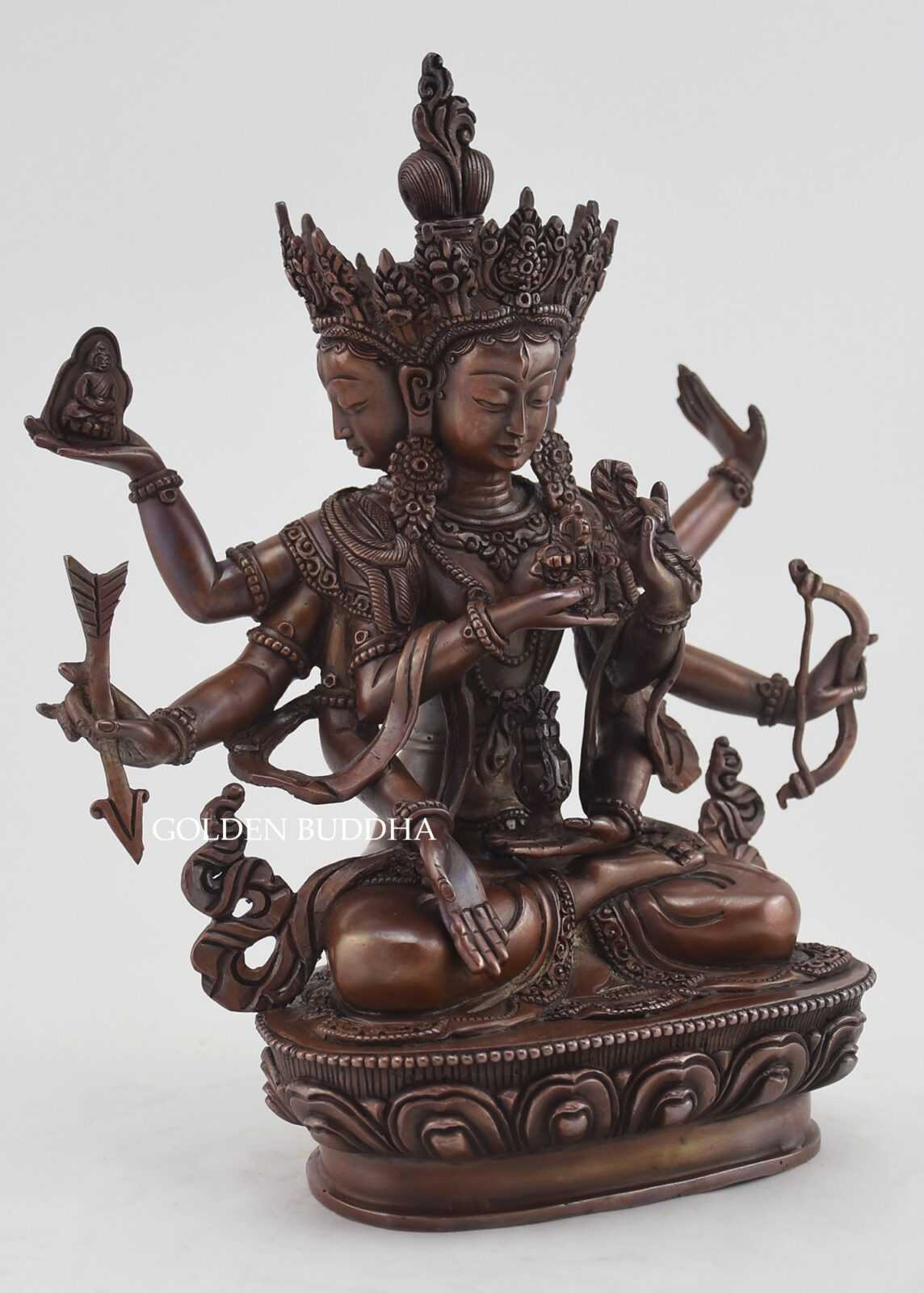
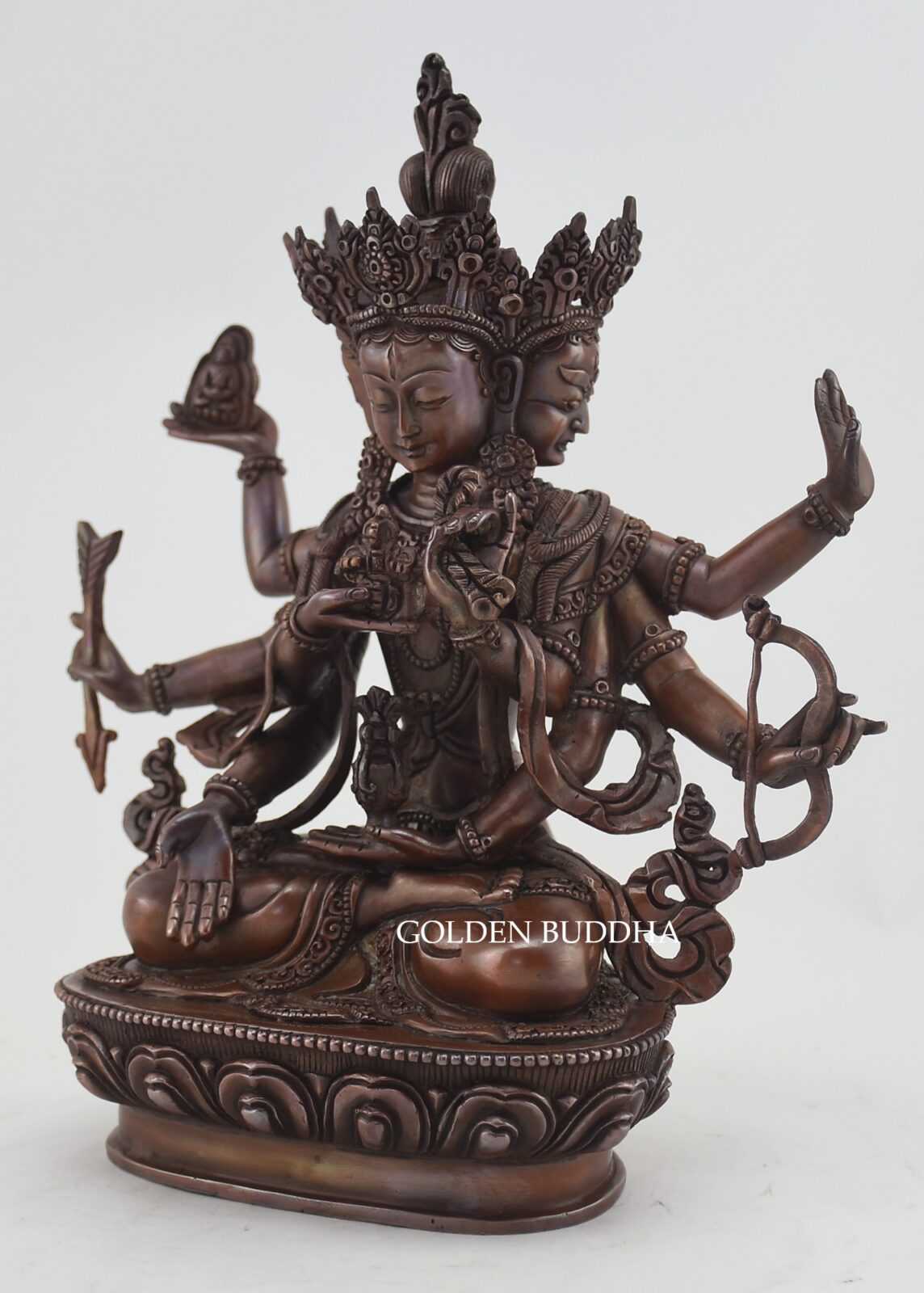
This finely detailed 9.5″ Oxidized Namgyalma statue represents Ushnishavijaya, known in Tibetan as Namgyalma, the victorious long-life deity associated with purification, protection, and overcoming the conditions that lead to untimely death. Handcrafted from copper alloy by a master Newar artisan in Patan, Nepal, the sculpture was created through the traditional lost-wax casting method and given a rich oxidized copper finish. Warm reddish-brown highlights emerge across the faces, arms, torso, and lotus throne, while darker tones settle within the crown, jewelry, garment borders, and ritual attributes, revealing the depth of the artisan’s carving without the use of gold gilding or facial paint.
The composition is remarkably complex yet carefully balanced. Namgyalma has three faces and eight arms, each modeled separately and arranged so that her numerous gestures and attributes remain distinct. Her elaborate five-pointed Bodhisattva crown rises beneath a tall gathered topknot and ornamental finial. Layered necklaces, earrings, armlets, bracelets, patterned shoulder coverings, and flowing celestial scarves complete her Sambhogakaya adornment. Fine scrolling borders appear around the crown, jewelry, neckline, shoulder wrap, and robe hemlines, while the oxidized finish gives the entire sculpture the quiet authority of an older Tibetan monastery image.
Oxidized Namgyalma Statue Meaning and Long-Life Practice
Namgyalma’s Sanskrit name, Ushnishavijaya, may be translated as “Victorious One of the Ushnisha.” The ushnisha is the crown protuberance associated with the transcendent wisdom of a fully awakened Buddha, and Namgyalma is traditionally understood to have arisen from this enlightened source. She is especially invoked for the purification of harmful karma, protection against untimely death, the removal of obstacles to longevity, and the creation of favorable conditions in which a long life can be used for Dharma study, meditation, ethical conduct, and service to others.
Her role is therefore not limited to extending life for its own sake. Within Tibetan Buddhism, longevity is valuable when additional time permits practitioners to deepen wisdom and compassion, complete beneficial activity, support teachers and communities, and progress toward awakening. Namgyalma practice joins long life with purification: obstacles are removed, negative karmic tendencies are cleansed, and the practitioner seeks to preserve the human life through which meaningful spiritual development remains possible. Learn more about her relationship with Amitayus and White Tara in our guide to the Three Long Life Deities of Tibetan Buddhism.
Three Faces and the Wisdom Eyes of Namgyalma
The three faces of this Oxidized Namgyalma statue express awareness that is not confined to a single direction or perspective. Her central face remains peaceful and meditative, while the two side faces extend her enlightened vision toward every realm. Together they may be understood as representing complete awareness of the past, present, and future, or the ability to perceive and benefit beings throughout the three times. The arrangement also gives the sculpture an impressive ceremonial presence when viewed from different angles.
A vertical third eye appears upon the forehead of the central face, signifying transcendent wisdom beyond ordinary perception. An additional eye is depicted in the palm of her lowered right hand. These wisdom eyes symbolize compassionate activity guided by complete understanding: Namgyalma does not merely observe suffering, but recognizes its causes and responds with the means appropriate to remove them.
Oxidized Namgyalma Statue ‒ Eight Arms and Sacred Attributes
Namgyalma’s eight arms communicate the breadth and immediacy of her enlightened activity. Her principal hands near the heart hold ritual implements associated with indestructible wisdom and the restraint of obstacles. The double vajra represents the unchanging stability of awakened mind and the indestructible foundation of enlightenment. The rope or lasso symbolizes her ability to bind harmful forces, restrain destructive tendencies, and draw wandering beings back toward the path of liberation.
Her lower right hand extends toward devotees in the Varada mudra, the gesture of generosity, blessings, and compassionate giving. The open palm, marked with a wisdom eye, shows that her gifts are guided by insight rather than offered indiscriminately. Another raised hand displays a protective gesture corresponding to the Abhaya mudra, communicating freedom from fear and protection from spiritual and worldly dangers.
The bow and arrow form a complementary pair. Their union symbolizes concentrated awareness directed accurately toward its purpose, as well as the inseparability of wisdom and skillful means. One upper hand supports a small Buddha image associated with Amitabha, connecting Namgyalma with the Buddha family of Infinite Light and the wider long-life tradition. Her lower left hand rests near the lap while supporting the vase of longevity, filled with the nectar of immortality. This vessel is the clearest emblem of her power to preserve life and renew the favorable conditions needed for sustained spiritual practice.
Bodhisattva Crown, Jewelry and Oxidized Copper Finish
The artisan has modeled Namgyalma with the complete adornments of a celestial Bodhisattva. Her tall crown is composed of individually carved points enriched with scrolling motifs and recessed settings. Large circular earrings, layered necklaces, beaded ornaments, bracelets, and armlets establish a visual rhythm across the intricate eight-armed composition. At the buyer’s request, suitable settings in the crown and jewelry may be adorned with turquoise and red coral stones before delivery, creating a vivid contrast against the dark oxidized copper surface.
Turquoise combines blue and green, colors traditionally associated with purity, healing, and enlightened activity. Red coral is especially appropriate within this long-life grouping because it recalls Amitabha’s red Buddha family and Namgyalma’s connection with Amitayus. The sculpture is equally compelling without stones, however, because the antiquated finish allows the elaborate crown, jewelry, faces, hands, and ritual implements to remain visually unified within a single warm copper palette.
Full Lotus Posture and Single Lotus Throne
Namgyalma sits in the full lotus posture upon a broad single lotus throne. Her crossed legs create a stable foundation beneath the elaborate arrangement of arms, scarves, attributes, and three crowned faces. The front of the pedestal is formed by a continuous register of rounded lotus petals beneath a precise beaded rim. The lotus symbolizes purity arising within samsara, expressing the possibility of developing wisdom and compassion without being stained by the difficult conditions through which spiritual growth occurs.
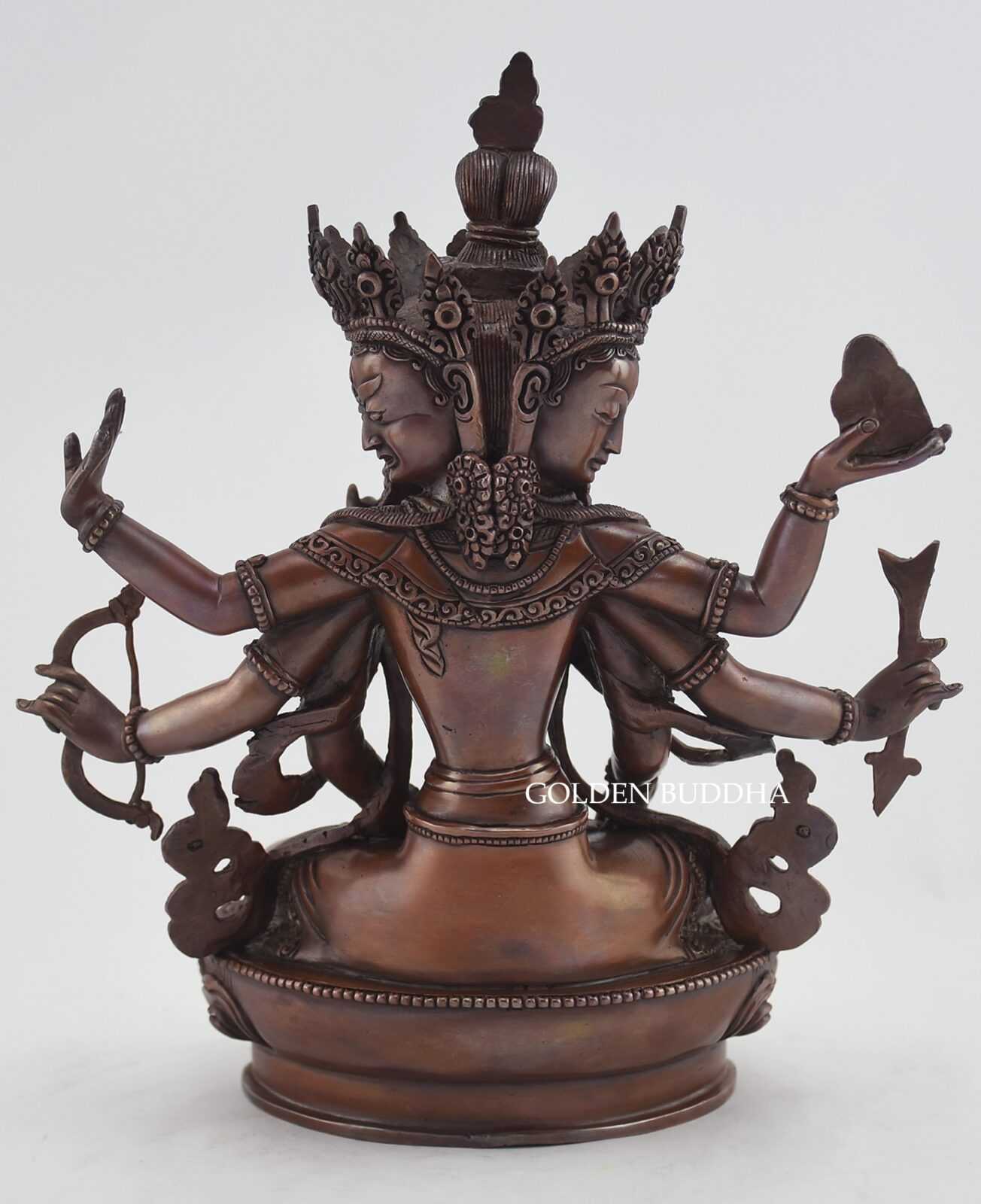
Viewed from behind, the broad lower garment, waist, shoulder ornament, crown, and individually arranged arms are carefully completed rather than flattened into a single mass. Engraved scrolling borders continue around the shoulder covering, while the separately cast implements remain clearly recognizable from the reverse. This attention to the back makes the statue suitable for an open shrine or temple arrangement where it may be viewed from several directions.
The Three Long Life Deities Statue Set
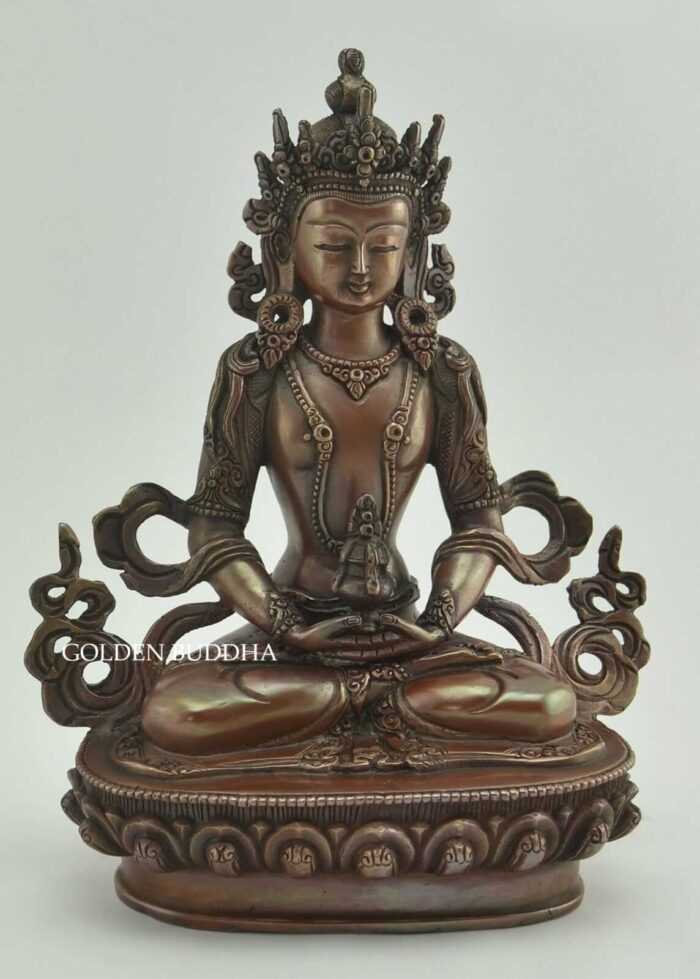
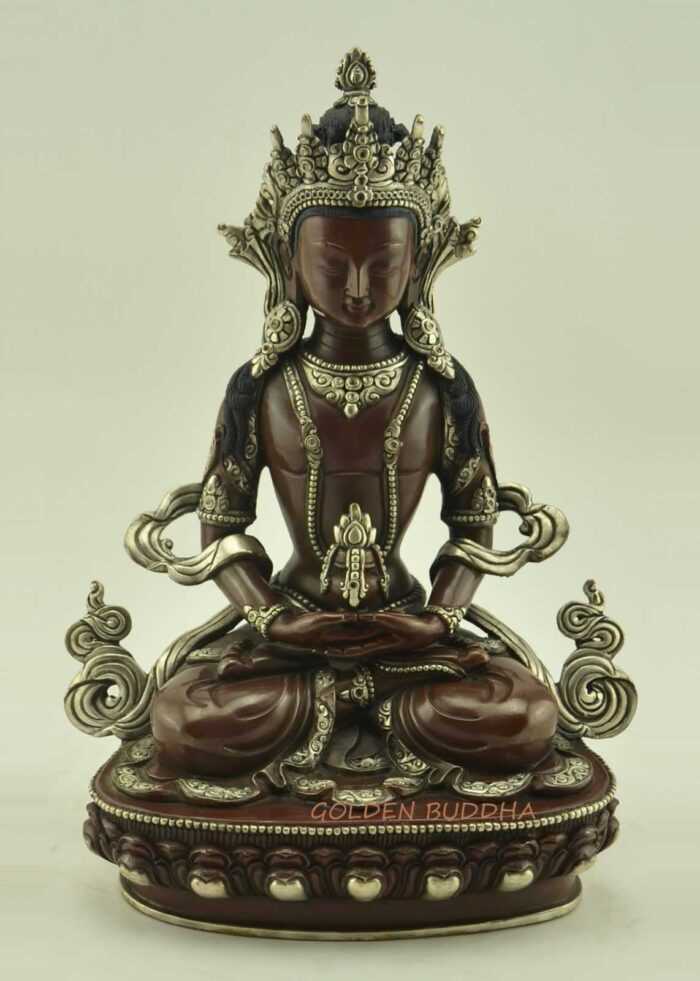
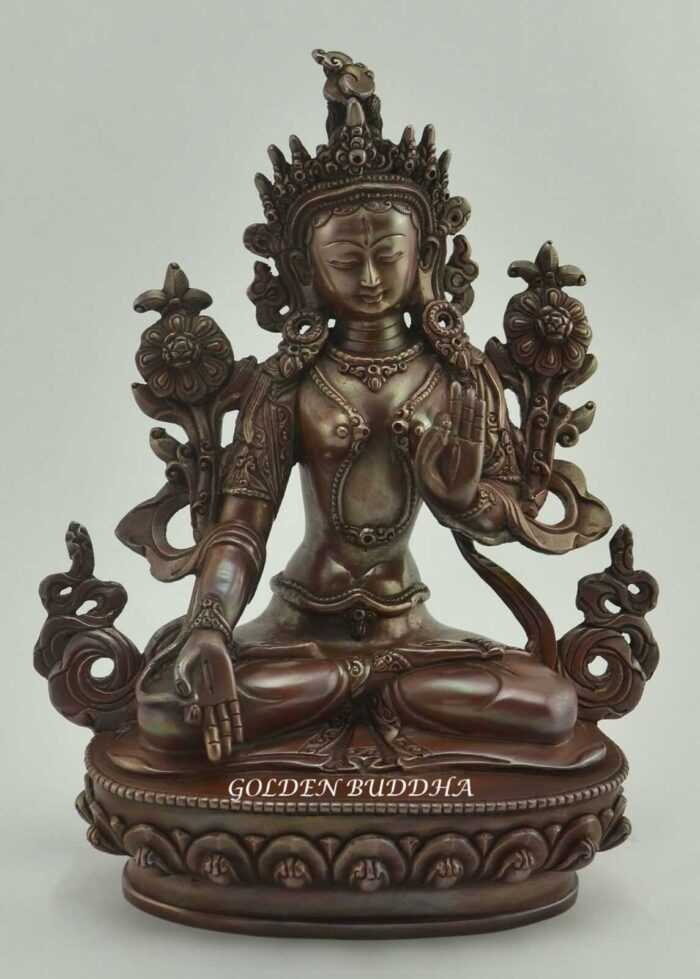
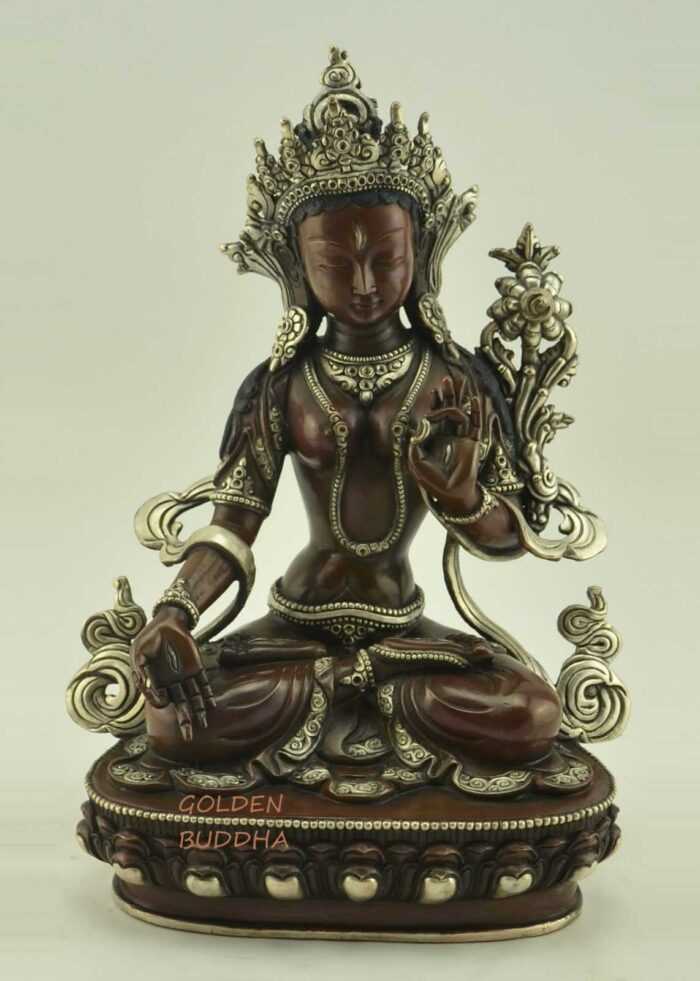
This Oxidized Namgyalma statue forms a coordinated altar set with our oxidized Tsepame statue, representing Amitayus, and our oxidized Cintachakra statue, representing White Tara or Dolkar. The three sculptures were created by the same master artisan and share copper-alloy casting, warm oxidized finishes, unpainted faces, Bodhisattva crowns and jewelry, flowing scarves, traditional lost-wax workmanship, and closely coordinated altar proportions. Although Namgyalma’s eight arms make her composition wider and more complex, the shared materials and artistic treatment allow the three figures to stand together as a unified shrine ensemble.
The three deities contribute complementary dimensions to Tibetan longevity practice. Tsepame, or Amitayus, is the Buddha of Infinite Life and holds the vase containing the nectar of immortality; he is especially associated with extending life, merit, and the conditions needed for continued Dharma practice. Cintachakra, or White Tara, embodies compassionate healing, serenity, protection, and the restoration of depleted life force. Namgyalma purifies negative karma, removes obstacles connected with untimely death, and protects the practitioner from unfavorable rebirth. Displayed together, White Tara heals and restores life energy, Amitayus increases longevity and merit, and Namgyalma purifies and protects the conditions supporting that life. Their combined doctrinal purpose is not simply to prolong existence, but to preserve a precious human life so that it may be used meaningfully for the benefit of oneself and others.
Custom Made Oxidized Namgyalma Statue and Long-Life Deities
Collectors, practitioners, monasteries, and Dharma centers may commission a custom made Tibetan Buddhist statue inspired by this Namgyalma design. A custom sculpture may be produced in a different size with an oxidized copper finish, an antiquated bronze-colored finish over the copper-alloy casting, selective 24K fire gilding, or a fully fire-gilded surface. Available options may include personalized engraving, additional detail in the crown and jewelry, turquoise or red coral embellishment, alternative lotus-petal designs, refined ritual attributes, or a face hand painted with 18K gold and natural pigments when a gilded presentation is selected.
A complete Three Long Life Deities set may also be commissioned with Namgyalma, Tsepame, and Cintachakra created together so that all three share the same scale, finish, crown and jewelry treatment, facial character, engraving style, and lotus-throne proportions. Commissioning the figures as a set allows the artisan to preserve their visual unity while expressing their complementary spiritual attributes: Amitayus extending life and merit, White Tara healing and replenishing life force, and Namgyalma purifying karma and protecting against untimely death. Every custom statue is individually cast, chased, engraved, and finished by hand in Nepal according to traditional Himalayan iconographic proportions.
Authentic, Handmade in Nepal
Every statue and ritual item is handcrafted in Patan, Nepal, using traditional lost wax casting and comes with a certificate of authenticity issued by Nepal's Department of Archaeology, verifying its materials, technique, and origin.