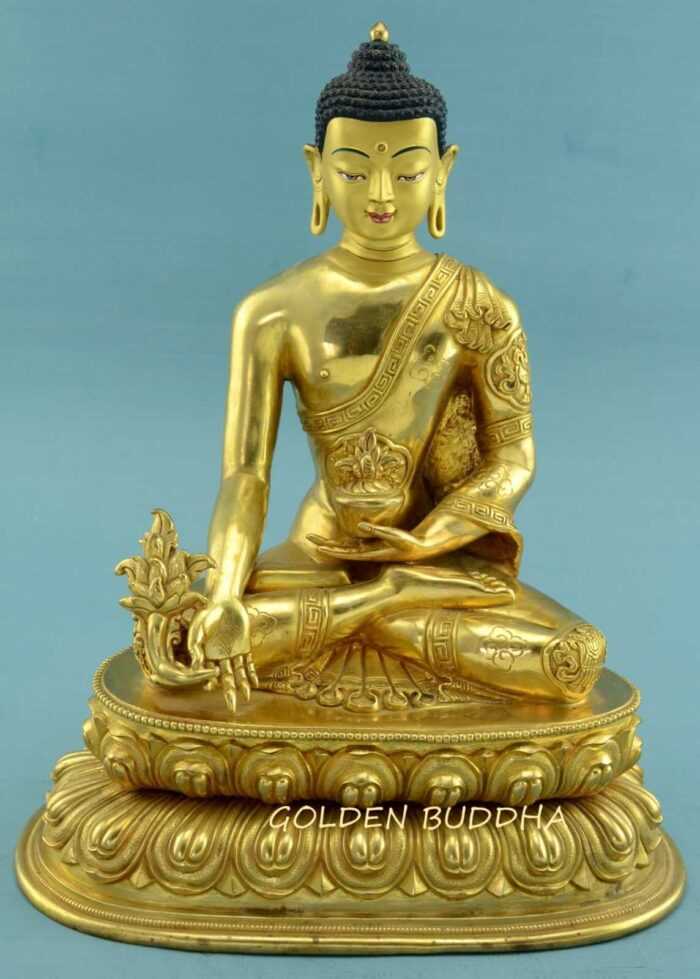
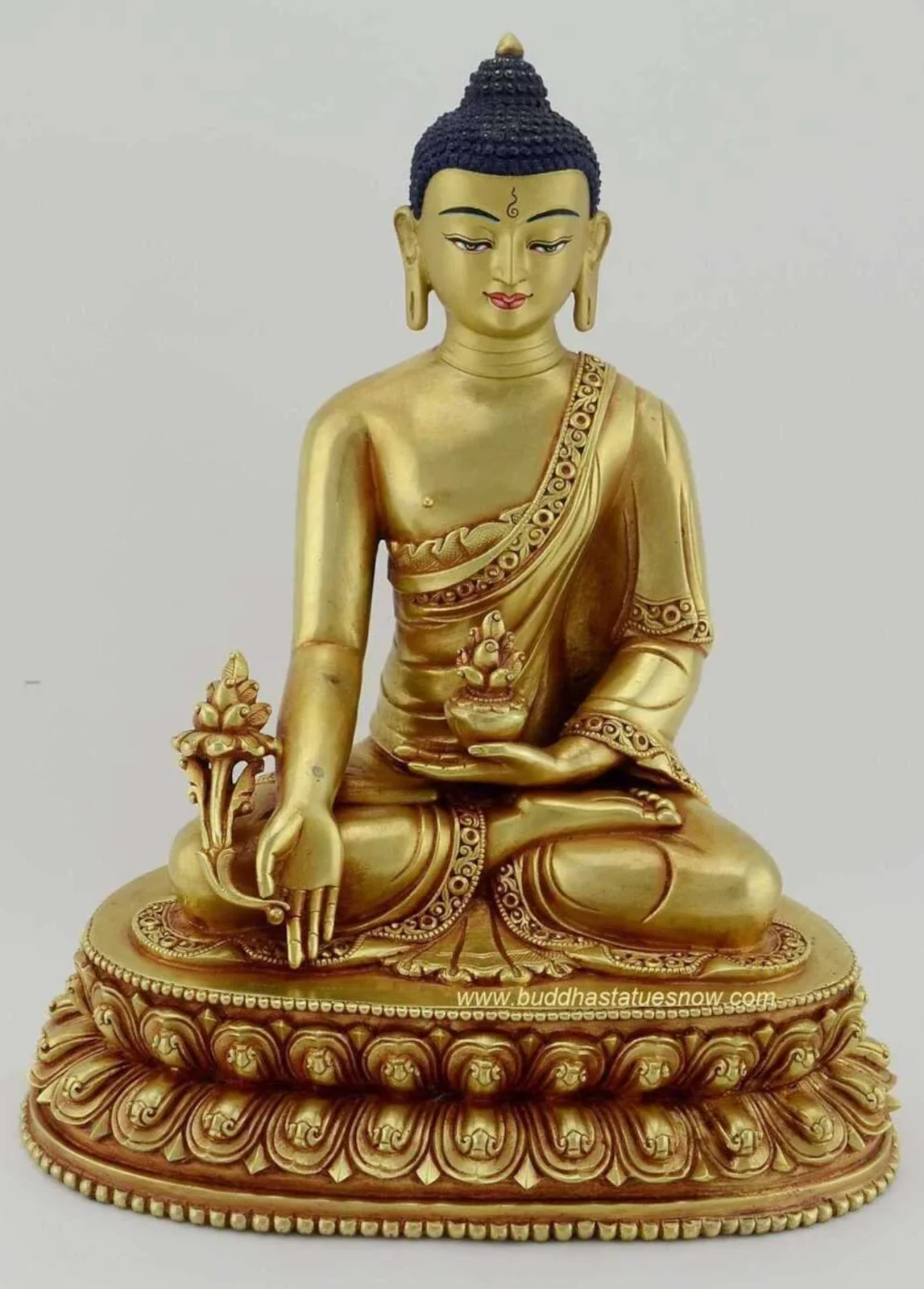
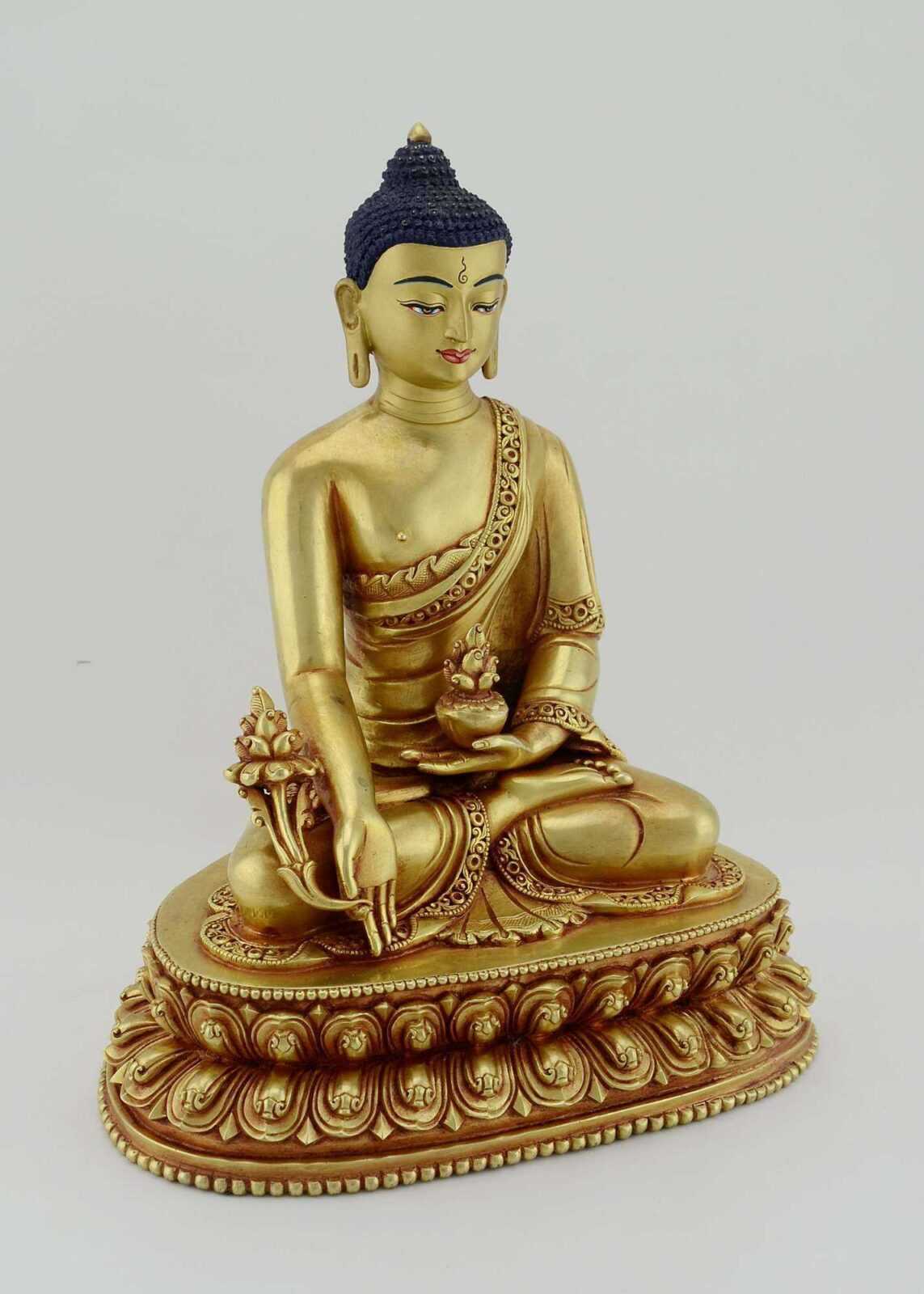
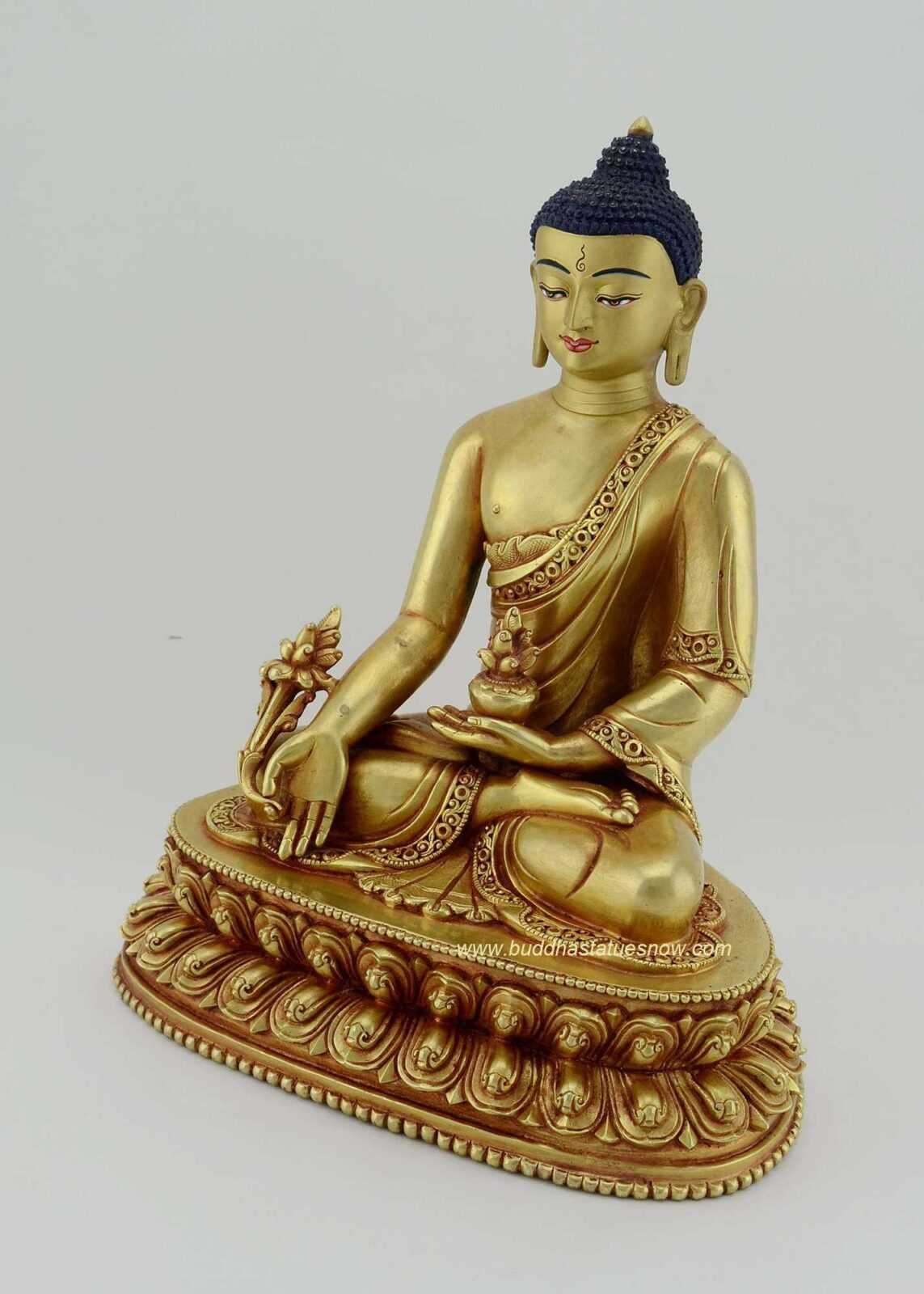
This beautifully proportioned 8.75″ Medicine Buddha statue portrays Bhaisajyaguru, the Master of Healing, in the traditional monastic form of an awakened Buddha. Handcrafted from copper alloy by master Newar artisans in Patan, Nepal, the sculpture was produced through the traditional lost-wax casting method and fire gilded in pure 24K gold. Its rich, low-luster finish gives the gold a warm and contemplative appearance rather than a highly reflective shine, allowing the carefully sculpted robe folds, engraved hemlines, medicinal attributes, and double lotus throne to remain clearly defined.
The face is separately hand painted with 18K gold and natural pigments, giving Medicine Buddha a calm expression framed by dark brows, gently lowered eyes, a wisdom urna, and softly colored lips. His blue-black hair is arranged in tightly formed right-turning curls that rise into the ushnisha, crowned by a small gilded finial. The elongated earlobes and three horizontal lines upon the neck complete the traditional physical characteristics of a fully awakened Buddha. Although compact enough for a home altar, the substantial double lotus pedestal gives this Medicine Buddha statue a dignified presence suitable for a shrine room, healing space, monastery, or Dharma center.
Medicine Buddha Statue Meaning and Healing Activity
Medicine Buddha embodies the healing dimension of enlightened wisdom. Buddhist teachings frequently compare the Buddha to a skilled physician, suffering to an illness, the Dharma to the medicine prescribed for that illness, and disciplined practice to the treatment through which recovery becomes possible. This comparison closely corresponds to the Four Noble Truths: suffering is recognized, its causes are diagnosed, freedom from suffering is understood to be possible, and the path provides the method through which that freedom can be realized.
A Medicine Buddha statue therefore represents more than the wish for relief from physical disease. Bhaisajyaguru is approached for assistance with bodily illness, emotional distress, harmful habits, karmic obscurations, and the ignorance that lies beneath recurring dissatisfaction. His practice encourages compassionate care while reminding practitioners that the deepest form of healing requires wisdom, ethical conduct, meditation, and the transformation of the mental afflictions. Learn more about his vows, mantra, and practice in our complete guide to Medicine Buddha statues and healing symbolism.
Varada Mudra and the Myrobalan Plant
Medicine Buddha extends his right hand over the knee in the Varada mudra, the gesture of generosity, blessings, and compassionate giving. The palm faces outward toward sentient beings, expressing his readiness to provide whatever form of assistance is genuinely beneficial. Between the fingers he holds the stem of the myrobalan plant, which rises beside his right knee in a carefully modeled cluster of leaves and fruit.
Myrobalan has an important place in traditional Himalayan and Ayurvedic medicine and is the principal botanical attribute used to identify Medicine Buddha. Within Buddhist iconography, it also symbolizes the perfected wisdom that diagnoses and treats suffering at its source. The plant therefore represents both a physical remedy and the spiritual medicine of the Dharma. Its branching form introduces a graceful organic element beside the seated Buddha while emphasizing that enlightened compassion does not remain abstract but responds directly to the needs of living beings.
Medicine Bowl and the Three Healing Nectars
His left hand rests in the lap in the Dhyana mudra, the gesture of meditation, concentration, and inner equilibrium. Supported within the open palm is the traditional medicine bowl, decorated with a carefully modeled lid and healing emblem. The bowl is understood to contain medicinal nectar capable of counteracting the three poisons of ignorance, attachment, and hatred. These afflictions are regarded as the underlying causes from which harmful actions, emotional turmoil, and continued suffering arise.
The positions of the two hands unite compassionate activity with contemplative wisdom. The lowered right hand reaches toward the world, while the left remains centered in meditation. Together they express the principle that lasting healing requires both practical care and a clear understanding of causes and conditions. The composition is especially appropriate for an altar devoted to healing prayers, Medicine Buddha mantra recitation, meditation, or the dedication of merit for family members, teachers, patients, and other beings facing illness.
Monastic Robes and Engraved Hemlines
This Medicine Buddha statue wears the robes of an ordained Buddhist monk rather than a Bodhisattva crown or celestial jewelry. The robe passes over the left shoulder, leaving the right shoulder and upper chest uncovered in the classical monastic arrangement. Finely engraved scrolling borders follow the garment across the chest, upper arm, wrist, lap, and folded legs. The artisan has concentrated the decoration along the hemlines, preserving broad areas of softly gilded copper alloy and creating a refined contrast between smooth surfaces and intricate ornamental bands.
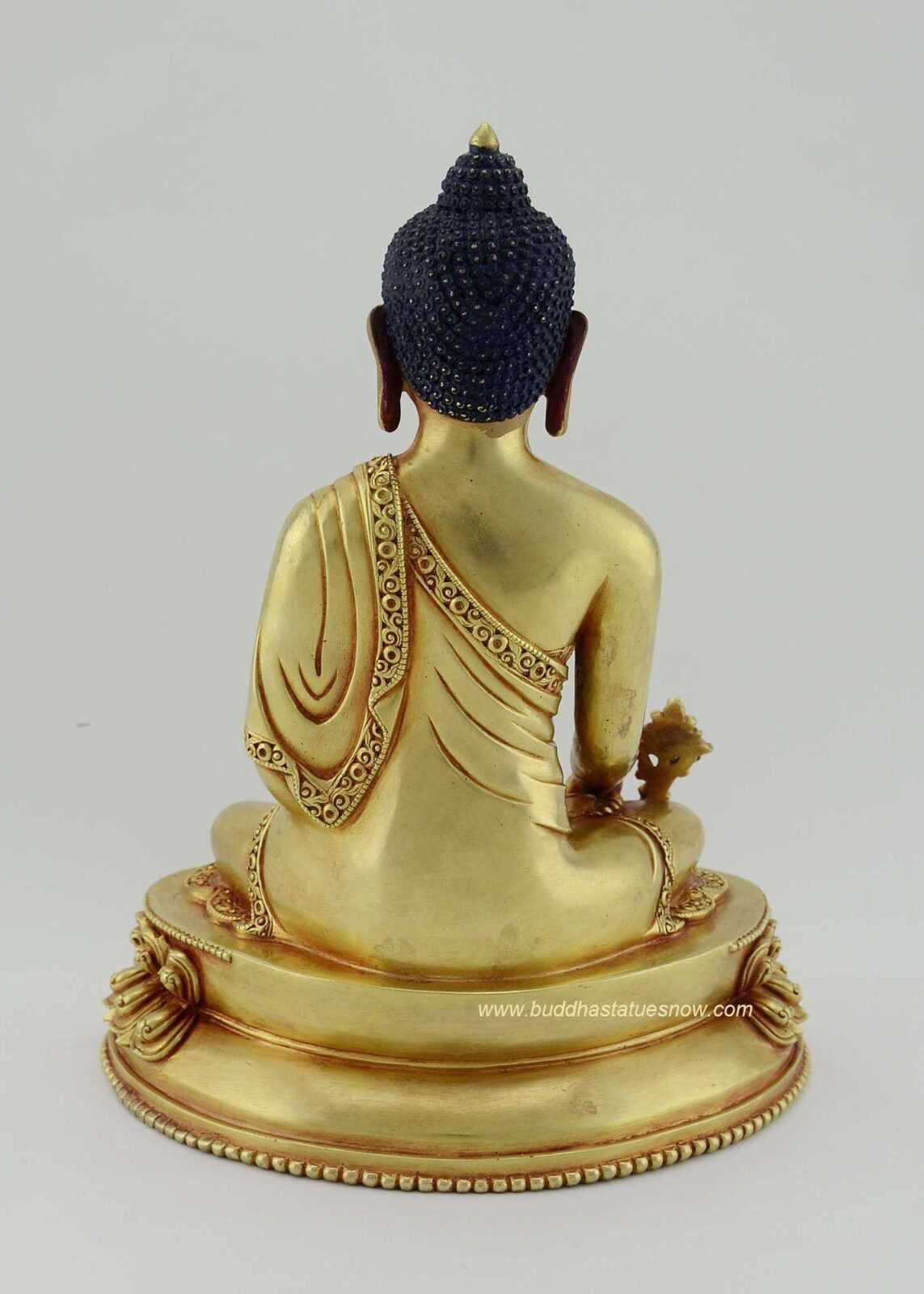
The workmanship continues around the reverse, where the robe descends naturally over the left shoulder and across the back. Engraved borders trace the outer edges of the garment, while shallow folds give the cloth a convincing sense of weight and movement. This restrained approach maintains the simplicity appropriate to a monastic Buddha while demonstrating the precise chasing, engraving, and finishing for which the sacred metalworkers of Patan have been renowned for generations.
Double Lotus Throne and Low-Luster Gold Gilding
Medicine Buddha sits in the full lotus posture upon a substantial double lotus throne. The pedestal is composed of two complete registers of overlapping petals: a smaller upper row directly beneath the Buddha and a broader lower row that strengthens the architectural presence of the base. Fine beadwork frames the upper seat, while chased details within the petals create depth across the warm, low-luster gilded surface.
The lotus symbolizes purity arising within the conditions of samsara. Just as the flower develops through muddy water without becoming stained, wisdom and compassion can grow amid illness, uncertainty, and the difficulties of ordinary life. The double lotus throne gives the sculpture a formal shrine quality and visually connects it with the matching Shakyamuni and Amitabha statues created by the same master artisan.
A Matching Medicine Buddha, Shakyamuni and Amitabha Set
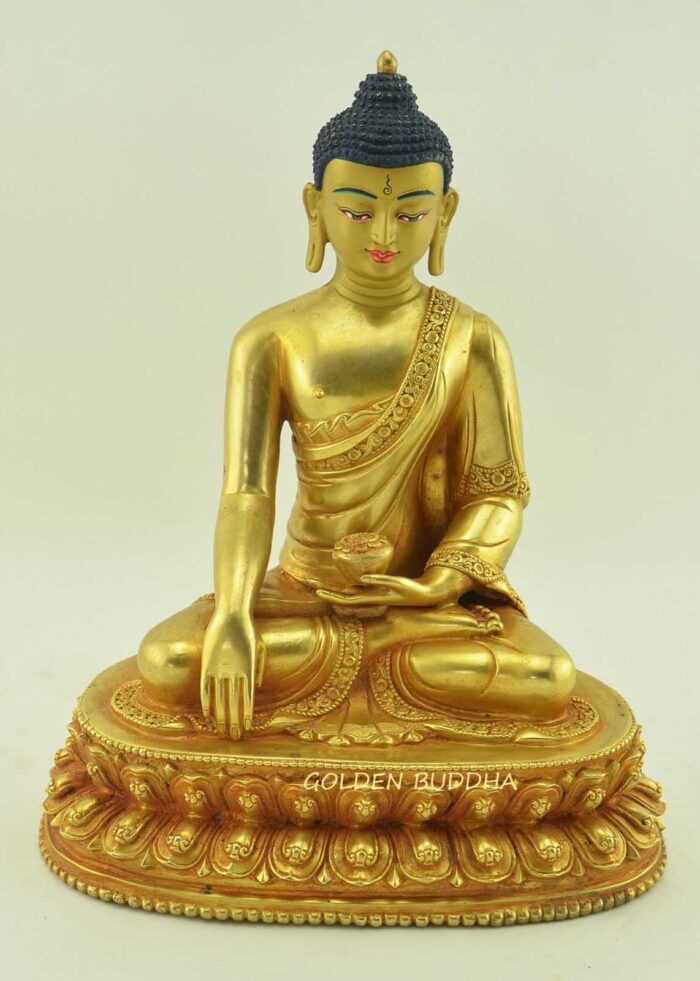
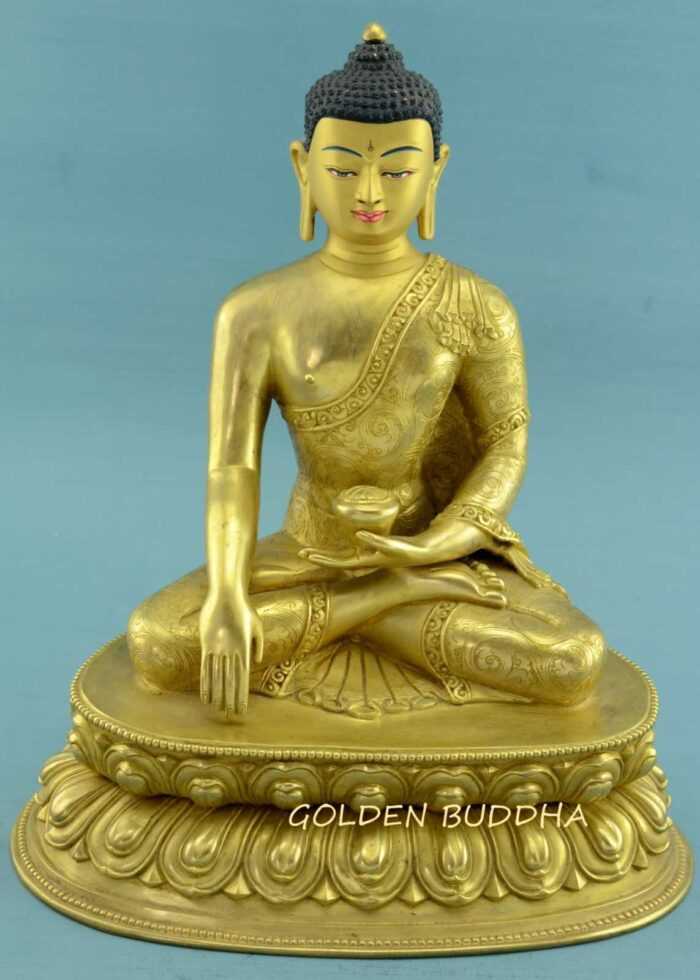
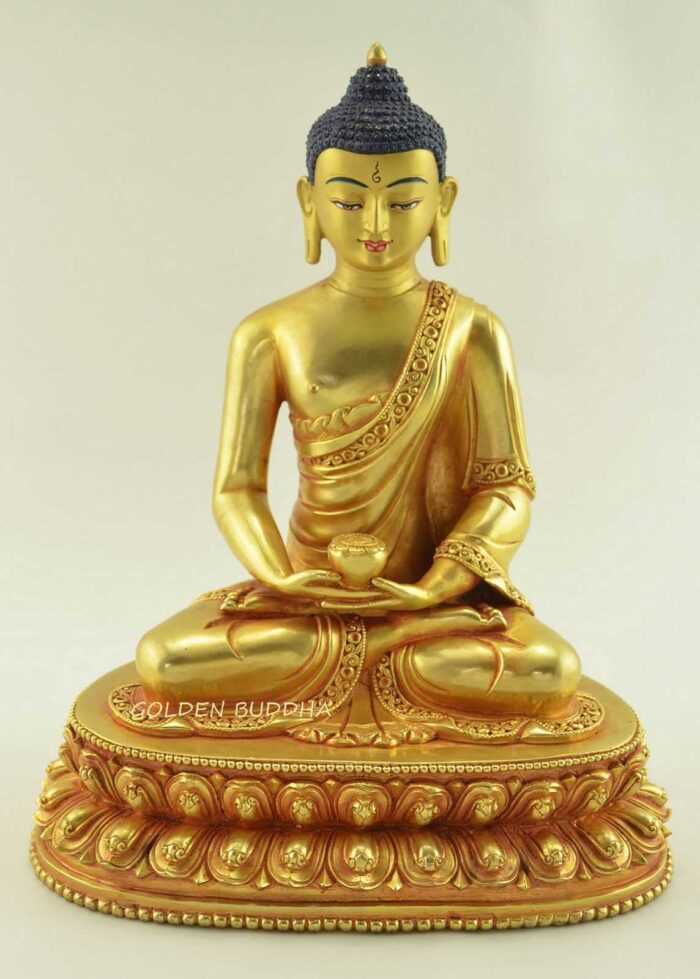
This Medicine Buddha statue forms a harmonious three-piece altar arrangement with our Tibetan Shakyamuni sculpture and gold-gilded Amitabha statue. The three sculptures were created by the same master artisan and share closely coordinated dimensions, copper-alloy casting, rich low-luster 24K fire gilding, hand-painted faces, traditional monastic robes, finely engraved garment borders, full lotus postures, and substantial double lotus thrones. Their shared finish and artistic proportions allow them to form a unified shrine while preserving the individual mudras and attributes of each Buddha.
The three Buddhas also create a meaningful doctrinal grouping. Shakyamuni is the historical teacher who attained enlightenment beneath the Bodhi tree and revealed the Dharma path beyond suffering. Medicine Buddha embodies the healing power of awakened wisdom and supports the restoration of favorable physical, emotional, and spiritual conditions. Amitabha represents Infinite Light and the compassionate vows that established Sukhavati as a favorable realm for continued progress toward awakening. Displayed together, Shakyamuni provides the teaching, Medicine Buddha supports healing during the journey, and Amitabha represents confidence in favorable rebirth and the completion of the path.
Custom Made Medicine Buddha Statues
Collectors, practitioners, monasteries, healing centers, and Dharma organizations may commission a custom made Tibetan Buddhist statue inspired by this Medicine Buddha design. A custom Medicine Buddha statue may be created in a different size with a rich low-luster 24K fire-gilded finish, brighter polished gilding, selective gold details, an oxidized surface, or an antiquated patina over the copper-alloy casting. Available options may include personalized robe-border engraving, alternative lotus-petal designs, hand-painted facial details, adjusted proportions, and refinements to the myrobalan plant or medicine bowl.
A coordinated Medicine Buddha, Shakyamuni, and Amitabha set may also be commissioned so that all three sculptures share the same height, monastic robe style, low-luster gilding, engraved hemlines, facial treatment, and double-lotus proportions. Commissioning the figures together allows the artisan to preserve their visual harmony while expressing their complementary roles: Shakyamuni as the teacher who reveals the path, Medicine Buddha as the healer of suffering and its causes, and Amitabha as the Buddha of Infinite Light whose vows support continued progress toward enlightenment. Every custom sculpture is individually cast, chased, engraved, fire gilded, painted, and finished by hand in Nepal according to traditional Himalayan iconographic proportions.
Authentic, Handmade in Nepal
Every statue and ritual item is handcrafted in Patan, Nepal, using traditional lost wax casting and comes with a certificate of authenticity issued by Nepal's Department of Archaeology, verifying its materials, technique, and origin.