

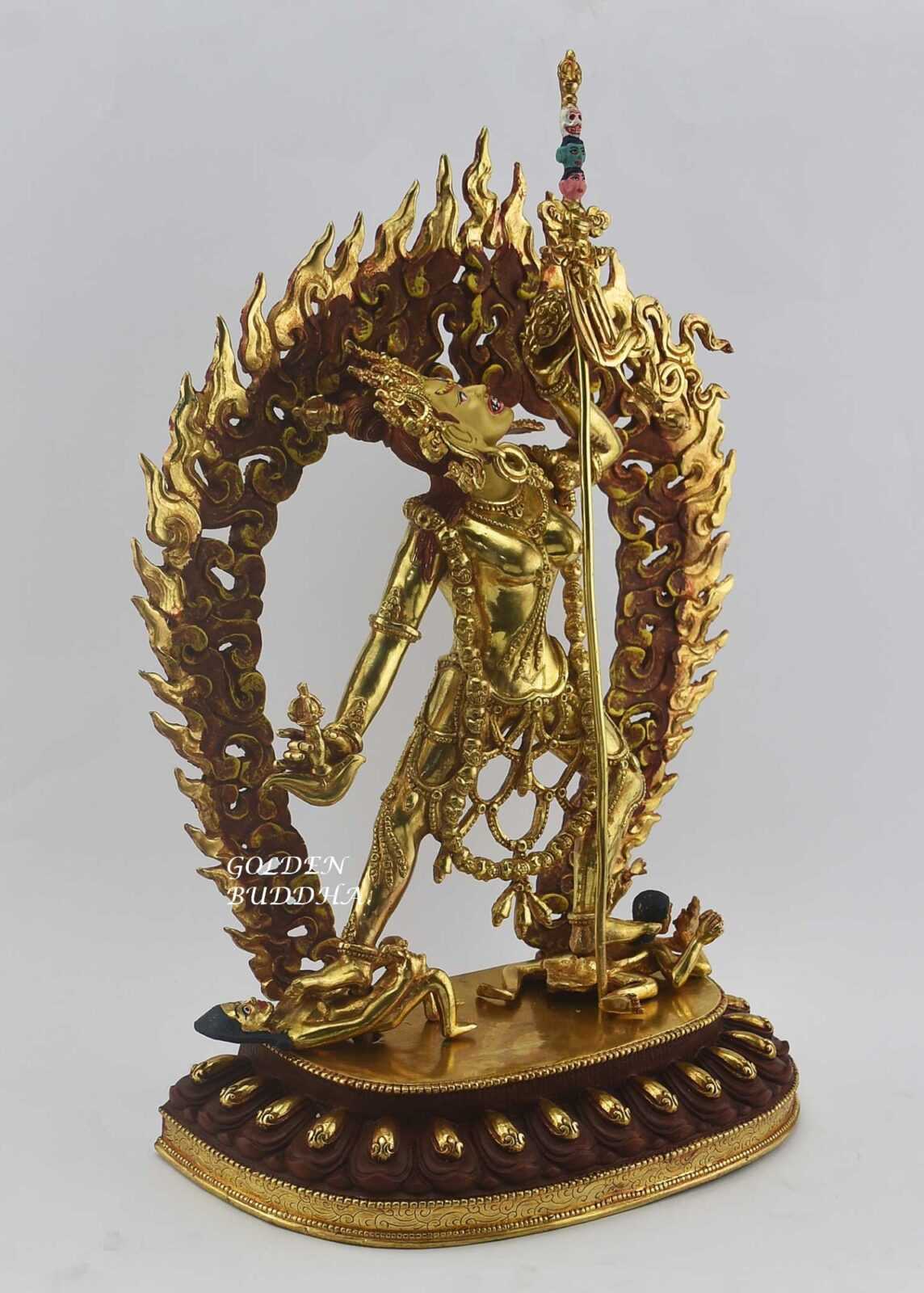
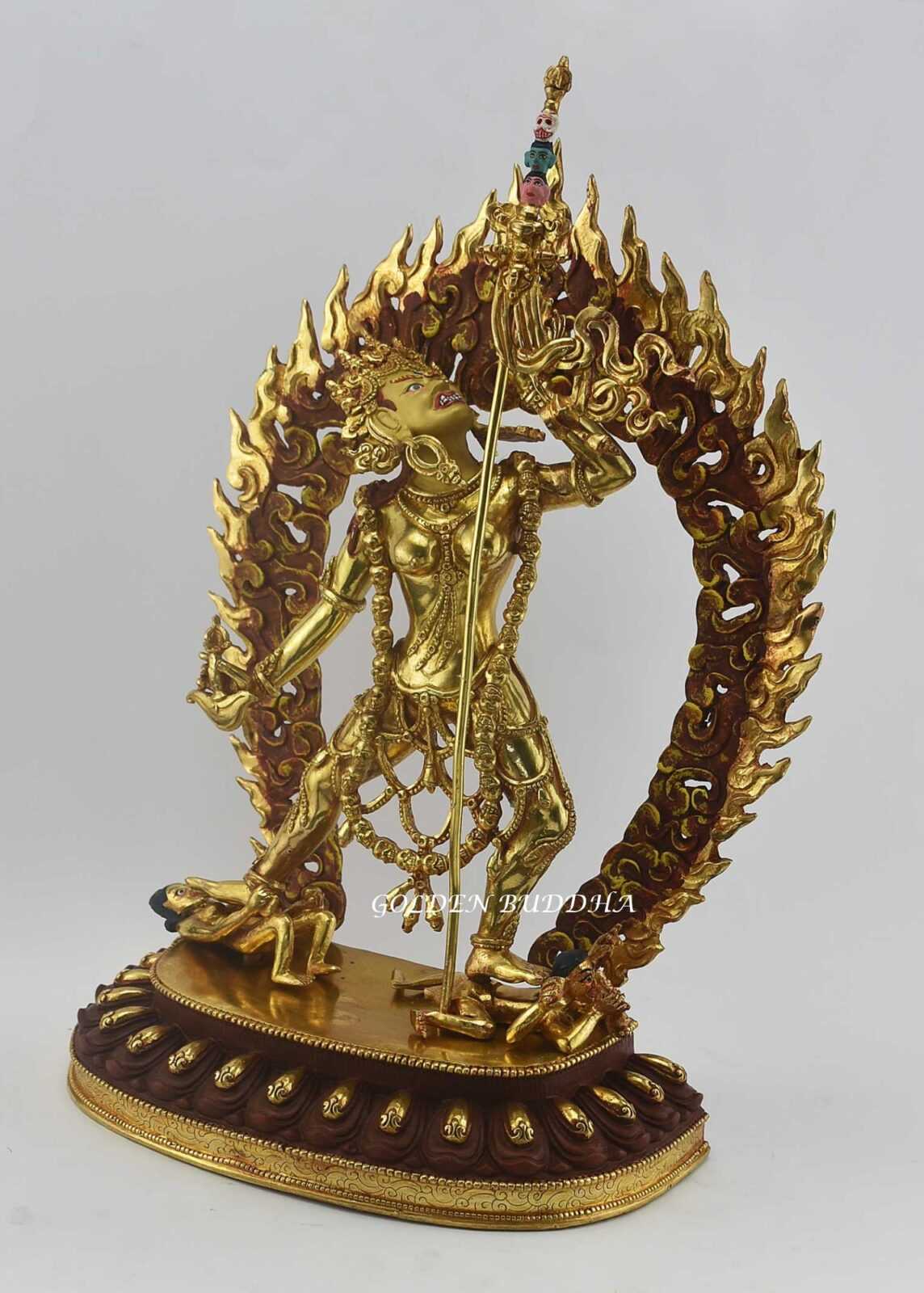
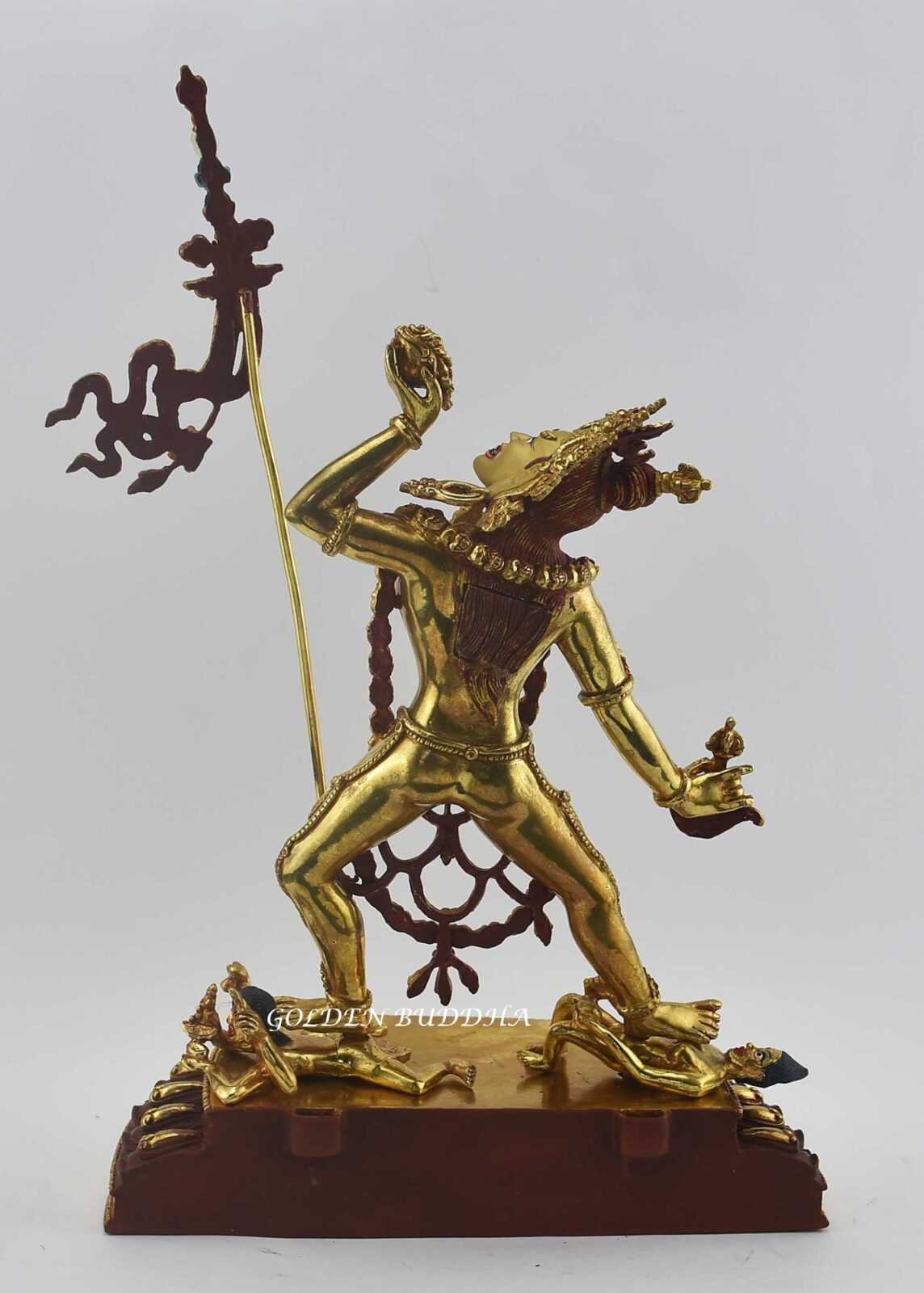
This magnificent Vajrayogini Sculpture portrays the Naro Kacho form of Vajrayogini standing within a removable mandorla of blazing flames. Handmade in Patan, Nepal, the entire composition—including the central deity, ritual implements, lotus pedestal, removable flame frame and its supports—was cast from copper alloy using the traditional lost-wax method. Vajrayogini’s body and principal ornaments are fire gilded in 24K gold, while the mandorla and portions of the pedestal retain a rich oxidized copper finish. The contrast between luminous gold and dark copper gives the sculpture exceptional depth and directs attention toward the deity’s upward gaze and dynamic tantric attributes.
This Vajrayogini Sculpture measures approximately 15.5 inches high when displayed with the complete khatvanga staff. Vajrayogini appears in a forceful striding posture, her head tilted upward toward the Pure Land of the Dakinis. Her lowered right hand holds the curved kartika flaying knife, while her raised left hand lifts a kapala skull cup toward her mouth. The khatvanga rises beside her left shoulder and visually extends the composition above the surrounding flames.
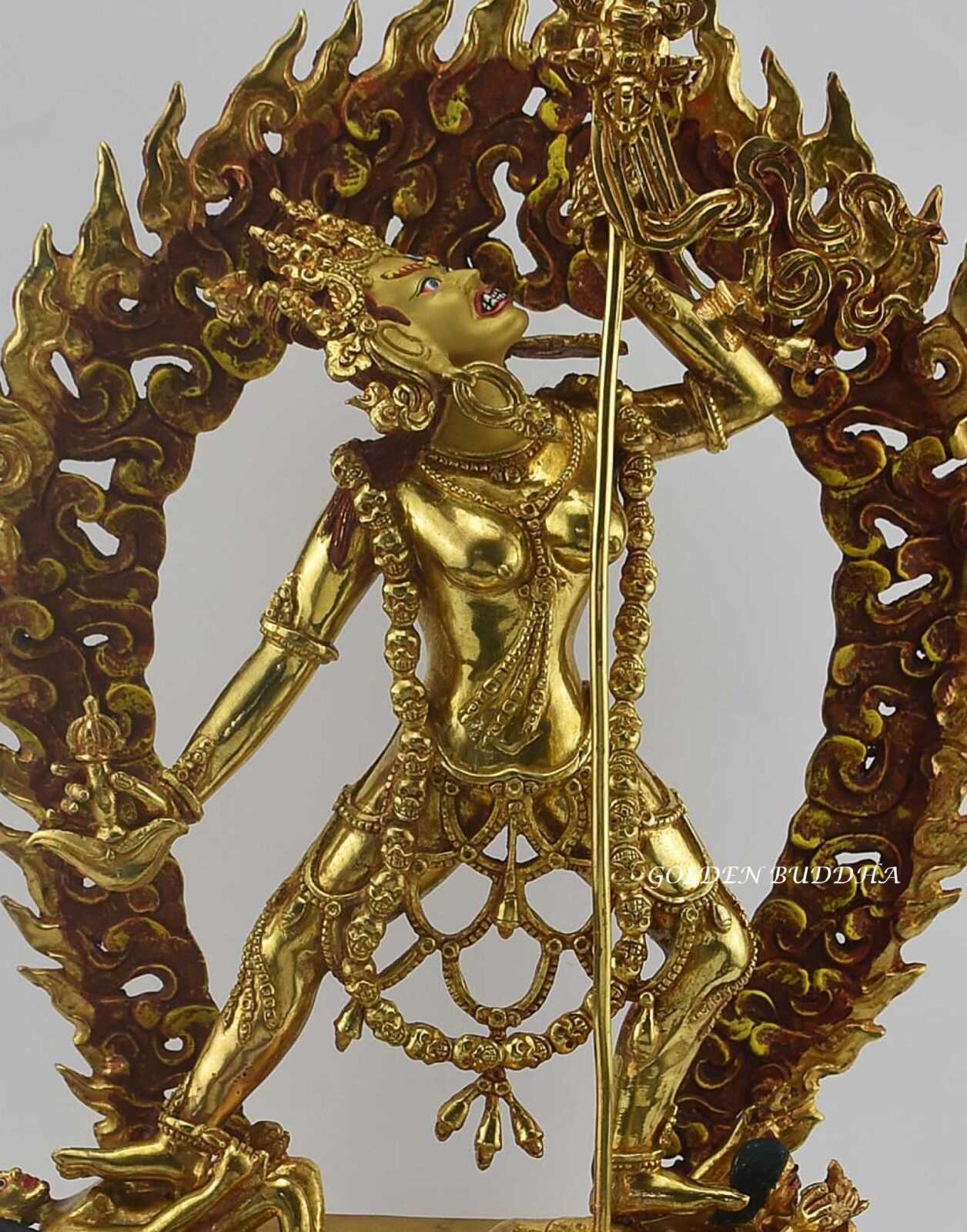
The deity wears a five-skull crown, elaborate bone ornaments and a long garland of severed heads. Her three eyes, open mouth and small fangs express fierce awakened awareness rather than anger. Her face is separately hand painted with 18K gold and natural pigments, giving definition to the upward-looking eyes, brows, lips and teeth. Beneath her feet are the subdued figures traditionally identified as Kalarati and Bhairava, representing forces of ordinary worldly existence brought under the mastery of enlightened wisdom.
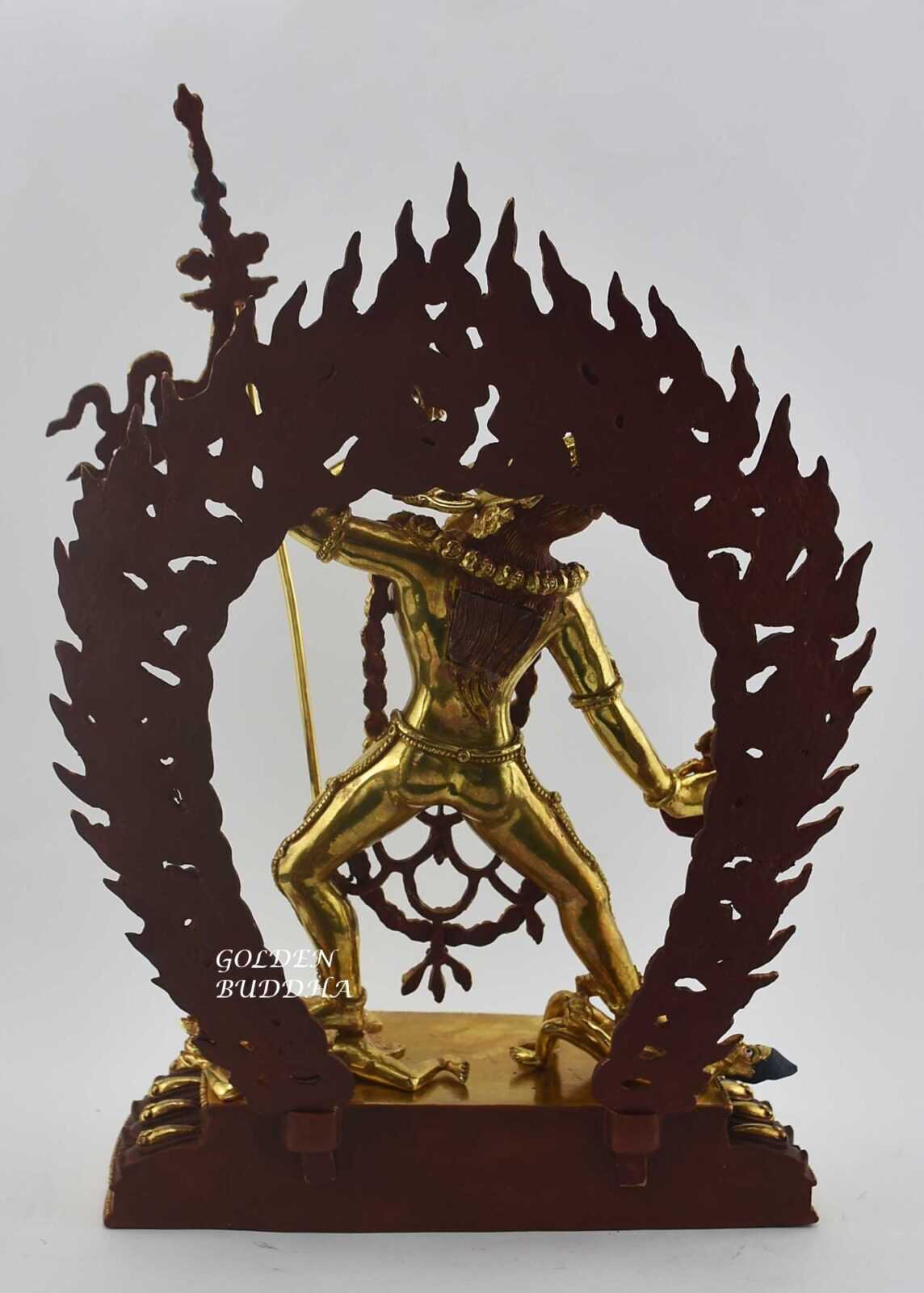
The removable flame mandorla is made entirely from copper alloy. Its dark oxidized surface is selectively highlighted with 24K fire-gilded flame tips and curling edges. The openwork construction allows light to pass through the frame, preserving the clarity of Vajrayogini’s slender form while surrounding her with the flames of pristine awareness. The mandorla can be detached from the pedestal when the central deity is to be displayed without the surrounding frame.
Vajrayogini Sculpture in the Naro Kacho Tradition
Naro Kacho Vajrayogini is a prominent form of the enlightened Dakini associated with the transmission lineage of the Indian mahasiddha Naropa. Her iconography expresses the inseparability of emptiness and great bliss. She appears youthful and radiant, yet she is surrounded by skulls, bone ornaments, flames and charnel-ground imagery. These contrasting qualities illustrate the tantric transformation of experiences ordinarily associated with desire, fear and death.
Vajrayogini does not symbolize the rejection of embodied life. She represents the transformation of its energy. Ordinary attachment is purified of grasping and converted into blissful awareness, while fear of impermanence is transformed into direct recognition of the mind’s empty nature. Her fierce appearance communicates the speed and decisiveness with which awakened wisdom cuts through delusion.
Her body bends upward in a dramatic arc, and her eyes are directed above rather than toward the viewer. This upward orientation is one of the clearest identifying features of the Naro Kacho form. Learn more about Naro Kacho Vajrayogini iconography and the meaning of her ritual attributes.
Upward Gaze toward the Pure Land of the Dakinis
Vajrayogini raises her face toward the Pure Land of the Dakinis, traditionally known as Khechara. Her upward gaze is closely connected with the kapala raised in her left hand. She appears to drink from the skull cup while directing her awareness beyond ordinary perception and habitual attachment to the physical body.
The pose is not merely theatrical. It serves as a visual instruction within Vajrayogini practice. The rising movement of the head, eyes, kapala and khatvanga draws the practitioner’s attention toward awakened awareness and the transcendence of ordinary birth and death. Her feet remain engaged with the worldly figures beneath her, showing that realization is achieved through transformation of samsaric experience rather than escape from it.
Kartika Flaying Knife in Vajrayogini’s Right Hand
Vajrayogini’s lowered right hand holds the kartika, a curved ritual flaying knife associated with enlightened Dakinis and tantric deities. Its hooked crescent blade represents the severing of attachment, ego-clinging and the obscurations that prevent recognition of the true nature of mind.
The kartika is not an emblem of ordinary violence. Its cutting action is symbolic and precise. Wisdom removes the false assumption that the body, emotions and personal identity possess permanent independent existence. In doing so, it exposes the open and luminous nature of awareness concealed beneath habitual grasping.
The lowered position of the right hand directs the blade toward the realm of ordinary experience. Vajrayogini’s wisdom is therefore shown cutting downward through the bonds of samsara, while her gaze and raised left hand move upward toward the Dakini Pure Land.
Kapala Skull Cup Raised in the Left Hand
Vajrayogini raises a kapala skull cup in her left hand and turns her face toward it. The vessel is traditionally described as containing blood or transformative nectar. Within tantric symbolism, this substance represents ordinary life-force, attachment and sensory experience transformed into the nectar of blissful wisdom.
The kapala confronts the practitioner with impermanence and the reality of death. Rather than treating these subjects as causes for fear or avoidance, Vajrayogini incorporates them directly into the path. The skull cup teaches that experiences considered impure or frightening can become supports for realization when their empty nature is understood.
The raised kapala and lowered kartika form a coordinated pair. The kartika cuts through ignorance and ego-clinging, while the kapala represents the transformation of what has been severed into awakened experience. Together they express the union of penetrating wisdom and tantric method.
Vajrayogini Sculpture ‒ Khatvanga Staff and the Three Stacked Heads
The tall khatvanga rests beside Vajrayogini’s left side and extends above the flame mandorla. In solitary representations of Vajrayogini, the staff signifies her inseparability from her consort Chakrasamvara, or Heruka. Their union represents method and wisdom, bliss and emptiness, experienced as a single awakened reality.
The upper staff displays three stacked heads in successive states—a freshly severed head, a more decomposed head and a dry skull—surmounted by a ritual finial. These forms evoke impermanence and the complete transformation of the three realms of desire, form and formlessness.
The colored faces on the khatvanga introduce restrained polychrome detail into the predominantly gold and oxidized copper composition. The long shaft creates a strong vertical line beside Vajrayogini and visually reinforces her upward gaze.
Five-Skull Crown, Three Eyes and Bone Ornaments
Vajrayogini wears a crown formed from five skulls. The five skulls represent the transformation of the five principal afflictions—ignorance, anger, pride, attachment and jealousy—into the five awakened wisdoms. This is a tantric skull crown rather than a conventional jeweled Bodhisattva crown.
Her third eye is positioned vertically upon the forehead. Together, the three eyes symbolize unrestricted awareness and the ability to perceive past, present and future. The eyes are directed upward, reinforcing the characteristic Naro Kacho posture.
Bone ornaments decorate her hair, neck, arms, waist and legs. These charnel-ground adornments proclaim freedom from attachment to physical beauty, social identity and the permanence of the body. Their delicate workmanship contrasts with their severe meaning, combining refined Newar craftsmanship with uncompromising tantric symbolism.
Garland of Severed Heads
A long garland of severed heads descends from Vajrayogini’s shoulders and encircles her body. Traditionally described as containing fifty heads, the garland is associated with the Sanskrit letters and the conceptual structures formed through ordinary language.
The imagery represents the cutting of ego-driven conceptual thought rather than the destruction of living beings. Under Vajrayogini’s influence, ordinary speech is transformed into mantra, and conceptual activity is transformed into direct nondual awareness.
Fine chains and pendant ornaments extend below the waist and between the legs. Their openwork arrangement keeps the standing form visually light while adding elaborate detail to the central area of the sculpture.
Standing upon Kalarati and Bhairava
Vajrayogini stands upon two prone figures traditionally identified as red Kalarati and black Bhairava. Her extended right foot presses upon Kalarati, while her bent left leg subdues Bhairava. The two figures represent worldly forces and states of consciousness brought under the control of awakened wisdom.
Their subjugation should not be understood as personal hostility. Vajrayogini stands above the habitual patterns, fears and afflictions that dominate unenlightened experience. Her powerful stance demonstrates that these forces lose their authority when their empty nature is recognized.
Vajrayogini Sculpture ‒ Removable Copper-Alloy Flame Mandorla
The removable copper-alloy mandorla surrounds Vajrayogini with an oval field of curling flames. Its central surface has a deep oxidized copper finish, while raised flame tips and selected edges are highlighted in 24K fire-gilded gold.
The flames represent pristine awareness consuming ignorance and obscuration. They are not ordinary destructive fire; they symbolize the transformative energy of wisdom through which every experience becomes part of the path.
The openwork frame is fully cast in copper alloy and finished on both sides. Its irregular flame tips create a forceful silhouette, while the internal curling forms allow the gilded deity to remain visible through the mandorla. The frame attaches securely to the base but can be removed for a more open presentation of the central figure.
Vajrayogini Sculpture ‒ 24K Fire Gilding and Oxidized Copper Finish
The central Vajrayogini figure is fire gilded in 24K gold. This luminous finish emphasizes her body, ritual implements, skull crown, ornaments and dynamic posture. The darker recessed areas around the jewelry and garland help preserve the clarity of the fine sculptural details.
The oxidized copper finish across the mandorla and lotus throne creates a deliberate contrast with the golden deity. Selected flame tips, lotus details, rims and engraved borders are gilded so that the frame remains visually connected with Vajrayogini without losing its darker dramatic character.
The face is separately hand painted with 18K gold and natural pigments. Carefully rendered eyes, brows, lips and fangs give Vajrayogini a fierce yet controlled expression appropriate to an enlightened Dakini.
Oxidized Lotus Pedestal with Gilded Details
The Vajrayogini sculpture rests upon a broad single lotus pedestal cast from copper alloy. The lotus course is finished in dark oxidized copper, with gilded details applied to the inner petal tips, upper rim and decorative borders.
A beaded band separates the standing platform from the lotus petals. Beneath them, a gilded lower course is engraved with fine scrolling designs. The dark lotus row gives the base visual weight, while the gold border frames the entire composition.
The lotus represents purity arising within samsara. Its presence beneath Vajrayogini reconciles the sculpture’s fierce charnel-ground imagery with the purity and awakened nature of the deity it supports.
Traditional Lost-Wax Casting in Patan, Nepal
This Vajrayogini Sculpture was handmade by Newar artisans in Patan, Nepal, through the traditional lost-wax casting process. Separate wax models are prepared for Vajrayogini, the ritual implements, worldly figures, pedestal and removable flame mandorla.
Each wax component is enclosed in a heat-resistant mould and fired until the wax melts away. Molten copper alloy is then poured into the resulting cavity. After cooling, the mould is broken and the raw metal components are chased, filed and refined individually.
The artisan sharpens the three eyes, fangs, skull crown, bone ornaments, severed-head garland, kartika, kapala and khatvanga before assembling the complete figure. The thin openwork flames require particular skill because they must appear energetic and delicate while remaining structurally secure.
The central deity is prepared for 24K fire gilding, while the mandorla and pedestal receive their oxidized finishes and selective gilded highlights. Because the original wax models are destroyed during casting and the finishing is performed by hand, each completed statue possesses subtle individual variations.
Vajrayogini Sculpture and Dorje Shugden Statue Pair
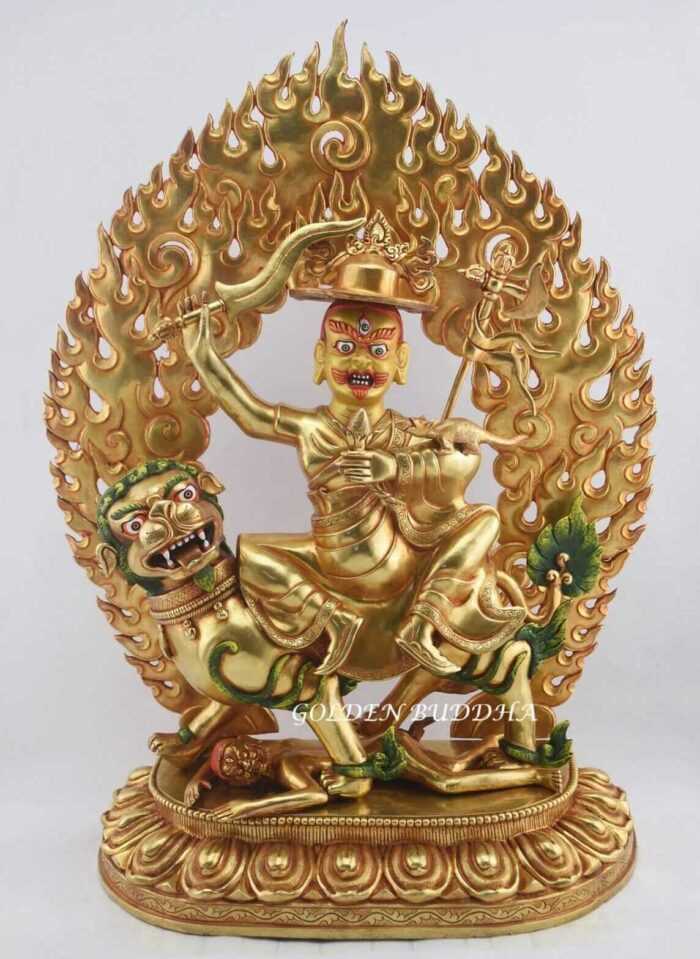
This Vajrayogini Sculpture would form a visually commanding two-piece arrangement with the Masterpiece Dorje Shugden statue. Both sculptures combine extensive 24K fire gilding with darker oxidized copper details, substantial pedestals and forceful sacred imagery.
The pairing is most appropriate for practitioners whose lineage recognizes and relies upon both figures. Vajrayogini is a meditational deity whose practice transforms ordinary experience into the realization of great bliss and emptiness. Dorje Shugden is approached within particular traditions as a Dharma protector whose activity is directed toward removing obstacles and safeguarding favorable circumstances for practice.
Within that context, Vajrayogini represents the central transformative path, while Dorje Shugden represents protective activity supporting the practitioner’s progress. Their roles are therefore complementary rather than equal: the protector safeguards the conditions for practice, while Vajrayogini embodies the realization toward which that practice is directed.
Because Dorje Shugden practice is lineage-specific, the statues should be arranged and used according to the guidance, commitments and instructions of the practitioner’s qualified teacher.
Custom-Made Vajrayogini Sculptures
A custom-made Vajrayogini statue may be commissioned in a preferred size, finish and level of ornamentation. Available options include compact personal shrine statues, larger temple-scale images, antiquated oxidized copper finishes, selectively gilded compositions and sculptures fire gilded in 24K gold.
A custom commission may include a separately removable copper-alloy flame mandorla. The frame may retain a dark oxidized finish with gilded flame tips, or receive more extensive 24K fire gilding according to the desired visual effect.
The five-skull crown, bone ornaments, severed-head garland, kartika, kapala and khatvanga can be refined according to the scale of the commission while preserving authentic Naro Kacho iconography. Genuine turquoise and red coral may be added selectively to appropriate ornamental settings.
Custom Vajrayogini sculptures can be created for experienced private practitioners, Dharma centers, temples and monasteries. The deity’s characteristic upward gaze, raised left-hand kapala, lowered right-hand kartika, three eyes, khatvanga and stance upon Kalarati and Bhairava are preserved throughout the design process.
A coordinated commission may also pair Vajrayogini with the Masterpiece Dorje Shugden statue. Their heights, gilded surfaces, oxidized details and pedestal proportions can be planned together, while their individual iconography and traditional ritual roles remain clearly distinguished.
Authentic, Handmade in Nepal
Every statue is handcrafted in Patan, Nepal, using traditional lost wax casting and comes with a certificate of authenticity issued by Nepal’s Department of Archaeology, verifying its materials, technique, and origin.
frankfreywis (verified owner) –
This statue is very qualified and very special. I am very happy with the qualitiy and the service. Thank you very much, Edwin.
Edwin –
Beautiful handmade statue! Thank you for the special consecration at the Vajrayogini Temple in Sankhu, Nepal.