

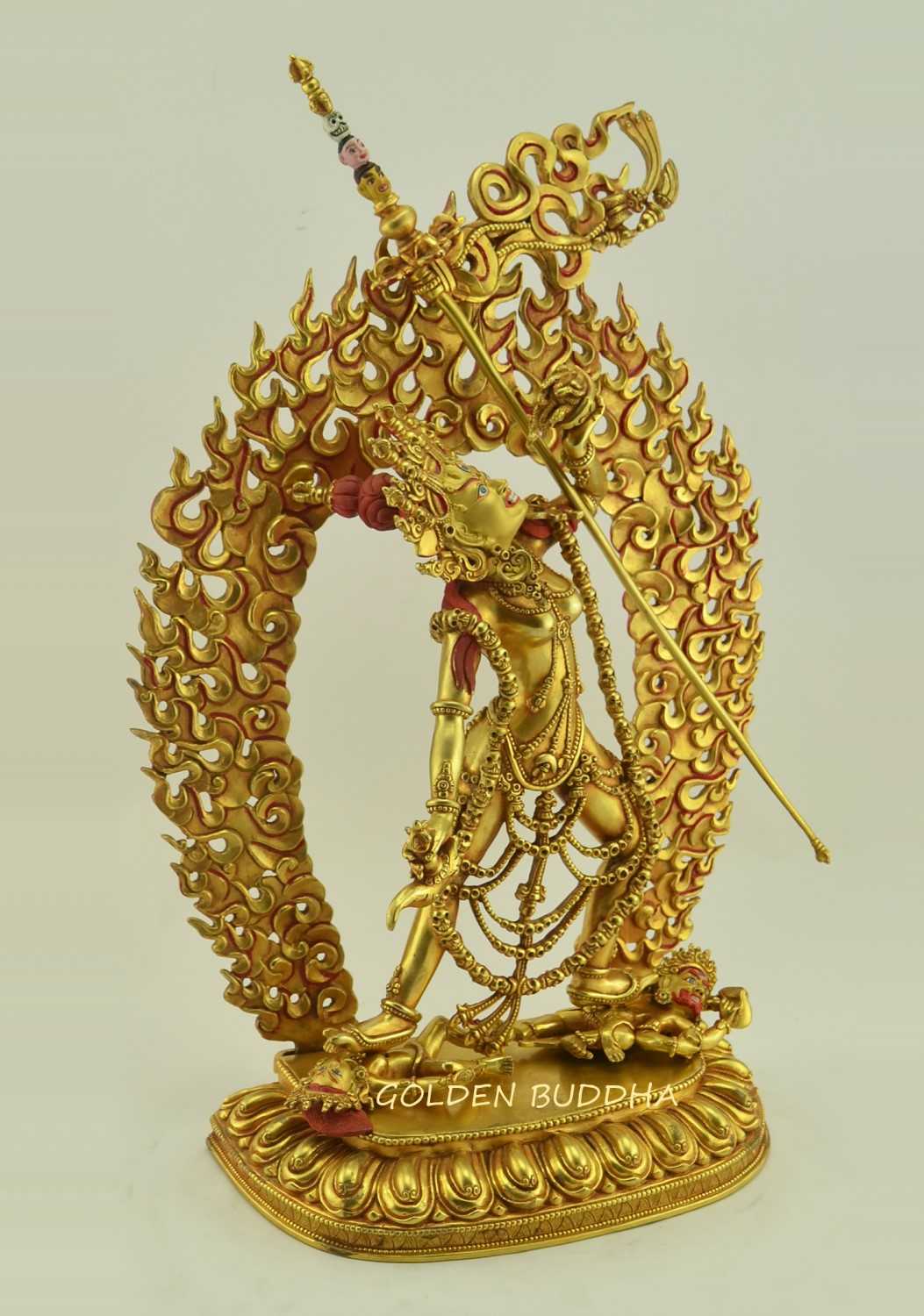


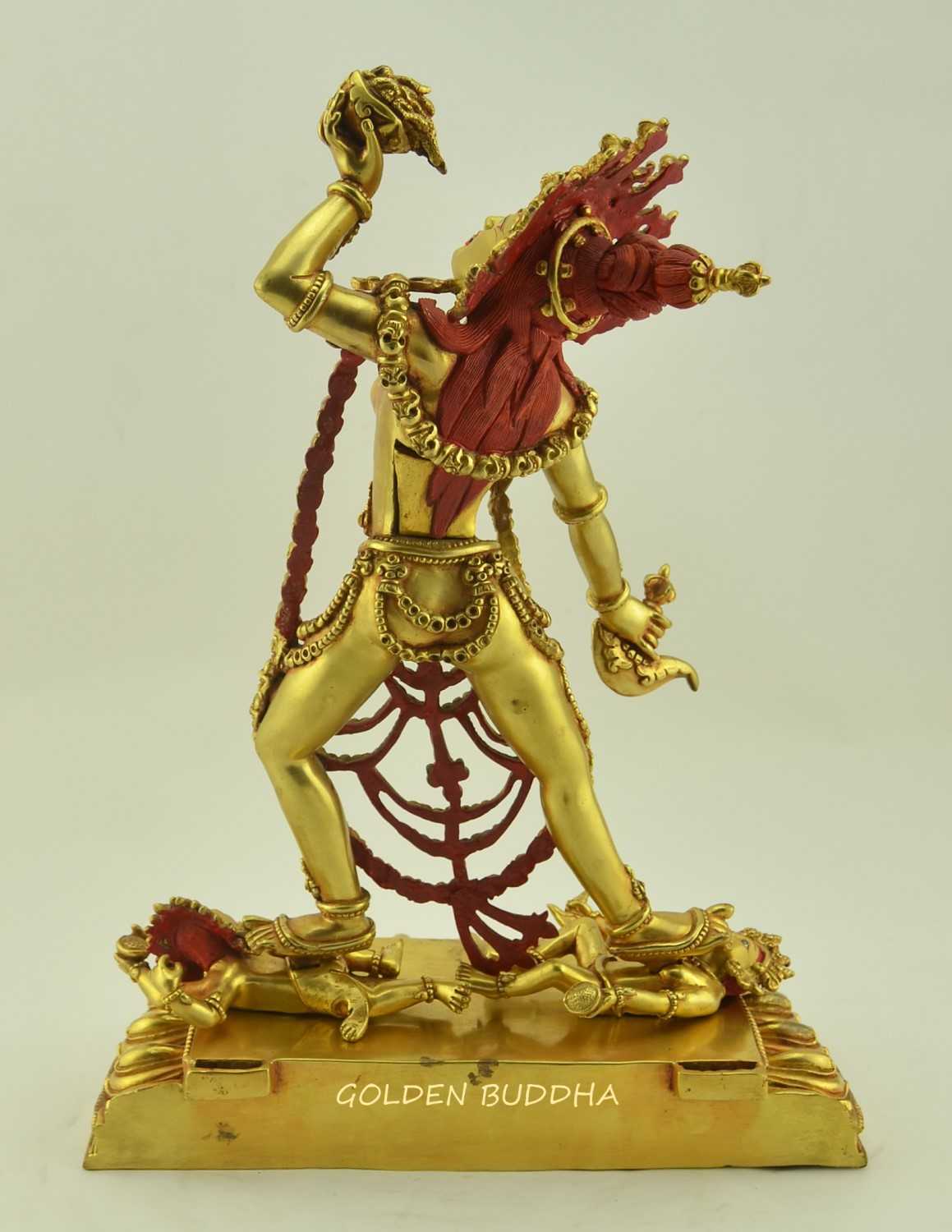
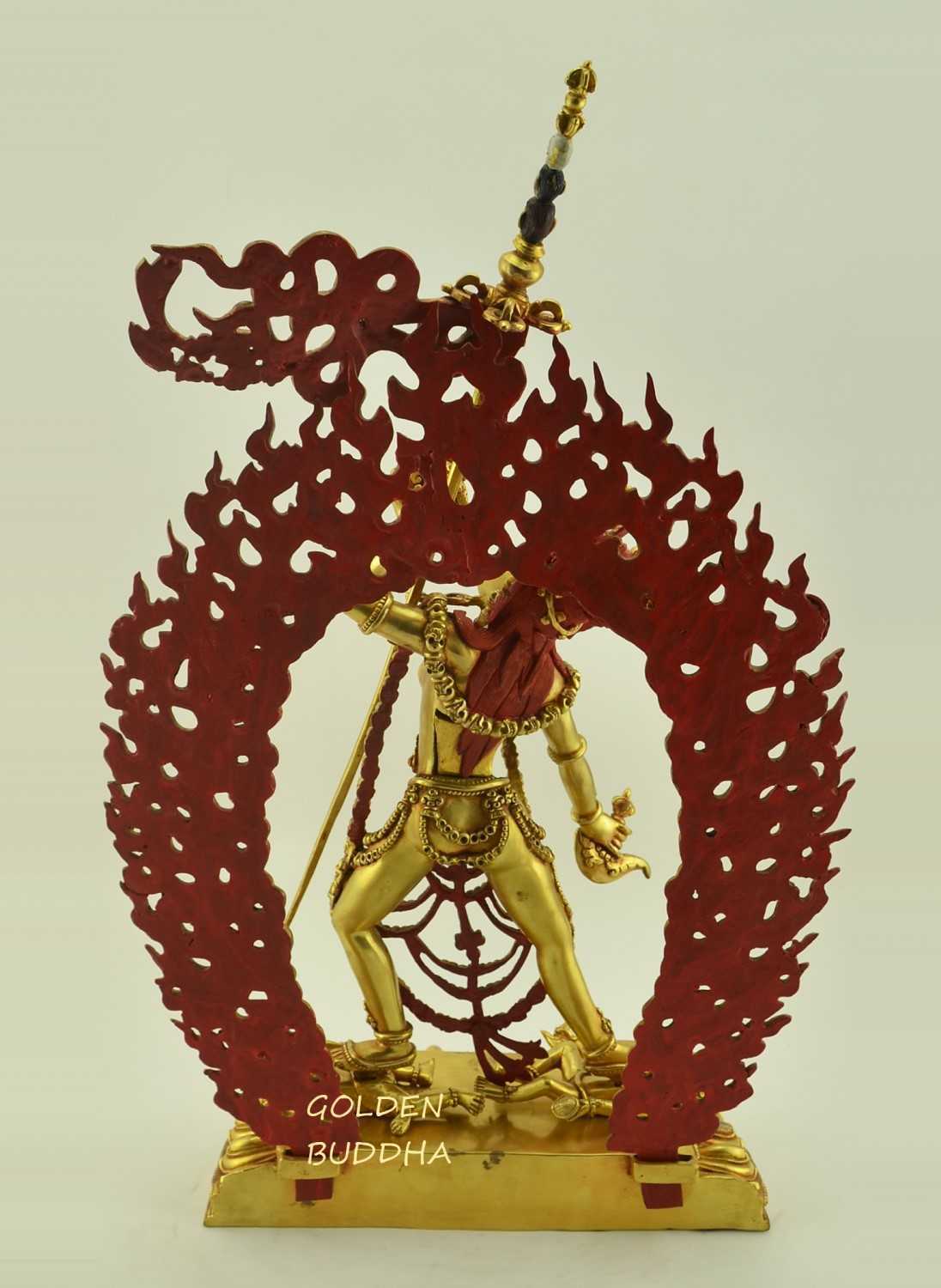
This extraordinary Masterpiece Vajrayogini Statue portrays Dorje Naljorma in the Naro Kacho form, standing within an elaborate aureole of wisdom flames and raising her gaze toward the pure realm of the Dakinis. Handcrafted in Patan, Nepal, by accomplished Newar artisans, the sculpture is cast in copper alloy through the traditional lost-wax method and fire gilded in 24K gold. The complete composition—including Vajrayogini, her ritual implements, the two subdued figures beneath her feet, the lotus pedestal, and the removable flame mandorla—is created from a copper-alloy base.
The complete sculpture measures approximately 19.5 inches in height when the elevated khatvanga is included. Vajrayogini measures approximately 13 inches without the surrounding frame, while the assembled statue reaches approximately 16.5 inches to the top of the flame mandorla. With a width of approximately 12 inches and a depth of 5.5 inches, this is a substantial altar-scale sculpture whose tall, open composition gives it an impressive presence without appearing visually heavy.
Vajrayogini is a fully enlightened female Buddha and one of the most important meditational deities of the highest yoga tantra traditions. Her Sanskrit name combines vajra, signifying indestructible enlightened awareness, with yogini, denoting a female master of the profound Tantric path. She embodies the inseparability of great bliss and emptiness, transforming the energies that ordinarily sustain attachment and confusion into the direct means of awakening.
Masterpiece Vajrayogini Statue in the Naro Kacho Form
This Masterpiece Vajrayogini Statue follows the distinctive Naro Kacho tradition associated with the Indian mahasiddha Naropa. The name Naro Kacho may be understood as “Naropa’s Sky-Goer,” identifying a specific transmission of Vajrayogini practice preserved within Tibetan Vajrayana. Her iconography is recognizable through her upward gaze, dynamic standing posture, kartika, kapala, khatvanga, five-skull crown, bone ornaments, and the two worldly deities beneath her feet. Readers can explore the history and symbolism of the Naro Kacho lineage of Vajrayogini in our detailed guide.
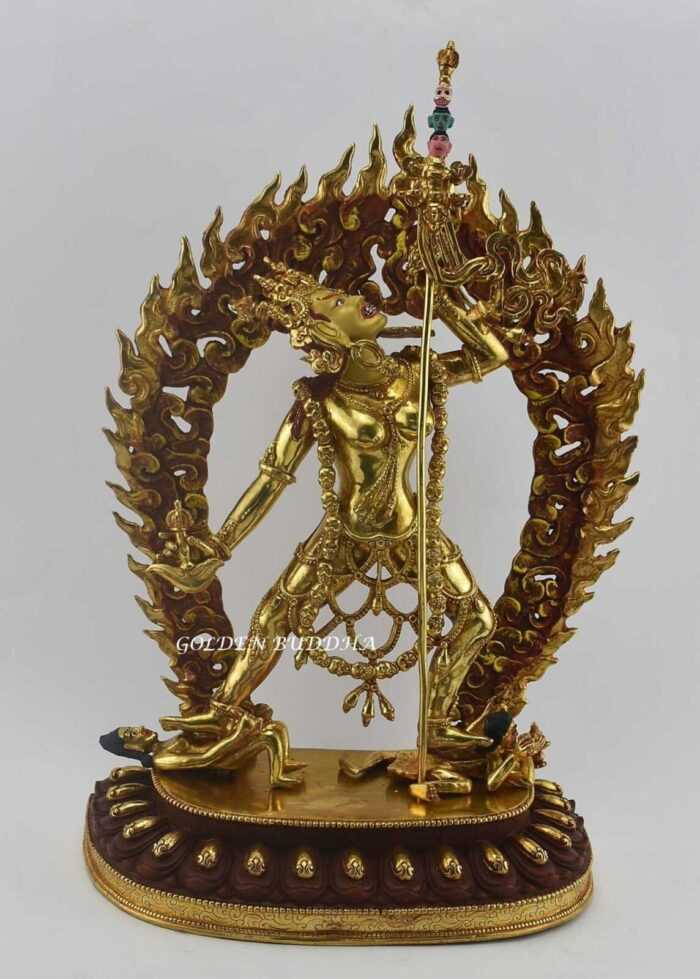
Her body inclines gracefully toward her raised left hand while her head turns sharply upward. This unmistakable upward gaze is one of the defining characteristics of the Naro Kacho form. Rather than looking outward toward the viewer, Vajrayogini directs her attention toward the pure realm of the Dakinis, expressing a consciousness no longer confined by ordinary appearances. Her open mouth approaches the skull cup held above her, creating a dramatic line from the lifted face through the extended arm and into the ritual vessel.
Although Vajrayogini statues are traditionally visualized with a red body, this sculpture presents her form in a refined 24K fire-gilded finish. The luminous gold surface highlights the modeling of her torso, limbs, facial features, and ritual ornaments while red pigment is selectively applied to her flowing hair and other details. This artistic treatment preserves the essential Naro Kacho iconography while emphasizing the metalworking and gilding traditions for which the Newar artisans of the Kathmandu Valley are renowned.
The Kartika Flaying Knife in Her Right Hand
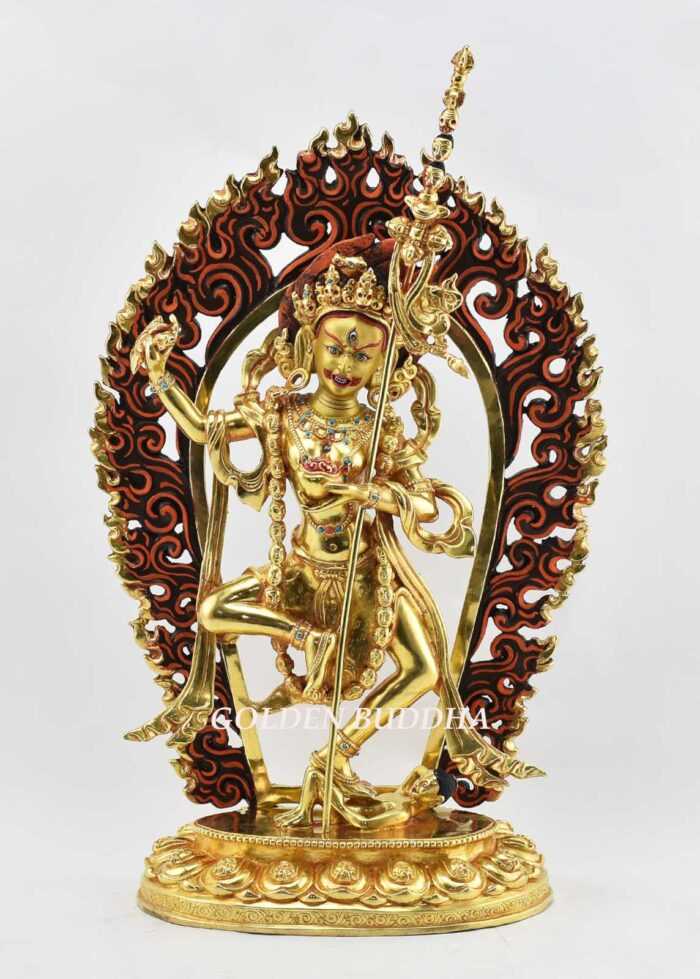
In her lowered right hand, Vajrayogini holds the kartika, the curved ritual flaying knife characteristic of Dakini iconography. The implement is positioned beside her right thigh, with its crescent blade projecting outward and its ornamented handle enclosed within her hand. The kartika does not represent ordinary violence. It symbolizes the sharp activity of wisdom cutting through ego-clinging, attachment, and the conceptual habits that bind beings to samsara.
The curved profile of the blade traditionally evokes the removal of a hide, symbolizing the stripping away of superficial identities and deceptive appearances. In this sculpture, the kartika is carefully integrated into the descending line of the right arm. The restrained placement of the implement balances the elevated kapala on the opposite side and contributes to the graceful but forceful movement of the figure.
The Kapala Skull Cup Raised in Her Left Hand
Vajrayogini raises a kapala skull cup in her left hand, bringing it toward her open mouth. The vessel is modeled with the recognizable contours of a human cranium and embellished with a decorative rim. In Tantric symbolism, the kapala represents the transformation of ordinary experience, desire, and the fear of mortality into the nectar of bliss-wisdom. Rather than rejecting difficult aspects of existence, Vajrayogini reveals their empty nature and transforms their energy into the path.
The raised cup, upward-turned face, and extended neck form the central expressive gesture of this Masterpiece Vajrayogini Statue. Her posture conveys immediacy and complete absorption, as though the figure has been captured at the height of a sacred Tantric movement. Fine painted details around the eyes, lips, and vertical third eye add definition to the gold-painted face without obscuring the quality of the underlying sculptural work.
Masterpiece Vajrayogini Statue ‒ Khatvanga and Her Inseparable Union with Heruka
The tall khatvanga rises beside Vajrayogini and rests along her left side, extending well above the flame mandorla. This ritual staff represents her inseparable union with her consort Heruka Chakrasamvara. Although Heruka is not represented as a separate figure, the presence of the khatvanga signifies that method and wisdom, compassion and emptiness, remain indivisible within Vajrayogini’s enlightened realization.
The upper section is crowned by a vajra finial and a vertical arrangement of heads and skull forms, while the decorated shaft descends beside the figure. Flowing ribbons and ornamental elements spread outward from the upper staff, creating an elaborate horizontal counterpoint to the tall vertical structure. Because the khatvanga extends above the mandorla, it establishes the full 19.5-inch height of the assembled sculpture and gives the composition its soaring visual character.
Five-Skull Crown, Third Eye and Flowing Red Hair
Vajrayogini wears a prominent crown of five skulls, not the jeweled crown of a peaceful Bodhisattva. Each skull is carefully integrated into the elaborate diadem above her forehead. The five skulls symbolize the transformation of the five mental poisons—ignorance, attachment, anger, pride, and jealousy—into the five forms of enlightened wisdom. They also signify freedom from grasping at the five aggregates as a permanent self.
A vertical third eye appears in the center of her forehead, complementing the two natural eyes and symbolizing direct wisdom beyond ordinary dualistic perception. Her face combines beauty and intensity: the features are finely modeled, the lips are slightly parted toward the kapala, and the gaze is sharply directed upward. These qualities communicate Vajrayogini’s nature as both an embodiment of radiant feminine beauty and a fearless enlightened presence who has completely transcended death, attachment, and conventional limitation.
Her long hair streams freely down her back and is finished in a deep red tone that contrasts powerfully with the surrounding gold. The rear view reveals individual strands and gathered sections of hair cascading beneath the crown. This unfettered hair represents her freedom from ordinary social, conceptual, and karmic restraints. It also introduces rich color and texture across the reverse of the sculpture, demonstrating that the statue has been carefully finished from every viewing angle.
Masterpiece Vajrayogini Statue ‒ Bone Ornaments and the Transformation of Mortality
Vajrayogini’s body is adorned with an elaborate array of Tantric bone ornaments. Earrings, necklaces, bracelets, anklets, girdles, and suspended chains decorate her otherwise unclothed form. These are not conventional ornaments intended merely to convey luxury. They connect Vajrayogini with the charnel grounds—the traditional environments in which accomplished yogis and yoginis confronted impermanence, fear, attachment to the body, and the inevitability of death.
The front of the sculpture displays multiple beaded strands suspended from the waist and thighs in a highly detailed ritual apron. Additional chains follow the contours of the hips and torso, while the rear view reveals a more open arrangement that allows the gilded form of the back and legs to remain visible. A garland of skull forms encircles her upper body and descends through the composition, representing the purification of ordinary speech and conceptual thought into enlightened expression.
The contrast between Vajrayogini’s youthful form and her ornaments of skulls and bone expresses one of the central paradoxes of her iconography. Beauty and mortality, attraction and renunciation, bliss and emptiness are not treated as irreconcilable opposites. Instead, they are revealed as experiences whose true nature can be understood and transformed through wisdom.
Kalarati and Bhairava Beneath Her Feet
Vajrayogini stands upon the recumbent forms of Kalarati and Bhairava, the principal Hindu worldly goddess and god represented beneath her feet. These figures are modeled as separate reclining bodies extending across the upper surface of the pedestal. Their placement symbolizes Vajrayogini’s transcendence of worldly powers, conditioned existence, and the dualistic oppositions through which ordinary consciousness interprets reality.
Her feet press firmly upon the two figures while her legs form the dynamic reverse stance characteristic of this Naro Kacho depiction. One knee bends and the other leg extends, generating a sense of movement through the hips, torso, and raised arm. The figures beneath her are cast in copper alloy and fire gilded in 24K gold, with selective red facial and hair details that distinguish them from the broad gold surface of the pedestal.
Removable Copper-Alloy Flame Mandorla
The entire removable flame mandorla is made from a copper-alloy base. From the front, the frame is richly fire gilded in 24K gold, with red-toned recesses accentuating the curling outlines of the individual flames. The openwork design allows light and background space to pass through the aureole, preventing the extensive frame from overwhelming the slender central figure.
The reverse presents a contrasting red oxidized copper finish that clearly reveals the extensive handwork used to create the frame. Rows of curling flames rise from fitted supports at the rear of the pedestal and converge above Vajrayogini’s head. The mandorla represents the fire of pristine awareness that consumes ignorance, attachment, aversion, and every mental obstruction preventing the realization of emptiness.
Because the frame is removable, the statue can be carefully disassembled for secure packing and international transport. It may also be displayed without the mandorla when a more minimal presentation is preferred, although the complete assembly provides the fullest expression of Vajrayogini’s fiery Naro Kacho iconography.
Copper-Alloy Casting and 24K Fire Gilding
This Masterpiece Vajrayogini Statue is handcrafted through the traditional lost-wax casting process practiced by generations of Newar artisans in Patan. Vajrayogini, the khatvanga, ritual implements, subdued figures, pedestal, and removable flame mandorla are all made from copper alloy. The complex sculpture requires numerous separately cast elements to be modeled, chased, finished, and fitted together with precision.
Following casting, the metal surfaces are refined by hand so that the facial features, bone ornaments, skull crown, ritual implements, flowing hair, and flame contours retain crisp definition. The principal surfaces are then fire gilded in 24K gold. This traditional process creates a permanent bond between the gold and copper-alloy base, producing the warm, luminous surface associated with high-quality Himalayan sacred sculpture.
Selective pigments bring additional clarity to the red hair, facial details, third eye, skull forms, and recessed ornamentation. The finish does not conceal the sculptural quality of the metalwork; instead, it directs attention to the subtle contours of the body and the exceptional density of the ritual ornamentation. The result is a museum-quality sculpture that rewards close observation from the front, sides, and rear.
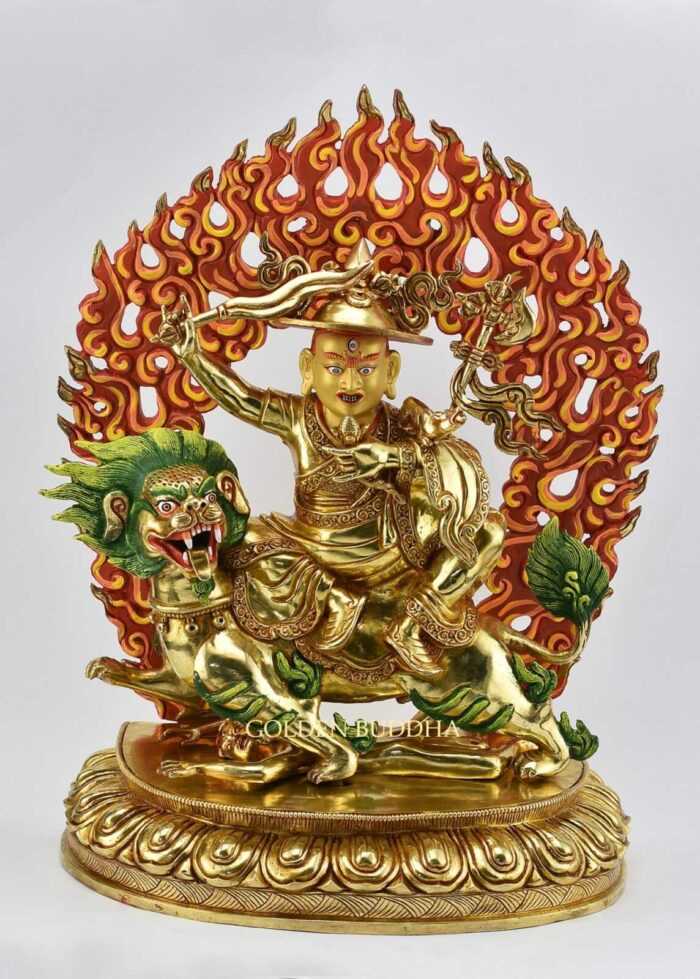
A Doctrinal Pairing with Masterpiece Dorje Shugden
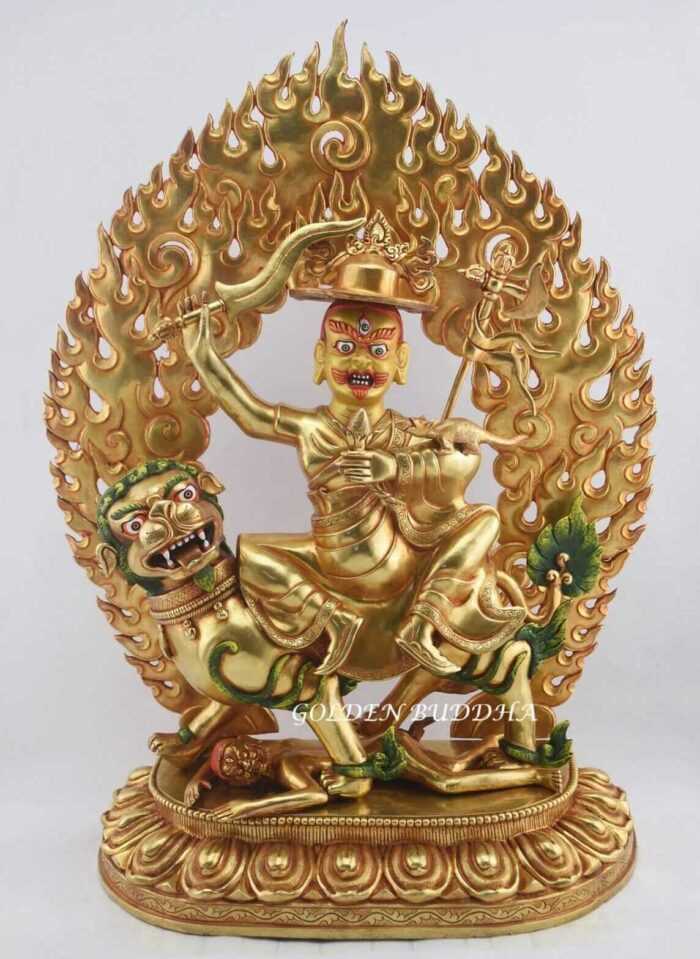
This Vajrayogini can form a meaningful two-piece collection with the Masterpiece Dorje Shugden Sculpture. The two deities perform distinct rather than interchangeable roles. Vajrayogini is the meditational deity whose practice embodies profound inner transformation, the union of great bliss and emptiness, and the direct realization of enlightened wisdom. Dorje Shugden is understood within lineages that rely upon him as a Dharma protector who safeguards favorable conditions for practice and helps remove external and internal obstacles.
Their attributes visually express these complementary functions. Vajrayogini’s kartika cuts through ego-clinging, while her kapala transforms the experiences of samsara into bliss-wisdom. Her khatvanga signifies inseparable union with Heruka, and her five-skull crown represents the transformation of the five poisons into the five wisdoms. Dorje Shugden raises the wisdom sword that severs ignorance, carries the heart jewel associated with essential attainments, and bears the vajra hook symbolizing the gathering of favorable conditions and the subduing of impediments.
In Gelug and other practice contexts where both traditions are maintained, displaying these statues together can represent the relationship between the principal meditational path and the protective activity that supports it. Vajrayogini embodies the realization toward which the practitioner directs the inner path, while Dorje Shugden represents the safeguarding of conditions that allow disciplined study, meditation, and retreat to continue. This interpretation should be understood as lineage-specific rather than as a universal relationship accepted across every school of Tibetan Buddhism.
Custom-Made Masterpiece Vajrayogini and Dorje Shugden Statues
Practitioners, collectors, monasteries, and Dharma centers may commission custom-made Tibetan Buddhist statues handcrafted by experienced Newar artisans in Patan, Nepal. A custom Vajrayogini may be created in a preferred height, gilding style, pedestal design, or level of ornamental complexity. Particular care can be given to the upward gaze, five-skull crown, kartika in the right hand, kapala in the left hand, khatvanga at the left shoulder, bone ornaments, Kalarati and Bhairava beneath her feet, and the proportions of the removable flame mandorla.
A corresponding Dorje Shugden sculpture may also be commissioned so that the two works share a harmonious scale, quality of copper-alloy casting, 24K fire gilding, flame-frame design, engraving, and pigment treatment. The pair can be planned as a coherent altar ensemble while preserving the precise iconographic attributes and distinct doctrinal identity of each deity. Vajrayogini would remain the meditational deity embodying transformation through bliss and emptiness, while Dorje Shugden would be represented in his lineage-specific role as protector of the conditions supporting Dharma practice.
Every custom commission is individually modeled and cast in copper alloy through the traditional lost-wax process. The statue may be finished with 24K fire gilding, selective oxidized copper elements, hand-painted details, and—when requested and iconographically appropriate—traditional turquoise and red coral embellishments. Progress photographs can be provided during production so that important artistic and iconographic details may be reviewed before the statue is completed.
With its soaring khatvanga, openwork flame mandorla, complex bone ornaments, expressive upward gaze, and radiant 24K fire-gilded surface, this Masterpiece Vajrayogini Statue is an exceptional representation of Dorje Naljorma in the Naro Kacho form. Its combination of precise iconography, copper-alloy construction, removable components, and refined Newar craftsmanship makes it a commanding devotional sculpture for an altar, Dharma center, monastery, or distinguished collection of Himalayan Buddhist art.
Authentic, Handmade in Nepal
Every statue and ritual item is handcrafted in Patan, Nepal, using traditional lost wax casting and comes with a certificate of authenticity issued by Nepal's Department of Archaeology, verifying its materials, technique, and origin.
Reviews
There are no reviews yet.