

Mahakala statues portray the supreme wrathful protector of Tibetan Buddhism — the Great Black One (Sanskrit: Mahākāla; Tibetan: Nag po chen po) — whose thundering presence stands at the threshold between the practitioner and every obstacle, confusion, and enemy of the Dharma. No deity in the Tibetan Buddhist pantheon commands greater reverence across more lineages simultaneously. Bernagchen Mahakala is the heart protector of the Karma Kagyu tradition. Panjarnata Mahakala — the Lord of the Pavilion — is the supreme guardian of the Sakya lineage and the Hevajra Tantra. Black Mahakala is the fierce, six-armed wrathful emanation of Avalokiteshvara who tramples ego, ignorance, and demonic forces in a ring of wisdom fire. Each form is distinct in iconography, lineage, and practice — yet all share the same thunderous mandate: to destroy every obstacle to enlightenment with the force of wrathful compassion.
The history of Mahakala statues is inseparable from one of the most extraordinary episodes of religious-political history in the ancient world: the conversion of the Mongol empire to Tibetan tantra. According to Esoteric Buddhism and the Tantras in East Asia (Brill, 2011), Mahakala was adopted as the Grand Protective Deity of the Country by Kublai Khan’s Yuan dynasty — and Sakya pa lamas credited the deity’s intervention with helping to bring about the final surrender of the holdout Song dynasty in southern China. Mahakala temples and statues were then scattered throughout the empire, making this fierce protector the first Buddhist deity to achieve continent-spanning imperial cult status in East Asian history.
This post covers the full story: the origins of Mahakala in Hindu Shaivite tradition, his transformation into a Buddhist protector, his central role in the Yuan dynasty, the distinctive iconography and practice of each major form, his relationship with Palden Lhamo (Shri Devi), and a complete guide to authentic Mahakala statues handcrafted in Patan, Nepal.
Contents
- Mahakala’s Origins — From Shiva to Buddhist Protector
- Mahakala and the Mongol Yuan Dynasty
- Sakya pa and Kagyu pa — Two Great Mahakala Lineages
- Wutai Shan — Where Manjushri and Mahakala Meet
- Vajravarahi — Mahakala’s Great Companion in the Yuan Court
- The Chinese Literati and the Decline of Tibetan Influence
- Palden Lhamo — Mahakala’s Consort and Co-Protector
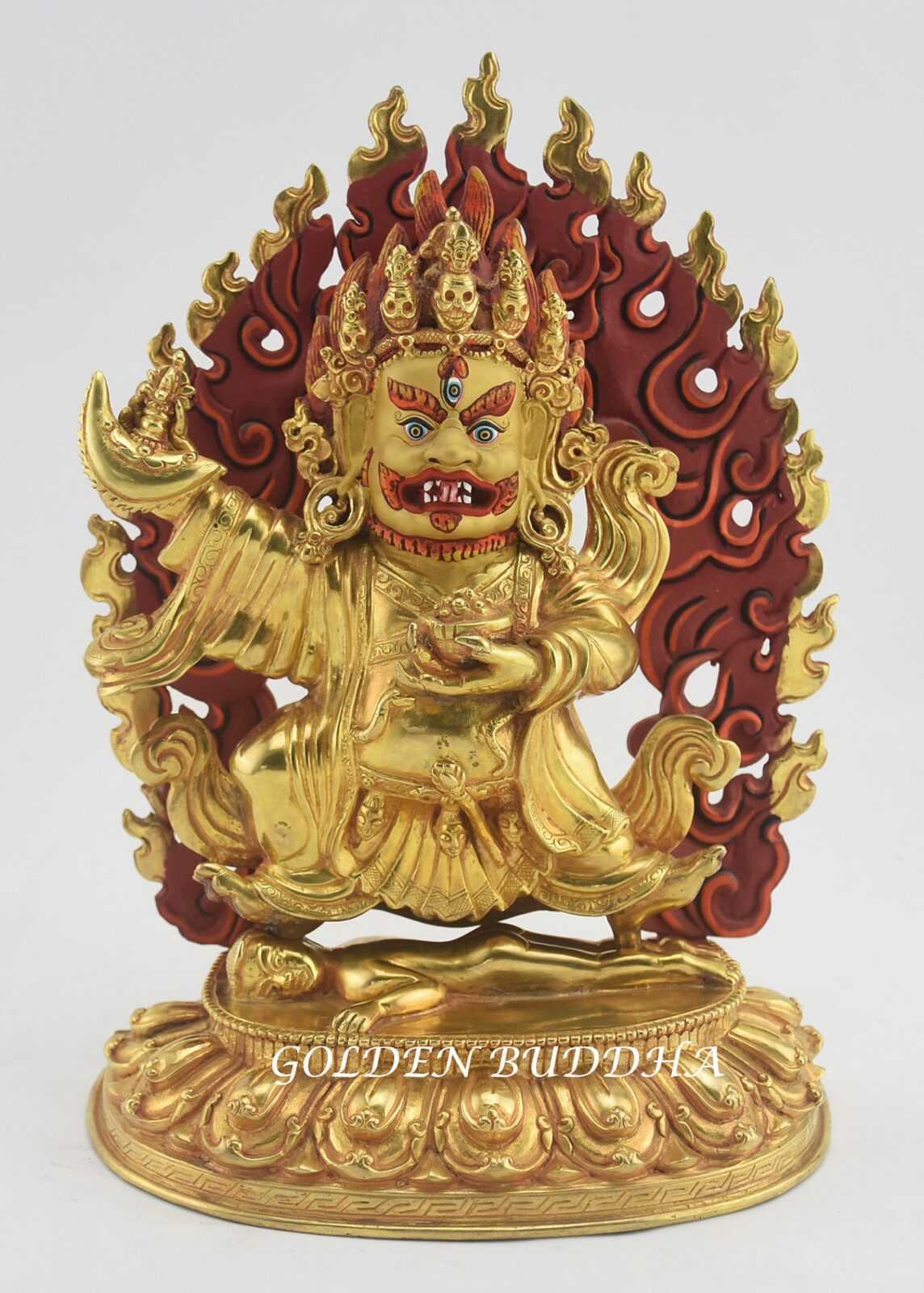
- Black Mahakala Statue — Iconography and Practice
- Bernagchen Mahakala — The Black Cloaked Protector of the Kagyu
- Panjarnata Mahakala — Lord of the Pavilion and the Sakya Lineage
- Chuchepa Mahakala — The Tent Lord with Consort
- Differences Between Mahakala Forms at a Glance
- Mahakala Mantra and Practice Benefits
- Authentic Mahakala Statues from Nepal
- Frequently Asked Questions About Mahakala Statues
Mahakala’s Origins — From Shiva to Buddhist Protector
The origins of Mahakala lie not in Buddhism but in the Shaivite strand of Hinduism, where he appeared as one of the most terrifying aspects of Shiva — the destroyer god in his most cosmic, all-consuming form. The name combines two Sanskrit roots: maha (great) and kala (time/black), yielding “Great Time” or “Great Black One.” In this earliest conception, Mahakala represented the inexorable power of time itself — the force that devours all existence, against which no protection is possible. He was associated with cremation grounds, the skull crown, and the annihilation of the ego through direct confrontation with death.
The absorption of Mahakala into the Buddhist tantric pantheon occurred gradually over centuries, beginning in India and accelerating dramatically as Vajrayana Buddhism spread through the Himalayan world and into Central Asia. The essential transformation was characteristic of how Tibetan Buddhism handles wrathful Hindu deities: rather than being discarded or demonized, Mahakala was subjugated and converted — his terrifying power redirected from destruction for its own sake to the destruction of obstacles to liberation. In this new Buddhist conception, Mahakala’s ferocity, his fire, his weapons, and his trampling of demonic forces all represent the activity of enlightened compassion expressed through wrathful means.
According to Esoteric Buddhism and the Tantras in East Asia, Mahakala is understood in Chinese Buddhist sources as the Great Black Heavenly God (Da heitian shen) — and his cult had entered Chinese Buddhism through earlier transmission routes before the Mongol conquest brought Tibetan Mahakala practice to the imperial court in full force. The Dali kingdom of Yunnan province had elevated the four-armed Brahma-Mahakala to the status of a national cult deity, worshipped alongside Vaishravana — a pairing that would recur throughout the Mahakala cult’s history across Asia.
In Tibetan Buddhism, Mahakala is classified as a Dharmapala — a Dharma Protector — specifically of the category known as Wisdom Protectors (Jnanasattvas), meaning he is understood as a fully enlightened Buddha or high Bodhisattva who voluntarily manifests in terrifying form to protect practitioners and the Dharma. Most traditions identify him as a wrathful emanation of Avalokiteshvara, the Bodhisattva of Compassion — an identification iconographically encoded in his statues by the image of Amitabha Buddha in his crown.
Mahakala and the Mongol Yuan Dynasty
The most dramatic chapter in the history of Mahakala statues was written not in Tibet but in China — during the Mongol Yuan dynasty (1271–1368), when the most powerful empire the world had ever seen adopted Tibetan tantra as its spiritual foundation, and placed Mahakala at the center of that adoption.
As Mongolian forces pushed south and east, conquering one kingdom after another, they encountered Tibetan Buddhist lamas — particularly those of the Sakya pa and Kagyu pa traditions — who demonstrated abilities the pragmatic, militarily-minded Mongols found immediately valuable: healing the sick, performing rain rituals, and protecting armies through tantric ritual. Mongol princes had already established individual patron-priest relationships (yon mchod) with different Tibetan Buddhist sects well before Kublai Khan’s rise: Möngke Khan supported the ’Bri gung Kagyu, while Kublai initially patronized the Tshal pa Kagyu.
The decisive moment came with the relationship between Kublai Khan and ‘Phags pa bla ma Blo gros rgyal mtshan (1235–1280) of the Sakya pa lineage. ‘Phags pa became the first imperial preceptor of the Yuan dynasty — the supreme religious authority of the entire Mongol empire — and members of the Sakya ’Khon family held this position successively until the dynasty’s end. The Sakya pa lamas headed the Xuanzheng yuan, the Bureau for Tibetan and Buddhist Affairs at the central government.
It was through the Sakya pa connection that the Mahakala cult was essentially introduced to the Mongols. The central figure was Dam pa bla ma, the state preceptor sGa A gnyan dam pa Kun dga’ grags (1230–1303). According to Esoteric Buddhism and the Tantras in East Asia (Brill, 2011), Dam pa was credited in Chinese sources with a remarkable achievement: by propitiating Mahakala, he helped bring about the eventual surrender of a Song army during the decade-long Mongol conquest of South China — the most difficult military campaign of Kublai’s reign. The holdout Song dynasty had resisted the Mongols for decades, and its final capitulation was attributed not merely to military force but to Mahakala’s supernatural intervention.
Mahakala was proclaimed the Grand Protective Deity of the Country (huguo daming wang) — a title equivalent to naming a deity the official protector of the entire Mongol imperial project. According to the same scholarly source, “Mahakala temples and statues were scattered throughout the country” following this proclamation. A deity who had been the esoteric protector of Himalayan monasteries became the officially endorsed state protector of the world’s most powerful empire.
The legendary Nepalese artist Anige (1245–1306), who arrived in Dadu (Beijing) in 1267 alongside ‘Phags pa, played a central role in this transformation. Appointed Supervisor-in-Chief of All Classes of Artisans by Kublai Khan, Anige served the empire for forty-five years as architect, statue maker, and painter. He was the chief architect of the White Stupa consecrated in 1279 in Beijing, and the stupa at Wutai Shan in 1301. The magnificent Mahakala statues created under Anige’s supervision established the visual template for Mahakala statues in East Asia for generations.
Sakya pa and Kagyu pa — Two Great Mahakala Lineages
The two Mahakala lineages that dominated the Yuan court — and that remain central to Tibetan Buddhism today — are the Sakya pa and the Kagyu pa, each possessing its own principal Mahakala form with distinct iconography, mantra, and practice tradition.
The Sakya pa lineage’s principal Mahakala is Panjarnata Mahakala — the six-armed Lord of the Pavilion, protector of the Hevajra Tantra. Panjarnata’s connection to the Sakya pa runs deep: the Hevajra Tantra forms the canonical foundation of the Sakya pa’s central practice lineage, the lam ’bras (path and fruit teaching) transmitted by the great Indian mahasiddha Virupa. This is the same teaching that Kublai Khan himself received initiation into three times from ‘Phags pa bla ma, making Panjarnata Mahakala the protector of the Mongol imperial spiritual practice itself.
The Kagyu pa lineage’s principal Mahakala is Bernagchen Mahakala — the two-armed Black Cloaked Mahakala, specifically associated with the Karma Kagyu tradition and its Karmapa lineage. While the Sakya pa dominated the early Yuan period, the Karma Kagyu rose to prominence in the later Yuan. Esoteric Buddhism and the Tantras in East Asia records that both the third Karma Kagyu patriarch Rang byung rdo rje (1284–1339) and the fourth patriarch Rol pa’i rdo rje (1340–1383) were invited to the imperial capital and spent considerable time at court. His successor’s relationship with the last Yuan emperor Toɣon Temür (1336–1405) was described as comparable to the relationship between ‘Phags pa and Kublai Khan.
Wutai Shan — Where Manjushri and Mahakala Meet
The sacred mountain complex of Wutai Shan (Mt. Wutai) in northern Shanxi province represents one of the most fascinating intersections of the Mahakala story with the broader history of esoteric Buddhism in China. According to Esoteric Buddhism and the Tantras in East Asia, from early in Chinese Buddhist history Mt. Wutai was identified as the holy abode of Mañjuśrī, the Bodhisattva of Wisdom — a connection that Amoghavajra (705–774 CE) formalized during the Tang dynasty through his translation of Manjushri scriptures and his promotion of the mountain’s cult.
The Mongol-Yuan period brought a decisive new layer to Wutai Shan’s history. The Nepalese master artist Anige — the same sculptor who created the first major Mahakala statues for the Yuan court — built the stupa at Wutai Shan in 1301, inaugurating a new era of Tibetan Buddhist presence at the mountain. According to the scholarly record, after the Yuan dynasty, “both exoteric and Esoteric Buddhist forms of Mañjuśrī, including those associated with Tibetan Tantrism, were fused into a single cult” at Wutai Shan. The mountain became simultaneously a Chinese Buddhist holy site and a Tibetan tantric pilgrimage destination — a fusion that persists to the present day.
The connection between Manjushri’s presence at Wutai Shan and the Mahakala cult runs through the overarching Tibetan Buddhist understanding of protective hierarchy: Manjushri, as the Bodhisattva of Wisdom, represents the transcendental wisdom that Mahakala, as wrathful protector, defends with ferocious activity. The Mongol patronage of both cults was not coincidental — it represented a coherent Tibetan Buddhist spiritual strategy, combining wisdom and protection into a single imperial religious program.
Vajravarahi — Mahakala’s Great Companion in the Yuan Court
One of the most illuminating findings in Esoteric Buddhism and the Tantras in East Asia concerns the deity who stood beside Mahakala in popularity and importance throughout the Yuan dynasty. The text states explicitly: “Next to Mahākāla, Vajravārāhī was the most popular protective deity, especially favored by followers in both Tangut Xia and Mongol Yuan.”
Vajravarahi — the Vajra Sow, a fierce form of the great dakini Vajrayogini — was the supreme female yidam and protector of the Hevajra cycle, the same cycle that Panjarnata Mahakala guards as its male protector. The pairing of Mahakala and Vajravarahi in the Yuan court was not accidental: they were the twin guardians of the Sakya pa’s central practice lineage, the lam ’bras teaching, whose canonical text is the Hevajra Tantra. Kublai Khan’s three-times Hevajra initiation from ‘Phags pa placed him squarely within the protection of both deities simultaneously.
To learn more about Vajravarahi’s iconography and her relationship to the Vajrayogini practice tradition, see our dedicated guide.
The Chinese Literati and the Decline of Tibetan Influence
The extraordinary influence of Tibetan Buddhism — and Mahakala — at the Mongol court did not go uncontested. From the very beginning of the Yuan period, Chinese scholars and officials of the Confucian literati tradition mounted a sustained critique of Tibetan lamas and their practices, documented in considerable detail in Esoteric Buddhism and the Tantras in East Asia.
The most explosive element of the literati critique concerned the secret teaching of supreme bliss (bimi daxile fa) — tantric practices that became associated, in Chinese accounts, with the late Yuan court of Emperor Toɣon Temür (1336–1405). Chinese sources described initiation rituals and yogic practices involving the imperial family and court officials — a picture that, whatever its accuracy or distortion, provided generations of Chinese literati with devastating ammunition against Tibetan Buddhism. The scholarly record makes clear that these accounts were almost certainly exaggerated or misunderstood: the practices described appear to correspond to the yogic inner heat practice (gtum mo) and the Hevajra Tantra’s path and fruit teaching, both legitimate Tibetan tantric traditions misread through a Confucian lens.
With the establishment of the Ming dynasty (1368–1644), the imperial cult of Mahakala was dismantled and Tibetan Buddhist influence at court was dramatically curtailed. Yet the Mahakala cult never disappeared from China entirely — teachings and practices continued to be transmitted through both official and unofficial channels throughout the Ming and into the Qing dynasty (1636–1911), when Tibetan Buddhism once again achieved imperial patronage under the Manchu emperors.
Palden Lhamo — Mahakala’s Consort and Co-Protector
No discussion of Mahakala statues is complete without acknowledging his relationship with Palden Lhamo, his consort — also known as Shri Devi, or in Tibetan, dPal ldan lha mo. Palden Lhamo is the only female Dharmapala among the Eight Great Protectors of Tibetan Buddhism, the personal protector of the Dalai Lama lineage, and — in a remarkable number of lineages and iconographic traditions — the consort and spiritual partner of Mahakala.
In the Mahakala iconographic tradition associated with the Obstacle-Removing Mahakala, Palden Lhamo appears specifically in his retinue — either as an independent figure within his protective mandala or associated with Ekajati, the Dzogchen protector, another fierce female protector. She is described in traditional sources as “the tutelary deity of Tibet and its government” and is “celebrated all over Tibet and Mongolia” — the latter connection linking her directly to the same Mongol-Tibetan interface where Mahakala achieved his greatest historical prominence.
To learn more about Palden Lhamo’s iconography, her extraordinary origin story as Remati the Sri Lankan queen, and her role as protector of the Dalai Lama lineage, see our dedicated guide.
Black Mahakala Statue — Iconography and Practice
Black Mahakala statues depict the primary six-armed form of Mahakala that is most widely represented across Tibetan Buddhist traditions — a figure of overwhelming ferocity who nonetheless embodies the deepest compassion of Avalokiteshvara in wrathful form.
The Body and Posture: Black Mahakala is depicted with a jet-black or very dark navy body, massive and powerful in build, standing within a ring of pristine wisdom fire. His enormous belly signifies abundance and the capacity to consume all obstacles without remainder. He stands on human corpses representing the death of ego, ignorance, and the five poisons. In some depictions he specifically tramples Ganesha — an iconographic statement that Mahakala is the true and complete remover of all obstacles.
The Three Eyes: Black Mahakala’s three eyes represent his omniscient knowledge of past, present, and future simultaneously. The three eyes also correspond to the three bodies of a Buddha (Dharmakaya, Sambhogakaya, Nirmanakaya), encoding Mahakala’s nature as a fully enlightened being within his very face.
Black Mahakala — List of Six Armed Features
- Curved Kartrika (Flaying Knife) — cuts through ego and the root of ignorance.
- Kapala (Skull Cup) — contains the blood of the four maras, representing their transformation into nectar of wisdom.
- Damaru (Small Drum) — the heartbeat of awakening, calling all beings to liberation.
- Trident (Khatvanga) — the three kayas and the subjugation of the three realms of existence.
- Skull Rosary (Mala) — the continuous cycle of compassionate activity across all lives.
- Lasso — the binding and capture of all beings for liberation, from which none can escape once Mahakala has committed to their protection.
The Crown of Five Skulls: The five dried skulls adorning Black Mahakala’s crown represent the transformation of the five poisons into the five wisdoms — one of the central teachings of Vajrayana Buddhism. Desire becomes discriminating wisdom; anger becomes mirror-like wisdom; ignorance becomes dharmadhatu wisdom; pride becomes equanimity wisdom; jealousy becomes all-accomplishing wisdom.
Black Mahakala Mantra: OM SHRI MAHAKALA HUM HUM PHAT SVAHA
This mantra is recited to activate Mahakala’s protective power, clear obstacles, and encourage virtuous qualities in the practitioner. Regular recitation, ideally combined with visualization of the statue and torma (ritual cake) offerings, constitutes the core of the Black Mahakala practice as transmitted across all major Tibetan Buddhist lineages.
Bernagchen Mahakala — The Black Cloaked Protector of the Kagyu
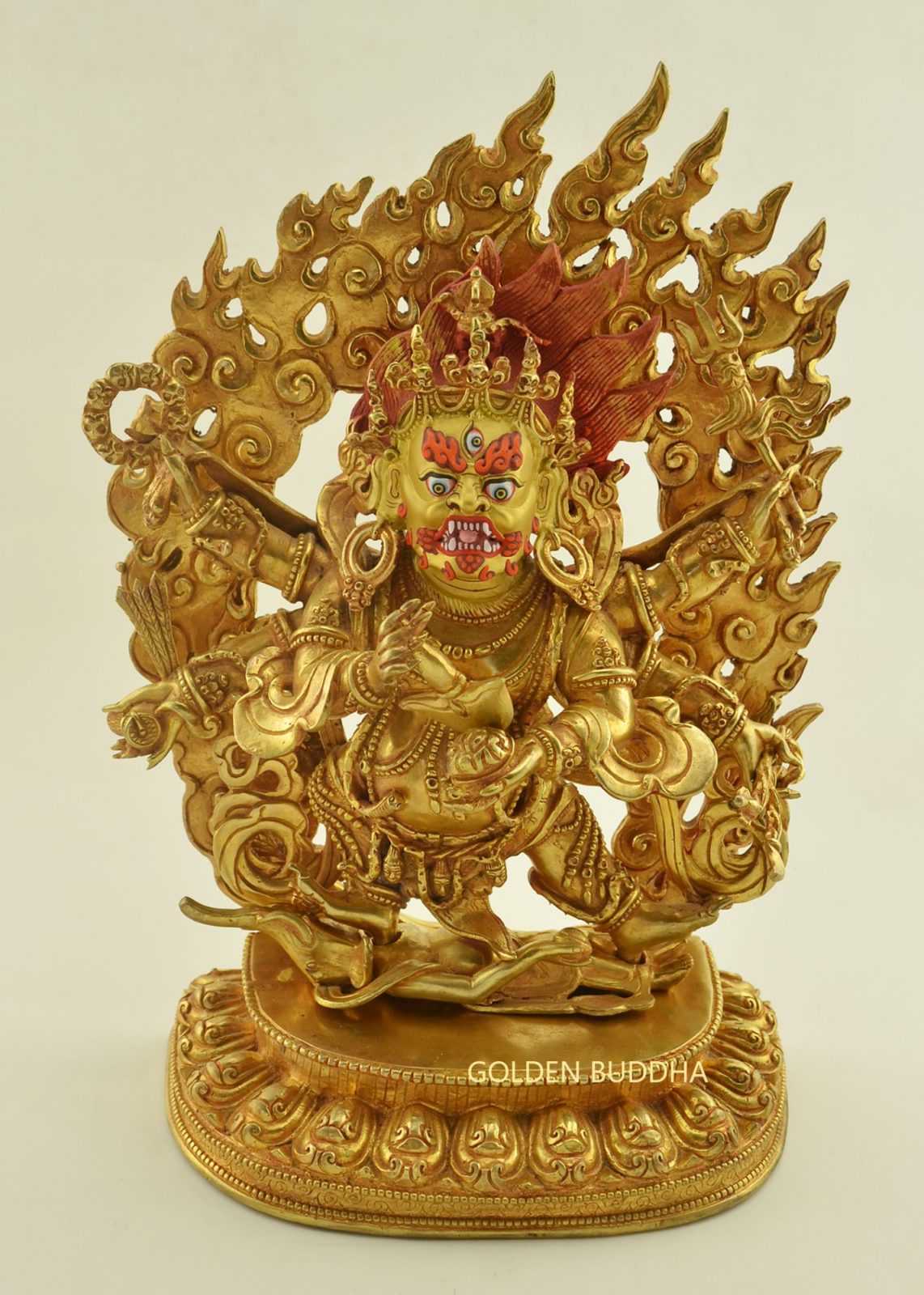
Bernagchen Mahakala — whose Tibetan name translates as “Wearing the Black Cloak” (Ber nag can) — is the heart protector of the Karma Kagyu school of Tibetan Buddhism. He is a two-armed Mahakala, distinguishing him immediately from the six-armed Black Mahakala, and his most remarkable iconographic feature is the long black cloak that falls behind him — the emblem of the Karma Kagyu protective energy that has accompanied every Karmapa incarnation since the lineage began.
Iconography: Bernagchen is depicted as a powerful, dark-bodied figure with a wrathful expression, three glaring eyes, and a crown of five skulls. In his right hand he holds the kartrika (curved flaying knife) raised above his head, and in his left hand he holds a kapala (skull cup) at heart level. He stands within a ring of wisdom fire, and his dramatic black cloak billows behind him. Unlike the six-armed forms, Bernagchen’s two-armed presentation gives him a quality of concentrated, singular power — the focused, cutting precision of a protector who has reduced his protective function to its essential core.
Bernagchen’s Connection to the Karma Kagyu: Bernagchen Mahakala is considered a wrathful emanation of Avalokiteshvara, making him the protector par excellence of the Karma Kagyu lineage. Every Karmapa is considered an emanation of Avalokiteshvara — and Bernagchen, as Avalokiteshvara’s wrathful form, is the Karmapa’s own protective power externalized in deity form. This is why Bernagchen Mahakala statues are found at the entrance of virtually every Karma Kagyu monastery worldwide.
The historical importance of Bernagchen’s lineage in China was demonstrated during the Yuan period, when both the third Karma Kagyu patriarch Rang byung rdo rje and the fourth patriarch Rol pa’i rdo rje achieved imperial patronage — expanding Bernagchen’s presence from Himalayan monasteries to the palaces of Beijing.

Panjarnata Mahakala — Lord of the Pavilion and the Sakya Lineage
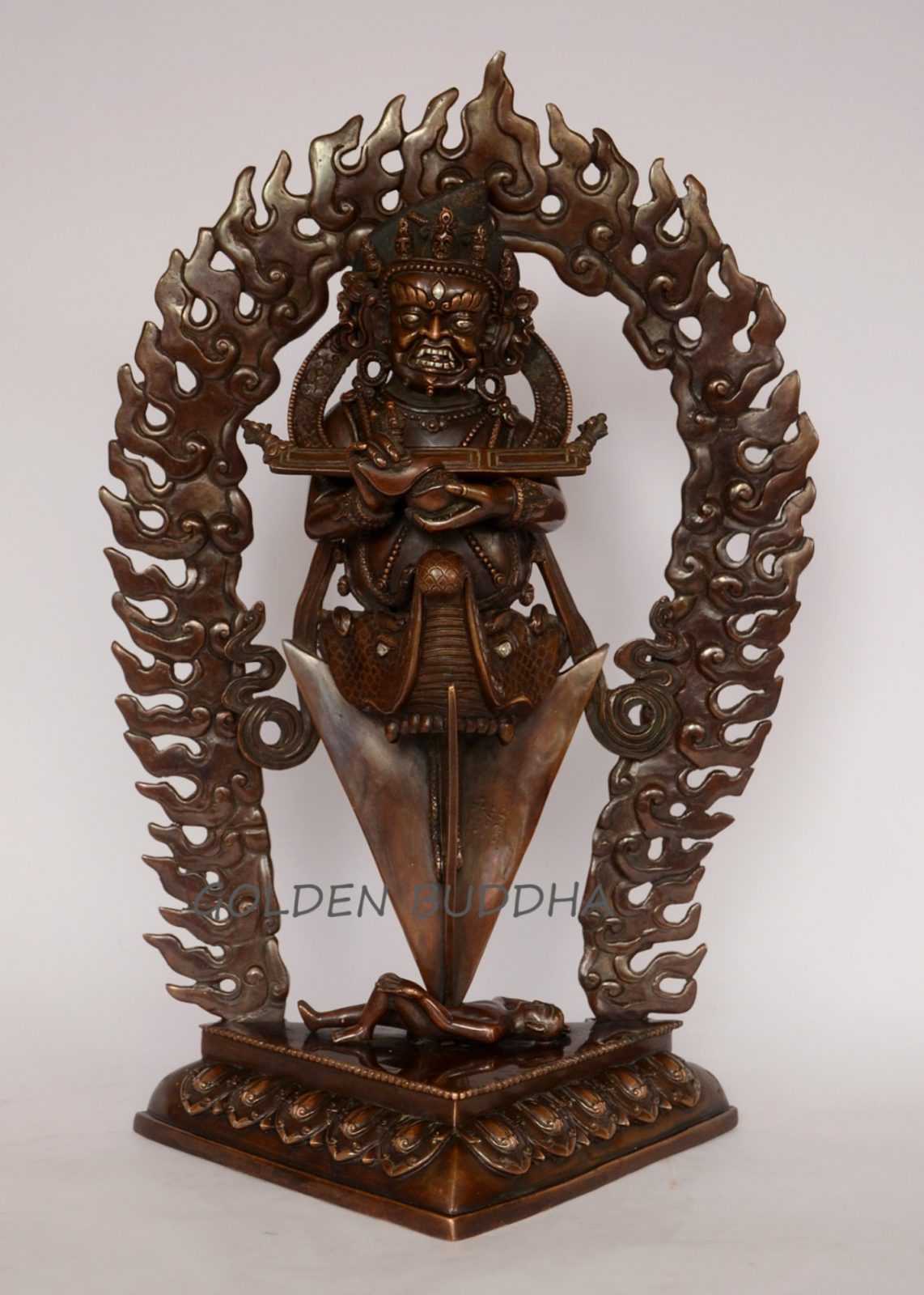
Panjarnata Mahakala — whose Sanskrit name translates as “Lord of the Pavilion” (Skt: Pañjarānātha; Tib: gur gyi mgon po) — is the supreme protector of the Sakya pa lineage of Tibetan Buddhism and the principal guardian of the Hevajra Tantra. He is a six-armed standing figure depicted in an intensely dynamic posture, and his presence in the Sakya pa’s inner sanctum represents the protection of their most sacred lineage transmission.
Panjarnata’s connection to the Hevajra Tantra is fundamental: he is described in traditional sources as the guardian who “stands at the entrance of the Hevajra mandala” — the protective deity whose fierce presence ensures that the secret tantric teachings remain protected from misuse. Given that the Hevajra Tantra was the canonical foundation of the Sakya pa’s lam ’bras teaching, and given that Kublai Khan took Hevajra initiation three times from ‘Phags pa, Panjarnata occupied a position of extraordinary significance at the Mongol imperial court.
Iconography: Panjarnata is depicted as a six-armed, standing figure with a very dark body, three glaring eyes, and an expression of supreme ferocity. He stands on a human corpse (representing the death of negativity) in the warrior’s stance with his right knee forward. His crown features five dried skulls. The phurba (ritual dagger) is Panjarnata’s distinctive implement among six-armed forms — reflecting his role as a protector who pins down and immobilizes obstacles with unchanging awareness.
Panjarnata in the Sakya Liturgical Tradition: Panjarnata Mahakala is the subject of one of the most elaborate liturgical traditions in the Sakya pa school. His practice includes the famous Mahakala tent ritual, performed in a tent or pavilion — a ceremony that protects the surrounding territory and all practitioners within it. Sakya pa monasteries typically maintain continuous Panjarnata practice as part of their standard liturgical schedule.

Chuchepa Mahakala — The Tent Lord with Consort
Chuchepa Mahakala is a form of Mahakala particularly associated with the Sakya tradition and known especially for his depiction together with his consort, making this form unique among the major Mahakala statues in its portrayal of the yab-yum (union of wisdom and method) principle.
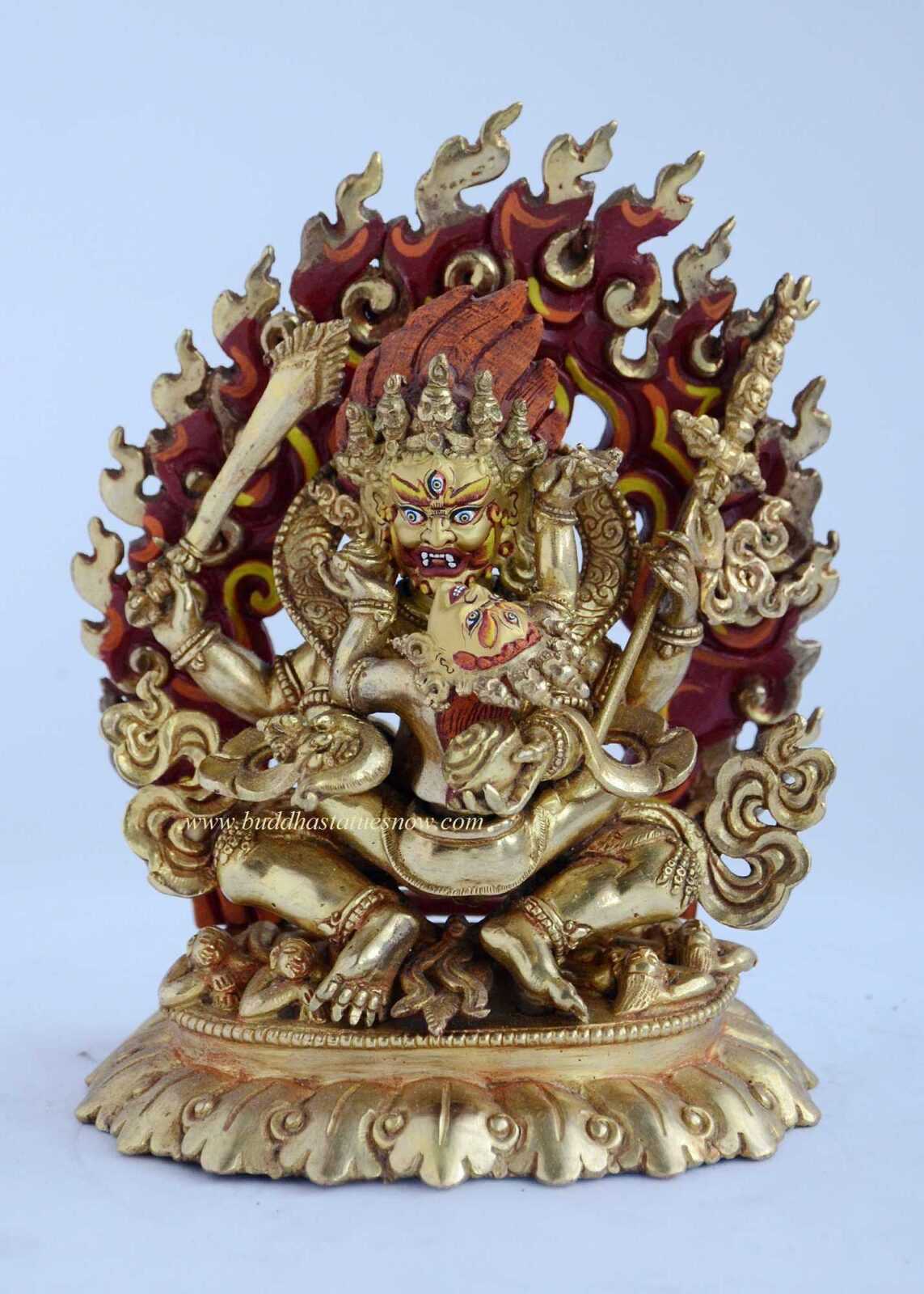
Chuchepa Mahakala statues typically portray the deity as a four-armed figure — distinguishing him from both the two-armed Bernagchen and the six-armed Black Mahakala and Panjarnata — hovering above several trampled human figures representing the death of negativity. His four arms hold the ritual implements appropriate to his form: the kartrika and kapala in the primary hands, with additional implements in the secondary hands.
When depicted with his consort, Chuchepa Mahakala stands in the yab-yum position — the consort figure embracing him from the front, their union representing the non-dual nature of wisdom and compassionate method. This iconographic element reflects the tantric understanding that the highest level of enlightened activity requires the union of wisdom (prajña, represented by the female consort) and skillful means (upaya, represented by the male deity). The Chuchepa Mahakala practice serves to establish a sacred boundary around the practice environment, protecting it from external and internal obstacles.
Differences Between Mahakala Forms at a Glance
Black Mahakala (Six-Armed): The most universally recognized form, six arms carrying kartrika, kapala, damaru, trident, skull mala, and lasso. Dark blue-black body, three eyes, five skull crown. Associated broadly across lineages as the primary wrathful Avalokiteshvara form.
Bernagchen Mahakala (Two-Armed, Black Cloaked): Distinctively two-armed — kartrika in right hand, kapala in left — with the iconic black cloak flowing behind. Specifically associated with the Karma Kagyu tradition and the Karmapa lineage. The only major Mahakala form with a distinctive garment rather than implements as his primary visual identifier.
Panjarnata Mahakala (Six-Armed, Standing): Six arms in standing warrior posture on a corpse, carrying kartrika, kapala, damaru, phurba, trident, and skull mala. Specifically associated with the Sakya pa tradition as guardian of the Hevajra Tantra. The phurba is Panjarnata’s distinctive implement. Primary protector of the lam ’bras teaching.
Chuchepa Mahakala (Four-Armed, with Consort): Four arms, sometimes depicted with female consort in yab-yum. Associated with the Sakya pa tradition and the tent ritual. The only commonly depicted Mahakala form routinely shown in union with a consort, reflecting an advanced tantric practice dimension.
Mahakala Mantra and Practice Benefits
The primary Mahakala mantra recited across all traditions is:
OM SHRI MAHAKALA HUM HUM PHAT SVAHA
This mantra directly invokes Mahakala’s enlightened protective power. OM is the universal syllable of the enlightened body, speech, and mind; SHRI is an honorific meaning “glorious”; MAHAKALA is the deity’s name; HUM HUM is the seed syllable associated with Mahakala’s transformation of anger into mirror-like wisdom; PHAT is the syllable that destroys and dissolves obstacles; and SVAHA seals the mantra’s power.
Mahakala Practice Benefits
- Removal of Obstacles — to spiritual practice, material wellbeing, and all life activities.
- Protection — from negative external forces, harmful beings, and environmental obstacles.
- Swift Completion — of positive activities undertaken for the benefit of self and others.
- Transformation — of the five poisons into five wisdoms through the power of fierce compassionate activity.
- Support for the Dharma — the protection and continuation of Buddhist teachings and lineages.
Mahakala practice is typically performed after requesting transmission from a qualified teacher, making offerings before the statue (torma, incense, water bowls, light offerings), and reciting the mantra with visualization of the deity. The statue serves as the focal point for this visualization — the practitioner imagines Mahakala’s presence condensing into the statue, and radiating outward as protection in all directions.
Authentic Mahakala Statues from Nepal
The Mahakala statues in our collection are handcrafted in Patan (Lalitpur), Nepal — the ancient city in the Kathmandu Valley that has been the world center for Himalayan Buddhist statuary for over a thousand years. The artisans of Patan, drawn primarily from the Shakya caste of traditional Buddhist craftsmen, create each statue using the lost wax casting method (cire perdue) that has been passed from parent to child in Patan workshops for more generations than can be counted.
Each authentic Mahakala statue begins as a hand-sculpted wax model, capturing every iconographic detail required by traditional Tibetan Buddhist iconography — the precise number of eyes, the correct implements in each hand, the appropriate crown elements, the right facial expression. The wax model is cast in copper alloy, hand-finished by master craftsmen, and finished with 24K gold fire gilding using the traditional mercury amalgam process that fuses real gold permanently to the copper surface. The result is a statue that will remain tarnish-free and iconographically precise for generations.
All statues are certified by the Department of Archaeology in Kathmandu and include a certificate of authenticity. Consecration (rabne) at a recognized Kathmandu monastery is available upon request. The artisans of Patan have been the preferred source of Buddhist statues for Tibetan monasteries for centuries — when you purchase a Mahakala statue from our collection, you receive a monastic-quality sculpture in the same tradition that supplied the Mongol imperial court seven hundred years ago.
Frequently Asked Questions About Mahakala Statues
What does Mahakala represent in Tibetan Buddhism?
Mahakala, meaning “Great Black One” or “Great Time,” is the supreme wrathful protector in Tibetan Buddhism — a fully enlightened being, typically understood as a wrathful emanation of Avalokiteshvara, who protects practitioners and the Dharma by removing obstacles, destroying ignorance, and subduing forces hostile to liberation. His fierce appearance represents compassionate activity directed through wrathful means — in Tibetan Buddhist understanding, the most powerful and fastest method for cutting through deeply entrenched obstacles to practice.
What are the main differences between the Mahakala statue forms?
The primary differences between Mahakala forms lie in the number of arms, lineage association, and primary iconographic implements. Black Mahakala is six-armed and broadly revered across lineages. Bernagchen Mahakala is two-armed, identifiable by his black cloak, and is the heart protector of the Karma Kagyu tradition. Panjarnata Mahakala is six-armed and standing, carries the phurba as his distinctive implement, and is the primary protector of the Sakya pa lineage and the Hevajra Tantra. Chuchepa Mahakala is four-armed and is sometimes depicted with a consort, reflecting an advanced tantric practice dimension.
What is Bernagchen Mahakala and why is he called the “Black Cloaked” Mahakala?
Bernagchen Mahakala takes his name from the Tibetan ber nag can, meaning “wearing the black cloak” — referring to the distinctive long black robe that billows behind him and serves as his primary visual identifier. He is a two-armed form of Mahakala, the heart protector of the Karma Kagyu school of Tibetan Buddhism and the Karmapa lineage. Unlike most Mahakala forms identified by their implements, Bernagchen’s identification comes primarily from this dramatic cloak, representing the Karma Kagyu’s distinctive protective energy. He is understood as a wrathful emanation of Avalokiteshvara and was historically one of the most important Dharmapala practices at the Mongol Yuan dynasty court.
What role did Mahakala play in the Mongol Yuan dynasty?
According to Esoteric Buddhism and the Tantras in East Asia (Brill, 2011), Mahakala was adopted as the Grand Protective Deity of the Country by Kublai Khan’s Yuan dynasty — the single most important religious-political recognition a Buddhist deity could receive in imperial China. Sakya pa lamas, especially the state preceptor sGa A gnyan dam pa Kun dga’ grags (1230–1303), were credited in Chinese sources with invoking Mahakala’s power to help bring about the surrender of the holdout Song dynasty in southern China, completing the Mongol conquest. Following this, Mahakala temples and statues were established throughout the empire. The Mahakala cult formed part of the Sakya pa’s central lam ’bras practice lineage, the same teaching that Kublai Khan himself received initiation into from ‘Phags pa bla ma three times.
Is Palden Lhamo related to Mahakala?
Yes — in a number of Tibetan Buddhist lineages and iconographic traditions, Palden Lhamo (Shri Devi) is described as the consort of Mahakala, and she appears in the retinue of the Obstacle-Removing Mahakala form either as an independent figure or associated with Ekajati, another fierce female protector. She is the only female deity among the Eight Great Dharmapalas of Tibetan Buddhism and the personal protector of the Dalai Lama lineage. Both Palden Lhamo and Mahakala achieved their widest historical expansion during the same Mongol Yuan period, under the same Sakya pa and Kagyu pa lineages — making their connection both mythological and deeply historical.
Are the Mahakala statues from Nepal authentic and certified?
Yes. Every Mahakala statue in our collection is handcrafted in Patan, Nepal by artisans of the traditional Shakya caste using the lost wax casting method and finished with 24K gold fire gilding. Each statue comes with a certificate of authenticity from the Department of Archaeology in Kathmandu, verifying its materials, technique, and origin. Consecration (rabne) at a recognized Kathmandu monastery is available upon request. The artisans of Patan have been the preferred source of Buddhist statues for Tibetan monasteries for centuries — when you purchase a Mahakala statue from our collection, you are receiving a monastic-quality sculpture in the same tradition that supplied the Mongol imperial court seven hundred years ago.