

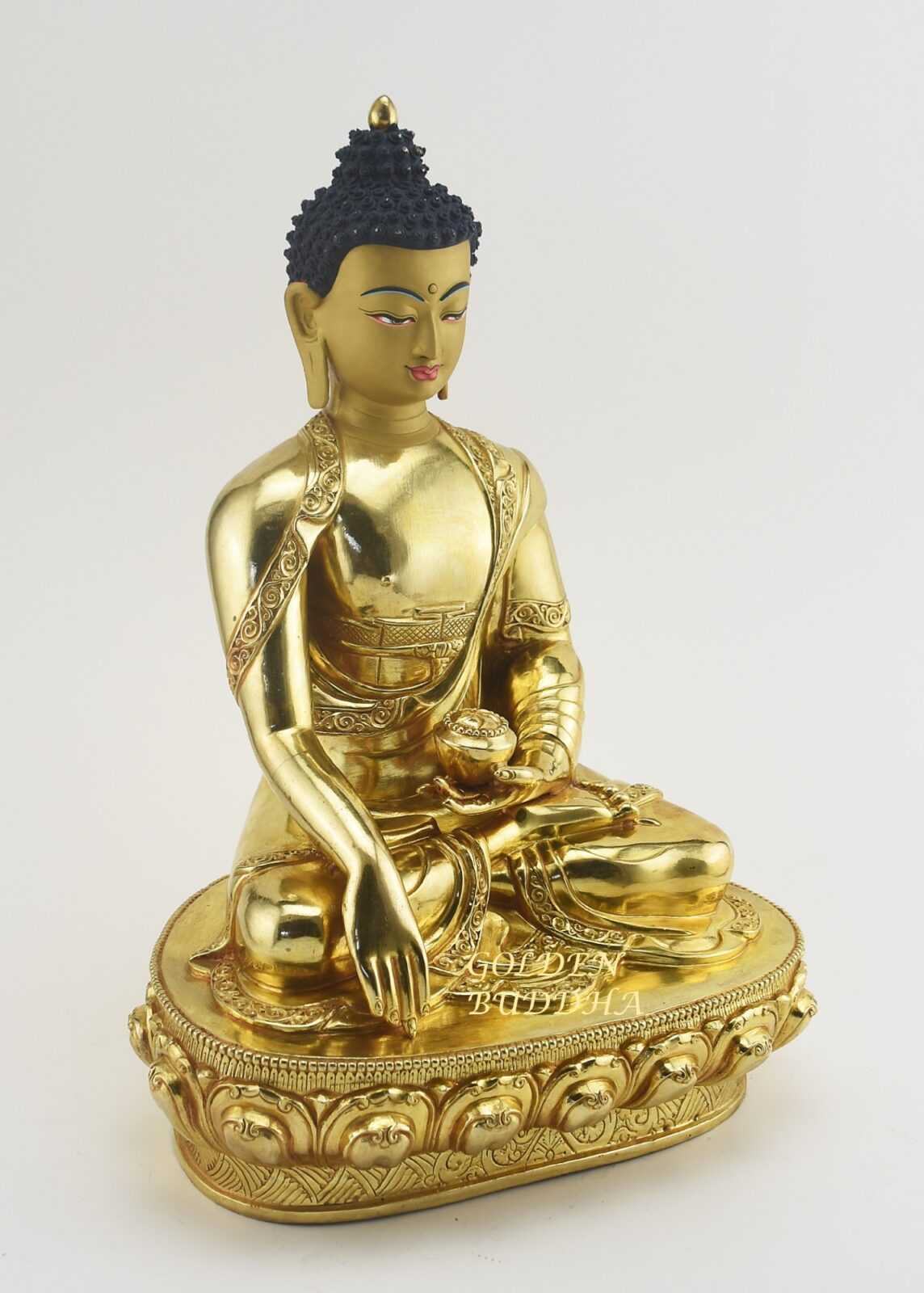

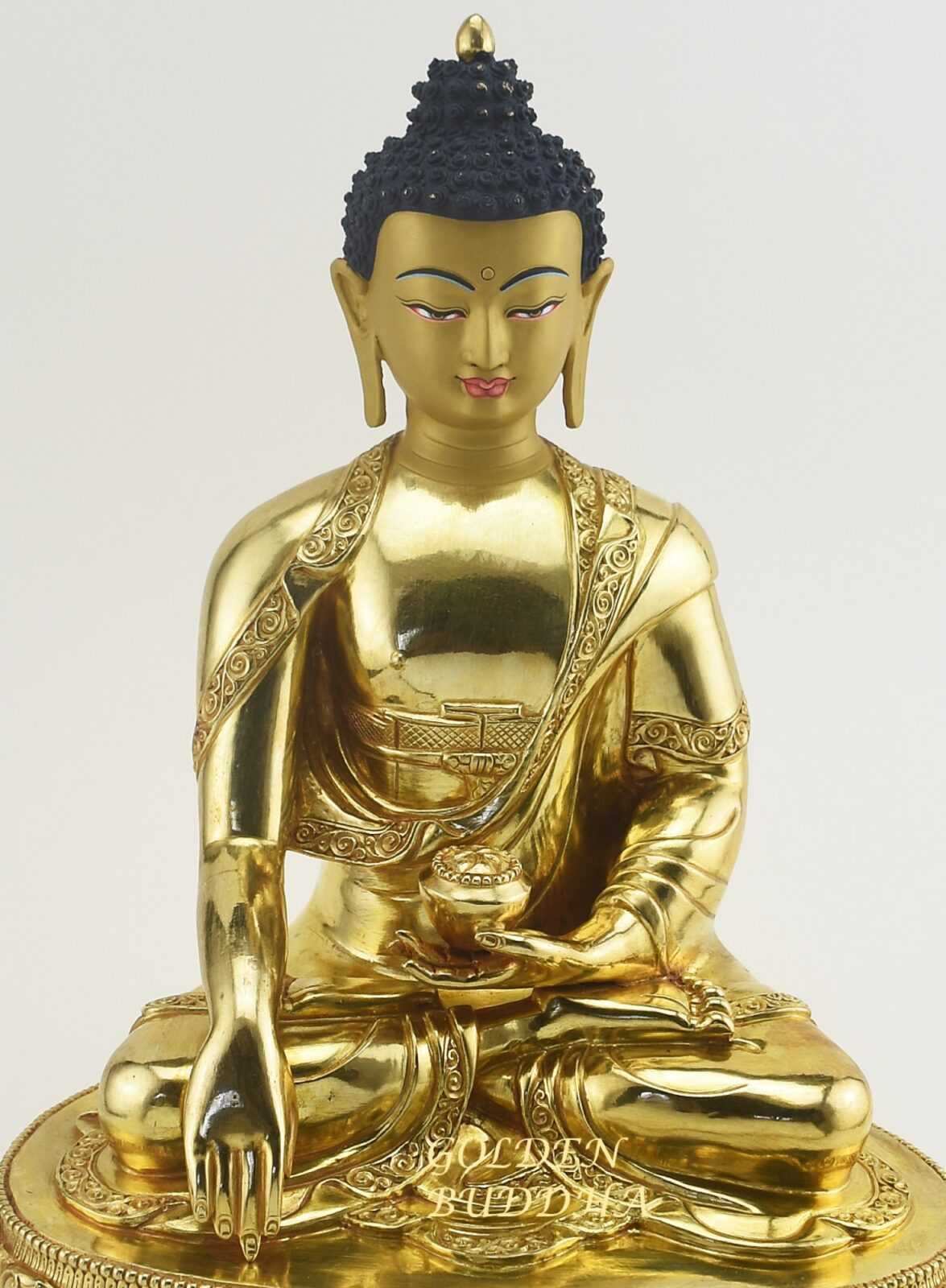
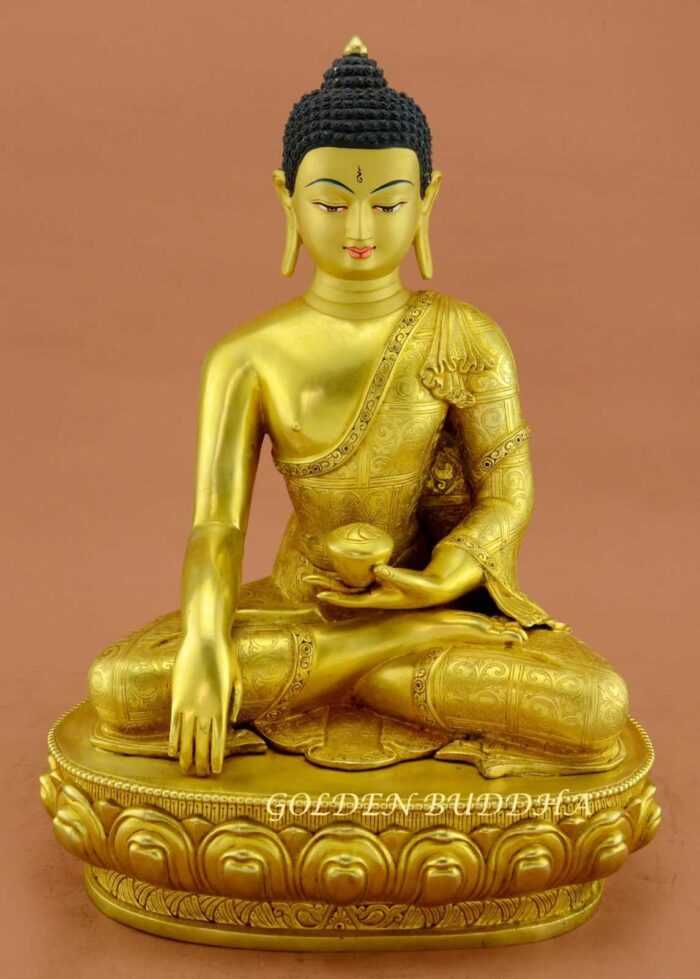
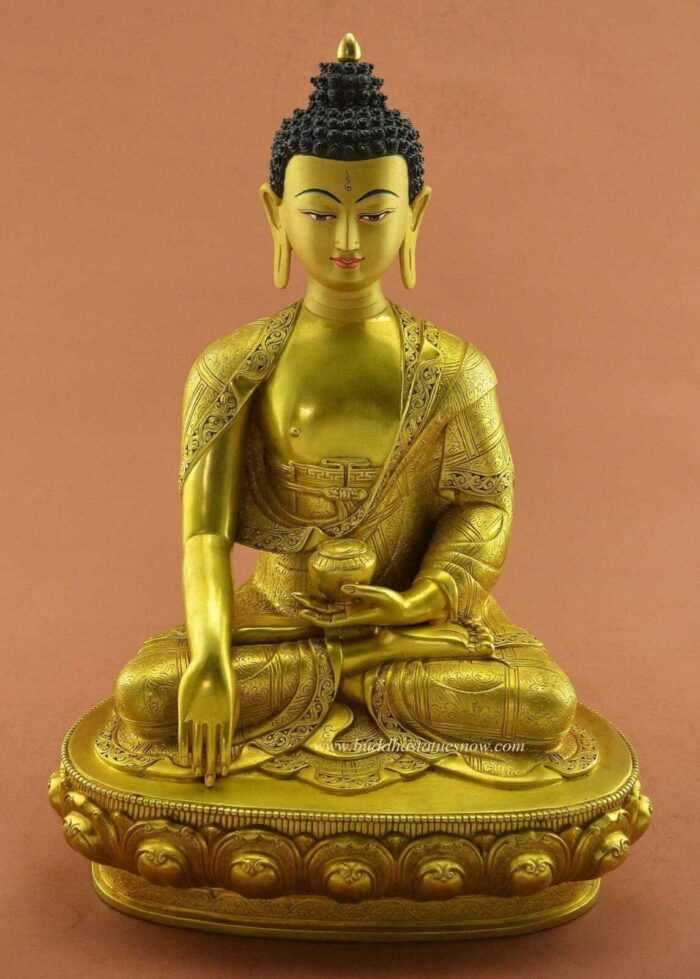
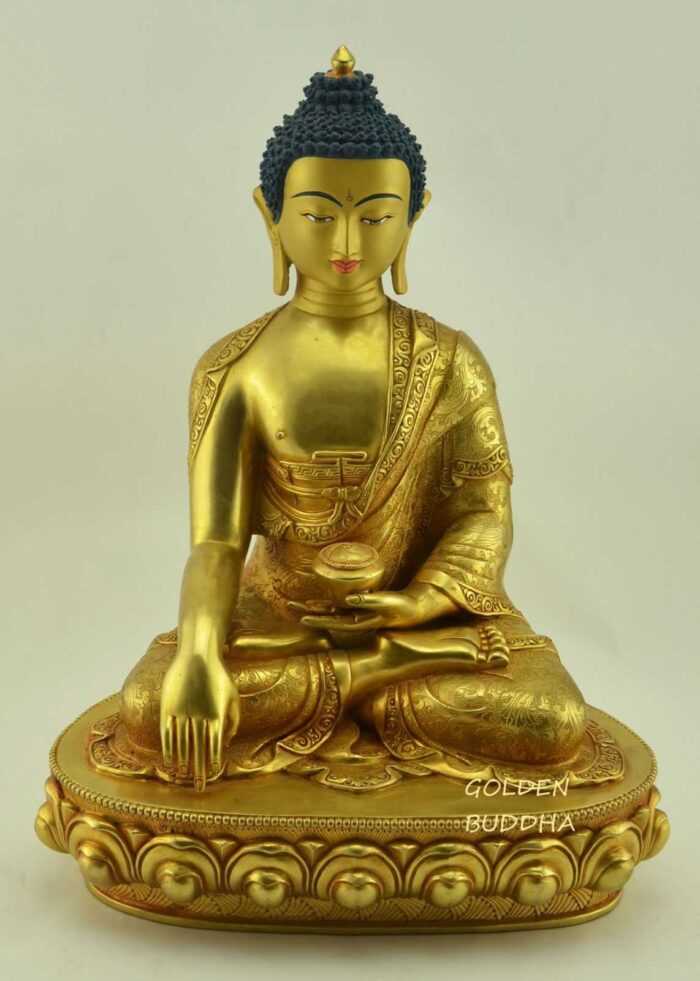
This 12.5″ Shakyamuni Buddha Sculpture was handcrafted in Patan, Nepal from copper alloy and finished throughout with genuine 24K gold using the traditional fire-gilding method. Measuring 9.5″ wide and weighing approximately five kilograms, the statue has the substance and visual presence required for a principal home shrine, meditation room, Dharma center, or collection of fine Himalayan Buddhist art. Its radiant gold surface is complemented by dark blue-black hair, a hand-painted face, delicately engraved monastic robes, and an oval single lotus pedestal decorated with individually modeled petals and ornamental borders.
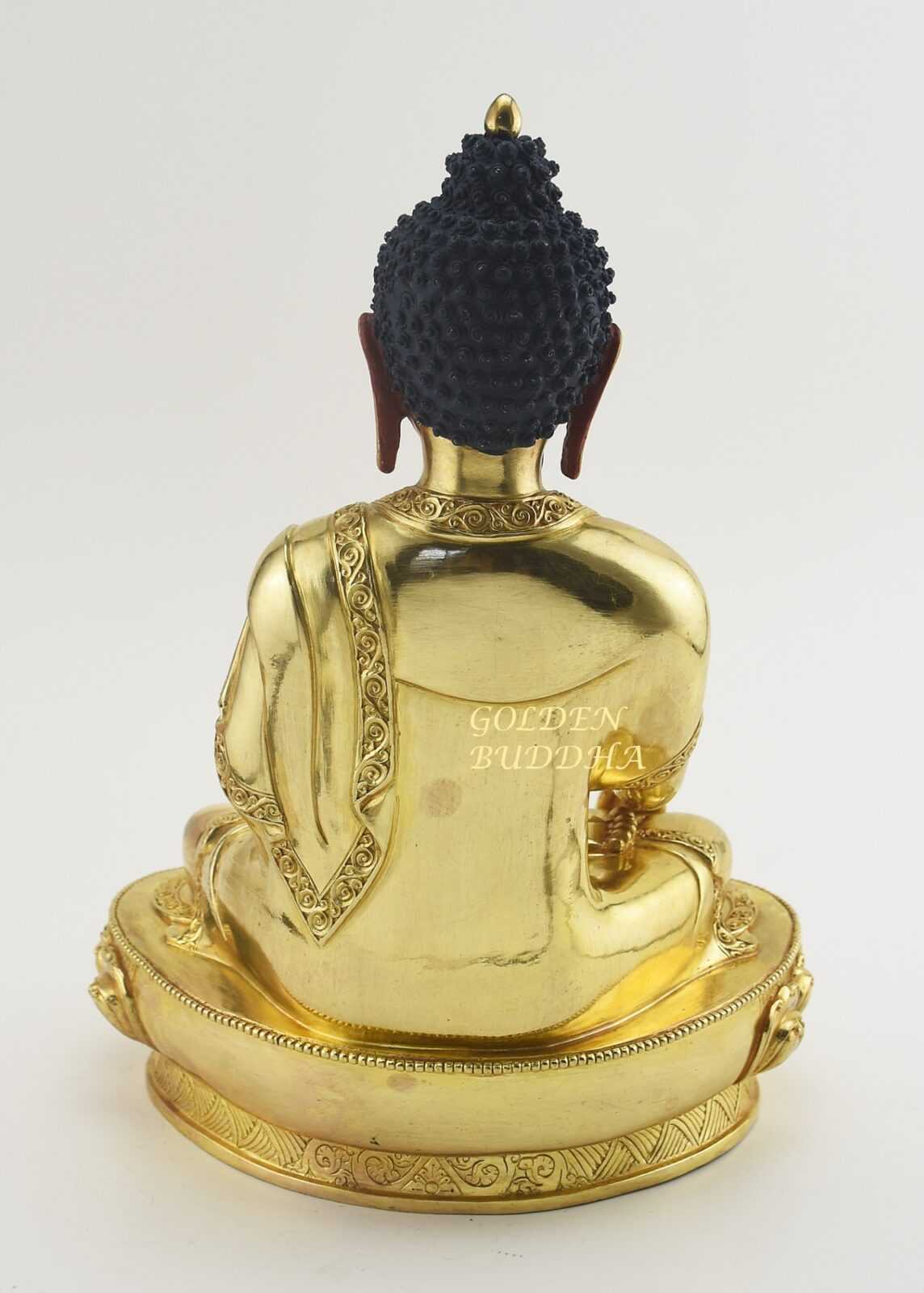
A master Newar artisan created this Shakyamuni Buddha Sculpture through the traditional lost wax casting process. After the copper-alloy figure was cast, every surface was refined, chased, engraved, polished, and prepared for gilding by hand. Fine scrolling patterns follow the robe around the neckline, across the shoulder, along the upper arm, and over the folds gathered between the crossed legs. The engraving continues around the lotus pedestal, while the rear view reveals a carefully finished back, a smoothly modeled robe, and ornamental borders that extend around the entire three-dimensional sculpture.
Although the body and pedestal are fire gilded in 24K gold, the face receives a separate traditional treatment. The artisan hand painted the facial features with gold and natural pigments, creating finely outlined eyes, gently arched brows, a softly colored mouth, and the urna between the eyebrows. The tightly curled hair rises into the ushnisha and is crowned by a small gilded finial. Together with the elongated earlobes and three lines across the neck, these features belong to the traditional physical characteristics of the Buddha represented in authentic Himalayan sculpture.
Shakyamuni Buddha Sculpture and the Historical Buddha
Shakyamuni Buddha was born as Prince Siddhartha Gautama in Lumbini, Nepal, and became the historical teacher upon whose awakening the Buddhist tradition is founded. After leaving palace life, he pursued a path beyond the suffering caused by attachment, ignorance, aging, illness, and death. His spiritual search culminated in enlightenment beneath the Bodhi tree at Bodh Gaya, where he realized the nature of suffering and the path leading to liberation. The name Shakyamuni means “Sage of the Shakya Clan,” connecting the enlightened teacher to the family and community into which Siddhartha was born.
Unlike adorned celestial Buddhas and Bodhisattvas, Shakyamuni appears in the simple robes of a renunciant monk. His uncluttered appearance emphasizes meditation, ethical discipline, wisdom, and direct realization rather than royal status or worldly wealth. The calm symmetry of the body, contemplative eyes, and stable full-lotus posture express the unshakable awareness attained after he overcame the final challenges of Mara. Learn more about the historical teacher and his sacred imagery in our guide to Shakyamuni Buddha statues.
Shakyamuni Buddha Sculpture Mudras
The right hand of this Shakyamuni Buddha Sculpture displays the Bhumisparsha mudra, or earth-touching gesture. The arm extends over the right knee with the palm turned inward and the fingers directed toward the ground. According to Buddhist tradition, Shakyamuni formed this gesture when Mara challenged his right to attain enlightenment. By touching the earth, he called it to witness the merit accumulated throughout his previous lives and the authenticity of his realization.
The Bhumisparsha mudra represents determination, the defeat of ignorance, and the immovable foundation of awakening. It is the hand gesture most closely associated with the historical Buddha and immediately identifies the moment depicted by the statue. A detailed explanation can be found in our guide to the meaning of the Bhumisparsha mudra.
Shakyamuni’s left hand rests in his lap in the Dhyana mudra, the gesture of meditation, with a small lidded alms bowl supported upon the open palm. The balanced position of the hand symbolizes concentration, inner stability, and the meditative awareness required for insight. The alms bowl recalls the Buddha’s life as a mendicant teacher and his complete renunciation of attachment to possessions. Symbolically, it may also hold the healing nectars that counteract the three poisons of ignorance, attachment, and aversion.
Engraved Robes and Single Lotus Pedestal
Shakyamuni sits in the full lotus posture with both feet resting upon the opposite thighs. His monastic robe passes over the left shoulder and across the torso, leaving the right shoulder exposed in a traditional arrangement frequently seen in Nepali and Tibetan Buddhist sculpture. Raised and engraved borders follow the robe across the chest, around the upper arm, over the knees, and through the layered folds at the front of the seat. The intricate patterns remain clearly visible beneath the reflective gold finish and provide a finely detailed contrast to the statue’s smooth torso and limbs.
The figure rests on an oval single lotus pedestal with a beaded upper rim and a prominent row of rounded petals. Each petal has been separately modeled with an inward-turning tip, while the lower border is engraved with floral scrollwork and repeating geometric patterns. The pedestal supports the figure without overwhelming it, producing balanced proportions when the statue is viewed from the front, sides, or rear.
Matching Shakyamuni and Amitabha Buddha Statue Set
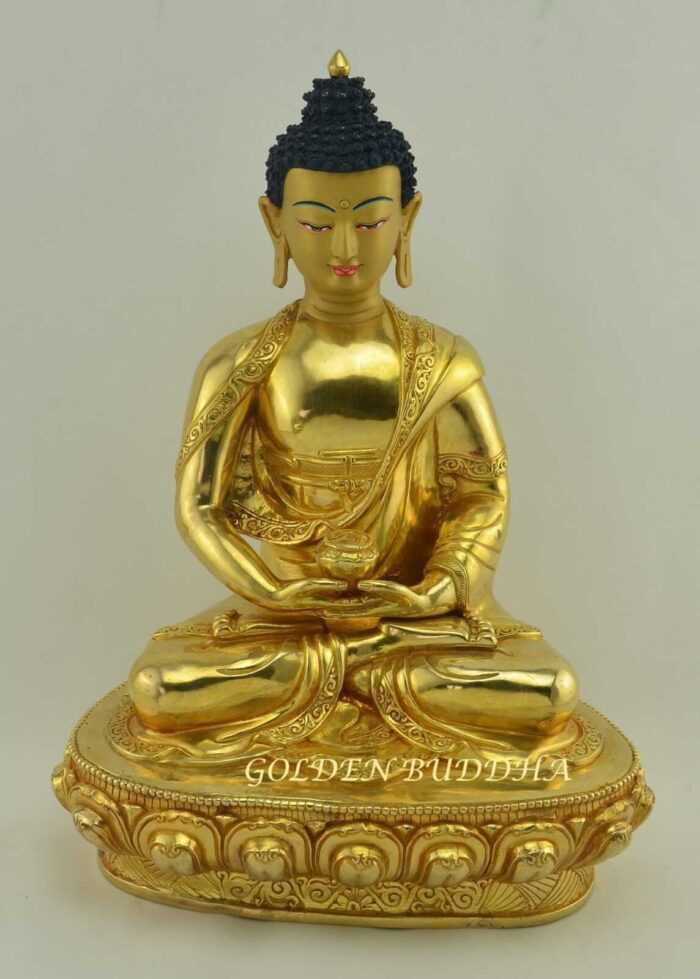
This statue can be paired with our 24K gold-gilded Amitabha Buddha statue to form a harmonious two-piece Buddha set. The 13″ Amitabha statue was created by the same master artisan with matching copper-alloy construction, 24K fire gilding, hand-painted facial details, engraved robes, and a similarly proportioned single lotus pedestal. Their closely matched height, width, finish, facial style, and gilded surfaces allow the statues to be displayed together without either figure appearing visually dominant.
Placed side by side, the two sculptures express complementary aspects of Buddhist practice. Shakyamuni represents the historical teacher, awakening through meditation, and the Dharma taught in this world, while Amitabha represents infinite light, compassionate aspiration, and the Western Pure Land of Sukhavati. The pairing is especially suitable for a broad Mahayana shrine, a meditation room, or a collection intended to present both the historical and celestial dimensions of Buddhahood.
Filling, Blessing, and Consecration
This Shakyamuni Buddha Sculpture may be appreciated as an original work of Himalayan art or prepared as a sacred support for Buddhist meditation and devotional practice. Traditional Nepali statues contain an interior space that may be filled with mantras, incense, medicinal substances, precious materials, miniature scriptures, and other consecration contents selected according to the practitioner’s lineage. The completed statue may then be blessed by a qualified teacher or monastic practitioner before installation on a shrine. Learn more about Buddha statue filling, blessing, and consecration.
Custom Made Shakyamuni Buddha Sculptures
A custom Shakyamuni Buddha Sculpture may be commissioned from our master artisans in Patan for a private shrine, monastery, Dharma hall, meditation center, or collection of sacred Buddhist art. The sculpture can be produced in a preferred size with a fully gilded, partly gilded, oxidized copper, or antiquated finish. Additional choices may include the lotus pedestal design, robe engraving, facial expression, gold face painting, alms bowl style, consecration chamber, and degree of ornamental detail.
Coordinated altar sets may also be commissioned with matching dimensions, pedestal proportions, gilding, engraving patterns, and facial treatments. Shakyamuni may be paired with Amitabha and Medicine Buddha, accompanied by his principal disciples, or placed at the center of a larger group of Buddhas and Bodhisattvas. Visit our custom Tibetan Buddhist statues page to learn about commissioning an original statue or matching altar set directly from Nepal.
Authentic, Handmade in Nepal
Every statue is handcrafted in Patan, Nepal, using traditional lost wax casting and comes with a certificate of authenticity issued by Nepal’s Department of Archaeology, verifying its materials, technique, and origin.
timo.a.rasanen (verified owner) –
The statue is what I expected according to the website and I am very satisfied with it. Delivery to Finland was quick. Edwin responded to my messages almost immediately and helped me to find the statue I was looking for. Altogether, very good service!
Edwin –
Dear Timo, thank you for the nice review. Welcome back anytime when you are looking for a new statue or Tibetan Ritual Items. -Edwin