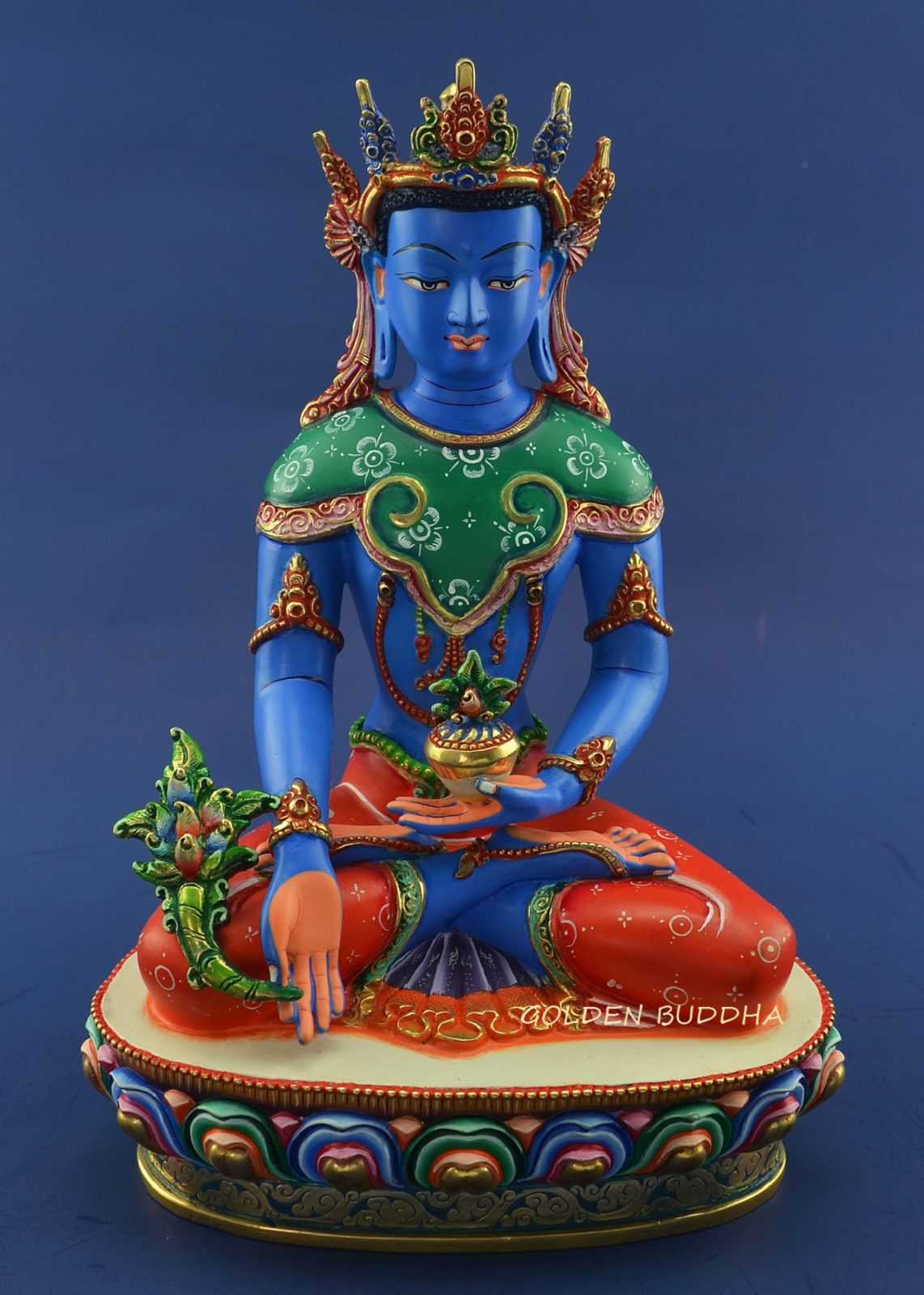
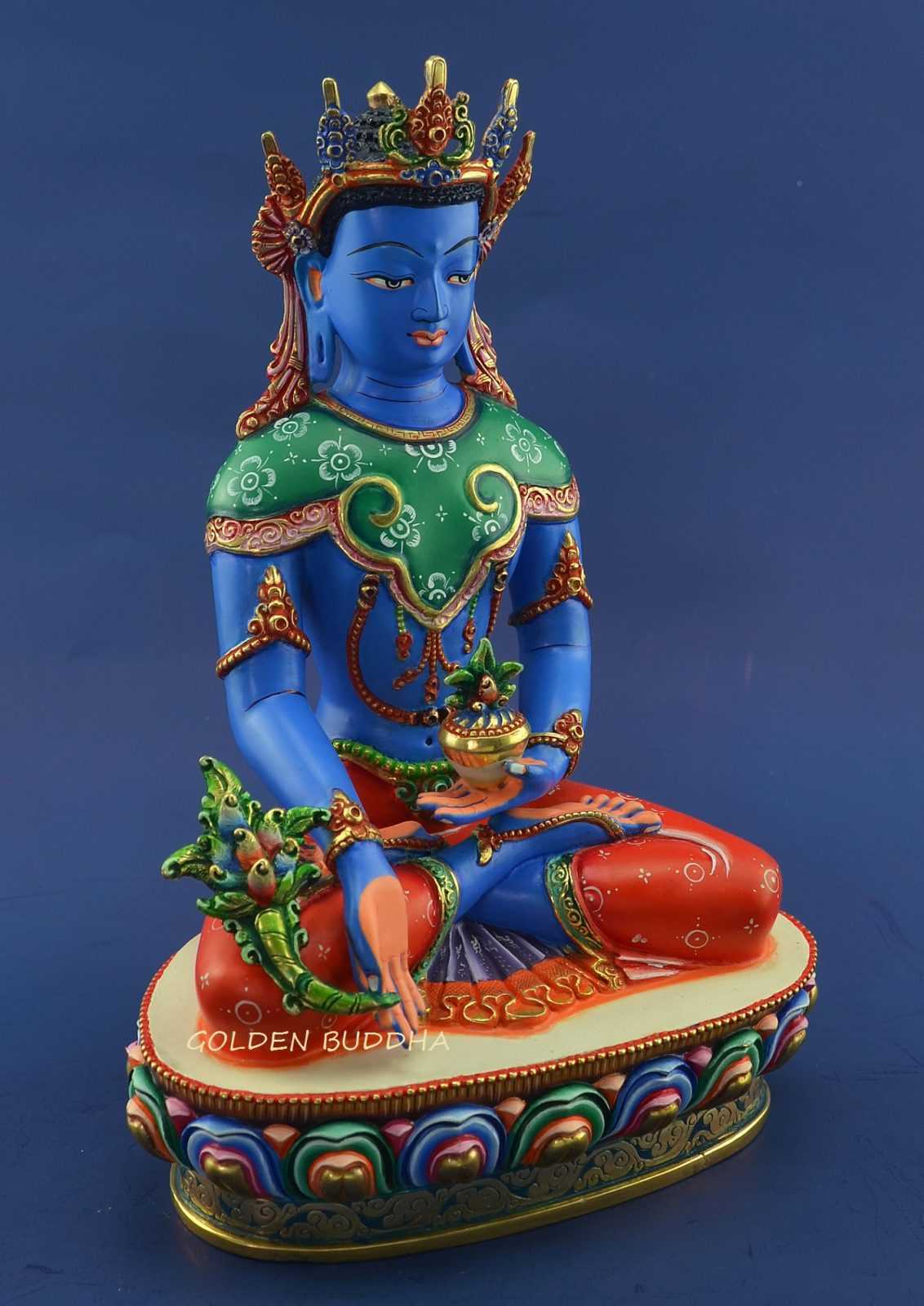
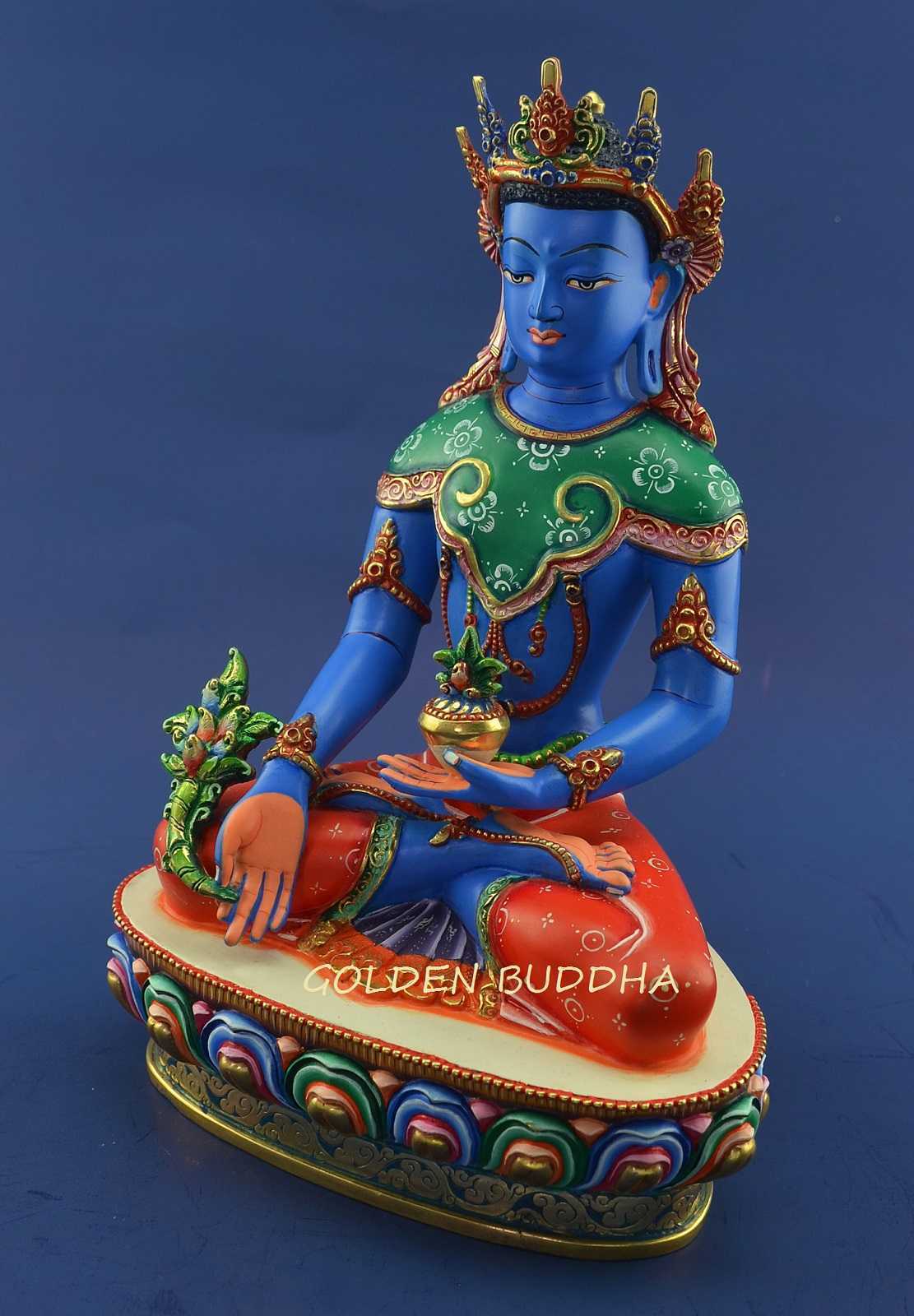
This striking Multicolored Medicine Buddha Statue portrays Bhaisajyaguru, the Healing Buddha, in an elaborately adorned celestial form. Handmade in Patan, Nepal, the 10.5-inch sculpture was cast from copper alloy through the traditional lost-wax method. Its vivid polychrome finish combines Medicine Buddha’s canonical blue body with a green shoulder covering, red lower robe, multicolored crown and jewelry, and a richly decorated lotus throne. Selected ornamental details are fire gilded in 24K gold, producing luminous highlights throughout the crown, jewelry, garment borders, medicine bowl and pedestal.
Medicine Buddha sits in full lotus posture with his right hand lowered in Varada mudra, the gesture of generosity and the granting of blessings. A carefully modeled myrobalan plant rises beside the open hand, identifying his compassionate healing activity. His left hand rests in Dhyana mudra and supports an ornate medicine bowl containing healing substances. These attributes distinguish Bhaisajyaguru from other seated Buddhas and unite physical healing with the deeper Buddhist remedies for attachment, aversion and ignorance.
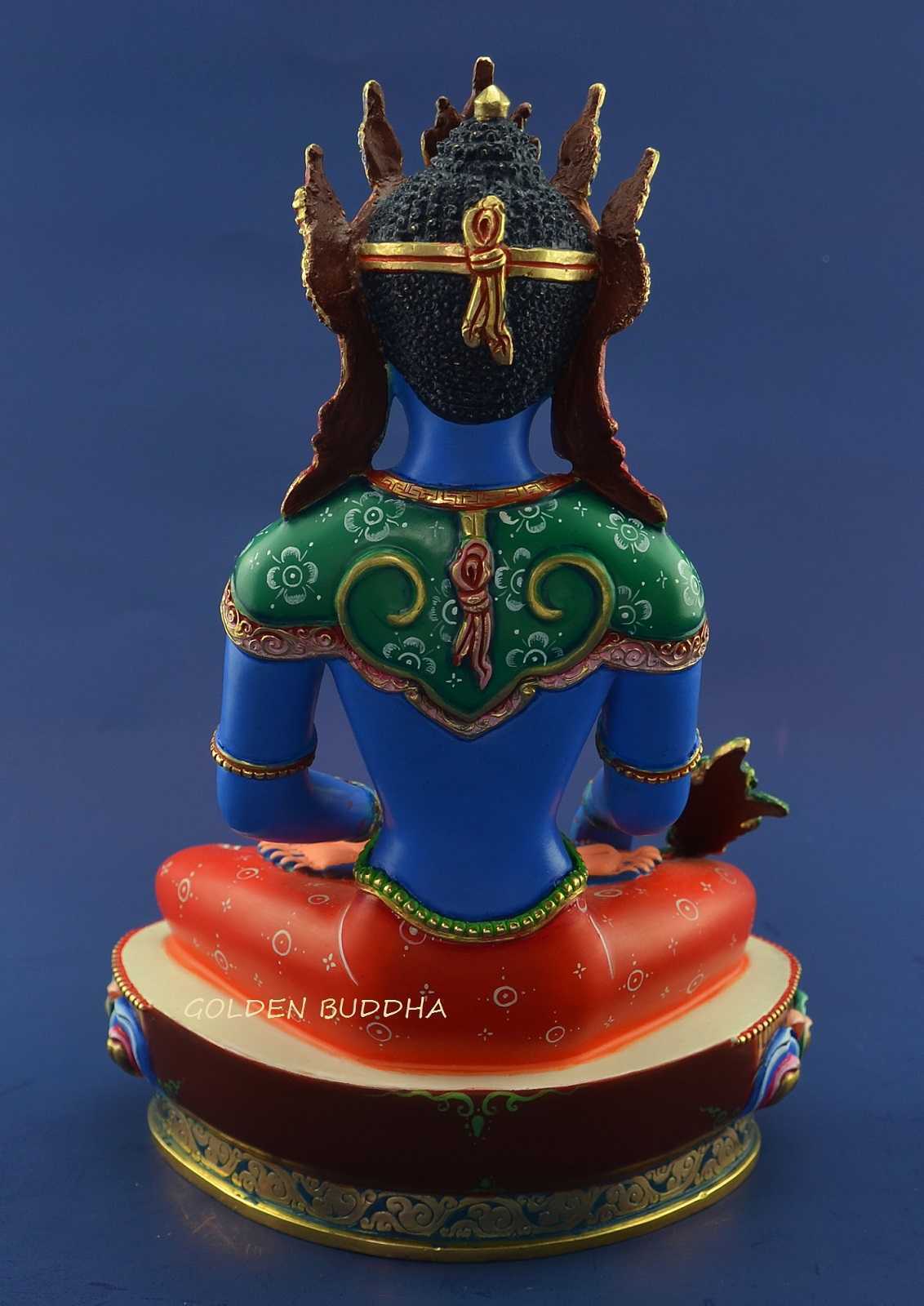
The statue’s intense blue body forms a dramatic contrast with the red robe and green upper garment. White floral designs decorate the shoulder covering, while delicate painted symbols animate the lower robe across both folded legs. The elaborate five-point crown, earrings, necklaces, armlets, bracelets and waist ornaments are finished in red, blue, green and gold. This detailed polychrome treatment continues across the reverse, including the crown, shoulder covering, robe and architectural pedestal.
Measuring approximately 10.5 inches high, 7 inches wide and 4.25 inches deep, this Multicolored Medicine Buddha Statue is large enough to serve as a principal healing image while remaining suitable for a home altar or meditation room. It was created by the same master artisan as the matching Multicolored Shakyamuni sculpture and Multicolored Amitabha Buddha statue, allowing the three sculptures to form a visually unified and doctrinally meaningful shrine ensemble.
Multicolored Medicine Buddha Statue of Bhaisajyaguru
Medicine Buddha is known in Sanskrit as Bhaisajyaguru and in Tibetan as Sangye Menla. His complete title is commonly translated as the Medicine Master Buddha of Lapis Lazuli Radiance. He embodies the enlightened capacity to recognize suffering, understand its causes and apply the appropriate remedies for its removal.
Although Medicine Buddha practice is closely associated with physical health, its meaning extends beyond bodily illness. Buddhist teachings identify ignorance, attachment and aversion as the fundamental mental poisons that produce harmful behavior and recurring suffering. Bhaisajyaguru therefore represents healing on physical, emotional and spiritual levels.
This Multicolored Medicine Buddha Statue presents the Healing Buddha in a richly adorned form rather than the simpler monastic appearance seen in many traditional images. The crown, jewelry and elaborate garments emphasize the abundance of his enlightened qualities and the cosmic scope of his healing activity.
Learn more about Medicine Buddha’s meaning, iconography and meditation practice in our complete guide to Bhaisajyaguru.
Blue Body of the Multicolored Medicine Buddha Statue
The blue body is Medicine Buddha’s most recognizable iconographic feature. Tibetan Buddhist paintings traditionally depict Bhaisajyaguru in a deep lapis-blue color associated with clarity, purity and healing wisdom. The saturated blue treatment covers the face, neck, torso, arms, hands and visible portions of the folded legs.
Blue is traditionally connected with mirror-like wisdom—the awakened capacity to perceive phenomena clearly without distortion, preference or aversion. A polished mirror reflects whatever appears before it without grasping or rejecting. In the same way, Medicine Buddha’s wisdom recognizes suffering and its causes accurately, making an appropriate response possible.
The blue body also creates the visual foundation for the statue’s broader polychrome design. Red, green, gold and white details stand out clearly against the cooler body color, allowing the gestures, garments, crown and healing attributes to remain distinct.
The serene blue face has a gently lowered gaze, fine painted eyebrows and subtly colored lips. This peaceful expression suggests compassionate attention joined with the meditative stability required to respond effectively to suffering.
Varada Mudra and the Gift of Healing
Medicine Buddha’s right hand extends over his knee in Varada mudra. The open palm faces outward and downward, expressing generosity, compassionate giving and the granting of spiritual blessings. The gesture creates a direct visual connection between Bhaisajyaguru and the beings who seek his assistance.
The hand is painted in a warmer flesh tone across the palm and fingers, providing a subtle contrast with the blue forearm. This color distinction helps the open gesture remain visible against the red robe and green myrobalan branch beside it.
Varada mudra signifies more than the offering of temporary relief. Medicine Buddha gives the Dharma—the deeper remedy that helps practitioners understand and transform the mental causes of suffering. The gesture therefore includes both compassionate assistance and the wisdom required for lasting healing.
The relaxed fingers extend toward the lotus throne, suggesting that healing activity reaches outward into the conditions of ordinary life rather than remaining confined to an abstract celestial realm.
Myrobalan Plant and Healing Wisdom
A large, vividly colored myrobalan plant rises beside Medicine Buddha’s right hand. Its twisting green stem, leaves and multicolored blossoms create an energetic sculptural element beside the calm seated figure.
Myrobalan has long been associated with traditional healing systems in India, Nepal and Tibet. Within Medicine Buddha iconography, however, it represents more than a single medicinal herb. It symbolizes the correct remedy selected after the true character and underlying cause of an illness have been understood.
The plant therefore expresses the union of compassion and discernment. Concern for suffering motivates the healer, while wisdom determines which remedy is appropriate. Without compassion, treatment may become impersonal; without insight, even sincere efforts may be ineffective.
Its placement beside Varada mudra reinforces the idea that Medicine Buddha offers healing knowledge freely. The green leaves and painted flower details also echo the green shoulder covering, visually integrating the plant with the rest of the sculpture.
Medicine Bowl and Dhyana Mudra
Medicine Buddha’s left hand rests upon his lap in Dhyana mudra, the gesture of meditation and inward stability. The open palm supports a richly decorated medicine bowl positioned at the center of the seated composition.
The bowl is ornamented with green, red, blue and gold details and crowned by a leafy healing form. Its careful decoration distinguishes it from a simple monastic alms bowl while preserving the rounded vessel traditionally associated with Bhaisajyaguru.
The placement of the bowl upon the meditation hand carries an important doctrinal meaning. Complete healing arises from a stable and disciplined mind. The remedies represented by the vessel rest upon the foundation of meditative awareness rather than being separated from Buddhist practice.
The contents of the bowl are traditionally associated with medicinal nectars capable of healing the three poisons of attachment, aversion and ignorance. These poisons are understood as the deepest causes of destructive actions and recurring dissatisfaction.
Crown and Jewelry of the Healing Buddha
The elaborate five-point crown is one of the most visually prominent features of this Multicolored Medicine Buddha Statue. Its central red ornament is surrounded by green scrollwork, while alternating blue and red points rise around the dark Buddha curls. Selected edges and raised details are fire gilded in 24K gold.
The crown is fully modeled around the head rather than existing only across the forehead. The rear photograph reveals its individual points, gilded securing band and central fastening ornament against the dark textured hair.
Long earrings frame the blue face, and further jewelry appears across the chest, upper arms, wrists and waist. Red, blue, green and gold settings give the ornaments a jewel-like appearance, while small fire-gilded accents catch the light and draw attention toward the sacred attributes.
At the buyer’s request, the crown and jewelry may be further embellished with genuine turquoise and red coral before shipping. The stones can be placed selectively within the existing settings while preserving the balanced polychrome design.
Green Shoulder Covering and Floral Decoration
A deep green garment covers Medicine Buddha’s shoulders and upper chest. Its broad shape frames the blue torso and creates a strong transition between the elaborate crown and red lower robe.
White floral motifs and delicate painted marks are distributed across the green surface. These designs resemble the ornamental treatment found in Tibetan thangka painting and give the garment the appearance of an embroidered ceremonial textile.
The front edges curl inward across the chest and are outlined in gold and red. Small pendant ornaments hang from the pointed center, connecting the shoulder covering visually with the necklaces and medicine bowl below.
The garment continues across the reverse, where symmetrical gold-edged scrolls curve inward toward a central red ornament. White flowers cover both shoulders and remain clearly visible against the green background.
Red Robe and Painted Hemlines
Medicine Buddha’s lower robe is painted in a warm red-orange color and decorated with fine white circles, crescents and small linear motifs. The vivid garment covers both folded legs and creates a strong contrast with the blue body.
Green and gold borders follow the robe around the knees and waist. These narrow hemlines define the structure of the garment and help separate the painted surfaces from the body and lotus platform.
The red robe remains visible across the reverse, where the white motifs continue around the folded legs. This complete treatment confirms that the statue was designed as a fully finished sacred image rather than as a front-facing decorative object.
The interaction of blue, red and green mirrors the color relationships commonly seen in Himalayan Buddhist paintings. The statue translates that painted iconographic language into a three-dimensional devotional form.
24K Fire-Gilded Details
Selected crown, jewelry, garment and pedestal details are fire gilded in 24K gold. The gilding is used as a carefully controlled accent rather than covering the entire sculpture.
Gold highlights appear along the crown points, earrings, necklaces, armlets, bracelets, medicine bowl, garment borders and lotus petals. These luminous details stand out against the matte painted surfaces and guide the viewer’s attention through the complex composition.
The gilding also defines the boundaries between adjacent colors. Narrow gold courses separate green from blue, red from cream and the colored lotus petals from the darker architectural base.
This combination of polychrome painting and selective fire gilding gives the statue both visual richness and structural clarity. The gold catches reflected light, while the pigments preserve the distinct iconographic colors of Bhaisajyaguru.
Full Lotus Posture of the Multicolored Medicine Buddha Statue
Medicine Buddha sits in the full lotus posture with both legs folded symmetrically before him. The broad triangular arrangement provides a stable foundation beneath the upright torso, crown and sacred hand gestures.
The full lotus position symbolizes meditative concentration, balance and the unshakable nature of awakened awareness. Medicine Buddha perceives suffering clearly while remaining free from the fear and confusion that ordinarily accompany it.
The blue feet remain partly visible within the red garment, while green and gold hemlines trace the edges around the folded legs. This layering preserves the iconographic clarity of the posture despite the elaborate painted finish.
The calm symmetry of the seated body balances the organic movement of the myrobalan plant and the detailed medicine bowl. The result is an image that combines contemplative stability with active healing compassion.
Multicolored Medicine Buddha Statue ‒ Lotus Throne and Ornamental Base
The sculpture rests upon a broad lotus throne decorated in green, blue, red, pink, cream and gold. A pale upper platform supports the seated Buddha and is framed by a narrow red beaded border.
Large stylized petals surround the front and sides. Green outer forms enclose blue and pink inner layers, while rounded gilded centers provide luminous focal points. Small red diamond-shaped elements separate the principal petals.
The lotus symbolizes purity arising from samsara. Although it develops from muddy water, its flower opens above the surface without becoming stained. As Medicine Buddha’s seat, it represents healing wisdom that engages suffering without becoming bound by it.
The lowest architectural band carries scrolling gold foliate motifs against a darker blue-green field. This decorative course continues around the reverse and gives the colorful lotus throne a stable visual foundation.
Ushnisha and Marks of Buddhahood
Medicine Buddha’s dark textured hair rises into the ushnisha, the cranial protuberance traditionally associated with the wisdom and spiritual attainment of a fully awakened Buddha.
The crown surrounds the ushnisha without completely concealing it. From the reverse, the carefully modeled curls remain visible beneath the crown points and gilded securing band.
A small urna appears between the brows, symbolizing transcendent vision and the Buddha’s capacity to perceive the circumstances and needs of sentient beings. Three horizontal lines across the neck form another established feature of Himalayan Buddha iconography.
The elongated earlobes recall the heavy jewelry associated with royal life. They represent the Buddha’s renunciation of worldly privilege and the transformation of royal status into enlightened service.
Finished Across the Front and Reverse
The back view demonstrates that the multicolored finish continues throughout the sculpture. Medicine Buddha’s crown, dark hair, green shoulder covering, red robe and lotus pedestal are all carefully completed from behind.
The crown points remain individually modeled around the ushnisha, while the rear fastening band and central ornament are highlighted with gold and red. Dark painted curls cover the back of the head in a dense, textured field.
The green upper garment extends across both shoulders and carries white floral motifs around the reverse. Gold-edged scrolls curl inward toward a central red fastening ornament, producing a symmetrical design across the upper back.
The blue back and waist remain comparatively smooth, creating a calm central area between the decorated shoulder covering and red folded legs. The colored lotus petals and gilded lower border continue around the entire base, making the statue suitable for freestanding shrine placement.
Medicine Buddha Mantra and Healing Practice
Medicine Buddha’s mantra is commonly recited as Tayata Om Bekandze Bekandze Maha Bekandze Radza Samudgate Soha. The repeated word Bekandze is associated with releasing beings from suffering and the causes that produce it.
Practitioners may recite the mantra for themselves, for those experiencing illness or as a dedication for the health and welfare of all sentient beings. The practice is traditionally combined with visualization, ethical conduct and the cultivation of compassion.
The vivid blue form of this Multicolored Medicine Buddha Statue provides a strong visual support for meditation. The blue body, Varada mudra, myrobalan plant, medicine bowl and peaceful seated posture bring together the principal attributes contemplated during Bhaisajyaguru practice.
Medicine Buddha practice may complement appropriate medical care, but a sacred statue should not be understood as a substitute for professional diagnosis or treatment. Its purpose is to support meditation, compassionate intention and the Buddhist understanding of healing.
Traditional Lost-Wax Casting in Patan, Nepal
This Multicolored Medicine Buddha Statue was handmade in Patan, Nepal, using the traditional lost-wax casting method. The process begins with a wax model prepared according to established Buddhist iconometric proportions. The artisan forms Medicine Buddha’s posture, face, hands, crown, jewelry, bowl, myrobalan plant and lotus pedestal before preparing the sculpture for casting.
The wax figure is enclosed within a heat-resistant mould and fired until the wax melts away, leaving a cavity in its form. Molten copper alloy is poured into the mould and allowed to cool. Once the mould is removed, the raw casting is chased, filed and refined by hand.
The artisan sharpens the fingers, facial contours, crown points, jewelry, medicinal plant, bowl and lotus petals. The sculpture is then prepared for its multicolored painted finish, with separate areas assigned to the blue body, green shoulder covering, red robe and decorative throne.
Selected ornamental details are fire gilded in 24K gold to create contrast and definition. Because the original wax model is destroyed during casting and the chasing, painting and gilding are performed individually, every statue retains subtle handmade variations.
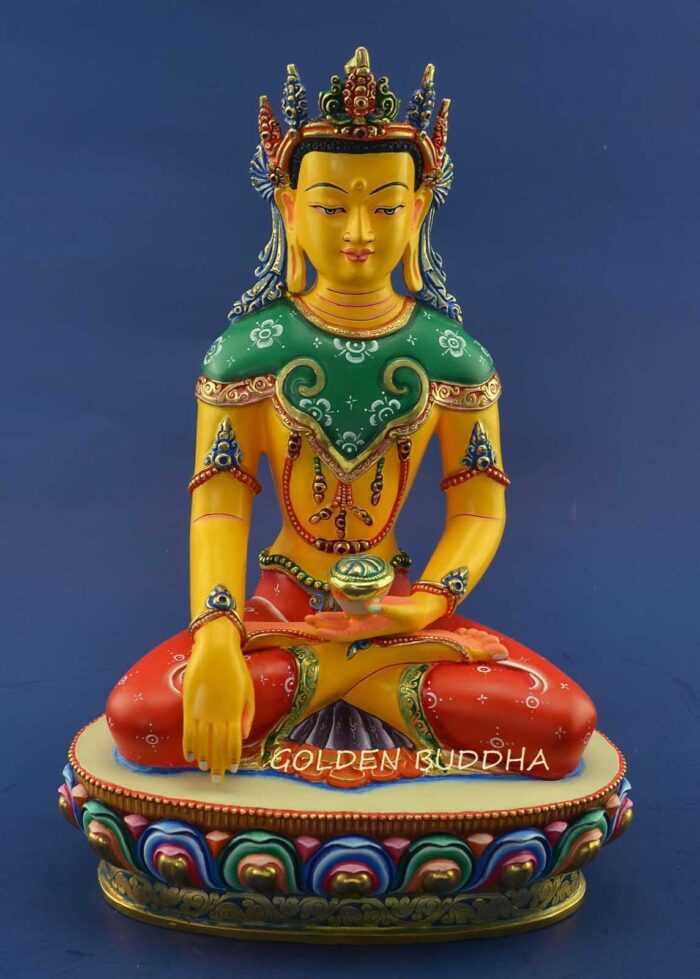
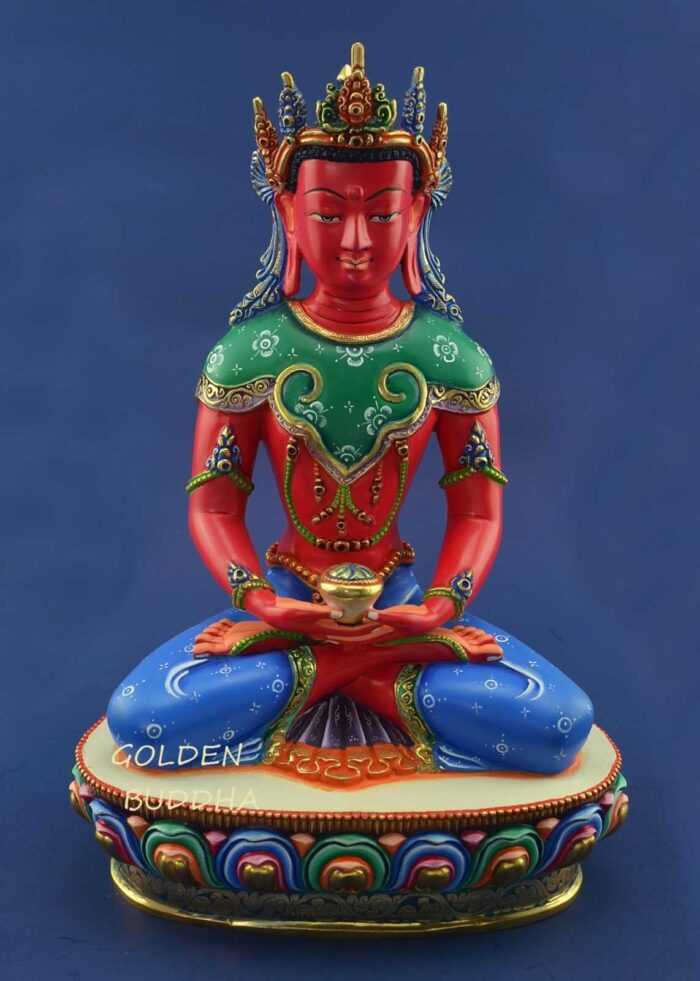
Multicolored Medicine Buddha Statue, Shakyamuni and Amitabha Set
This Multicolored Medicine Buddha Statue would form a vibrant three-piece shrine set with the matching Multicolored Shakyamuni sculpture and Multicolored Amitabha Buddha statue. All three images were created by the same master artisan and share copper-alloy construction, lost-wax casting, multicolored hand painting and selective 24K fire-gilded details.
The statues have matching dimensions and closely coordinated artistic treatments. Each measures approximately 10.5 inches high and features a multicolored crown, celestial jewelry, green upper garment, red lower robe and elaborately painted lotus pedestal. Their repeated colors and related proportions allow them to appear as an intentionally designed ensemble.
Each Buddha retains his own identifying gestures and sacred attributes. Medicine Buddha lowers his right hand in Varada mudra beside the myrobalan plant and supports a medicine bowl in Dhyana mudra. Shakyamuni touches the earth in Bhumisparsha mudra while holding his alms bowl in the meditation hand. Amitabha places both hands in Dhyana mudra around the monastic bowl.
Medicine Buddha represents healing, clarity and the transformation of physical, mental and spiritual suffering. His plant and bowl signify remedies selected and applied with compassionate wisdom.
Shakyamuni Buddha represents the historical revelation of the Dharma in our world. His awakening beneath the Bodhi tree and subsequent teachings established the path through which suffering and its causes can be understood and overcome.
Amitabha Buddha embodies Infinite Light, discriminating wisdom and the compassionate vows that established Sukhavati. His meditative gesture expresses concentration and the aspiration to continue toward awakening under favorable spiritual conditions.
Together, the three Buddhas form a coherent doctrinal arrangement. Shakyamuni reveals and teaches the path, Medicine Buddha supports healing and the removal of obstacles encountered while following it, and Amitabha represents compassionate refuge and favorable conditions for continued progress toward liberation.
Shakyamuni may be placed at the center as the Buddha of our historical era, with Medicine Buddha and Amitabha serving as complementary companions. The arrangement would unite teaching, healing and Pure Land aspiration within a visually balanced shrine.
Custom-Made Multicolored Medicine Buddha Statues
A custom-made Medicine Buddha statue may be commissioned in a preferred size, color scheme, finish and degree of ornamentation. Available options include personal shrine images, larger temple-scale sculptures, antiquated oxidized copper finishes, partly gilded statues and images fire gilded in 24K gold.
A custom polychrome version may be created with traditional mineral pigments or another coordinated color palette. The body, robes, shoulder covering, crown, jewelry, medicine bowl, myrobalan plant and lotus pedestal can be finished in complementary colors while preserving Medicine Buddha’s established iconography.
The crown and jewelry may be embellished with genuine turquoise and red coral. Stone placement may be restricted to selected crown settings and ornaments or expanded across the necklace, armlets, bracelets and throne according to the requested design.
Customers may request painted robes, hand-carved textile designs, fire-gilded hemlines or additional ornament across the rear garments and pedestal. Traditional Medicine Buddha attributes—including the blue body, Varada mudra, myrobalan plant, Dhyana mudra, medicine bowl, full lotus posture, urna and ushnisha—are preserved throughout the commission.
Custom statues can be produced for private collectors, home shrines, Dharma centers, Buddhist temples and monasteries. Larger commissions may include deeper lotus-petal carving, more elaborate architectural bases and fully coordinated rear decoration for freestanding display.
A complete three-piece set may also be commissioned with Medicine Buddha, the Multicolored Shakyamuni sculpture and the Multicolored Amitabha Buddha statue. Their heights, crown designs, pigments, gilded details, robes and lotus pedestals can be planned together so the finished sculptures form a unified altar ensemble.
Such a custom set would unite Medicine Buddha’s healing activity with Shakyamuni’s teaching and Amitabha’s Infinite Light and Pure Land aspiration. Shakyamuni reveals the path, Medicine Buddha helps relieve suffering and remove obstacles, and Amitabha represents compassionate refuge and continued progress toward awakening. Together, they create a visually vibrant and doctrinally meaningful expression of Buddhist healing, wisdom and hope.
Authentic, Handmade in Nepal
Every statue is handcrafted in Patan, Nepal, using traditional lost wax casting and comes with a certificate of authenticity issued by Nepal’s Department of Archaeology, verifying its materials, technique, and origin.