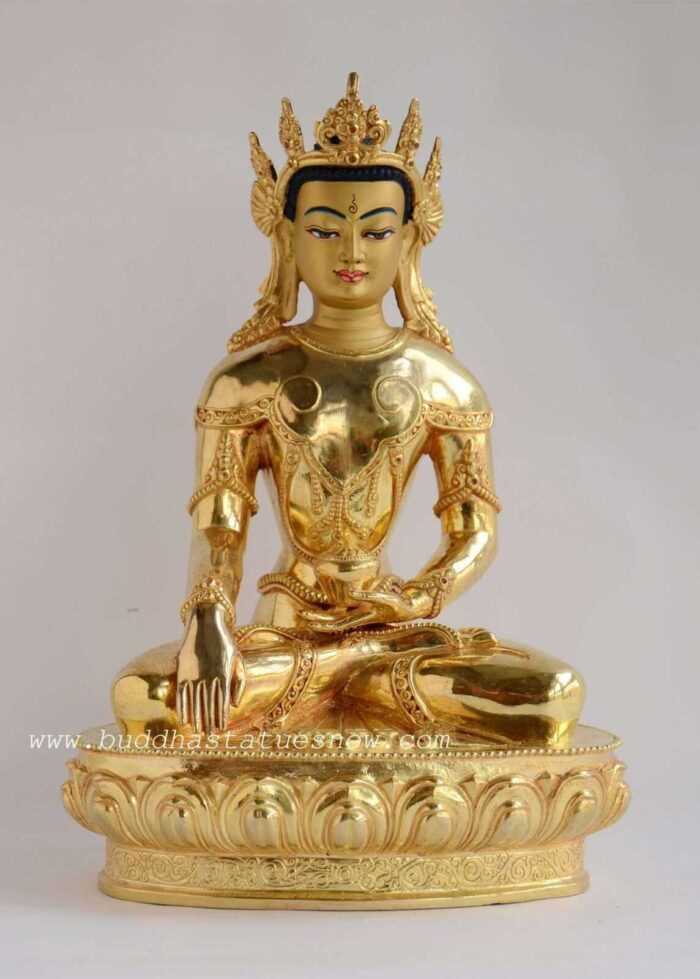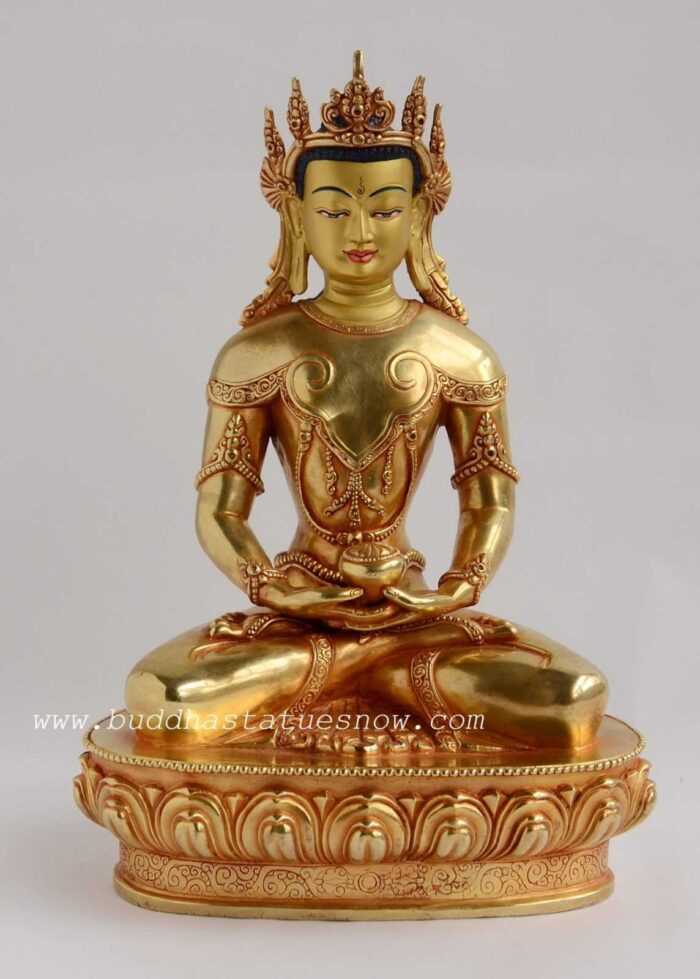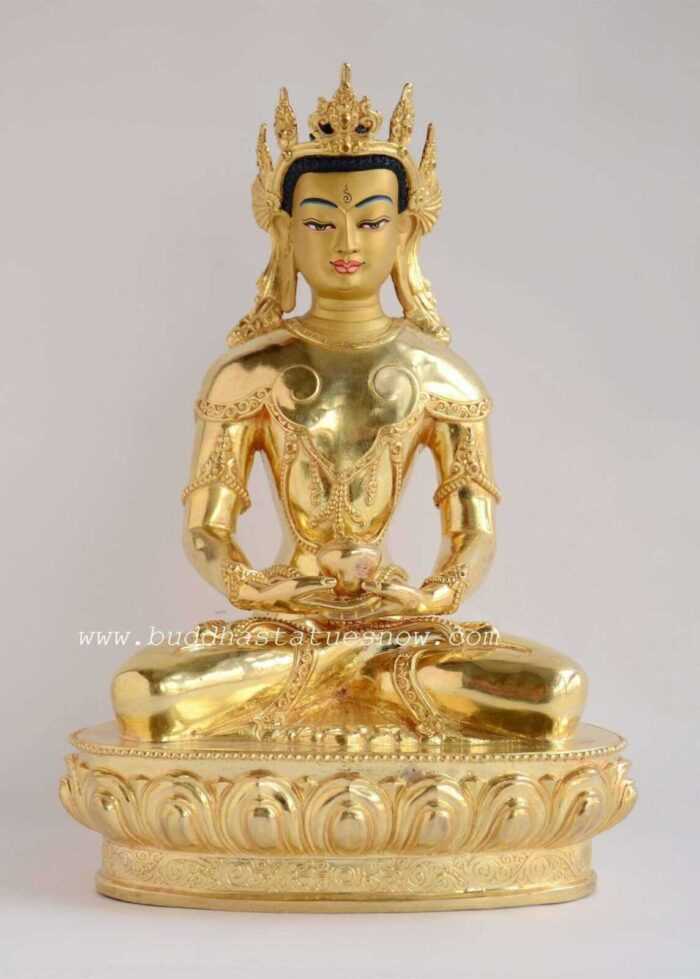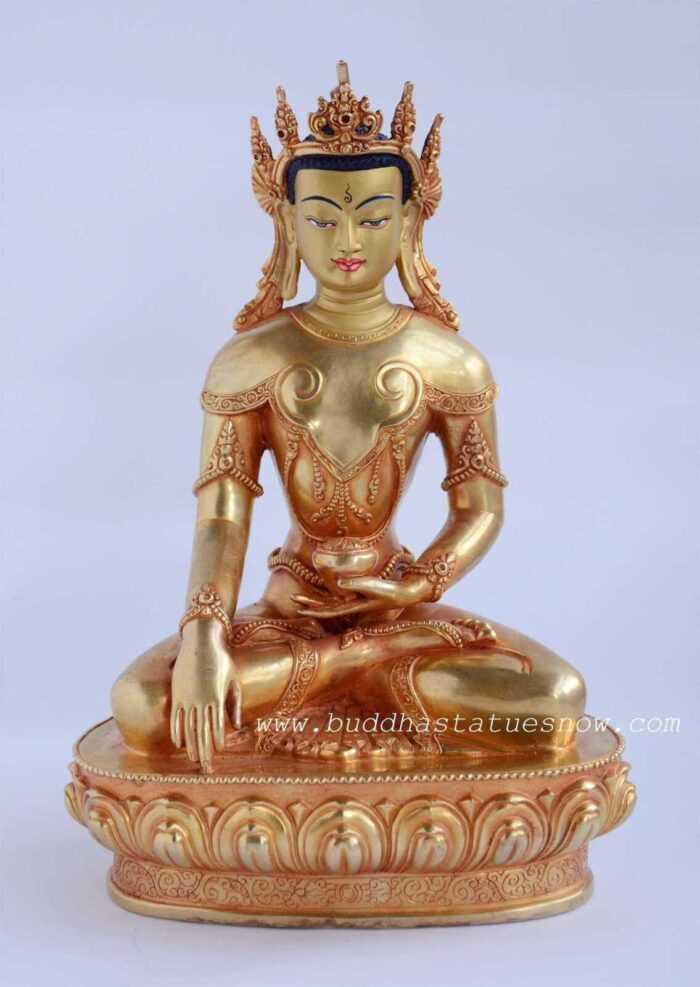

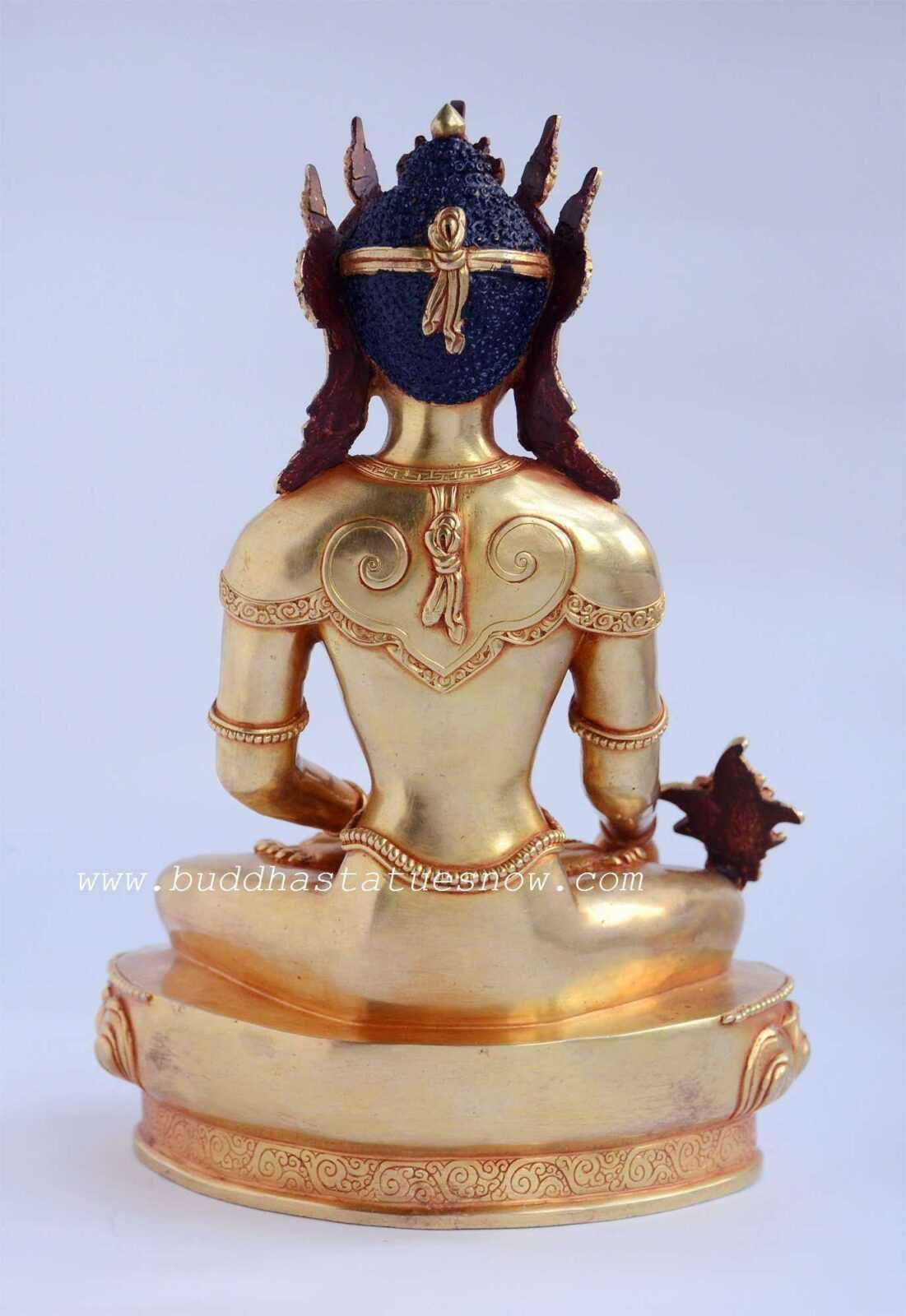
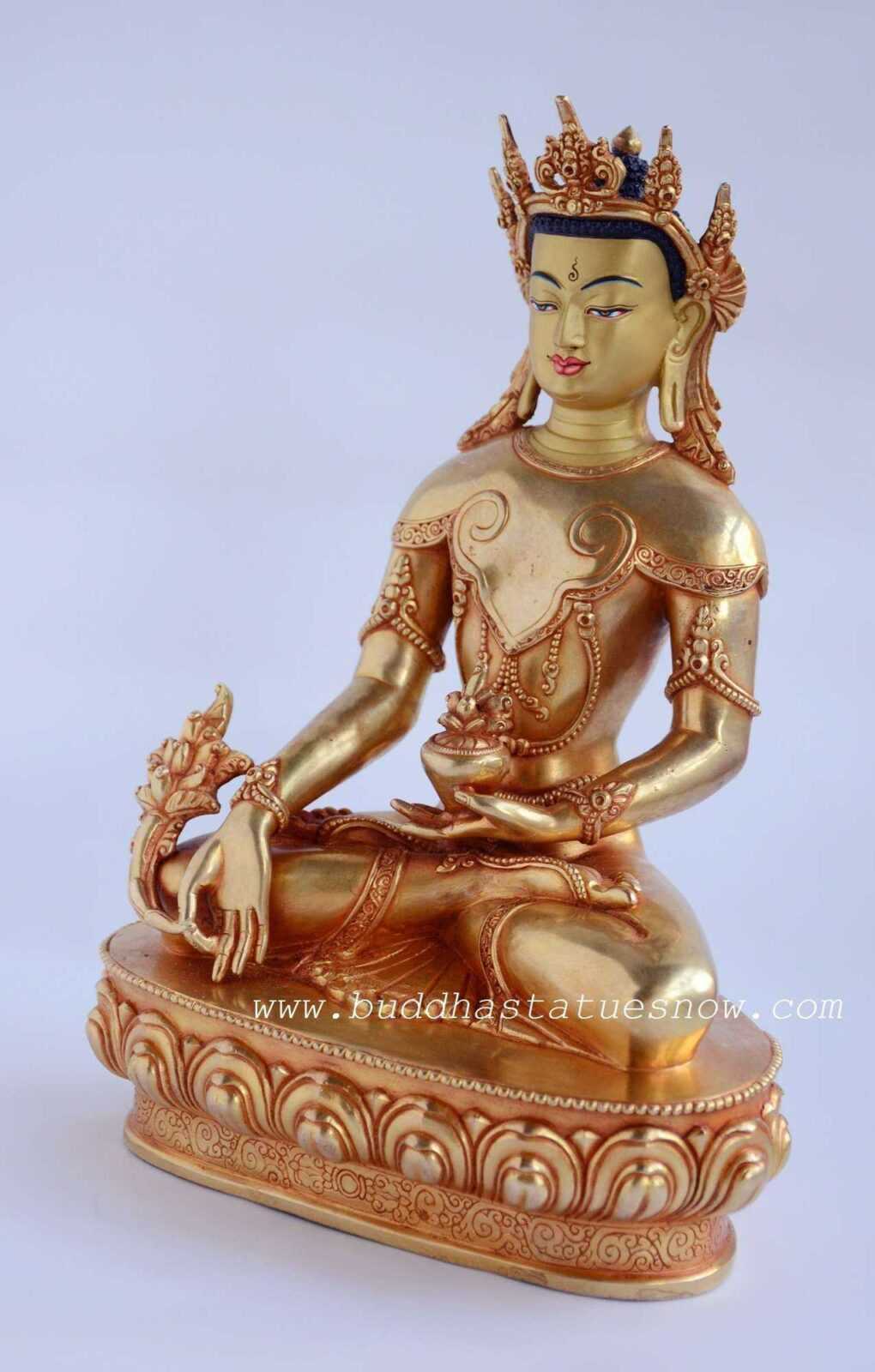
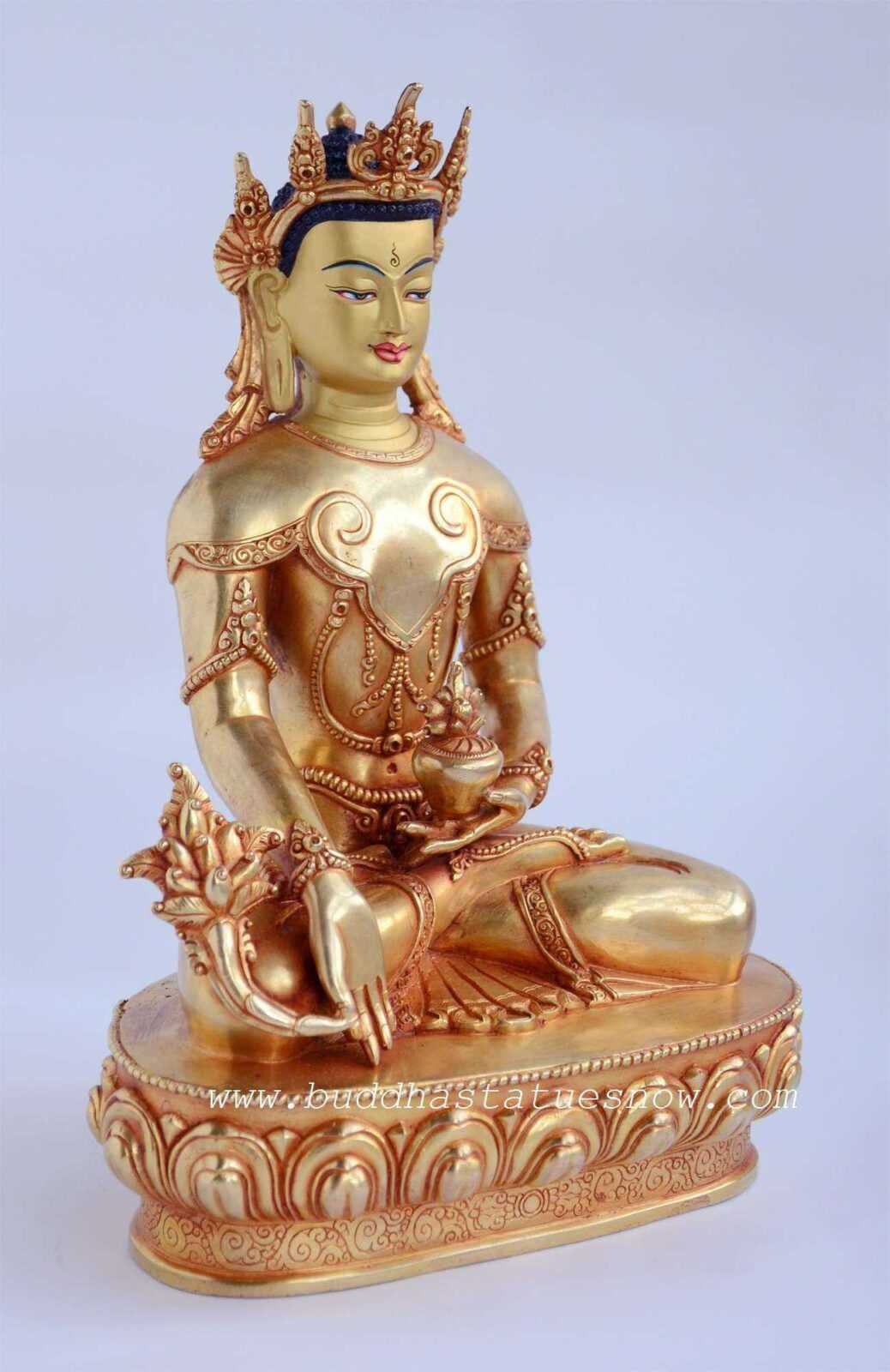
This distinguished 10.5″ Tibetan Medicine Buddha statue represents Bhaisajyaguru, known in Tibet as Sangye Menla, the Buddha whose enlightened activity is associated with healing, relief from suffering, and the restoration of balance in body and mind. Handcrafted from copper alloy by a master Newar artisan in Patan, Nepal, the sculpture was created through the traditional lost wax casting method and fire gilded in pure 24K gold. Its deliberately softened, low-luster finish gives the gold a warm rose-toned character, allowing the carved crown, jewelry, robe borders, medicinal attributes, and lotus pedestal to remain clearly defined without the glare of a mirror-polished surface.
The face is separately hand painted with 18K gold and natural pigments, giving Medicine Buddha a calm yet attentive expression framed by blue-black brows, gently lowered eyes, red lips, and the urna of enlightened wisdom. His dark hair rises beneath an elaborate five-pointed Bodhisattva crown, while fan-shaped ornaments descend beside the elongated earlobes. Curling pectoral forms, pendant chains, engraved armlets, bracelets, and finely ornamented robe hemlines complete the celestial presentation. At the buyer’s request, suitable settings in the crown and jewelry may be embellished with lapis lazuli, turquoise, or red coral stones before delivery at no additional charge.
Tibetan Medicine Buddha Statue Healing Symbolism
Medicine Buddha embodies the healing dimension of awakened wisdom. Buddhist teachings often compare the Buddha to a physician, suffering to an illness, the Dharma to medicine, and sincere practice to the treatment through which liberation becomes possible. His activity therefore extends beyond temporary relief from physical disease. Medicine Buddha practice is also directed toward emotional affliction, harmful habits, karmic obscurations, and the ignorance from which all recurring dissatisfaction arises.
The crowned form shown in this Tibetan Medicine Buddha statue presents him with the ornaments of a celestial Buddha. The ushnisha above his head symbolizes extraordinary wisdom, while the urna between the brows represents insight that sees beyond ordinary appearances. His elongated earlobes recall the royal ornaments worn before renunciation, and the three horizontal lines upon the neck are included among the auspicious physical marks traditionally associated with an enlightened being. Learn more about his identity, mantra, vows, and practice in our complete guide to Medicine Buddha statues and healing practice.
Varada Mudra and the Myrobalan Plant
Medicine Buddha sits in the full lotus posture while extending his right hand over the knee in the Varada mudra, the gesture of generosity, compassionate giving, and the granting of blessings. His open palm faces outward toward sentient beings, expressing a willingness to offer whatever form of aid is genuinely beneficial. Between the fingers he holds the stem of the myrobalan plant, which rises beside his right arm in a carefully sculpted cluster of leaves and fruit.
Myrobalan has long been valued in Tibetan and Ayurvedic medicine and serves as Medicine Buddha’s principal botanical attribute. Within Buddhist iconography, the plant also represents the perfected wisdom capable of diagnosing and treating the underlying causes of suffering. It therefore unites the symbolism of a physical remedy with the Dharma medicine that counters ignorance, attachment, and aversion within the mind. The branching leaves and fruit create an organic counterpoint to the precisely engraved crown and jewelry while immediately identifying the deity as Medicine Buddha.
Medicine Bowl and the Three Healing Nectars
His left hand rests in his lap in the Dhyana mudra, the gesture of meditation, concentration, and inner equilibrium. Supported in the open palm is the traditional medicine bowl, understood to contain healing nectar capable of counteracting the three poisons of ignorance, attachment, and hatred. These mental afflictions are regarded as the fundamental causes from which harmful conduct, emotional turmoil, and continued suffering arise.
The complementary arrangement of the two hands joins active healing with meditative insight. The right hand reaches compassionately toward the world, while the left remains centered in contemplation. Together they express the principle that genuine healing requires both practical care and clear understanding. This balance makes the statue especially meaningful for a healing shrine, meditation room, medical practice, home altar, monastery, or Dharma center dedicated to the welfare of family members, teachers, patients, and other sentient beings.
The Twelve Great Vows of Medicine Buddha
Before attaining Buddhahood, Medicine Buddha generated twelve great vows expressing his determination to relieve suffering in its many forms. These aspirations encompass healing illness and physical impairment, providing necessities to those experiencing deprivation, guiding beings away from mistaken views, restoring damaged ethical discipline, and protecting those burdened by fear or oppression. The vows reveal healing as a broad compassionate activity concerned with physical, psychological, ethical, social, and spiritual well-being.
For practitioners, the Tibetan Medicine Buddha statue can serve as a visual focus for mantra recitation, meditation, offerings, healing prayers, and the dedication of merit for those facing illness. Its presence may also remind the viewer that Buddhist healing does not consist solely of removing uncomfortable symptoms. It seeks to transform the habits and obscurations that repeatedly generate suffering while cultivating the wisdom and compassion necessary to benefit others.
Low-Luster Gilding and Bodhisattva Adornments
The warm, subdued gilding is one of the defining artistic qualities of this sculpture. Rather than reflecting light with a hard mirror brilliance, the 24K gold surface has a mellow antiquated luster with rose-toned undertones. This finish allows the engraved robe hemlines, crown points, shoulder bands, armlets, bracelets, pectoral ornament, and waist border to remain legible in soft shadow while giving the newly made statue the dignified presence of an older monastery image.
Curling forms rise across the chest and descend into a pointed ornamental panel decorated with beaded chains and foliate details. Fine scrollwork follows the shoulder ornaments and the borders of the garments across the folded legs. The broad torso and limbs remain comparatively smooth, producing a deliberate balance between polished gold surfaces and concentrated decorative detail. The reverse is also carefully finished, with paired curling forms sweeping across the shoulders toward a central pendant and engraved bands continuing around the upper arms and neckline.
The crown and jewelry may be further embellished with traditional Himalayan stones. Lapis lazuli is especially appropriate because the canonical body color of Medicine Buddha is lapis blue and his pure realm is associated with lapis lazuli radiance. Turquoise introduces blue-green tones traditionally associated with healing, protection, and awakened activity, while red coral creates a warm contrast against the softly gilded surface.
Double Lotus Throne and Full Lotus Posture
Medicine Buddha is seated in the full lotus posture upon a substantial double lotus throne. The tightly interlocked legs express meditative stability and the unshakable concentration associated with awakening. The throne is formed by layered architectural elements and a prominent register of rounded lotus petals, bordered by fine beadwork and a lower band of continuous engraved foliage.
The lotus symbolizes purity arising within samsara. Just as the flower grows through muddy water without becoming stained, wisdom and compassion can develop amid illness, uncertainty, and the other difficulties of conditioned life. The pedestal’s restrained ornamentation echoes the crown, jewelry, and robe borders while providing a stable foundation for the upright figure above.
A Matching Medicine Buddha, Shakyamuni and Amitabha Statue Set
This Tibetan Medicine Buddha statue forms a harmonious three-piece altar set with our Tibetan Shakyamuni Buddha statue and Tibetan Amitabha Buddha statue. All three sculptures were created by the same master artisan and share closely coordinated dimensions, copper-alloy casting, rich low-luster 24K fire gilding, hand-painted faces, elaborate Bodhisattva crowns and jewelry, finely engraved robe hemlines, balanced proportions, and corresponding lotus thrones. Their warm gilding and related decorative language allow them to be displayed as a unified shrine ensemble.
The three Buddhas also form a meaningful doctrinal grouping. Shakyamuni is the historical teacher who attained enlightenment beneath the Bodhi tree and revealed the Dharma in our world. Medicine Buddha embodies the healing activity of enlightened wisdom, addressing physical illness, mental affliction, and the deeper causes of suffering. Amitabha embodies Infinite Light and the compassionate vows that established Sukhavati as a favorable realm for continued progress toward awakening. Together, Shakyamuni provides the teaching, Medicine Buddha supports healing and restoration in the present, and Amitabha represents the aspiration for favorable future conditions and ultimate enlightenment.
Filling, Blessing and Consecration
The statue includes a consecration opening so that it may be filled with sacred texts, rolled mantras, incense, medicinal substances, precious materials, and other traditional offerings before receiving a blessing according to the buyer’s Buddhist lineage. Filling and consecration prepare the handcrafted image for use as an object of meditation, offering, and veneration. Our guide to Buddha statue filling, blessing, and consecration explains the customary preparation and available options for practitioners, collectors, monasteries, and Dharma centers.
Custom Made Tibetan Medicine Buddha Statues
Collectors, practitioners, monasteries, healing centers, and Dharma organizations may commission a custom made Tibetan Buddhist statue based upon this crowned Medicine Buddha design. A custom Tibetan Medicine Buddha statue may be produced in another size with a warm low-luster 24K fire-gilded finish, brighter polished gilding, selective gold details, an oxidized treatment, or an antiquated patina over the copper-alloy casting. Options may include personalized robe engraving, alternative crown and jewelry designs, hand-painted facial details, customized lotus-petal proportions, and lapis lazuli, turquoise, or red coral embellishments.
A coordinated Medicine Buddha, Shakyamuni, and Amitabha set may also be commissioned so that all three sculptures share the same height, low-luster gilding, crown style, jewelry, engraved borders, facial treatment, and pedestal proportions. Commissioning the figures together allows the artisan to preserve their visual continuity while expressing their complementary spiritual roles: Shakyamuni as the teacher of the path, Medicine Buddha as the healer of suffering and its causes, and Amitabha as the Buddha of Infinite Light whose vows support continued progress toward awakening. Every custom statue is individually cast, carved, engraved, fire gilded, painted, and finished by hand in Nepal according to traditional Himalayan iconographic proportions.
Authentic, Handmade in Nepal
Every statue is handcrafted in Patan, Nepal, using traditional lost wax casting and comes with a certificate of authenticity issued by Nepal’s Department of Archaeology, verifying its materials, technique, and origin.