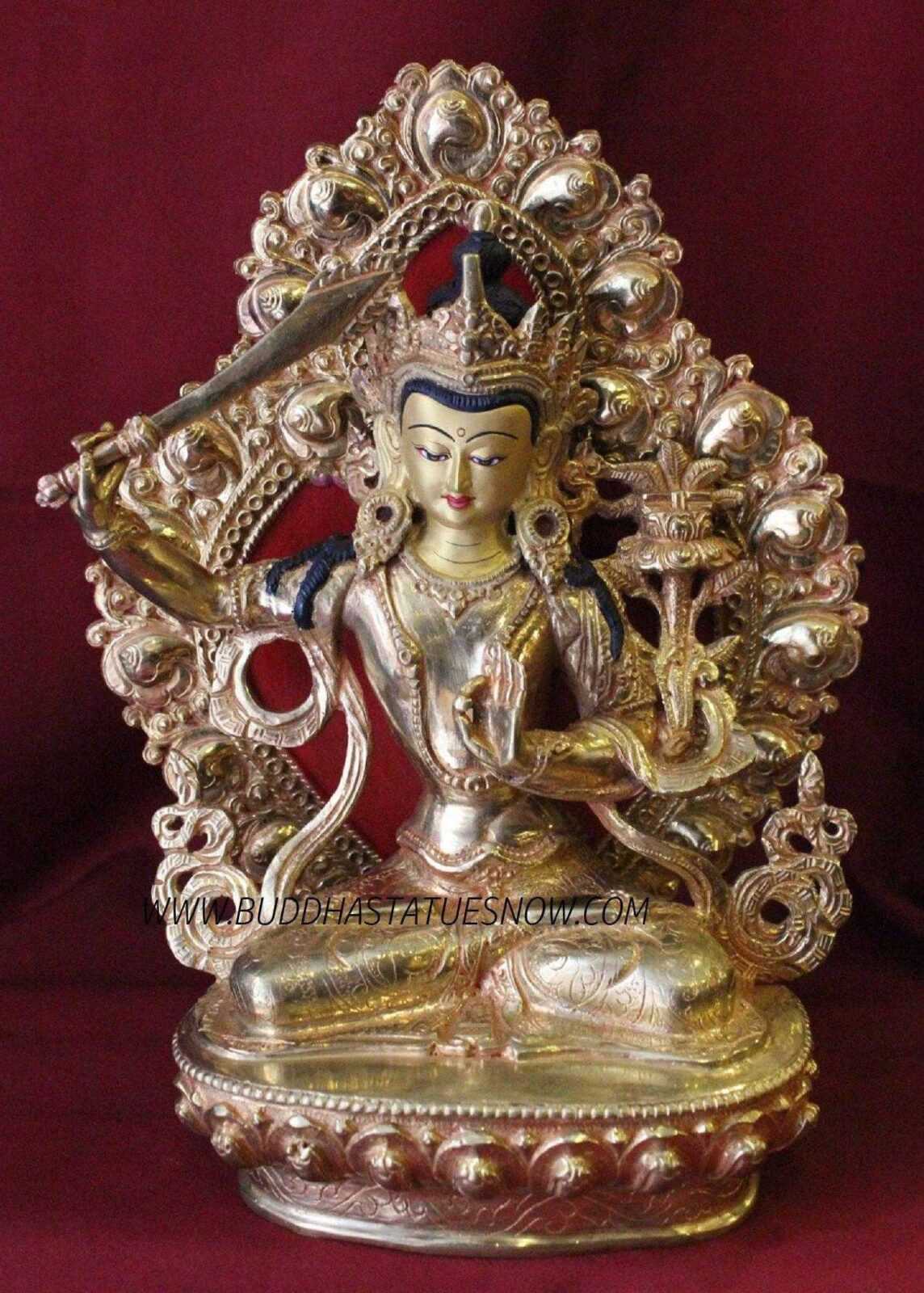
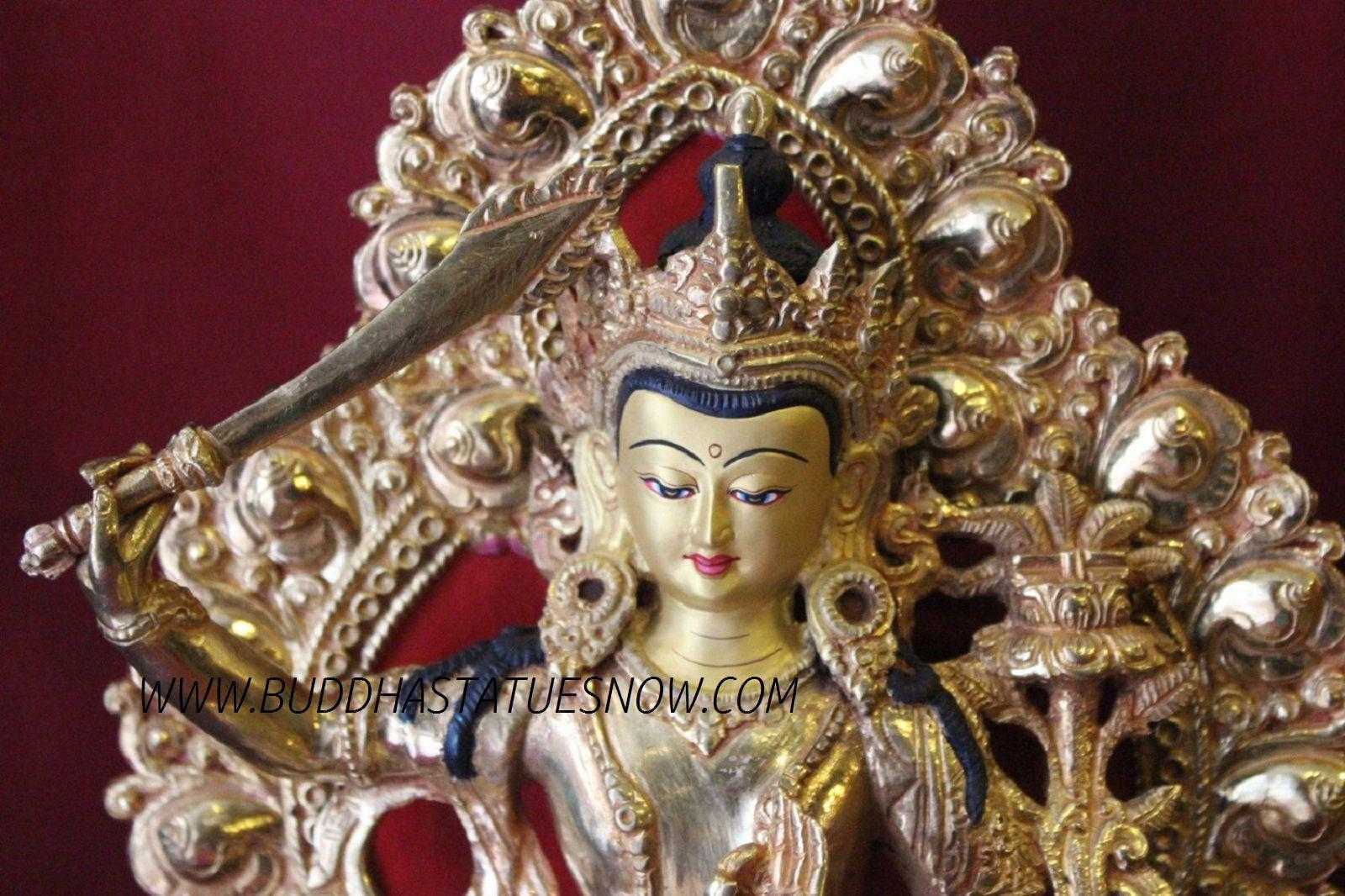
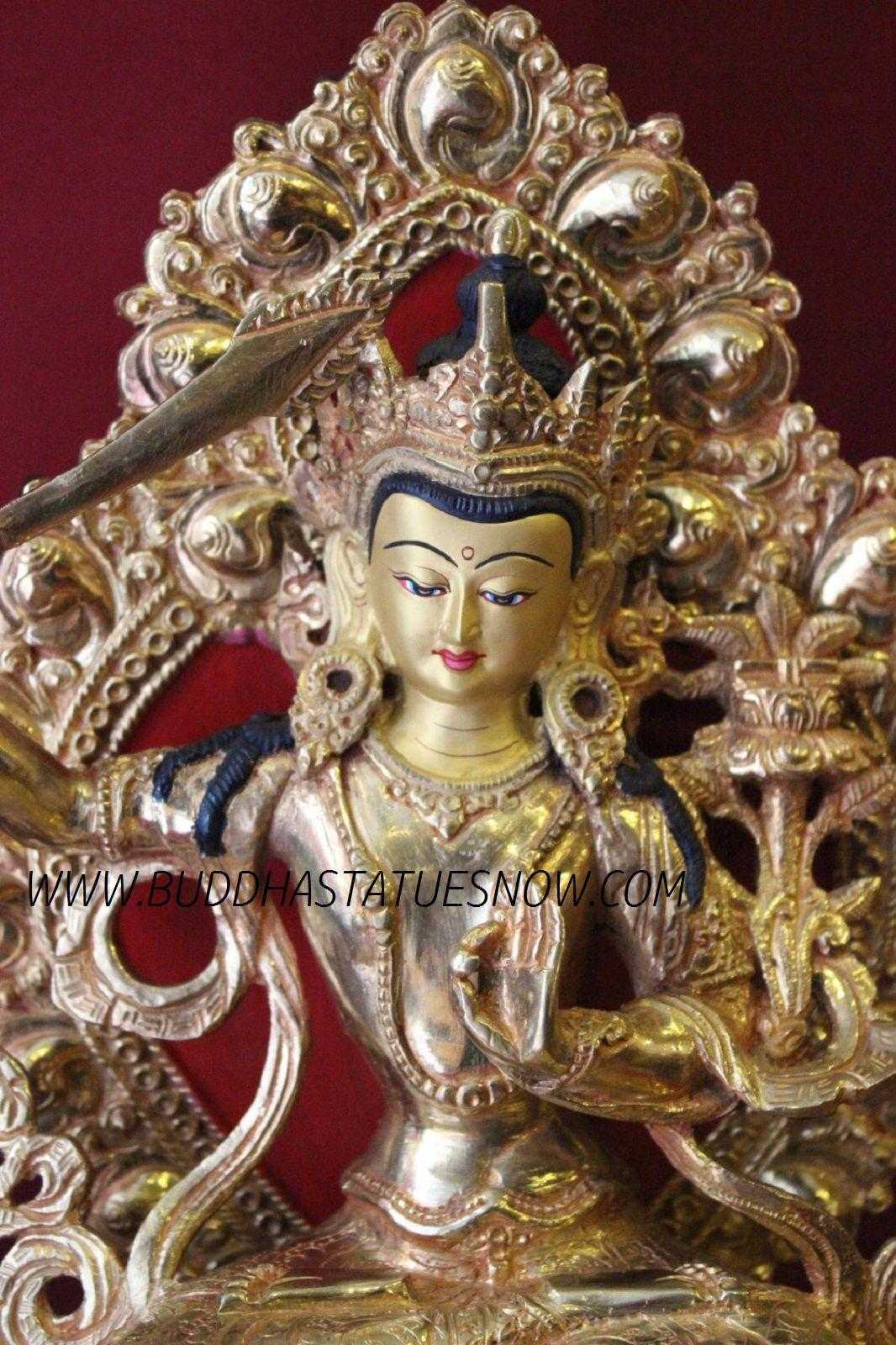
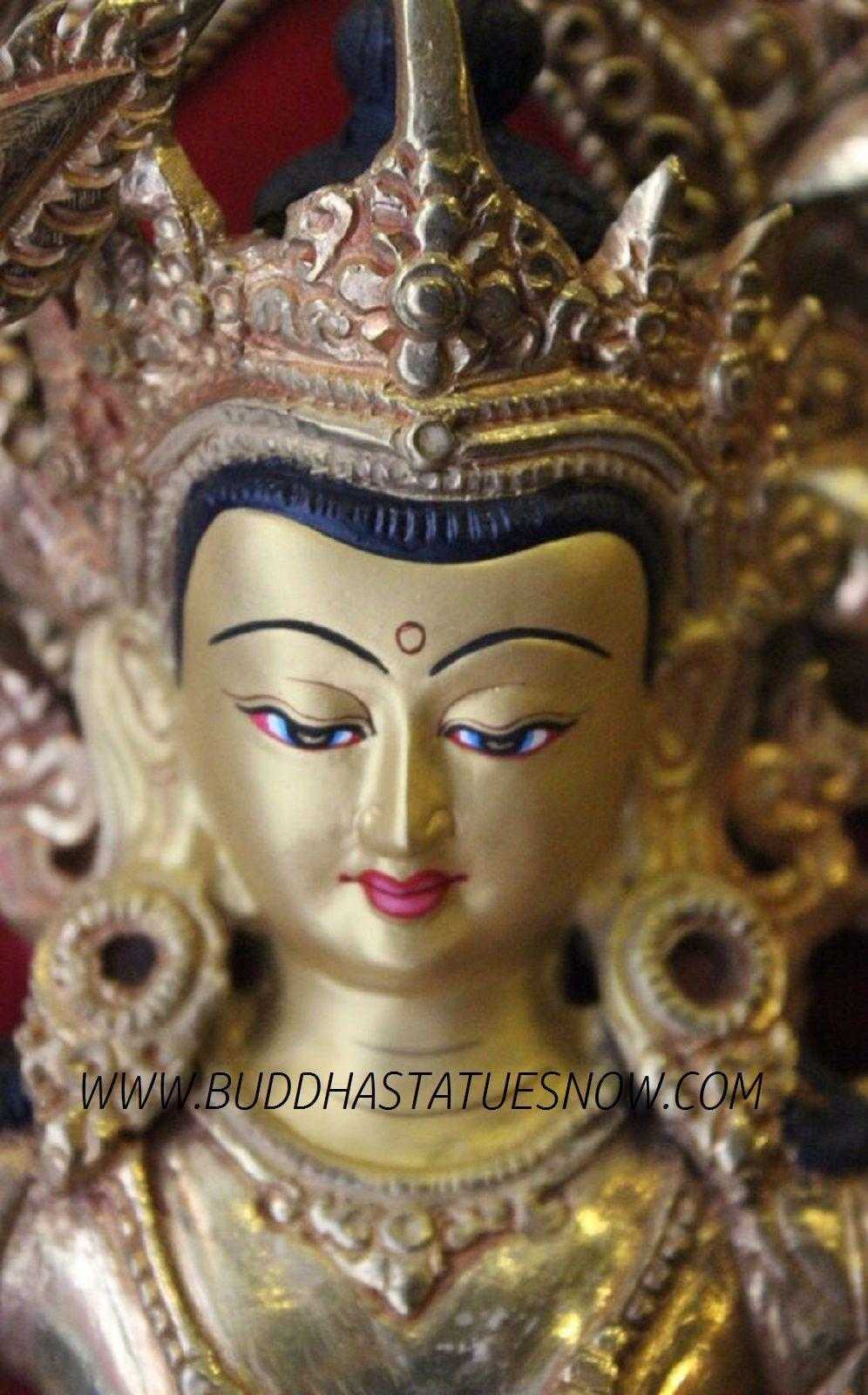
A magnificent hand-hammered aureole frames this 9″ Manjushri statue, its openwork repoussé of scrolling clouds, foliage, and raised bosses forming a full mandorla-style backdrop, edged along a flame-tipped border with an inner arched trefoil framing the head. This is the piece’s defining feature — a level of framing more commonly reserved for temple centerpieces.
The deity behind our Manjushri statue has his origins in the Prajnaparamita Sutra. In English, “prajna” translates as wisdom and “paramita” translates as perfection. Therefore, Manjushri is believed by devotees to embody the Buddha’s wisdom — indeed, this is the highest and most pure form of wisdom as described in the sutra. Manjushri is one of the oldest and most venerable Bodhisattvas, similar to Avalokiteshvara. He is also one of the Three Protector Bodhisattvas, alongside Avalokiteshvara and Vajrapani — explore how these three Bodhisattvas relate. The description of perfected wisdom is elaborate and detailed, and as a result, the Prajnaparamita Sutra took seven centuries to complete — begun in the 1st century and finished in the 7th.
Manjushri Statue Features
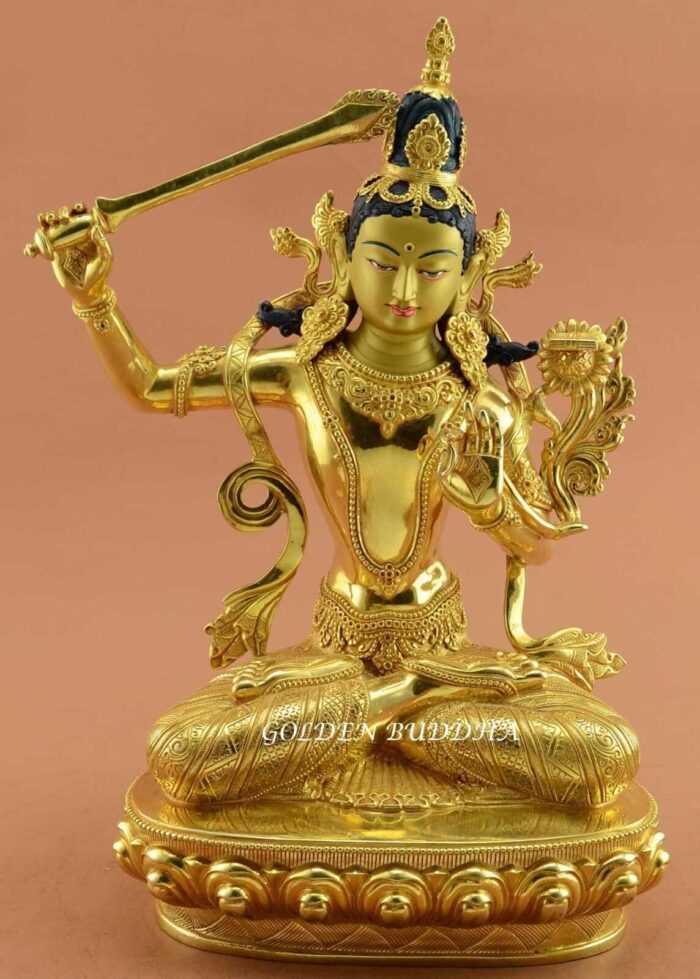
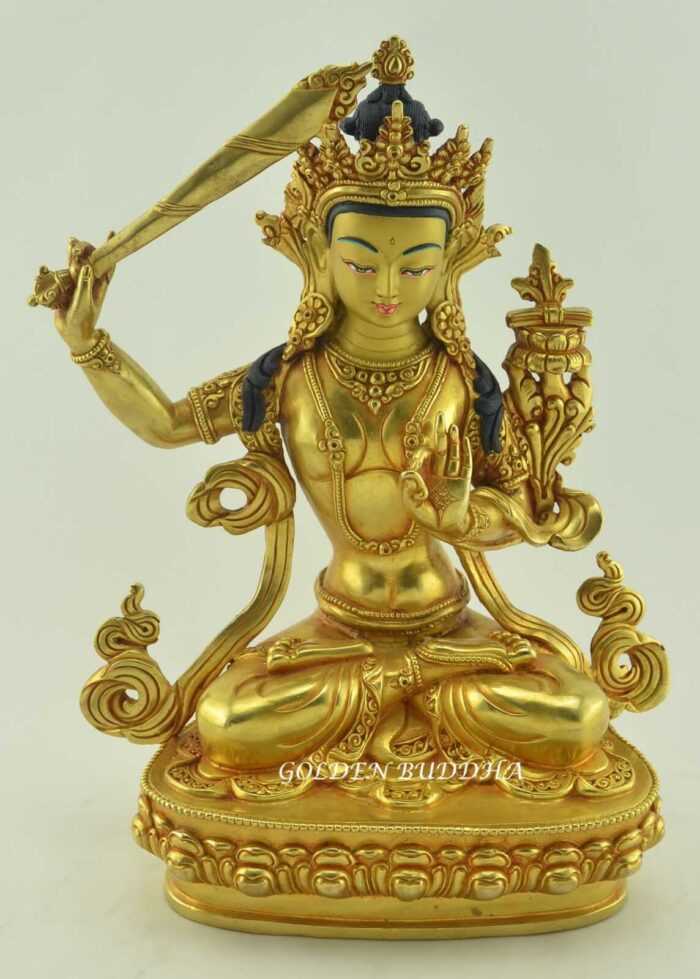
This Manjushri statue features his classic pose with the flaming sword raised over his right shoulder. However, this depiction represents the very effective yet gentle annihilation of ignorance — it is not meant to be a violent act. His left hand is held in front of the chest with the palm turned open and thumb and index finger meeting — a delicate Buddhist hand gesture symbolizing teaching, discussion, and intellectual debate. Explore the meaning of the many Buddhist hand gestures in our full guide to Buddha statue meaning. As a result, devotees should feel encouraged to engage in wisdom-cultivating study when viewing this statue: the objective is to use wisdom to defeat ignorance, so light will triumph over darkness.
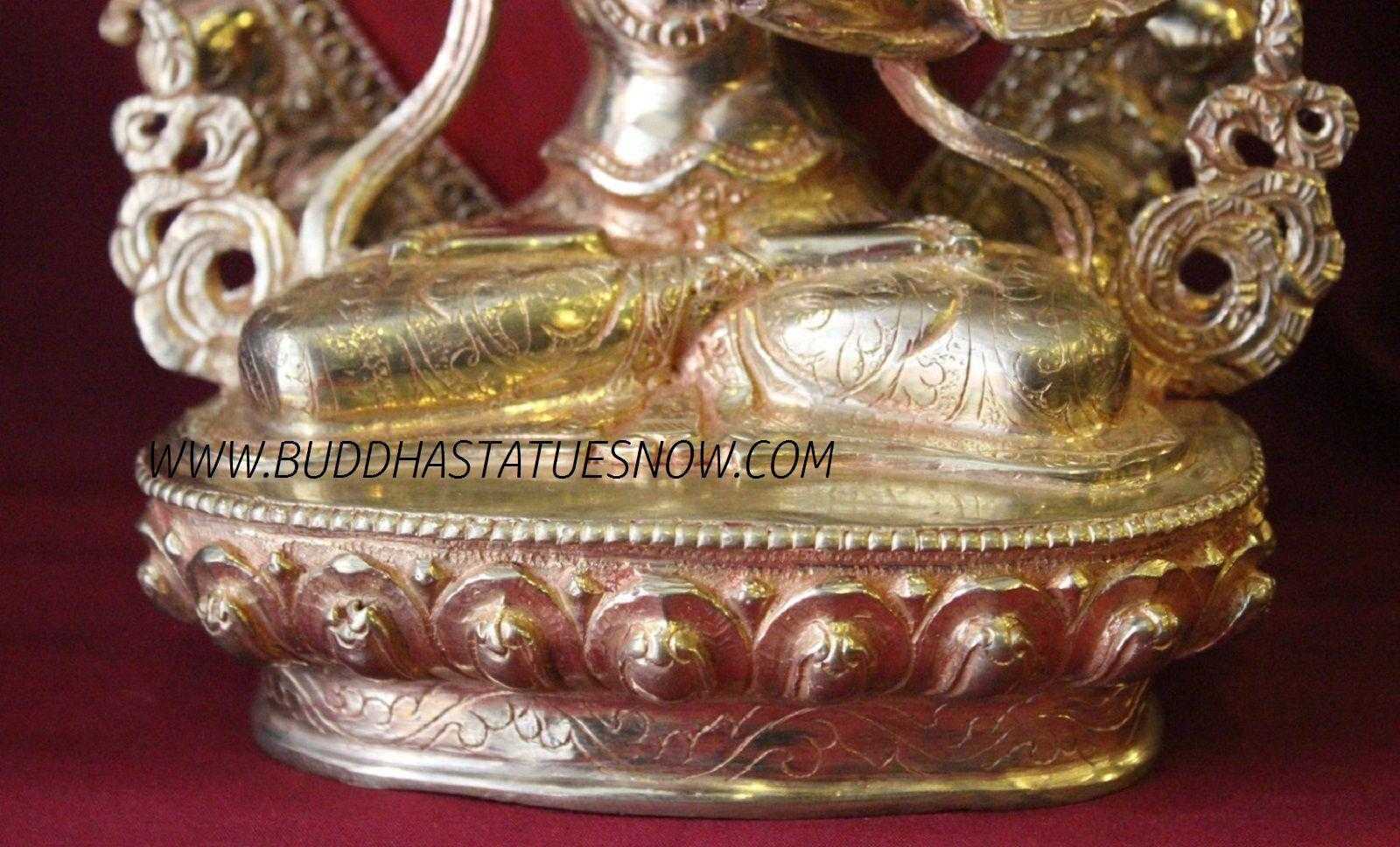
Manjushri sits in the full lotus pose on a single lotus pedestal. Additionally, there is a lotus flower growing over his left shoulder with an open blossom — the Prajnaparamita Sutra is lying inside the open lotus, so the source of his wisdom is always visibly present.
The Hand Painted Gold Face
One detail worth understanding about our gold gilded statues: the face is not fire gilded. Fire gilding cannot render the subtle life of a face — the arched brows, the delicate eye-line, the soft blush of the lips. Instead, on every gilded face, our artisan hand paints a specialized mix of 18K gold and natural pigments, layering the color and detail that give the sculpture its lifelike expression. So while the sculpture is described as “24K gold gilded,” the face is the beautiful exception — read the full explanation in our buyer’s guide to the gold face painting technique.
Shakya Artisans and the Lost Wax Method
Our Manjushri statues are hand sculpted by the world class artisans of the Shakya caste in Patan, Nepal. Gold is the specialty of these master craftsmen, whose traditional lost wax sculpting method was developed over a thousand years ago and has been protected within the caste from generation to generation. Every piece begins as a hand-sculpted beeswax model, encased in clay, then fired so the wax melts away and molten copper alloy is poured into the resulting mould. The clay is broken, the metal figure is cold-worked by hand — chased, engraved, and refined — before the surface is fire gilded with pure 24K gold. Because each wax model is destroyed in the casting, no two statues from the workshop are ever identical.
Custom Orders
If you would prefer this framed Manjushri in a different size, or in an oxidized copper, partly gilded, or silver plated finish, we can commission it directly with the artisan on your behalf. Explore our custom Tibetan Buddhist statues page for the full commissioning process and to see recent custom pieces we have delivered.
Authentic, Handmade in Nepal
Every statue is handcrafted in Patan, Nepal, using traditional lost wax casting and comes with a certificate of authenticity issued by Nepal’s Department of Archaeology, verifying its materials, technique, and origin.