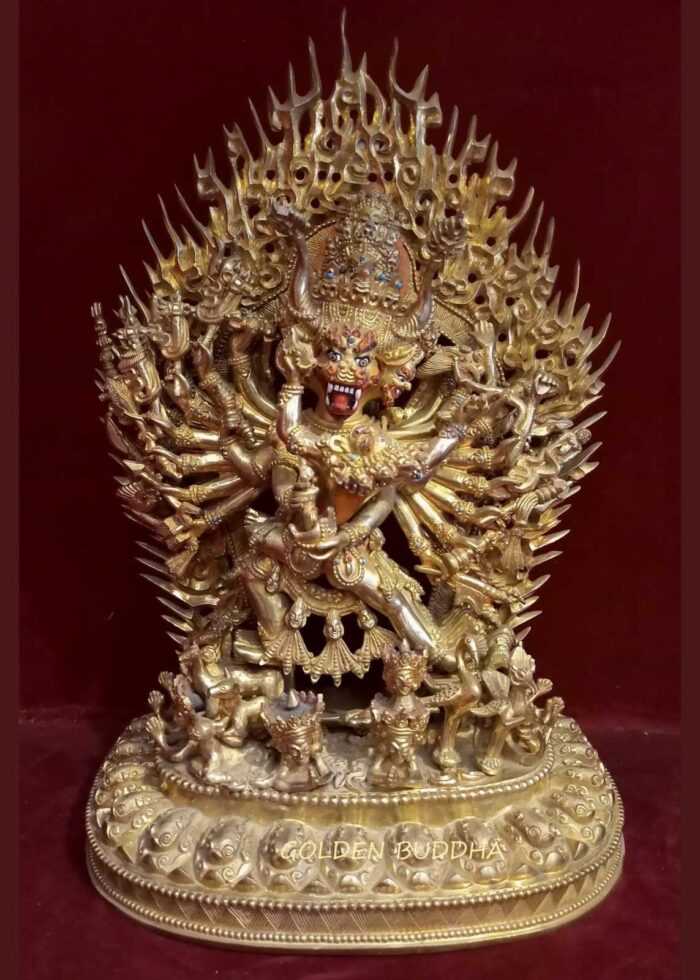
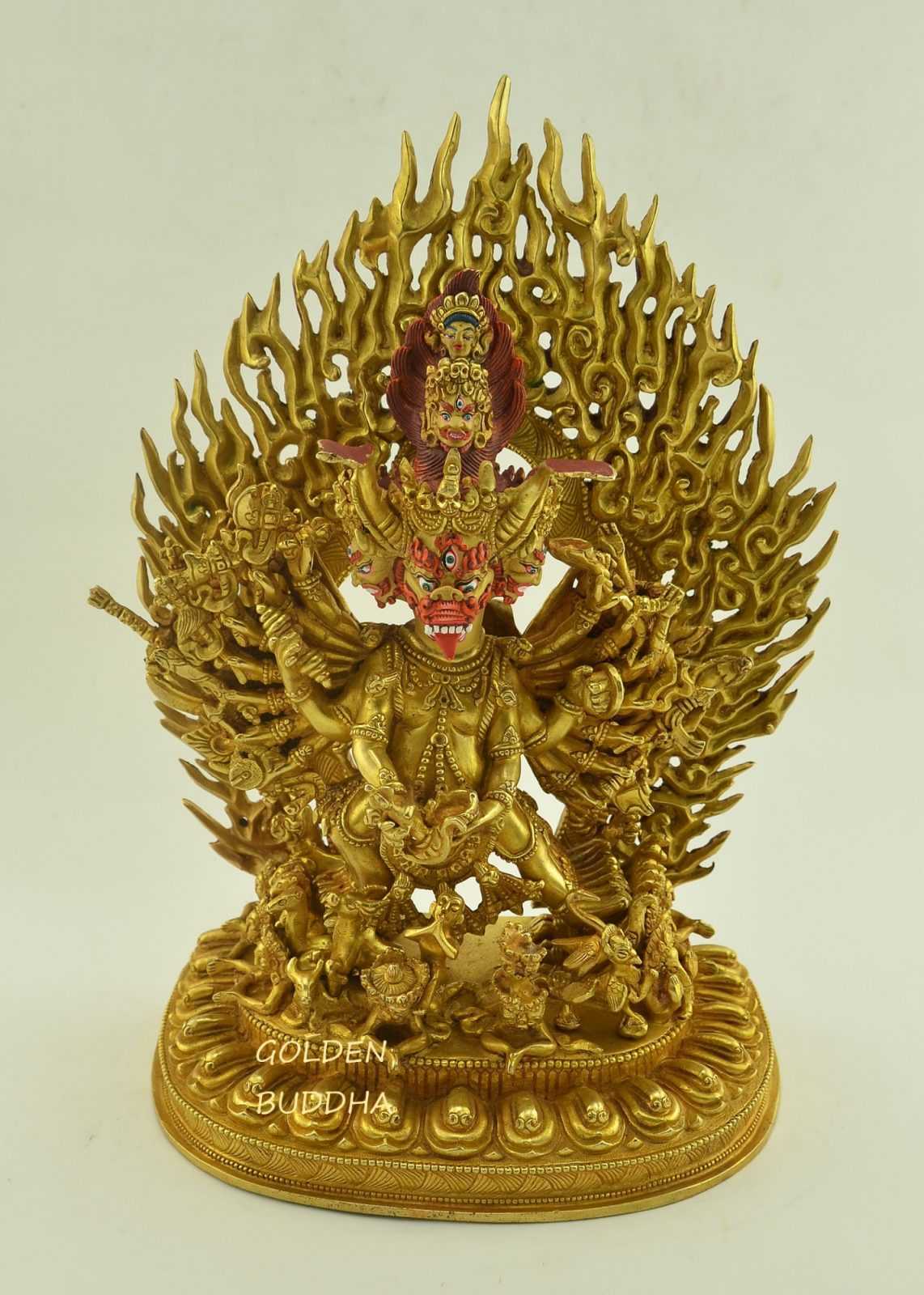
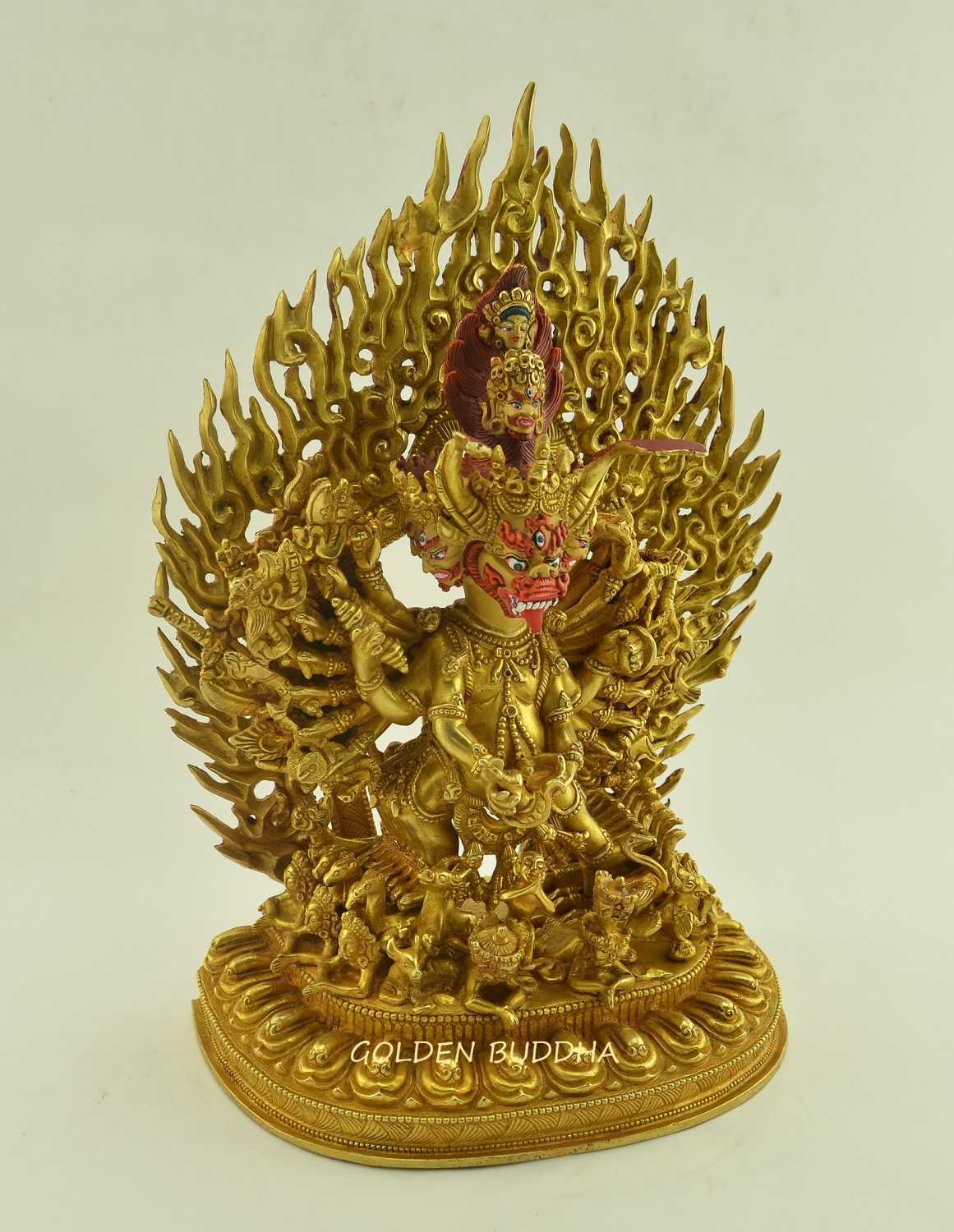
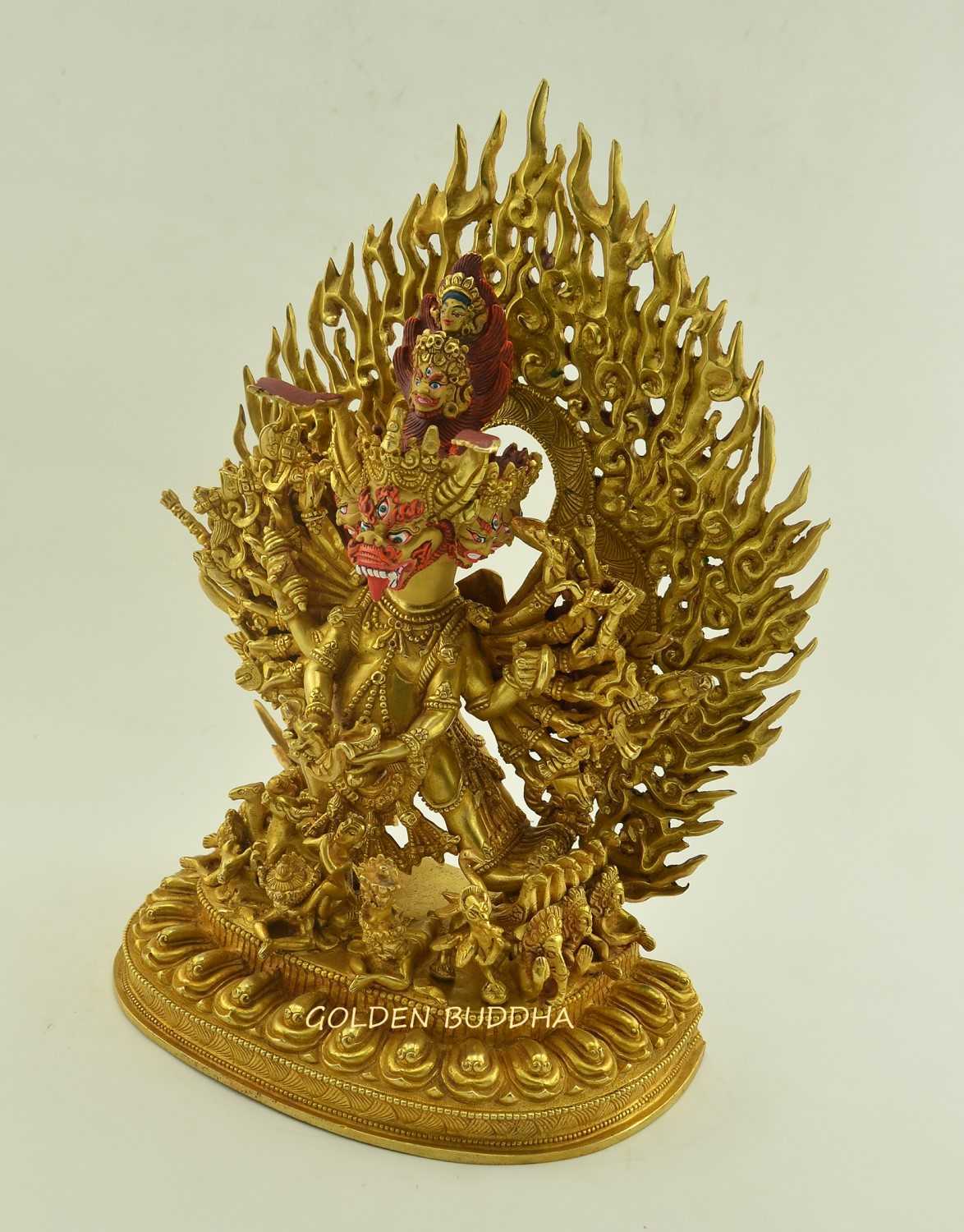
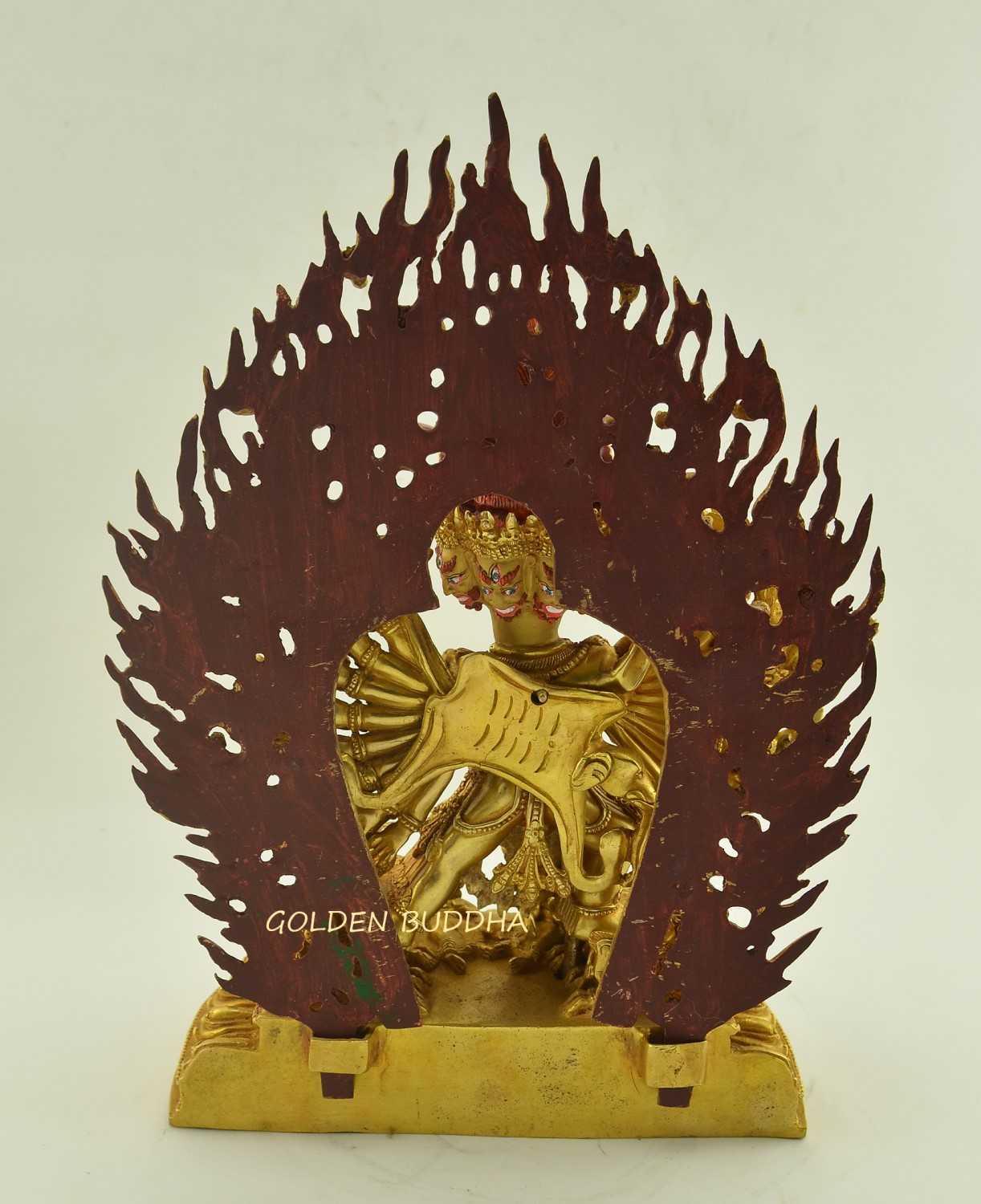
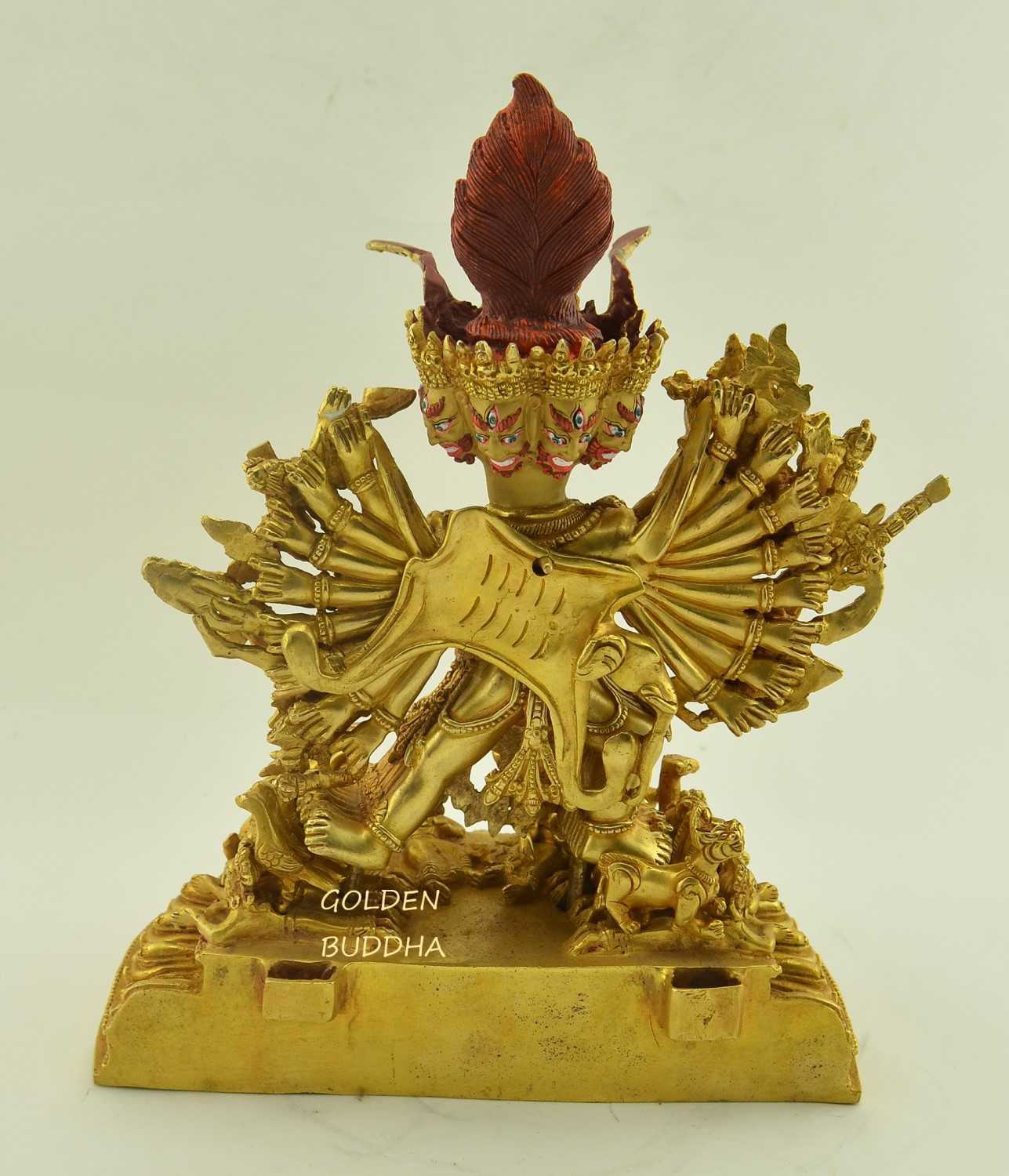
This 11.5-inch Ekavira Vajrabhairava Yamantaka Statue presents the “Solitary Hero” form of Vajrabhairava without a consort. Handmade in Patan, Nepal from copper alloy by the traditional lost-wax casting method, the sculpture is fire gilded in 24K gold and finished with individually hand-painted wrathful faces, natural pigments, and embedded turquoise and red coral gemstones. With the removable flame aureole installed, the composition reaches 11.5 inches in height; without the frame it measures 9.5 inches. The photographs reveal the extraordinary density of the image: nine faces, thirty-four arms, sixteen legs, numerous ritual implements, an outstretched elephant hide across the rear, many subdued beings beneath the feet, and an ornate lotus pedestal.
Ekavira Vajrabhairava Yamantaka Statue | Solitary Hero Form
Ekavira, Tibetan Pawo Chikpa, means “Solitary Hero.” In this form Vajrabhairava appears without Vajravetali, distinguishing it from the yab-yum form while preserving the complete multi-faced, multi-armed iconography. The absence of the consort does not mean that Ekavira is a reduced or simplified Yamantaka. Traditional descriptions retain nine faces, thirty-four hands and sixteen legs. The principal hands hold the curved kartika and kapala at the heart, while the remaining arms radiate outward with ritual weapons and symbolic implements. The openwork flame aureole frames this complexity without obscuring the central buffalo face or the many surrounding attributes.
Nine Faces, Thirty-Four Arms and Sixteen Legs
The nine faces follow the circular arrangement associated especially with later Gelug Vajrabhairava imagery. The lower tier contains seven faces in total: the horned buffalo head at the center with six additional wrathful faces surrounding it. One separate intensely wrathful face rises directly above the buffalo head, and the ninth face at the summit is Manjushri, shown in a comparatively restrained, slightly wrathful form. The arrangement is therefore seven plus one plus one. The sixteen legs spread across a crowded field of deities, human figures, animals and birds. Rather than assigning an unsupported fixed meaning to every figure, the entire lower register can be understood as the subjugation of obstructive forces under enlightened activity.
Ekavira Vajrabhairava Yamantaka Statue | Wrathful Manjushri
Vajrabhairava is the intensely wrathful tantric manifestation of Manjushri, the Bodhisattva of Transcendent Wisdom. Yamantaka means the “Destroyer of Yama” or “Ender of Death,” while Vajrabhairava may be rendered “Vajra Terrifier.” The terrifying appearance is therefore not ordinary anger: it is wisdom expressed in a form capable of confronting ignorance, attachment, fear and the conditions that sustain involuntary rebirth. The buffalo head deliberately recalls Yama, the Lord of Death, while Manjushri’s face at the summit discloses the deity’s true nature. Read our complete guide to Yamantaka and Vajrabhairava for the history, forms and iconography behind this imagery.
Lost-Wax Craftsmanship and Removable Flame Aureole
The lost-wax method allows the Newar artisans to preserve an unusually dense arrangement of arms, attributes, faces and subsidiary figures while maintaining a readable central silhouette. From the rear, the photographs clearly show the outstretched elephant hide and the extraordinary layering of the thirty-four arms. The removable copper-alloy aureole is gilded on the visible front and carries a darker reddish finish on the reverse. Fine hand finishing continues across the skull crowns, jewelry, lotus petals and pedestal borders. Turquoise and red coral gemstones are embedded into selected ornament settings, adding restrained color accents against the brilliant 24K gold surface and painted facial details.
Manjushri and Yama | Doctrinal Statue Pairing
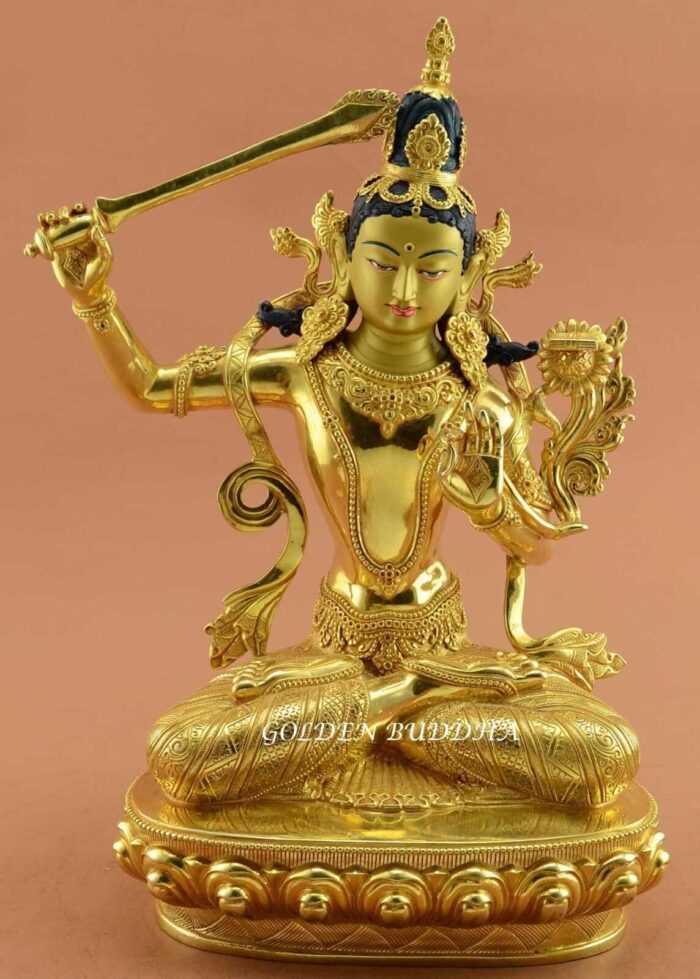
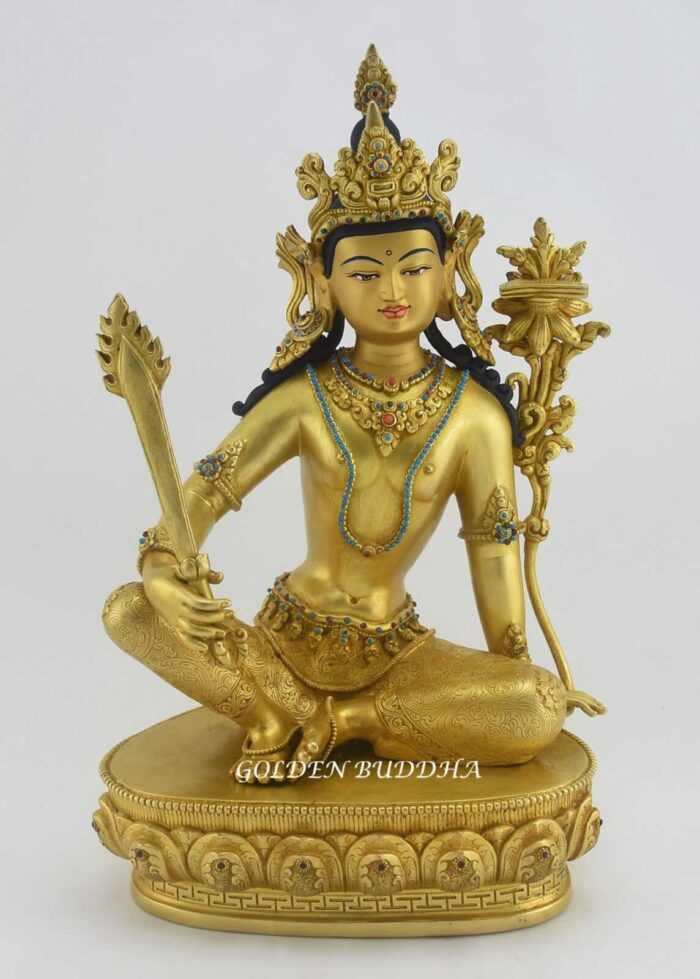
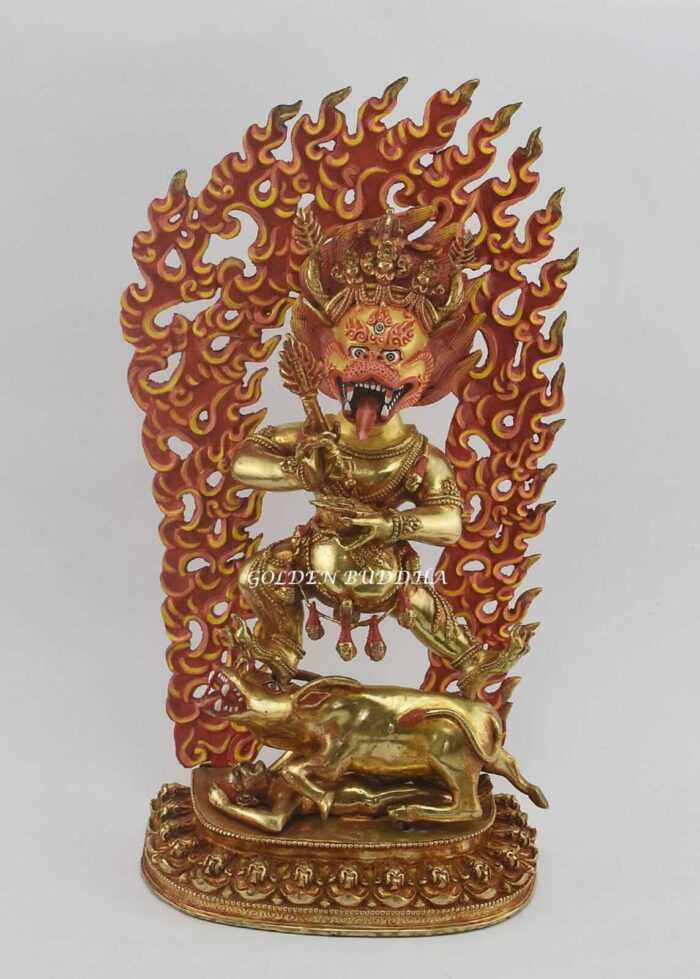
This sculpture makes a particularly instructive doctrinal grouping with our masterpiece Manjushri sculpture and a Yama statue. Manjushri is the direct peaceful source of Vajrabhairava: the serene Bodhisattva embodies transcendent wisdom, while Yamantaka presents that wisdom in its fiercest obstacle-subduing expression. Yama provides the complementary narrative relationship. Vajrabhairava assumes a buffalo-headed form that reflects the Lord of Death and, in traditional explanations, overwhelms and subdues Yama. Displayed together, the three figures allow the viewer to move visually from peaceful wisdom, to wrathful wisdom, to the imagery of death that gives Yamantaka his name and iconographic character.
Filling and Consecration for the Ekavira Vajrabhairava Yamantaka Statue
For practitioners preparing the sculpture for shrine use, traditional statue filling, blessing and consecration in Kathmandu, Nepal can be arranged before international shipment. Sacred contents may be placed within the hollow image before sealing and blessing according to Tibetan Buddhist custom. Formal Vajrabhairava deity-yoga practice belongs to an advanced tantric context and traditionally depends upon the appropriate empowerment and instruction from a qualified lineage teacher.
Custom Ekavira Vajrabhairava Yamantaka Statue | Handmade in Nepal
Collectors, practitioners, monasteries and Dharma centers may commission a custom Tibetan Buddhist statue in another size or finish. An Ekavira Vajrabhairava commission can be planned with 24K gold fire gilding, individually painted faces, gemstone settings, a removable flame aureole and coordinated pedestal proportions while preserving the required nine faces, thirty-four arms, sixteen legs and Solitary Hero presentation. A coordinated Manjushri, Vajrabhairava and Yama group can also be commissioned with compatible scale and finish for a unified shrine or Himalayan Buddhist art collection.
Authentic, Handmade in Nepal
Every statue is handcrafted in Patan, Nepal, using traditional lost wax casting and comes with a certificate of authenticity issued by Nepal’s Department of Archaeology, verifying its materials, technique, and origin.